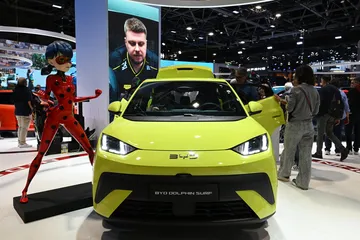
当李成东(Lee Seongdong,音译)在4月决定更换他的2016款雪佛兰Spark时,现代汽车公司Casper Electric长达两年的等待期已经让他倾向于比亚迪股份有限公司的海豚。他对这款配置丰富的车型印象深刻,当场签下了合同。
When Lee Seongdong decided to replace his 2016 Chevrolet Spark in April, a two-year wait for Hyundai Motor Co.’s Casper Electric was already pushing him toward BYD Co.’s Dolphin. He was so impressed by the feature-rich ride that he signed a contract on the spot.
价格也很有吸引力:海豚掀背车起售价为2450万韩元(约合1.85万美元),不过由于有优惠,李成东实际支付不足2300万韩元——这与享受补贴后的Casper Electric价格相似,后者在首尔约2200万韩元即可购得,但仅限最基础配置版本。加上提车等待时间无需超过韩国强制兵役的服役期限,这位47岁的YouTuber表示,比亚迪“实在太划算,不能错过”。
The price was attractive too: the Dolphin hatchback starts at 24.5 million won ($18,500), though discounts meant Lee paid less than 23 million won — similar to a subsidized Casper Electric, which can be bought at about 22 million won in Seoul, but only in its bare-bones trim. Combined with not having to wait for longer than South Korea’s mandatory military service to take delivery, the 47-year-old YouTuber said the BYD was “way too good to pass up.”
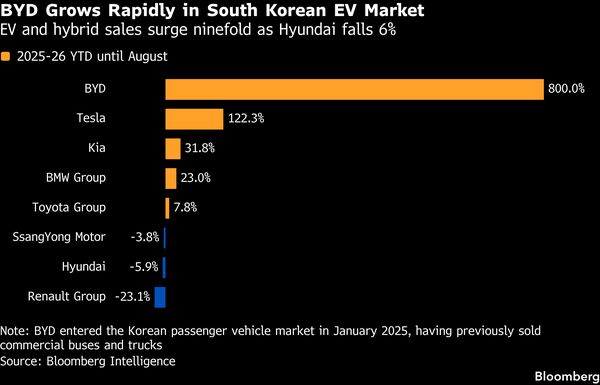
李成东的购买是比亚迪将其低成本战略——该战略已在欧洲赢得市场份额——带给韩国日益价格敏感型买家的一个新兴趋势的缩影。彭博智库的数据显示,1月至8月,比亚迪纯电动车和混合动力车销量激增九倍,达到近1.8万辆,而现代汽车同类车型销量下降6%,至约13.9万辆。
Lee’s purchase is part of a burgeoning shift underway as BYD brings its low-cost strategy, which is already winning it market share in Europe, to increasingly price-sensitive buyers in South Korea. Bloomberg Intelligence’s data shows a ninefold jump in BYD’s EV and hybrid sales from January to August to almost 18,000 units, as Hyundai’s comparable sales fell 6% to about 139,000.
根据韩国汽车与移动协会的数据,这种势头延续到了9月,比亚迪注册量达到2万辆——是其年度初始目标的两倍。
The momentum extended into September, when BYD’s registrations hit 20,000 — double its initial goal for the year, according to Korea Automobile & Mobility Association data.
比亚迪的迅猛崛起使其在韩国进口车品牌排名中超越了沃尔沃和丰田汽车公司——这是一个重要里程碑,考虑到它直到2025年初才进入韩国乘用车市场,且在7月因未满足部分要求而失去了政府补贴资格。这对仍占据国内市场合计72%份额的本土巨头现代汽车公司和起亚公司构成了日益增长的威胁,后者难以与比亚迪提供的低价、技术导向型车型竞争。
BYD’s rapid ascent means it’s overtaken Volvo and Toyota Motor Corp. in the ranks of foreign carmakers in Korea — a significant milestone given it only entered the passenger car market in early 2025 and, in July, lost access to government subsidies after not meeting some requirements. That’s a growing risk to local heavyweights Hyundai Motor Co. and Kia Corp., which despite still holding a combined 72% share of the domestic market, are struggling to compete with the lower-priced, technology-focused models on offer by BYD.
根据三星证券分析师林爱斯特(Esther Yim)的说法,除2020年疫情低迷期外,现代汽车年度全球销量将自2010年以来首次跌破400万辆,未能达成416万辆的目标。
For the first time since 2010 — excluding the 2020 pandemic slump — Hyundai’s annual global sales will likely fall below 4 million units, missing its 4.16 million target, according to Samsung Securities Co. analyst Esther Yim.
林爱斯特在近期的一份报告中写道:“他们放缓的最大驱动力是中国竞争对手。中国电动汽车制造商激进的出口推动在美国和印度以外的所有市场引发了激烈的价格战,而现代和起亚在这些市场均表现不佳。”中国车企正加速进军韩国市场。比亚迪正以3750万韩元的价格推出海狮06 DM-i插电式混合动力车型,拓宽产品阵容,该车型是同细分市场中最便宜的。
“The biggest driver of their slowdown is Chinese competition,” Yim wrote in a recent note. “Chinese EV makers’ aggressive export push has ignited intense price wars everywhere except the US and India, and Hyundai and Kia are underperforming in all those markets.”Chinese automakers are accelerating their push into Korea. BYD is broadening its lineup with the Sealion 6 DM-i plug-in hybrid at 37.5 million won, the cheapest in its segment.
吉利汽车控股有限公司的高端品牌极氪在预订量突破1500辆后,于上周开始交付7X电动SUV,而小鹏汽车和奇瑞汽车已设立当地实体,为进入韩国市场做准备。这种快速扩张让现代汽车的高管层感到不安。
Geely Automobile Holdings Ltd.’s premium brand Zeekr began deliveries of its 7X electric SUV last week after surpassing 1,500 preorders, while XPeng Inc. and Chery Automobile Co. have set up local entities ahead of their market debuts. The rapid expansion is rattling Hyundai’s executive ranks.
现代汽车集团负责整车开发的高级副总裁李在圭(Lee Jae-kyu,音译)本月在一次活动上发言时表示,他在最近的巴黎车展上看到中国车企展现出的设计和定价优势,感到“绝望”。
Speaking at an event this month, Lee Jae-kyu, a senior vice president overseeing vehicle development at Hyundai Motor Group, said he felt “despair” at the design and pricing edge Chinese automakers displayed at the recent Paris Motor Show.
李在圭说:“欧洲车企展示的设计和技术平平无奇,而中国车型却以便宜约1万美元的价格提供了更优越的设计。我挥之不去地认为欧洲公司很快就会倒闭,甚至我们集团的结构也可能最终被中国吞并。”尽管比亚迪增长迅速,但分析师表示,中国品牌因服务网络稀疏、维修成本高、保险费昂贵以及折旧迅速,面临长期障碍。在网络车主社区,比亚迪车主经常抱怨配件延迟和维修账单高昂,轻微保险杠和翼子板剐蹭的维修费在某些情况下超过1100万韩元。
“While European carmakers presented uninspiring designs and technology, Chinese vehicles offered superior design at prices roughly $10,000 cheaper,” Lee said. “I couldn’t shake the thought that European companies will go under soon, and even our group is structured in a way that it could eventually be swallowed by China.”Despite BYD’s rapid gains, analysts say Chinese brands face long-term hurdles due to sparse service infrastructure, high repair costs, steep insurance premiums and swift depreciation. In online driver communities, BYD owners regularly complain about spare parts delays and high repair bills, with minor bumper and fender benders exceeding 11 million won in some cases.
比亚迪计划到今年年底将其在韩国的服务网点从20个扩大至26个。据CLSA Securities Korea Ltd.的Brian Lee表示,这家总部位于深圳的公司的低价策略最终将面临现代和起亚拥有的1200多个国内服务中心网络的考验。
BYD plans to expand its South Korea service locations to 26 from 20 by the end of this year. The Shenzhen-based company’s low-price strategy will ultimately be tested against Hyundai and Kia’s network of more than 1,200 domestic service centers, according to Brian Lee at CLSA Securities Korea Ltd.
“目前,所有人都纯粹关注标价,”他说。“但随着市场成熟,保值率、服务便利性和维护成本变得清晰,它们的整体吸引力可能会下降。”尽管如此,拓展新的海外市场对中国车企至关重要,因为它们面临国内需求放缓、欧洲壁垒增高,且实际上被美国市场拒之门外。相比之下,韩国对中国进口乘用车仅征收8%的关税,并于8月将电动汽车排除在一项给予国内制造商税收抵免的法案之外,这使得现代和起亚几乎没有政策盾牌来抵御廉价中国进口车的冲击。
“Right now, everyone is focused purely on the sticker price,” he said. “But as the market matures and resale value, service access and maintenance costs become clear, their overall appeal could fade.”Still, expansion in new foreign markets is critical for Chinese automakers as they face slowing demand at home, growing barriers in Europe, and are effectively shut out of the US. In contrast, Korea imposes an import tariff of just 8% on Chinese passenger cars and in August excluded EVs from a bill granting tax credits to domestic manufacturers, leaving Hyundai and Kia with few policy shields against cheap Chinese imports.
上个月,代表韩国五大车企(还包括韩国通用、韩国雷诺和KG Mobility)的KAMA(韩国汽车制造商协会)敦促国会通过税收激励和政策支持。
Last month, KAMA — representing South Korea’s five automakers also including GM Korea, Renault Korea and KG Mobility — urged parliament to pass tax incentives and policy support.
该协会在一份声明中警告:“中国电动汽车的渗透可能引发不仅是国内电动汽车制造商,而是整个汽车产业的崩溃。”
“The penetration of Chinese EVs could trigger the collapse of not just domestic EV makers, but the entire auto industry,” the group warned in a statement.
对中国快速攻势日益加剧的担忧促使韩国议员本月提出了一项两党法案,提议为包括电动汽车在内的战略产业提供最高覆盖年度国内生产成本50%的税收抵免。
Growing concerns over China’s rapid push have prompted South Korean lawmakers to introduce a bipartisan bill this month proposing tax credits covering up to 50% of annual domestic production costs for strategic industries, including EVs.
对于像海豚车主Lee这样的购车者来说,更广泛的政策担忧映射出他所看到的市场现实:中国品牌正在提高竞争门槛。
For buyers like Lee, the Dolphin owner, the broader policy worries mirror what he sees in the market: Chinese brands are raising the competitive bar.
“我希望我们的国内汽车产业成功,但归根结底,必须通过公开的市场竞争取胜,”Lee说。“每个人都需要保持警惕并竞争。”
“I hope our domestic auto industry succeeds, but in the end, you have to win through open market competition,” Lee said. “Everyone needs to stay alert and compete.”