对于美国MBA项目的招生办公室来说,这是残酷的九个月。根据全球商学院协会管理专业研究生入学委员会的数据,今年秋季入学的2028届MBA申请量急剧下降。美国商学院报告称,全日制MBA的申请量较上一周期骤降27%。美国各类MBA项目乃至各类商科研究生项目的申请量均出现下滑。就连在线MBA项目的关注度也有所下降。
It was a brutal nine months for the admissions offices at US MBA programs. Applications for the class of 2028, entering this fall, took a nosedive, according to the Graduate Management Admission Council, a global association of business schools. US business schools reported that applications for full-time MBAs plummeted 27% from the previous cycle. Applications fell across all types of US MBA programs and, indeed, all types of graduate business programs. Even online MBA programs attracted less interest.

GMAC的一项新调查显示,在全球范围内,选择性越强的商学院面临的申请人数降幅通常越小。在美国,少数几所通常公布新生班级申请人数的商学院中,今年秋季只有两所公布了数据,但两所都报告了类似的下降:加州大学洛杉矶分校安德森管理学院的申请人数下降了21%,乔治城大学麦克多诺商学院下降了22%。杜克大学富卡商学院表示,其整体申请人数也出现了类似下降。
Worldwide, according to a new survey by GMAC, more selective schools generally faced smaller application shortfalls. In the US, only two of the few, invariably selective schools that typically publish the number of applications for their incoming class have yet done so this fall, but both reported similar drops: 21% at UCLA Anderson School of Management, and 22% at Georgetown University McDonough School of Business. Duke University Fuqua School of Business saw a similar overall drop, according to the school.
富卡商学院负责招生的副院长莎莉·休伯特在一份电子邮件声明中表示:“每个招生周期都有其自身的动态,今年也不例外。虽然我们的新生班级比近年来要小,但我们仍然专注于招收那些学业准备充分、成就突出、并准备好为富卡社区做出贡献的学生。”海外的观望情绪——主要是特朗普政府限制性签证政策的结果——推动了这一下降。
“Every admissions cycle brings its own dynamics, and this year was no exception,” Shari Hubert, Fuqua’s associate dean for admissions, said in an emailed statement. “While our entering class is smaller than in recent years, we remain focused on enrolling students who are academically prepared, accomplished, and ready to contribute to the Fuqua community.”
安德森全日制MBA项目副院长加里·弗雷泽表示,安德森MBA项目的国际申请人数下降了约30%。但国内申请人数也下降了约10%。弗雷泽说:“通常在经济下行周期,人们去读商学院时一般会认为毕业时情况会好转。但我们看到这一趋势发生了转变,对Z世代来说,这是一个更大的命题。他们是第一代不确定自己能否像父母一样出色、并且更多地质疑一切的人。我认为人们担心,两年后拿到学位时,经济未必会好转。”
Skittishness abroad — largely the result of the Trump administration’s restrictive visa policies — drove the decline. International applications to Anderson’s MBA program fell about 30%, says Gary Fraser, associate dean of Anderson’s full-time MBA program. But domestic applications also fell, around 10%.
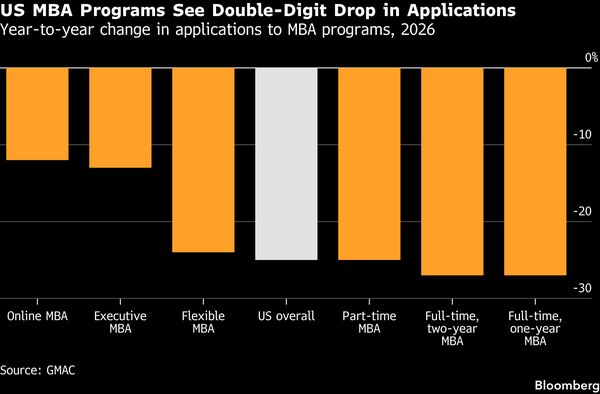
安德森的经历似乎是普遍现象。根据GMAC的数据,美国各类研究生商科项目的国际申请人数下降了38%,而国内申请人数下降了6%。
“Typically in a down cycle, people generally go to business school thinking things will be better when they graduate,” Fraser says. “But we’ve seen a shift in that trend, where it’s a bigger proposition with this Gen Z population. It’s the first population that isn’t sure if they’re going to do as well as their parents and question things a lot more. I think there’s concern that the economy won’t necessarily turn around in two years when they get their degree.”
(尽管GMAC过去曾提供过美国MBA项目国内外申请情况的变化数据,但据一位女发言人表示,今年无法提供,因为数据尚不易获得。)因此,从今年秋季公布的入学班级概况来看,MBA项目正在缩减招生名额。(截至10月26日,在《美国新闻与世界报道》最佳商学院排名中位列前35的美国商学院中,已有12所公布了班级概况。)
Anderson’s experience appears to be typical. According to GMAC, international applications across all types of US graduate business programs fell 38%, while domestic applications fell 6%. (Although GMAC has provided with changes in both domestic and international applications to US MBA programs in the past, it was unable to do so this year because the data isn’t readily available, according to a spokeswoman.) As a result, MBA programs are filling fewer seats, to judge by the profiles for the entering classes that have been released this fall. (As of Oct. 26, 12 of the top 35 US schools in ’s Best Business School Rankings have published class profiles.)
“其他学校将会报告大幅下降,”弗雷泽说。排名最高的学校降幅最小;只有麻省理工学院斯隆管理学院(在榜单上并列第9)保持了班级规模不变。该校一位发言人未回应置评请求。另一方面,印第安纳大学凯利商学院的入学班级规模几乎减半,从去年的106人降至57人。凯利商学院拒绝就本文置评。目前尚不清楚各校在多大程度上主动减少了招生名额。
“Other schools are going to report a major drop-off,” Fraser says. The declines were smallest at the highest-ranked schools; only MIT Sloan School of Management (tied for No. 9 on the list) held class size steady. A school spokesperson did not respond to a request for comment. Indiana University’s Kelley School of Business, on the other hand, saw its entering class reduced by almost half, from 106 last year to 57. Kelley declined to comment for this story. It’s not clear to what extent schools actively reduced the number of seats they offered.
乔治城大学的班级规模缩减幅度与申请人数下降大致成比例。然而,弗雷泽表示,安德森商学院原计划招收与去年大致相同的入学人数——约300名学生——但未能达标,因为更富有的学校用更丰厚的奖学金挖走了一些潜在学生。“我们有更多人在缴纳定金后选择不来安德森,因为他们在别处得到了更好的条件。”与此同时,一些国际申请者在获得签证方面遇到了困难。
Georgetown’s class shrank in close proportion to applications. Yet Anderson planned roughly the same entering class size as last year — about 300 students — but fell short, Fraser says, as richer schools lured some prospects away with more generous scholarship offers. “We had a lot more people who put down deposits and chose not to come to Anderson because they got a better deal somewhere else.”Some international applicants, meanwhile, had trouble getting visas.
杜克大学的情况也是如此,其入学班级规模的降幅没有申请人数降幅那么大。如果这样做的效果是让富卡商学院和安德森商学院显得不那么挑剔——因为它们录取的申请者比例更高——但这并没有转化为班级质量下降,正如各校概况报告所示。事实上,安德森商学院2028届班级的平均GMAT成绩提高了15分。
At Duke, too, the size of the entering class didn’t fall as much as the applicant pool. If the effect of this is to make Fuqua and Anderson appear less selective — because they are enrolling a higher share of applicants — it hasn’t translated into a less qualified class, as reported in the schools’ profiles. In fact, Anderson’s mean GMAT score increased 15 points for the class of 2028.
值得注意的是,虽然这组精英院校小样本中有三分之一的国际学生入学比例(即需要签证赴美学习的外国公民)大幅下降,但大多数院校仍设法将这一比例维持在相对稳定的水平,甚至有所上升。达特茅斯塔克商学院的这一比例跃升了7个百分点,达到29%。尽管如此,在这些院校中,只有麻省理工学院同时增加了外国学生人数和比例:今年秋季,来自65个国家的203名学生来到肯德尔广场。
Strikingly, while a third of this small sample of elite schools posted a substantially smaller share of international student enrollment (that is, foreign nationals requiring a visa to study in the US), most managed to keep that proportion relatively steady, or even increased it. At Dartmouth Tuck School of Business, that share jumped 7 percentage points, to 29%. Still, only MIT of these schools has increased the number of foreign students as well as the share: this fall, 203 students from 65 countries have come to Kendall Square.
在力所能及的范围内,许多商学院都试图控制班级构成。“学校绝对希望保持班级的全球多样性,让学生接触各种背景和生活经历,”Accepted(一家高等教育项目招生咨询公司)的招生顾问、卡内基梅隆大学Tepper商学院前硕士招生执行主任Kelly Wilson说。但也有学校不这样做,或无法做到。在Anderson商学院,国际学生比例略微上升至班级的36%,但Fraser表示,“我们并没有以这个数字为目标。国际生源的自然下降恰好汇聚到了这个数字。但感觉是对的,尤其是考虑到当前世界局势。”
To the extent they can, many schools try to manage the composition of the class. “Schools absolutely want to preserve the global diversity of the class, so students have exposure to a variety of backgrounds and life experiences,” says Kelly Wilson, an admissions consultant of Accepted, an admissions consultancy for higher ed programs, and a former executive director of masters admissions at Carnegie Mellon Tepper School of Business. But others don’t or can’t. At Anderson, the share of international students increased slightly, to 36% of the class, but Fraser says, “we didn’t work toward that number. The natural decline internationally sort of gathered at that number. But it feels right, especially with everything that’s going on in the world.”

全球对MBA项目的兴趣有所下降,尽管降幅不如美国那么剧烈。据GMAC统计,欧洲项目的申请量仅下降了2%。但在尼斯的EDHEC商学院,申请量下降了17%。不过,全球MBA项目总监Sandra Richez表示,情况好坏参半。她通过电子邮件说:“虽然在几个成熟招生市场的申请量有所下降,但入学转化率保持强劲,有助于在质量和数量上维持班级招生。”
Interest in MBA programs fell worldwide, though not as dramatically as in the US. Applications to European programs fell by only 2%, according to GMAC. At EDHEC Business School in Nice, applications were down 17%. But, says Sandra Richez, global MBA program director, the picture has been mixed. “While applications have fallen in several established recruitment markets, enrollment conversion has remained strong, helping to sustain class recruitment in both quality and quantity,” she said by email.
另一方面,尽管来自一些新兴地区(包括非洲)的合格申请激增50%或更多——非洲是美国商学院不断增长的申请来源,但这些学校去年年底因签证禁令和其他障碍而受阻——“这种增长并未按比例转化为入学人数,凸显了考生对MBA的兴趣与其支付学费和获得所需学生签证能力之间的差距。”她说,学校正试图通过向非洲和拉美学生提供更多经济援助来弥补这一差距。
On the other hand, although qualified applications surged by 50% or more from some emerging regions — including Africa, a growing source of applications for US schools throttled late last year by visa bans and other roadblocks — “this growth has not translated proportionately into enrollments, highlighting the gap between candidates’ interest in an MBA and their ability to finance one and obtain the required student visa.”The school, she says, is trying to redress this with more financial aid to African and Latin American students.