2024年初,美中科技战迎来了一个无可争议的“开火”时刻——通过荷兰。
An unmistakable shots-fired moment in the US-China tech war arrived in early 2024 — via the Netherlands.
“我们预计2024年无法获得针对中国的最先进浸没式光刻系统——NXT:2000及以上机型——的出口许可证,”全球半导体供应链核心环节的荷兰光刻巨头ASML Holding NV的高管在当年1月的财报电话会上表示,并警告称,这些限制措施是多年美国施压的结果,将使公司核心中国设备销售额减少10%至15%。
“We do not expect to get export licenses for our most advanced immersion systems — the NXT:2000 and up — for China in 2024,” executives at ASML Holding NV, the Dutch lithography giant at the heart of the global semiconductor supply chain, said on their earnings call in January that year, warning that the curbs, a result of years of US pressure, would knock 10% to 15% off the company’s core China equipment sales.
对全球投资者而言,这正是华盛顿在人工智能刚成为定义时代的通用技术之际,行使霸权肌肉以延缓关键竞争对手向前沿冲刺。但这一披露引发的疑问多于解答:ASML此类警告对投资组合意味着什么?成本由谁承担、利润由谁收获——设计限制的美国,还是作为打击目标的中国?而对于全球陷入交火的公司而言,风险与回报正如何被重写?
For global investors, this was Washington flexing its hegemonic muscle to delay a key rival’s race to the frontier of artificial intelligence, just as it was becoming the defining general-purpose technology of our era. But the disclosure raised more questions than it answered: What does a warning like ASML’s mean for investment portfolios? Who will bear the costs and reap the profits — the US, which designed the restrictions, or China, their intended target? And how are risks and returns being rewritten for companies caught in the crossfire across the world?
投资界在一份论文中找到了部分答案。该论文由耶鲁管理学院金融学教授Christopher Clayton及其他经济学家撰写。他们将跨越二十年、涵盖全球2.2万家上市公司(含中国企业)的逾60万场企业财报电话会录入运行在斯坦福大学算力系统上的开源大语言模型。算法旨在捕捉真实的因果关系:不仅关注CEO是否提及热点事件,更要判断国家胁迫是否真正迫使企业调整价格、转移投资或重塑供应链。
The investment community has some answers in , a paper written by Christopher Clayton, a Yale School of Management finance professor, and other economists. They fed more than 600,000 corporate earnings calls — spanning two decades and 22,000 listed firms worldwide, including China — to open-source large language models running on Stanford University’s computing systems. The algorithm listened for genuine causality: not merely whether CEOs mentioned flashpoints, but if state coercion actually forced them to alter prices, divert investments, or redraw supply chains.
这种细微差别至关重要,因为传统的关键词搜索在处理语境时会出错。即使是应用于“词袋”的复杂统计工具也无法胜任:一次例行维护停机可能被标记为业务中断,并被归因于关税行动。相比之下,预训练语言模型能够理解句子层面的意图,从而剔除此类假阳性。
That nuance matters because traditional keyword searches stumble over context. Even sophisticated statistical tools unleashed on a bag of words fail to do the job: A routine maintenance shutdown can get flagged as business disruption and ascribed to a tariff action. A pre-trained language model, by contrast, grasps sentence-level intent, weeding out such false positives.
语言模型对假阴性同样有效。在公开电话会议上,企业高管以沉默寡言著称,不愿过多谈论政府指令的后果——尤其是来自其本国政治领导人的指令。为了看透这种犹豫,研究人员用相同的模型分析了股票分析师的报告。AI 对高管层披露信息的解读,与独立卖方分析师的评估几乎完全吻合。
Language models are just as effective against false negatives. On public calls, corporate executives are notoriously reticent, loath to linger on the fallout of government diktats — particularly those from their own political leaders. To look past this hesitation, the researchers ran the same models over equity analysts’ reports. The AI’s reading of C-suite disclosures matched independent sell-side assessments almost in lockstep.
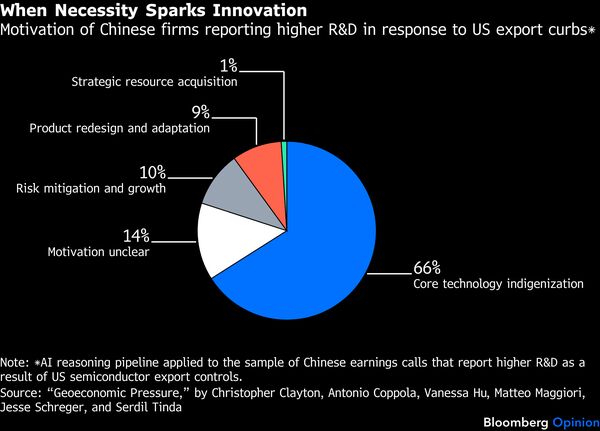
通过捕捉企业老板倾向于淡化的内容,AI 勾勒出了一幅关于痛苦与收益的细微图景。在美国,受到华盛顿限制的企业面临出货量下降和利润率收窄。在太平洋彼岸,这一冲击却像一剂肾上腺素。在约 40% 被标记为涉及出口管制的中国业绩电话会上,管理层表示正在加大研发投入。在详述支出增加的电话会中,三分之二符合 AI 标记为“核心技术国产化”的类别——即投入资金开发国产芯片设备,以摆脱美国的卡脖子封锁。
By latching on to what corporate bosses prefer to downplay, AI captured a nuanced account of pains and gains. In the US, firms subjected to Washington’s restrictions faced lost volumes and compressed margins. Across the Pacific, the shock worked like an adrenaline shot. In roughly 40% of Chinese earnings calls flagged for export curbs, management reported ramping up R&D. Among calls detailing higher spending, two-thirds aligned with a category that AI labeled as “Core Technology Indigenization” — pouring money into homegrown chip gear to escape the US chokehold. (The algorithm didn't just sort transcripts into pre-assigned slots; it coined the category names.)
(该算法不仅仅是将逐字稿归入预设类别;它还创造了类别名称。)其他地缘政治冲击也产生了类似的讽刺。2022 年俄罗斯入侵乌克兰后,西方制裁落地,欧美企业承担了减记、资产没收和更高的物流成本。真正的赢家是中印等不结盟的旁观者。它们摆脱了西方竞争对手,迅速填补真空,以大幅折扣价抢购乌拉尔原油。
Other geopolitical shocks produced similar ironies. When Western sanctions hit Russia after its 2022 invasion of Ukraine, firms in Europe and the US shouldered write-downs, asset forfeitures, and higher logistics bills. The real winners were non-aligned bystanders in China and India. Freed from Western competition, they rushed into the vacuum and scooped up heavily discounted Urals crude.
唐纳德·特朗普 2025 年的关税攻势同样未能按预期推进。正如美国总统所预测的那样,外国出口商并没有“吞下”这些关税。在管理层披露影响的案例中,近四分之三显示影响为负面。其中报告直接受损的企业里,近 60% 指向投入成本飙升。极少数国内受益者是那些与外国供应链隔绝的企业。由于不必承担依赖进口的竞争对手所支付的额外成本,它们依然能够提价。与此同时,外国生产商并非通过削减出口价格来吸收压力,而是将工厂迁往越南和墨西哥。
Nor did Donald Trump’s 2025 tariff offensive go as intended. Foreign exporters didn’t “eat” the duties, as the US president had predicted. In nearly three-quarters of instances where management disclosed an effect, the impact was negative. Among those reporting outright harm, close to 60% pointed to inflated input bills. The rare domestic winners were those insulated from foreign supply chains. Without being saddled with the extra costs paid by their import-reliant rivals, they could still raise prices. Foreign producers, meanwhile, absorbed the pressure not by slashing export prices, but by moving factories to Vietnam and Mexico.
无论武器是关税、制裁还是芯片禁令,经济手段的国家博弈很少能实现“外科手术式打击”。更多时候,它是一场凌乱的“地毯式轰炸”,留下大量附带损害。投资者若能在后果反映到价格之前识别出这些意外后果,便能获利。机器若能读懂企业高管的只言片语,或许就能让他们在市场其余参与者反应过来之前,押注地缘政治走向。
Whether the weapon is a tariff, a sanction, or a chip ban, economic statecraft is rarely a surgical strike. More often than not, it’s a messy carpet bomb that leaves substantial collateral damage in its wake. Investors profit from being able to spot unintended consequences before they appear in the price. Machines reading corporate chatter may just give them the edge to bet on geopolitics before the rest of the market catches on.