
投资者正在谈论欧元区爆发新一轮债务危机的风险,而这次焦点是法国,而非希腊。
Investors are talking about the risk of a fresh debt crisis in the euro area, and this time the focus is France, not Greece.
本月,衡量法国债券风险的指标升至2011年底以来的最高水平,当时正值希腊困境最严重时期。10月17日的暴力抗议让民众不安,两极分化的议会正在阻碍政府的削减债务计划。距离选举仅剩六个月,法国已成为欧洲市场的最大痛点,正如15年前的希腊。
A measure of French bond risk soared this month to levels not seen since late 2011, the height of Greece’s travails. Violent protests on Oct. 17 have left citizens on edge, and a polarized parliament is obstructing the government’s debt-cutting plans. With an election just six months away, France has become the biggest pain point in European markets, just as Greece was 15 years ago.
除了这些夸张的描述之外,法国的困境与曾威胁整个欧元计划的希腊危机几乎没有共同之处。但这并不能让看空投资者感到安慰,他们警告称,法国对欧盟构成了更大的压力测试,因为它是欧盟第二大经济体,拥有高达3.6万亿欧元(合4.0万亿美元)的债务负担,而且其债券在国际上被广泛持有。
Beyond the superlatives, France’s woes have little in common with the Greek crisis that threatened the entire euro project. That’s no comfort to bearish investors, who warn that France poses a bigger stress test for the European Union because it’s the bloc’s second-biggest economy, it has a massive €3.6 trillion ($4.0 trillion) debt load and its bonds are widely owned internationally.
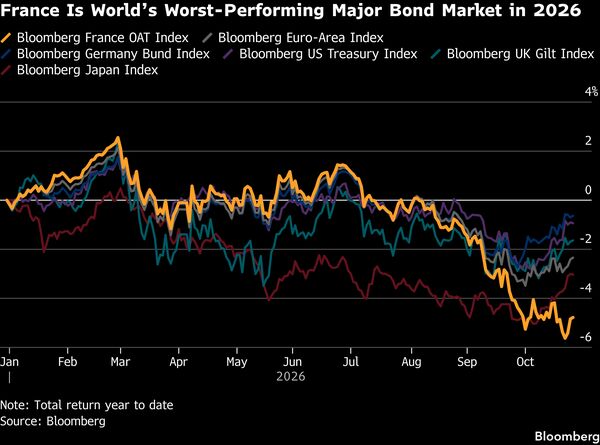
法国债券今年遭到重创,给投资者带来的损失超过其他任何主要政府债券市场。10年期法国国债收益率本月达到5%,为2002年以来首次。虽然这些走势部分归因于迫使欧洲央行加息的能源冲击,但也反映出投资者对法国本身的情绪恶化。
French debt has been pummeled this year, handing investors bigger losses than any other major government bond market. The yield on 10-year OATs hit 5% this month for the first time since 2002. While the moves are partly down to an energy shock that’s forced the European Central Bank to lift interest rates, it’s also a reflection of souring investor sentiment toward France itself.
目前的形势与希腊财政问题显现时的情况仍不可同日而语。投资者持有法国债券而非德国债券所要求的额外收益率本月飙升至1.78个百分点,而希腊的对应指标峰值曾超过35个百分点。此外,当年希腊因买家退缩而被债券市场拒之门外,而法国目前仍能发行新债。
The situation is still nothing close to what happened in Greece when its fiscal problems became apparent. The extra yield that investors demand to hold French bonds over German securities spiked to 1.78 percentage points this month. The equivalent measure for Greece peaked above 35 percentage points. And while Greece was shut out of bond markets as buyers balked, France can still issue new debt.
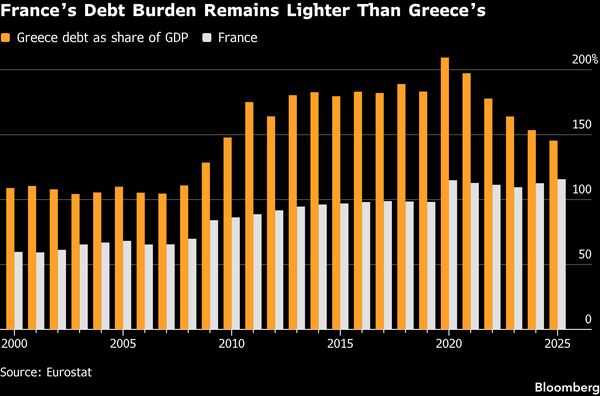
法国的债务相对于其经济规模而言要小一些。在2009年危机爆发之初,希腊的债务约占其国内生产总值的129%。在随后的几年里,这一比例激增,并在新冠疫情期间达到超过200%的峰值。但该比例正在快速下降,而法国的比例却在上升,且达到119%,远高于87%的欧元区平均水平。
France’s debt is smaller relative to the size of its economy. At the start of its crisis in 2009, Greece’s debt was equivalent to around 129% of its gross domestic product. It surged in the following years to peak at over 200% during the coronavirus pandemic. But the ratio is falling fast, while France’s is rising and — at 119% — is far above the euro area average of 87%.
关键的区别在于所涉债务的规模。法国在全球债券市场上的体量远远超过希腊历史上的任何时期,这也是富兰克林邓普顿投资公司等投资机构担心新危机可能会更严重的原因之一。法国3.6万亿欧元的债务大约是2011年希腊债务的10倍。其中约60%的债券由法国境外持有,这意味着债券危机的影响将在全球范围内产生连锁反应。
The key difference is the amount of debt at stake. France has a far bigger footprint in global bond markets than Greece ever did, which is one reason why investment firms such as Franklin Templeton Inc. are fretting that a fresh crisis could be worse. France’s €3.6 trillion of debt is about 10 times Greece’s in 2011. Some 60% of the bonds are held outside France, meaning the effects of a bond crisis would ripple around the world.
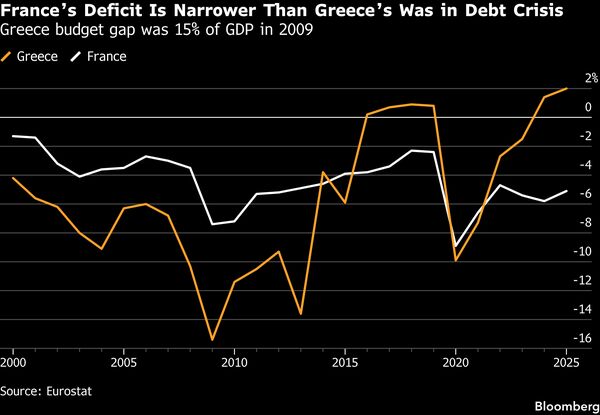
法国的赤字明显小于希腊危机爆发之初的水平。当时,雅典方面对财政缺口规模的虚假报告动摇了投资者的信心。
France’s deficit is significantly narrower than Greece’s was at the start of its crisis. Athens’ mis-reporting of the size of the gap shook investor confidence at the time.
虽然没有证据表明法国对其面临的挑战谎报军情,但由于税收收入令人失望、增长放缓以及少数派政府难以争取到对紧缩措施的支持,该国近年来一再错过公共财政目标。
While there is no evidence France has lied about its challenges, the country repeatedly missed public finance targets in recent years as tax receipts disappointed, growth slowed and minority governments struggled to get backing for belt-tightening measures.
今年将赤字从2025年的5.1%微降至5%这一目标甚至已被放弃,政府现在预计赤字缺口将在5.4%左右。
Even the goal of a minor narrowing of the deficit to 5% of economic output this year from 5.1% in 2025 has been abandoned, with the government now predicting a gap of around 5.4%.
占国民产出比例而言,法国的税收收入在欧洲名列茅,这意味着与其它地方相比,在不损害增长的前提下进一步加税的空间较小。与法国不同,希腊曾饱受普遍且系统的逃税问题困扰,因此打击逃税为其提升财政收入提供了更大的潜力。
France’s tax revenues are among the highest in Europe as a proportion of national output, meaning there’s less scope than elsewhere to raise taxes further without damaging growth. And unlike France, Greece suffered from widespread and systematic tax evasion, so a crackdown gave it greater potential to boost revenues.
因此,法国的焦点在于开支。法国的开支占经济产出的57%,在欧洲仅次于芬兰。但要控制呈上升趋势的开支却极具挑战性,这些开支因人口老龄化和医疗成本上升等结构性因素而不断增加。
France’s focus is therefore on spending, which is second only to Finland in Europe at 57% of economic output. But it’s challenging to contain outlays which are on an upward trend due to structural factors such as an aging population and rising health costs.
由于政治反对,削减福利也被证明是困难的。去年的社会保障预算在议会勉强通过,其赤字远超计划,且此前政府暂停了一项提高退休年龄的改革。
Making cuts to welfare has also proven difficult due to political opposition. Last year’s social security budget scraped through parliament with a much wider deficit than planned and after the government suspended a reform to raise the retirement age.
国际货币基金组织财政事务部负责人罗德里戈·瓦尔德斯本月表示:“归根结底,法国需要就养老金改革展开讨论,更广泛地说,需要就政府能够提供的保障规模展开讨论。”
“Ultimately, France requires a discussion about pension reform, and more broadly, a discussion of the size of what the government can provide,” Rodrigo Valdes, the head of the International Monetary Fund’s fiscal affairs department, said this month.
虽然希腊在债务危机爆发之初严重依赖旅游业、航运业和农业,但法国的经济规模大得多、更多元化,且涵盖奢侈品、航空航天和金融等利润丰厚的行业。法国巴黎银行强调,该国还是欧洲物流和科技领域的领头羊,这促进了服务贸易顺差。
While Greece’s economy relied heavily on tourism, shipping and agriculture at the onset of its debt crisis, France’s is significantly larger, more diversified and spans highly lucrative industries including luxury goods, aerospace and finance. BNP Paribas SA highlights that the country is also a European leader in logistics and technology, contributing to a surplus in services trade.
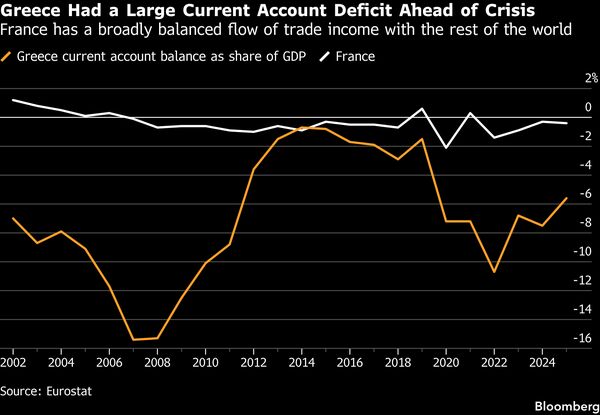
总体而言,法国的经常账户(衡量与世界其他地区贸易和收入流动的一个广泛指标)接近平衡。2009年,希腊的赤字约占国内生产总值的12%。
Overall, France’s current account — a broad measures of trade and income flows with the rest of the world — is close to balance. In 2009, Greece had a deficit of around 12% of GDP.
由于大部分电力来自核能和可再生能源,法国对化石燃料的依赖也低于其他国家。国际货币基金组织预计,长期来看,经济增长将稳定在1%左右,这将有助于抵消财政挑战。
France is also less dependent on fossil fuels than other countries as it produces the bulk of its electricity with nuclear energy and renewables. The IMF predicts that growth will stabilize around 1% in the long term, which would help offset the fiscal challenge.
法国飙升的主权风险引发了人们对其银行健康的担忧,这些银行通常持有大量政府债务。债券价格下跌会直接影响贷款人的偿付能力和财务实力比率。但法国的银行更加多元化、更具韧性且监管更完善,并拥有丰厚的资本缓冲,旨在发生亏损时保护其资产负债表。
France’s soaring sovereign risk has raised concerns for the health of the country’s banks, which typically own large chunks of government debt. Sinking bond prices can directly affect lenders’ solvency and financial strength ratios. But French banks are much more diversified, resilient and regulated, with chunky capital cushions designed to protect their balance sheets in the event of losses.
这与希腊的情况截然不同,希腊陷入了“厄运循环”。希腊银行大量持有本国政府债务,在主权债务重组中这些持仓遭受的损失实际上耗尽了其资本基础。这使得它们向企业和家庭放贷的能力下降,而深度衰退导致不良贷款飙升,致使银行体系需要大规模补充资本。
It’s a very different scenario to Greece, where a “doom loop” set in. Greek banks were heavily exposed to their own government’s debt, and losses on those holdings during the sovereign restructuring effectively wiped out their capital base. That made them less able to lend to businesses and households, and a deep recession sent non-performing loans soaring, leaving the banking system in need of extensive recapitalization.
与主权债务危机时期最显著的不同之一,在于欧元区架构的演变。当希腊和其他国家陷入困境时,政府从零开始为货币集团创建了救助机制,其中包括欧洲稳定机制。该机制曾被爱尔兰、葡萄牙、塞浦路斯和希腊使用,目前仍可提供贷款以换取经济改革,其他工具也已可用。
One of the most striking differences to the sovereign debt crisis is how the euro area’s architecture has evolved. When Greece and other countries ran into trouble, governments created a bailout facilities for the currency bloc from scratch, including the European Stability Mechanism. The facility, which was used by Ireland, Portugal, Cyprus and Greece, can still provide loans in return for economic reforms, and other tools are available as well.
另一道防线是欧洲央行。时任行长德拉吉在2012年宣布欧洲央行将“不惜一切代价”拯救欧元,创造了历史。这一承诺后来转化为一项名为“直接货币交易”的无限量债券购买计划,尽管从未被使用过,且附带严格条件。
Another line of defense is the ECB. Then-President Mario Draghi made history in 2012 by announcing the ECB would do “whatever it takes” to save the euro. That promise was later translated into an unlimited bond-buying program known as the Outright Monetary Transactions plan, although it’s never been used and would come with stringent conditions.
解读:为何欧洲央行对介入法国债券动荡持谨慎态度 在新冠疫情后,欧洲央行准备加息之际意大利债券收益率飙升至高于同行水平,欧洲央行管委会推出了另一项此类工具。该工具被称为“传导保护机制”,允许央行官员在认定市场波动不符合经济基本面且阻碍货币政策传导时购买主权债务。
Explainer: Why ECB Is Wary of Stepping Into French Bond Turmoil The ECB’s Governing Council came up with another such tool after the coronavirus pandemic, when the ECB was preparing to raise interest rates and Italian debt yields soared above those of their peers. Known as the Transmission Protection Instrument, it allows the bank’s officials to buy sovereign debt when they deem that market moves aren’t justified by economic fundamentals and hamper the transmission of monetary policy.
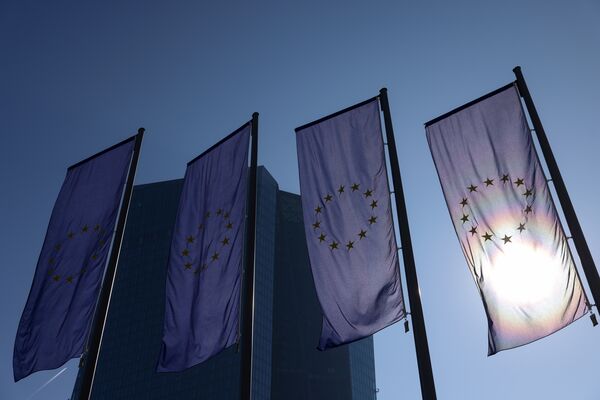
到目前为止,欧洲央行已拒绝了其即将介入的任何猜测,强调解决局势取决于法国。
So far, the ECB has waved off any speculation that it is about to step in, stressing that it’s up to France to fix the situation.
顺序不同,但2026年的法国与2009年的希腊之间存在政治上的相似之处。在这两个国家,财政问题都在建制政党瓦解、民粹主义者准备掌权之际逐步显现。
The sequencing is different, but there are political parallels between France in 2026 and Greece in 2009. In both countries, the fiscal problems were unfolding as establishment parties unraveled and populists stood ready to take power.
在希腊,传统的中间偏右政党于2015年被左翼煽动者亚历克西斯·齐普拉斯赶下台。在这场危机的最后一幕中,他与欧盟其他国家的对峙几乎迫使希腊退出欧元区,直到他接受大幅削减作为第三轮也是最后一轮纾困的条件。在法国,埃马纽埃尔·马克龙于2017年将自第五共和国成立以来一直把持总统职位的两个政党推到一边。极右翼民族主义者玛丽娜·勒庞是明年选举中最有希望接替他的人选,而许多民调显示极左翼领袖让-吕克·梅朗雄位居第二。
In Greece, the traditional center-right party was ousted by the left-wing firebrand Alexis Tsipras in 2015. In the final act of the crisis, his showdown with the rest of the EU almost forced Greece out of the euro before he accepted dramatic cuts as a condition of the third and final bailout. In France, Emmanuel Macron in 2017 pushed aside the two parties that had held the presidency since the dawn of the Fifth Republic. Far-right nationalist Marine Le Pen is the favorite to succeed him in next year’s election, while many polls put far-left leader Jean-Luc Mélenchon in second.