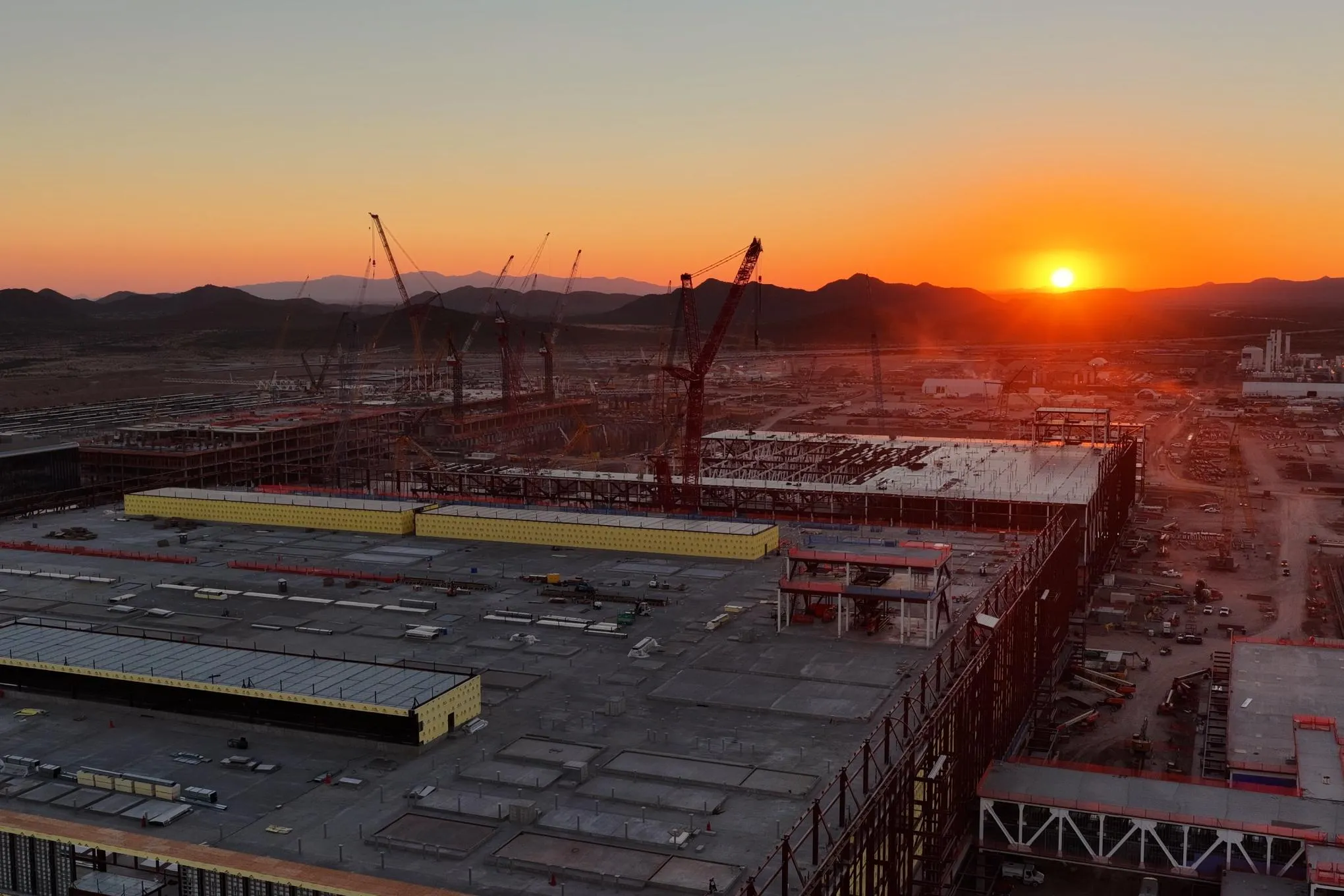
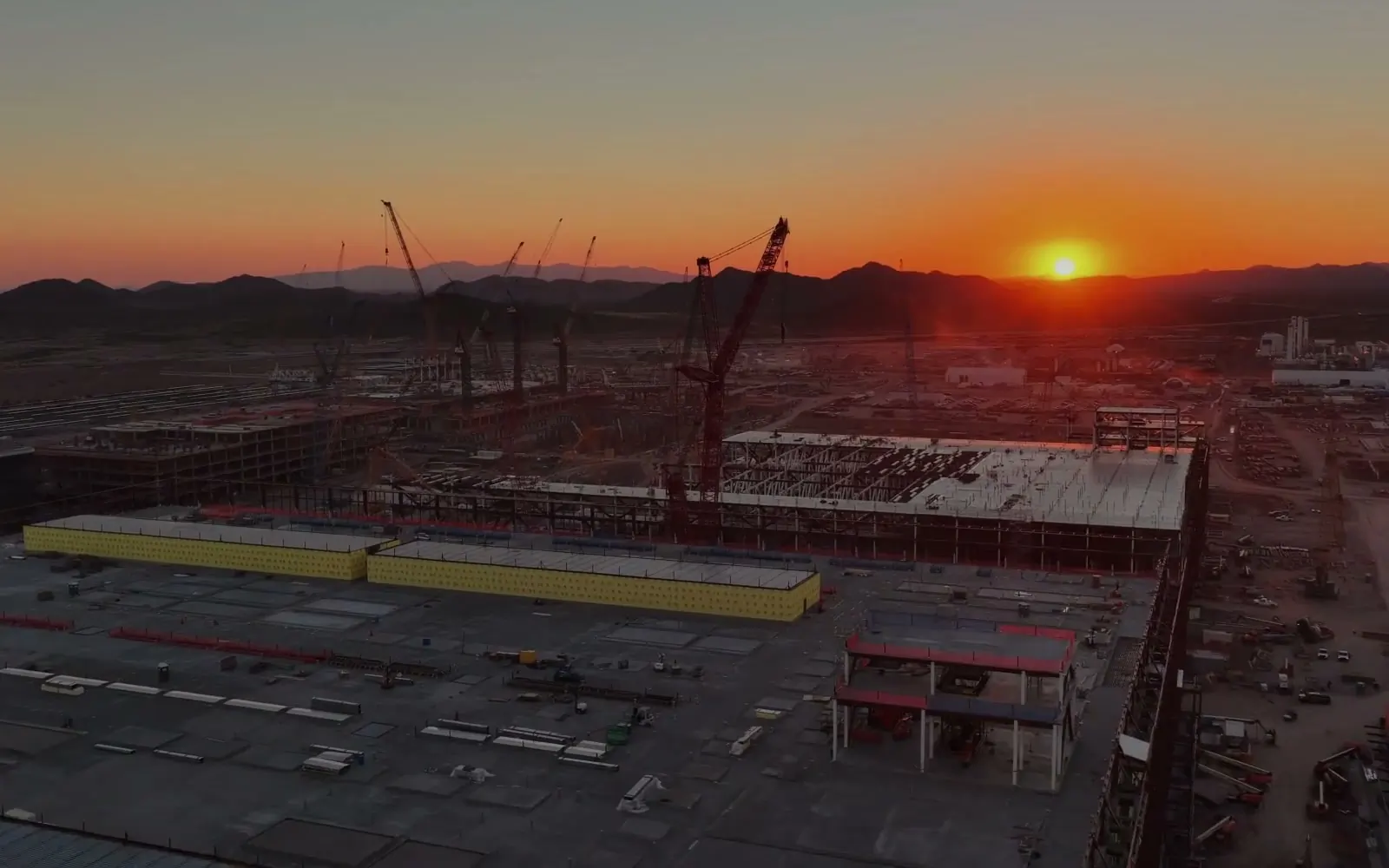
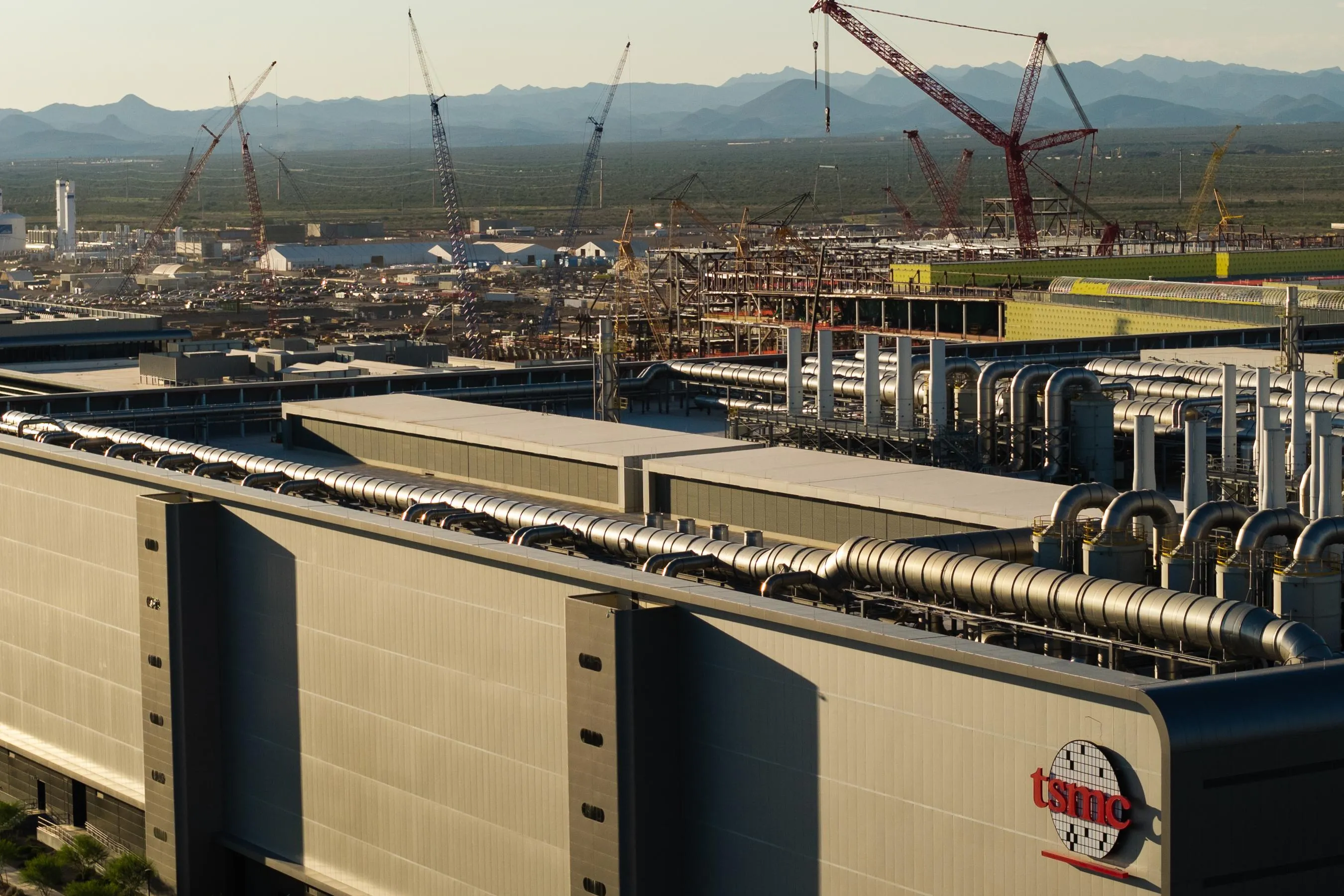
一座庞大灰色的巨构从沙漠中拔地而起。在内部,工程师们制造出驱动我们手机、电脑和家电、流媒体服务、搜索引擎、聊天机器人,以及“氛围编码”应用和网站的核心力量。这座建筑群既巨大又矮胖,在周围群山的衬托下显得渺小,又仿佛没有尽头。我驱车经过一栋楼,又一栋,接着大地裂开,施工队挖掘土地,为第三栋楼的拔地而起腾出空间。
A hulking gray giant rises from the desert. Inside, engineers create the force behind our phones and computers and appliances, our streaming services and search engines and chatbots and vibe-coded apps and websites. The complex is simultaneously massive and squat, dwarfed by the mountains that surround it, and it is endless. I drive past one building, and then another, and then the ground opens up where construction crews have dug up the earth so a third building can rise.
有一个停车场,又一个,再一个。街道对面是一块空地,停满了车,偶尔能看到餐车,为成千上万正忙着将这片沙漠变成工业园的工人提供餐食。到处是尘土,多得呛人,弥漫在空气中。
There is a parking lot, and then another, and then another. There is an empty lot on the other side of the street, full of cars and the occasional food truck to feed the thousands of laborers who are busy transforming this expanse of desert into an industrial park. There is dust, so much of it, choking the air.
我站在亚利桑那州经济救星的面前。像所有伟大的神祇一样,它要求献祭。在沙漠里,没有什么比水更珍贵,而水正是必须献上的供品——每天近500万加仑,日复一日,取自凤凰城市政供水。这笔供品物超所值。
I stand before the savior of Arizona’s economy. Like all great deities, it demands sacrifice. In the desert, nothing is more precious than water, and water is what must be given — nearly 5 million gallons a day, every day, sourced from Phoenix’s municipal supply. The offering has been well worth it.
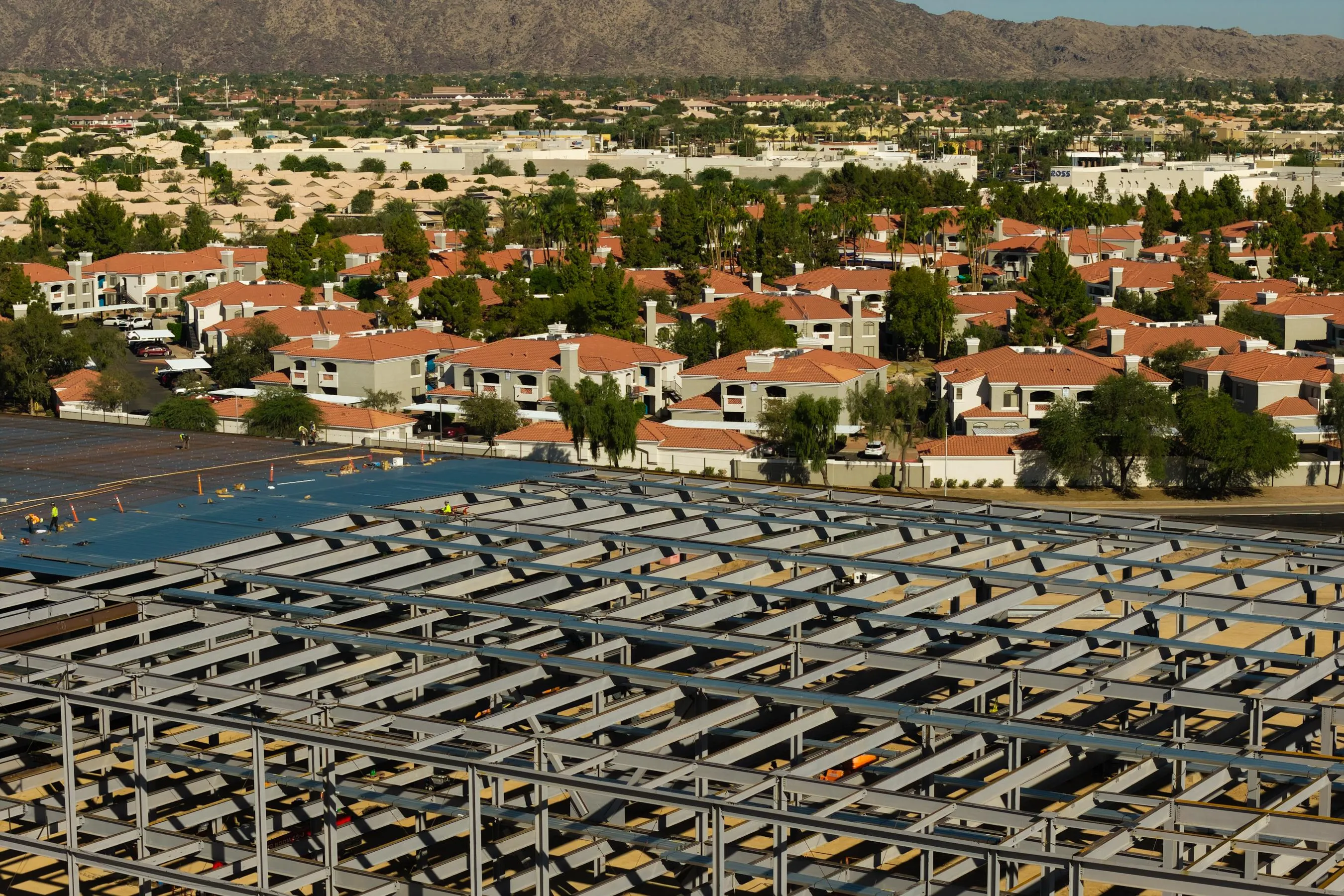
这一切都是台积电——全球领先的微芯片制造商——的成果。其亚利桑那业务源于凤凰城在疫情前为振兴疲软经济而下的一注赌局,那场大衰退后,当地经济始终未能完全复苏。如今,台积电的晶圆厂巍然矗立在城市郊外。
All of this is the fruit of the Taiwan Semiconductor Manufacturing Company, the world’s leading producer of microchips. Its Arizona operation is the result of a pre-pandemic gamble Phoenix made to revive its sluggish economy , which never quite rebounded from the Great Recession. Now TSMC’s foundry looms over the city’s outskirts.
台积电是一个成功案例,一些地方领导人或许曾希望在超大规模数据中心开发中复制这一成功。这一进程看似自然而然:大峡谷州不仅拥有太平洋这一侧最大的芯片工厂,还有172个数据中心,两者都未遭遇多少反对。但从凤凰城到图森提出的新一批更大规模开发项目,对一切的需求都更高——更多水、更多电力、更多土地——而亚利桑那人并不愿意付出。
TSMC is a success story, one that some local leaders may have hoped to repeat with hyperscale data center developments. The progression may have seemed natural: The Grand Canyon State is not only home to the largest chip factory this side of the Pacific but also 172 data centers , neither of which faced much pushback. But the newer, larger developments being proposed from Phoenix to Tucson demand more of everything — more water, more power, more land — than Arizonans are willing to give.
台积电受到热烈欢迎,第一波数据中心基本被忽视,而新开发项目在亚利桑那却面临大规模反对,当地一支出人意料的两党联合的基层居民联盟已团结起来反对数据中心。
Where TSMC was welcomed with open arms and the first wave of data centers was largely ignored, new developments are facing mass backlash in Arizona, where a grassroots, surprisingly bipartisan coalition of residents has united against data centers.
现在,亚利桑那本地人克里斯汀·麦凯告诉我,该州有了第六个C:“芯片。”
Now the state has a sixth C, Arizona native Christine Mackay tells me. “Chips.”
在报道这篇文章时,我与当地活动人士和经济开发人员、民选官员及其愤怒的选民交谈。我旁听了市议会会议,数十人排队发言反对数据中心项目;也走进温馨的郊区住宅,与曾经互不相识的紧密团体交谈,他们讲述了将他们聚在一起的斗争。我与外行人一起研究亚利桑那干旱、龟裂的地貌图,这些人在过去两年中,已让自己成为分区、土地利用和水资源消耗方面的专家,以便了解他们试图对抗的这个“怪兽”。
In reporting this story, I spoke to local activists and economic developers, elected officials and their angry constituents. I sat in on city council meetings where people lined up by the dozens to speak up against data center projects, and in cozy suburban homes where tight-knit groups of former strangers told me about the struggle that brought them together. I pored over maps of Arizona’s dry, cracked landscape with laypeople who, over the past two years, have made themselves experts on zoning and land use and water consumption so they can understand the beast they’re trying to fight.
这场辩论双方的当地人都声称想要同一件事:一个更美好、更繁荣的亚利桑那。然而,他们实现这一目标的愿景却完全背道而驰。
The locals on both sides of this debate claim to want the same thing: a better, more prosperous Arizona. Their visions for achieving it, however, are completely at odds.
在亚利桑那州及其他地方,数据中心开发商试图通过许诺带来的就业、税收和基础设施来赢得当地人支持。他们要求的回报只是水——并且发誓,用水量远不如人们想象的那么多。一些超大规模数据中心,例如俄勒冈州达尔斯的谷歌设施,每天用水约150万加仑,大约是台积电亚利桑那州综合体同期用水量的三分之一。然而,这些保证不足以让亚利桑那人放心,他们现在不得不面对这样一个事实:该州很快将失去来自科罗拉多河近30%的供水。
In Arizona and elsewhere, data center developers have tried to win over locals by making enticing promises about the jobs, tax revenue, and infrastructure they’ll bring with them. All they ask for in exchange is water — and, they swear, not nearly as much of it as you’d expect. Some hyperscale data centers, like Google’s facility in The Dalles, Oregon, use about 1.5 million gallons a day, about one-third of what TSMC’s Arizona complex consumes in the same timeframe. Those reassurances, however, aren’t enough to assuage Arizonans, who now have to contend with the fact that the state will soon lose access to nearly 30 percent of the water it receives from the Colorado River.
即便如此,随着全国各地的人们对人工智能失去兴趣,并在社区中反对数据中心,台积电的亚利桑那州运营却在没有显著反对的情况下持续运转。然而,要想理解亚利桑那人为何如此反对新的数据中心开发,首先必须了解他们为何热烈欢迎台积电,尽管这两个行业都必须面对困扰亚利桑那州自建州以来的问题:水资源不足。
Even now, as people across the country sour on AI and fight against data centers in their communities, TSMC’s Arizona operation hums along without significant opposition. And yet it’s impossible to make sense of why Arizonans are so opposed to new data center development without first understanding why they eagerly welcomed TSMC, even though both industries must contend with the issue that has plagued Arizona since its founding: There isn’t enough water.
在任何人都能记得的过去,亚利桑那州的商业围绕着传奇的“五C”展开:牛、铜、棉花、柑橘和气候,后者是对该地区温和宜人冬季的统称,当地人说,冬季往往足以弥补酷热的夏天。
For as long as anyone could remember, business in Arizona revolved around the storied “five C’s”: cattle, copper, cotton, citrus, and climate, a catchall for the region’s mild, salubrious winters, which locals say often more than make up for the sweltering summers.
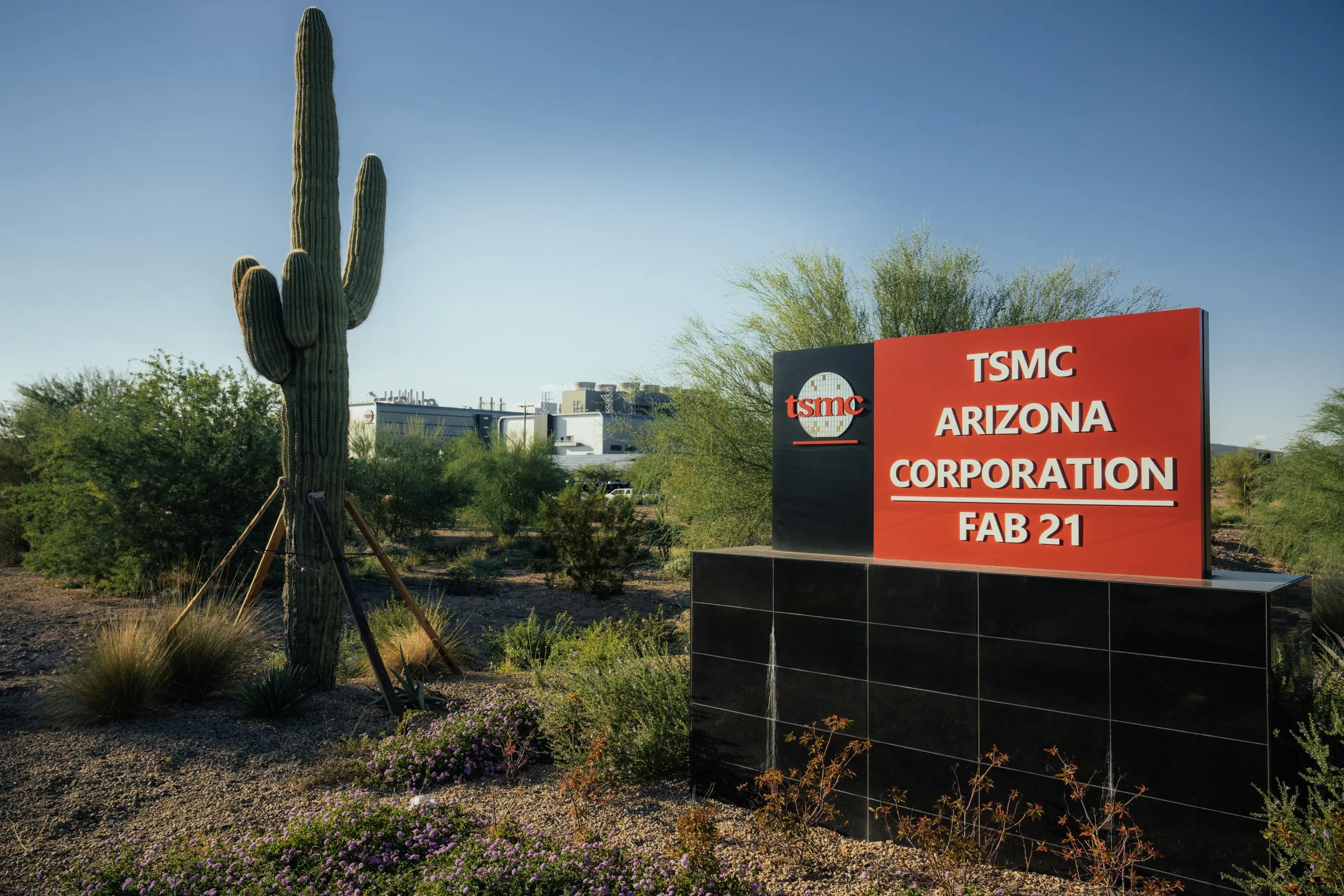
现在,该州有了第六个C,亚利桑那州本地人克里斯汀·麦凯告诉我。“芯片。”
Now the state has a sixth C, Arizona native Christine Mackay tells me. “Chips.”
台积电的发展,在某种程度上可以说是麦凯的功劳。作为凤凰城经济发展办公室的负责人,她主导了将这家台湾巨头引入索诺兰沙漠的努力。2020年,当全球经济几乎陷入停滞时,台积电发布了一项公告。让世界陷入停滞的同样力量,也创造了对台积电产品更大的需求,作为回应,台积电将在凤凰城开设一家先进的半导体晶圆厂——即行业术语中的“晶圆厂”。
The TSMC development is, in a sense, Mackay’s doing. As the head of Phoenix’s economic development office, she spearheaded the effort that brought the Taiwanese giant to the Sonoran Desert. In 2020, while the global economy was all but shut down, TSMC made an announcement. The same forces that brought the world to a standstill had created even more demand for TSMC’s products, and in response, TSMC would be opening an advanced semiconductor foundry — a “fab,” in industry jargon — in Phoenix.
最初,台积电预计到2029年将向亚利桑那州经济投入120亿美元。此后,台积电在该州的预计支出已膨胀至2650亿美元,该公司称这是美国历史上最大的外国直接投资。
Initially, TSMC predicted that it would pour $12 billion into Arizona’s economy by 2029. Since then, TSMC’s projected expenditure in the state has ballooned to $265 billion, what the company touts as the largest foreign direct investment in US history.
台积电刚刚在凤凰城北部一片昔日荒凉的地段完成了第二座晶圆厂的最后装修,第三座正在建设中,几座更多的晶圆厂计划也在推进之中。这一建设历时十余年。台积电从2016年开始在美国各地寻找选址。麦凯说,那一年,该公司以代号发布了提案请求。没有人中标。
TSMC just put the finishing touches on its second fab in a formerly desolate swath of north Phoenix, with a third under construction and plans for several more underway. This buildout has been more than a decade in the making. TSMC started shopping around for a US location in 2016. That year, Mackay said, the company put out a request for proposals through a codename. No one won.
“我们不是那种接受‘不’这个答案的团体,”麦凯自豪地说。她的办公室询问台积电高管认为亚利桑那州缺少什么,然后花了接下来的三年时间解决他们的顾虑。2019年,凤凰城派出一个代表团前往台湾,分享一项新的科技园区开发计划,该园区的核心将是一家工厂,最好是台积电的一家晶圆厂。“他们同意需要回来再看看凤凰城,”麦凯告诉我。
“We aren’t a group that takes no for an answer,” Mackay said proudly. Her office asked TSMC executives what they thought Arizona was missing, and then spent the next three years addressing their concerns. In 2019, Phoenix sent a delegation to Taiwan to share a new development plan for a science and technology park, the nucleus of which would be a factory, ideally one of TSMC’s fabs. “They agreed they needed to come back and take another look at Phoenix,” Mackay told me.
她的团队向他们展示了两个地点:亚利桑那州的莱文,凤凰城西南部的一个郊区,以及城市以北一片大约相当于曼哈顿大小的未开发区域,名为比斯基特弗拉茨,麦凯告诉我,之所以这样命名,是因为“它像饼干一样圆而平整。”“就在那天,”她回忆道,“他们说,‘这可能可行。’”随后出现的是该州前所未见的一波开发热潮。
Her team showed them two locations: Laveen, Arizona, a suburb southwest of Phoenix, and, just north of the city, an undeveloped area roughly the size of Manhattan called Biscuit Flats, so named, Mackay told me, because “it’s as round and flat as a biscuit.”“That very day,” she recalled, “they said, ‘This could work.’”What followed was a flurry of development unlike anything the state has ever seen.
台积电已为该州带来超过3500个工作岗位,一整个经济体也围绕着支持该公司在亚利桑那州的运营而兴起。与在台湾的情况颇为相似——该公司贡献了台湾近十分之一的国内生产总值——台积电即使算不上宇宙的中心,至少也自成一个星系。该公司控制着全球芯片市场约70%的份额,仅与苹果和英伟达的合同就占其年收入的三分之一以上。
TSMC has brought more than 3,500 jobs to the state, and an entire economy has sprung up to support the company’s Arizona operation. Much like in Taiwan — where the company accounts for nearly one-tenth of Taiwan’s gross domestic product — TSMC has become, if not the center of the universe, then at least a galaxy unto itself. The company controls an estimated 70 percent of the global chip market, and its contracts with Apple and Nvidia alone make up more than one-third of its annual revenue. (Apple and Nvidia design their own chips, but they don’t produce them. The complex manufacturing process is instead largely outsourced to TSMC.)
(苹果和英伟达自行设计芯片,但并不生产芯片。复杂的制造流程在很大程度上外包给了台积电。)台积电改变了凤凰城的大片区域——它的景观、它的产业——并带来了就业和繁荣。当地人担心,新的大型超大规模数据中心开发项目只会带来前者,而不会带来后者,即消耗资源却对社区贡献甚微。麦凯从事经济发展工作已有30多年,过去她协助招引数据中心开发项目时,并未遭遇明显的反对。“我最早做的10个数据中心看起来就像漂亮的小办公楼,”她说。
TSMC has changed swaths of Phoenix — its landscape, its industries — and it has brought with it jobs and prosperity. Locals fear that the new hyperscale data center developments will do the former but not the latter, consuming resources while contributing little to the community. Mackay, who has worked as an economic developer for over 30 years, didn’t experience significant pushback when she helped court data center developments in the past. “The first 10 data centers I did look like pretty little office buildings,” she said.
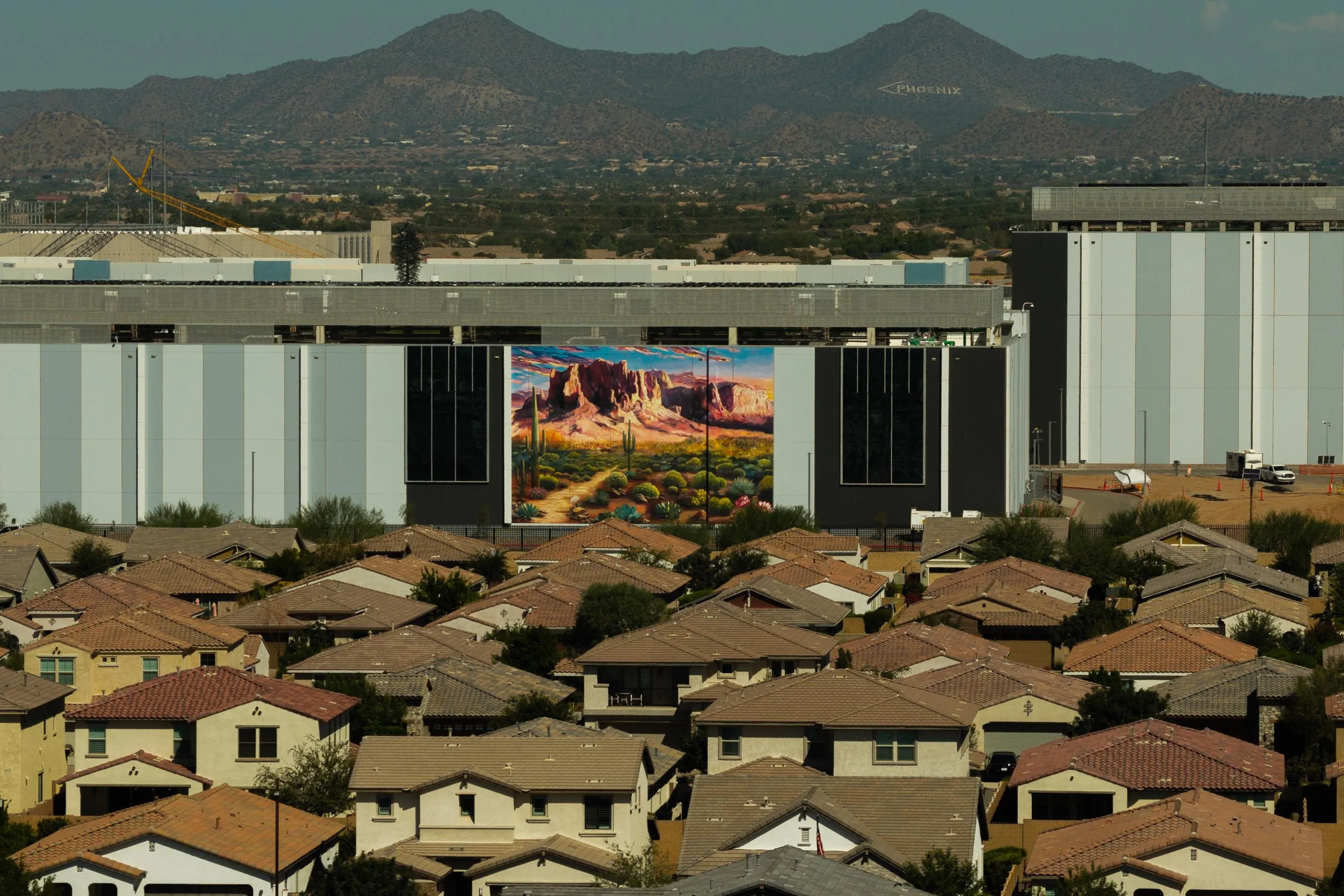
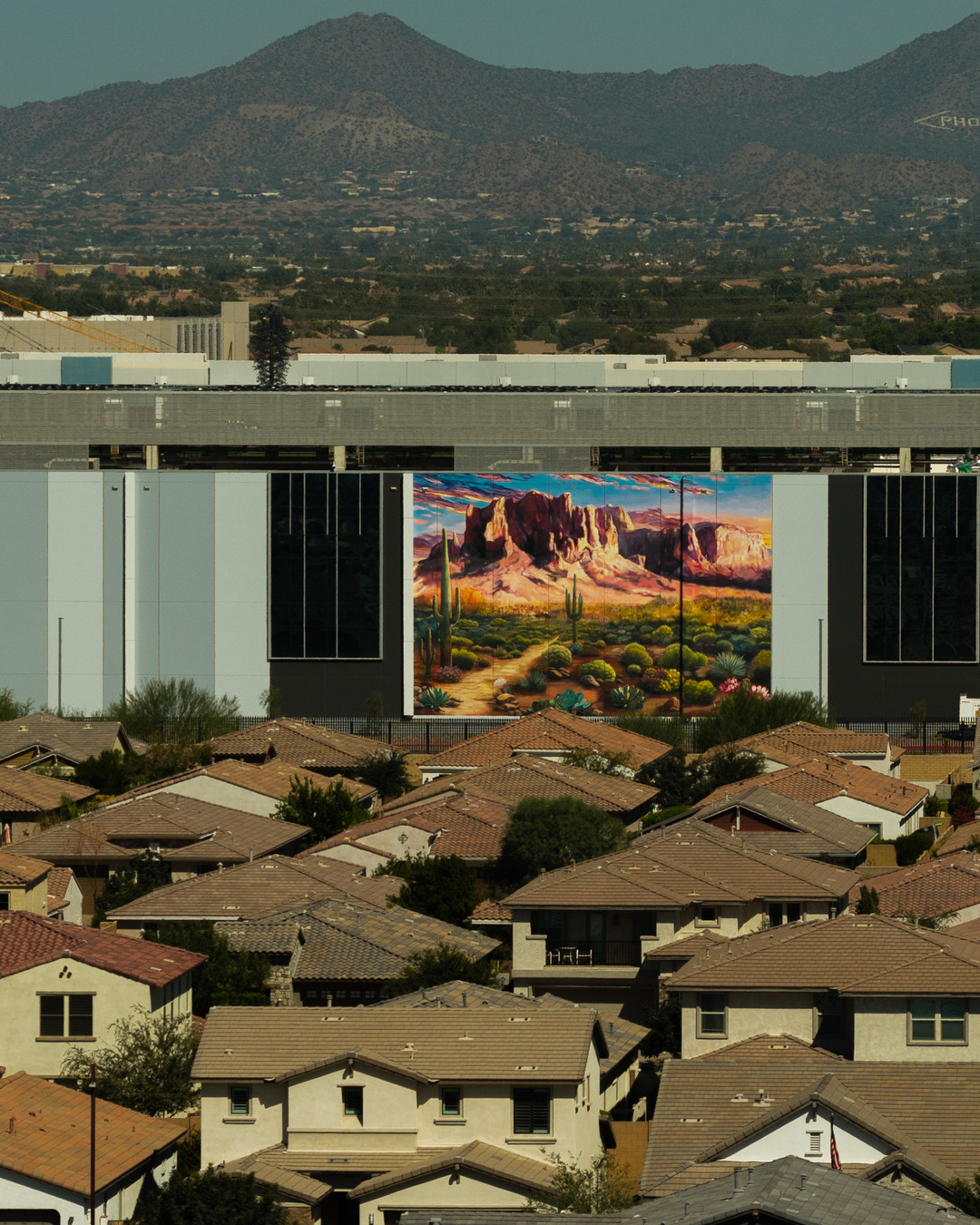
拟议中的新开发项目既不美观,也不小。早期的数据中心不引人注目,而开发商想在亚利桑那州建设的超大规模设施——通常建在农村农田或沙漠土地上——既巨大又突兀。尽管该州最近才获得了城市蔓延的名声,但仍有许多地方,在寂静的沙漠夜晚,你有时能听到一群郊狼在深夜嚎叫。这里有暗夜天空走廊和野生动物,有鬼城和仙人掌林。
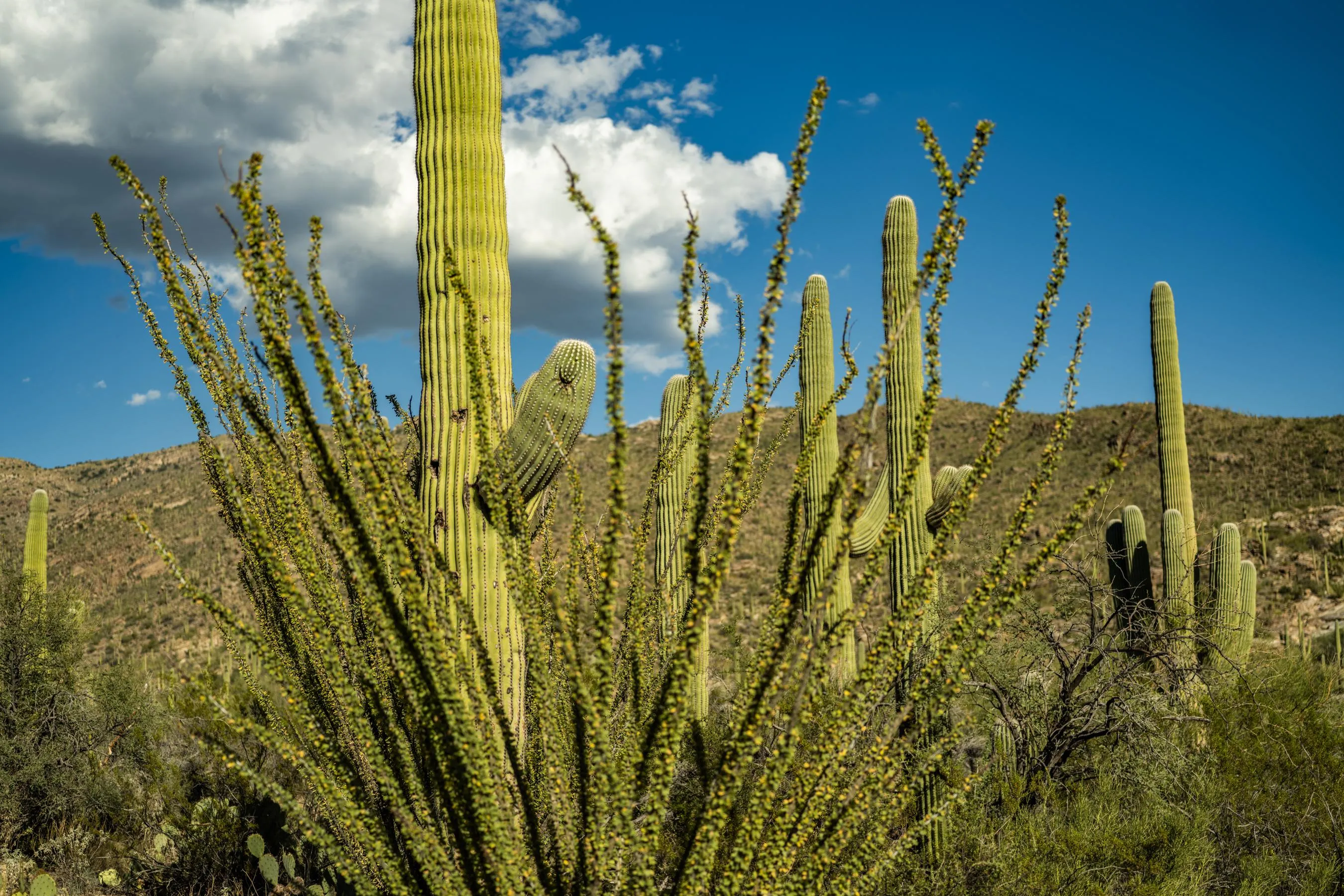
The new developments being proposed are neither pretty nor little. Where earlier data centers were inconspicuous, the hyperscale facilities developers want to build in Arizona — often on rural farm or desert land — are both massive and incongruous. Despite the state’s recently acquired reputation for sprawl, there are still plenty of places where, in the quiet desert stillness, you can sometimes hear a pack of coyotes howl in the middle of the night. There are dark-sky corridors and wild animals, ghost towns and saguaro forests.
一些当地人说,所有这些都可能被牺牲,以造福一个对人类自身也构成生存威胁的行业。这里存在伦理问题和环境问题,关于分区和税收的争论,以及最重要的是,关于水的争论。然而,城市和外围郊区仍在不断增长,向各个方向扩张,直到受到地理、官僚主义或原住民主权的限制。而行业,不知怎地,仍在不断到来,比以往任何时候都更加口渴。
All of this, some locals say, could be sacrificed for the benefit of an industry that also poses an existential threat to humanity. There are ethical questions and environmental ones, debates over zoning and taxes and, most of all, over water. Yet the cities and the outlying suburbs keep growing, spreading in all directions until they’re constrained by geography or bureaucracy or Indigenous sovereignty. And industry, somehow, keeps arriving, thirstier than ever.
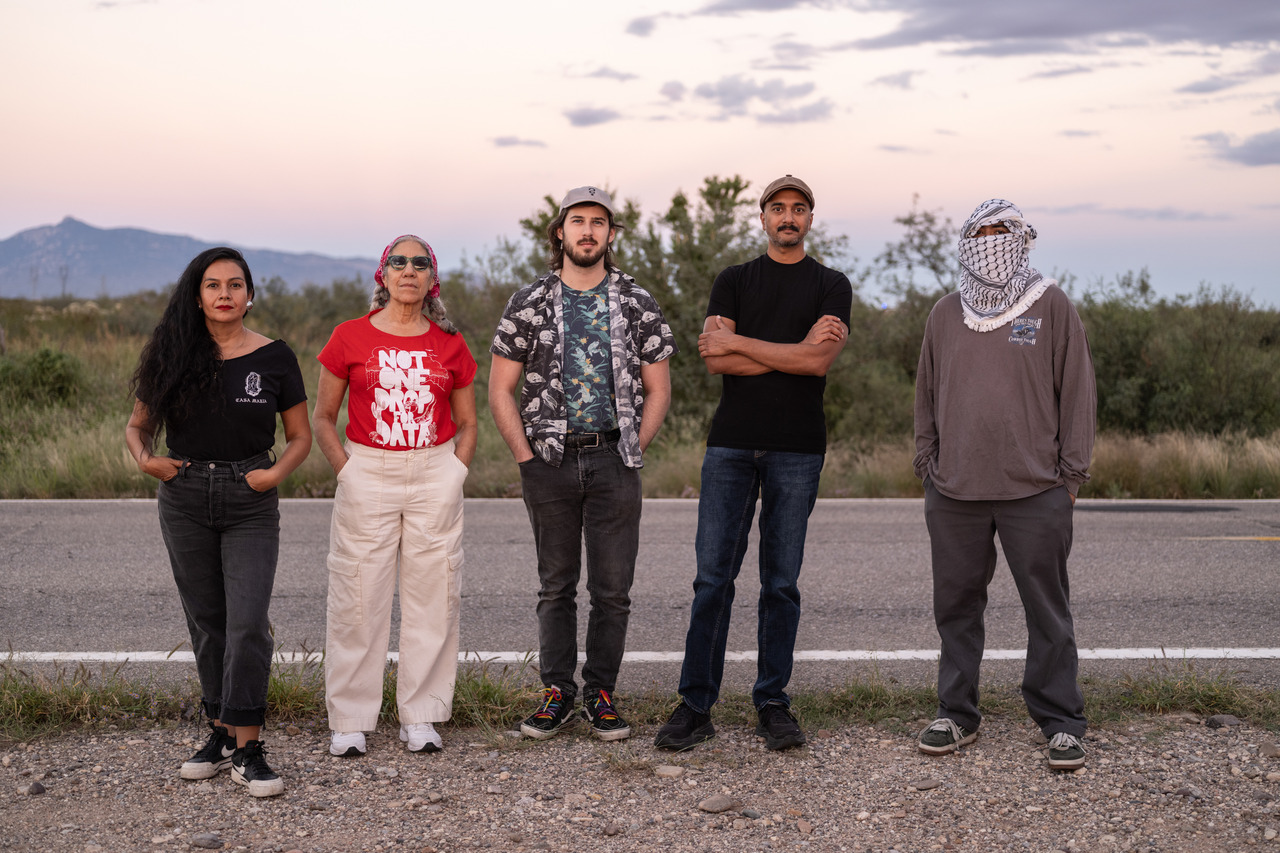
一年四季,尤其是在夏天,亚利桑那州居民都会根据自然环境调整自己的作息。司机小心避免被困在沙尘暴或季风中。慢跑者避免在上午晚些时候和下午早些时候外出,那时气温最炎热。而8月1日,正值季风季节高峰期,不想要沙漠数据中心联盟的抗议活动在傍晚开始,当时太阳那令人难以忍受的光芒开始让位于昏暗的沙漠日落。
Year-round but especially in the summers, Arizonans tailor their routines to the elements. Drivers are careful not to get stuck in dust storms or monsoons. Joggers avoid going out in late mornings and early afternoons, when the heat is at its most intense. And on August 1st, at the peak of monsoon season, the No Desert Data Center Coalition’s protest began in the early evening, when the sun’s punishing rays were starting to give way to a muted desert sunset.
约十几个人出现在图森郊外的集会上,站在占地290英亩的场地前,比尔基础设施公司正在那里建设一座600兆瓦的数据中心。每隔几分钟,组织者之一维韦克·巴拉坦就会提醒抗议者注意补水。孩子们互相用水枪喷水,乖乖地接过父母递来的饮料。参加者之一迈拉·杜龙带来了一箱洛神花水与大家分享。她说,这种紫红色的饮料富含电解质。
About a dozen people showed up to the rally on the outskirts of Tucson, in front of the 290-acre site where Beale Infrastructure is building a 600-megawatt data center. Every few minutes, Vivek Bharathan, one of the organizers, reminded the protesters to stay hydrated. Children sprayed each other with water guns and dutifully accepted drinks from their parents. Mayra Duron, one of the attendees, brought a cooler of agua de jamaica to share with the group. The magenta beverage, she said, was full of electrolytes.
水——水的匮乏、对水的需求、在沙漠中央建造巨型数据中心所需的水量——是大家最关心的问题。一条手绘横幅表达了总体情绪:比尔的数据中心会把我们吸干。
Water — the lack of it, the need for it, the amount required to build a massive data center in the middle of the desert — was top of mind. A hand-painted banner expressed the overarching sentiment: BEALE’S DATA CENTER WILL SUCK US DRY.
“如果你们觉得太热,请回家吧,”巴拉坦对这小群人说道。“今天很热,如果他们真在这里建成了数据中心,会更热。我们知道这些东西会形成热岛,可能使周边地区温度升高超过10华氏度。”杜龙是当地一位将仙人掌刺融入编织作品的macramé艺术家,她说她担心气温上升会影响该地区的巨人柱仙人掌。“在凤凰城,那里高度工业化,”她说,“他们那里的巨人柱仙人掌成片成片地死去。”
“If you feel the heat, please head home,” Bharathan told the small crowd. “It is a hot day, and if they succeed in building a data center here, it’ll be even hotter. We know these things create heat islands that can affect the surrounding area by over 10 degrees Fahrenheit.”Duron, a local macrame artist who incorporates cactus spines into her weaving, said she worried about how rising temperatures would affect the region’s saguaros. “In Phoenix, it’s hyper-industrialized,” she said, “and they’ve seen saguaros die left and right.”
汽车鸣笛表示支持。一些司机疾驰而过时从车窗里挥拳致意。2019年台积电项目宣布时,亚利桑那人并没有因为AI而激动,也没有注意到或太在意此前在全州各地悄然建起的那些数据中心。情况已经变了。图森似乎团结一致,反对这座被称为“蓝色计划”的数据中心综合体。但建筑还是在拔地而起。
Cars honked in support. Some drivers pumped their fists out their windows as they sped by. Arizonans weren’t riled up about AI in 2019, when the TSMC project was announced, nor did they notice or care much about the previous data centers that were quietly built throughout the state. Things have changed. Tucson, it appears, is united in its opposition to the data center complex dubbed Project Blue. But the buildings are going up anyway.
“我们把它当作正常的事,因为这种情况已经持续太久了。但它并不正常。这是一场灾难。”
“We take it as normal because it’s been that way for so long. But it isn’t normal. It’s a catastrophe.”
关于“蓝色项目”(Project Blue)的信息在2025年春天开始慢慢流出。最先传出的是项目名称,以及一些线索:这个开发项目,不管它是什么,将建在县属的一块土地上;它将创造3000个临时建筑岗位,并在未来带来200个高薪职位;它将在未来十年产生1.52亿美元的税收;它的规模会很大,而且耗水量也大,将新建供水管道来满足其需求。知情人士能说的就只有这些,因为拥有这块土地的县政府与潜在开发商签署了保密协议。
Information about Project Blue began slowly trickling out in the spring of 2025. First came the name, and some clues : The development, whatever it was, would be on a county-owned plot of land; it would create 3,000 temporary construction jobs and 200 well-paying positions down the road; it would generate $152 million in tax revenue over the next decade; it would be big, and it would be thirsty, and new water lines would be built to keep it satiated. That was all anyone in the know would say, because the county government, which owned the land, signed a nondisclosure agreement with the would-be developer.
这条消息以一种平淡、官僚的方式传出,就像中型城市潜在土地出售的信息通常那样。2025年6月,皮马县行政长官简·莱舍向县监事会提交了一份44页的备忘录。“数据中心”这几个字直到第四页才出现。这个数据中心将为图森市和该县提供“前所未有的”36亿美元机遇。备忘录中还有其他细节,有恭维之词,也有种种承诺。蓝色项目将使用“100%可再生水资源”。其开发商比尔基础设施公司(Beale Infrastructure)将自费建设关键基础设施,包括延长18英里的管道和一座含水层回灌设施。
The news came out in a mundane, bureaucratic way, as information about prospective land sales in midsize cities often does. In June 2025, Jan Lesher, the Pima County administrator, submitted a 44-page memo to the Board of Supervisors. The words “data center” did not appear until the fourth page. This data center would provide an “unprecedented” $3.6 billion opportunity for Tucson and for the county. There were other details, and there was flattery, and there were promises. Project Blue would use “100% renewable water resources.”Its developer, Beale Infrastructure, would build critical infrastructure at its own expense, including an 18-mile pipe extension and an aquifer recharge facility.
“它可能给本地经济带来的提振很可能是变革性的,”县监事会五名成员之一雷克斯·斯科特当时表示。他的同僚意见不一。他们以3比2的投票结果通过了这块290英亩土地的重新分区,并再次投票决定以约2000万美元的价格将其出售给比尔公司。但这还不是定局。交易条款之一要求图森市将该土地并入市域并批准出售,因为该市将负责这块土地的供水服务。
“The boost it could provide to our local economy may well be transformative,” Rex Scott, one of five members of the County Board of Supervisors, said at the time . His colleagues were split. They voted 3-2 to rezone the 290-acre tract, and voted again to sell it to Beale for around $20 million. But it wasn’t a guarantee yet. One of the terms of the deal required Tucson to annex the land and approve the sale, since the city would be on the hook for the land’s water service.
蜜月期,即便有,也没持续多久。董事会投票后仅几个小时,图森电力公司(Tucson Electric Power)就宣布正在研究一项电价上调计划,将使客户账单平均上涨14%。该公用事业公司声称,该决定与即将建成的数据中心无关。即便如此,一位投票同意重新划区并将土地出售给比尔(Beale)的委员,正式要求重新审议该重新划区决定。
The honeymoon, if there even was one, didn’t last. Just hours after the board’s vote, Tucson Electric Power announced it was looking into a rate hike that would increase customers’ bills by an average of 14 percent. The utility claimed the decision was unrelated to the forthcoming data center. Even still, one of the commissioners who voted to rezone the land and sell it to Beale officially asked to reconsider the rezoning.
也许是图森居民在如此短的时间内先后得知数据中心和电价上调的消息,再加上数据中心推高当地居民电费的无法回避的新闻,引发了他们的大规模反对。也许是《亚利桑那镜报》(Arizona Mirror)的报道起了作用:该报道称,蓝色计划(Project Blue)连同另一家拟建的数据中心,不仅将成为图森电力公司最大的客户,每年还将消耗相当于四个高尔夫球场用水量的水量。
Perhaps it was the fact that Tucsonans learned of the data center and the rate hike in such quick succession, coupled with the inescapable news of data centers raising locals’ utility bills , that catalyzed their mass opposition. Maybe it was the Arizona Mirror ’s report that Project Blue, combined with another proposed data center, would not only be TEP’s biggest customer but also consume more than four golf courses’ worth of water each year.
据报道,亚马逊网络服务(Amazon Web Services)是最终客户,而且县官员自2023年起就一直在讨论该项目,根据亚利桑那光明报(Arizona Luminaria)获得的公共记录,他们签署了禁止透露涉及公司名称的保密协议——这些都无疑雪上加霜。无论原因是什么,比尔高管们可能都没有料到公众会如此愤怒。
The fact that Amazon Web Services was reportedly the end client — and that county officials had been discussing the project since 2023, and, according to public records obtained by Arizona Luminaria , signed NDAs prohibiting them from naming the companies involved — certainly didn’t help. Whatever the reason, Beale executives probably weren’t prepared for just how angry the public would be.
2025年7月,大约200人出席了比尔在当地一所高中礼堂举办的公开信息会。其中大多数人对数据中心感到愤怒,或者担忧,或者恐惧。随后在图森会议中心举行的后续会议上,气氛更加紧张。超过一千人出席。比尔的代表还没完成自我介绍,嘘声就开始了,并且持续了整个晚上。
Around 200 people showed up to a public information meeting Beale hosted in the auditorium of a local high school in July 2025. Most of them were furious about the data center, or they were worried, or they were scared. Tensions were even higher at the follow-up meeting held at the Tucson Convention Center. Over a thousand people showed up. The boos started before Beale’s representatives got through their introductions, and they continued throughout the night.
代表比尔一方的律师之一凯里·西尔文试图活跃现场气氛。“我们都有手机,有电脑,我们中许多人家里有好几台电脑,”她说。“我看到的许多标语上都有二维码,如果你点击这些二维码,就会通过一个数据中心进入不同的网站。互联网就存放在数据中心里。数据中心就是这么回事。”比尔的团队解释说,他们之所以选择这个地点,是因为它远离居民区,随后他们又重复了数据中心开发商向心存疑虑的社区所做的如今已为人熟知的宣传。
Keri Silvyn, one of the attorneys representing Beale, tried to warm up the crowd. “We all have cellphones, we have computers, a number of us have multiple of those in our households,” she said. “Many of the various signs that I’ve seen have QR codes, that if you click on, will take you through a data center in order to get to different sites. The internet is housed in data centers. That’s what they are.”Beale’s team explained that they selected the site because it was far from residential areas, and then they reiterated the now familiar pitch data center developers make to wary communities.
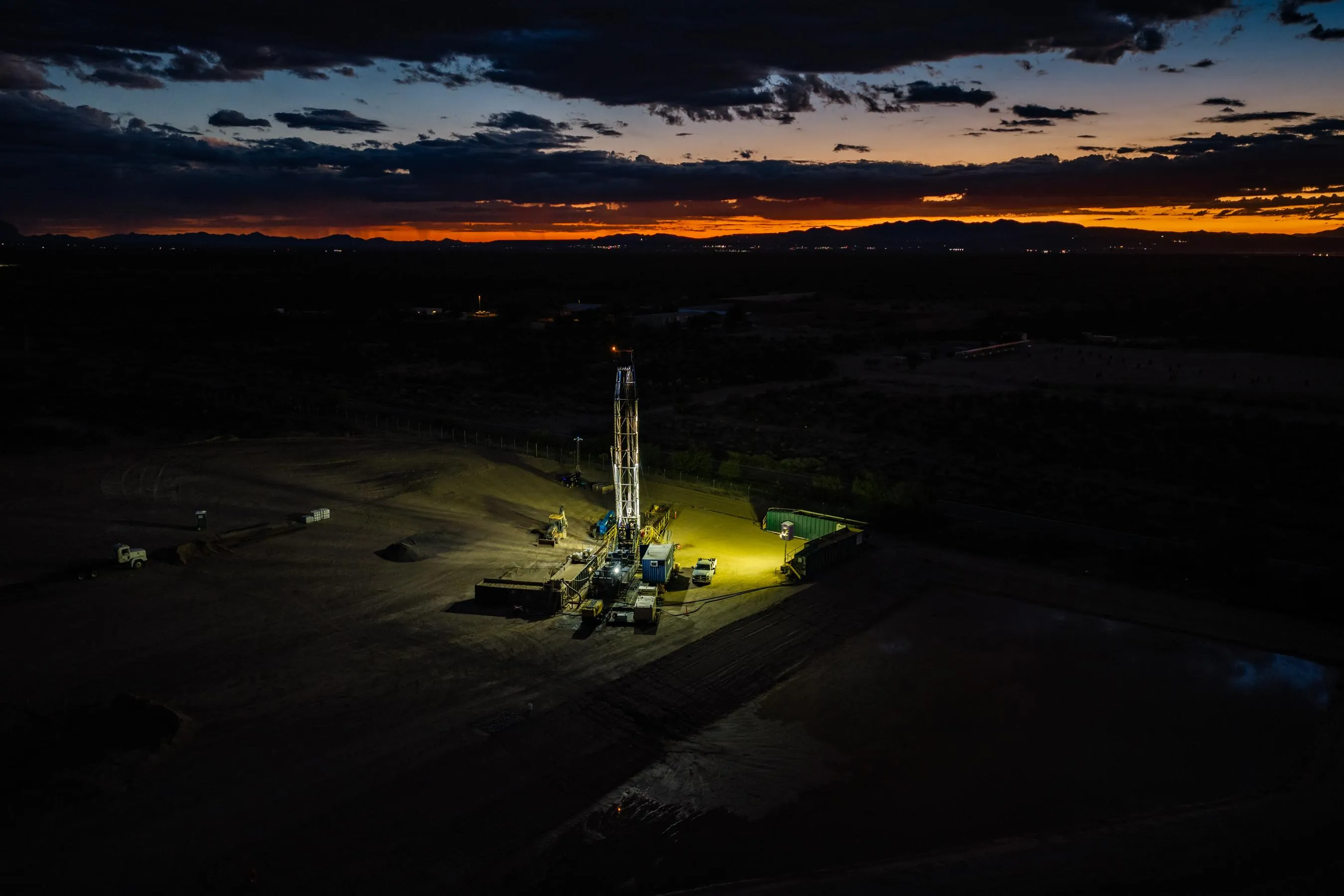
比尔表示,公司将出资修建一条管道,管道建成后,数据中心将使用再生水。(不过在那之前,它将依赖饮用水。)公司将出资清理受污染的水。它还会将多余的水注入当地含水层,最终使整个项目实现“水正效益”。这些说辞丝毫没有安抚住大约一千名听众,他们每隔几分钟就发出嘘声。
Beale said it would pay for a pipeline, and once the pipeline was built the data center would run on reclaimed water. (Until then, however, it would rely on potable water.) The company would pay to clean up contaminated water. It would inject any extra water into local aquifers, eventually making the whole thing “water-positive.”None of this mollified the thousand or so people in the audience, who booed every few minutes.
不出所料,反对意见主要集中在用水问题上。当地人担心,如果数据中心落户该镇,这一本就稀缺而珍贵的水资源将会消失。他们提到,亚利桑那州可能会失去更多科罗拉多河配额。他们脑海中浮现出更加炎热、更加干旱的夏天。“你能为子孙后代保证供水吗?”
To no one’s surprise, the opposition mostly came down to water. Locals worried that if the data center came to town, the resource, already so scarce and so precious, would vanish. They cited the fact that Arizona would likely lose more of its Colorado River allotment. They conjured images of even hotter, drier summers. “Can you guarantee us water for future generations?”
轮到梅拉妮·库利发言时,她描绘了一幅鲜有图森人熟悉的过往景象。库利是当地栖息地恢复非营利组织“流域管理集团”的教育专家。“我们现在坐的地方,125年前是一片森林,紧邻一条常年流淌的河流,”她说。“今天还活着的人中,有人就是在圣克鲁斯河里游泳长大的。”
When it was her turn to speak, Melanie Cooley, an education specialist at the Watershed Management Group, a local habitat restoration nonprofit, conjured up a past familiar to few Tucsonans. “Where we are sitting right now was a forest 125 years ago that adjoined a flowing river that flowed year-round,” she said. “There are people alive today who grew up swimming in the Santa Cruz River.”
库利说,图森现在的平均气温比一个世纪前高了11华氏度。其中约6华氏度的上升可以归因于全球变暖。库利解释说,另外5华氏度则是因为当地生态系统的变化,包括森林被砍伐以及圣克鲁斯河等河流干涸。“如今我们开车经过那条河时,它看起来就像一条又大又干的沟渠,我们把它当作正常现象,因为这种情况已经持续太久了。但这并不正常。这是一场灾难。这场灾难是由过度抽取地下水和糟糕的开发决策造成的,而‘蓝色项目’又是一个糟糕的开发决策。”
Average temperatures in Tucson are now 11 degrees Fahrenheit higher than they were a century ago, Cooley said. About six degrees of that rise can be attributed to global warming. The other five, Cooley explained, are because of changes in the local ecosystem, including the felling of forests and the drying up of rivers like the Santa Cruz. “What we see today when we drive across that river that looks like a big, dry ditch, we take it as normal because it’s been that way for so long. But it isn’t normal. It’s a catastrophe. It’s a catastrophe that was brought on by overpumping of our groundwater and bad development decisions, and Project Blue is another bad development decision.”
另一位发言者将“蓝色项目”比作过去几十年的工业项目。“这对我来说就像似曾相识,”他说,并列举了那些本应让这座城市改观的经济发展项目:雷神公司;其前身、军事承包商休斯公司;空军国民警卫队。“他们做了什么?他们污染了我们的水。直到今天,我们还得应对这个问题。”图森人曾竭尽全力节约用水。“我们拆掉了景观绿化,我们拆掉了游泳池。”
Another speaker compared Project Blue to industrial projects of decades past. “This is like déjà vu for me,” he said, listing off economic development projects that were supposed to turn things around for the city: Raytheon; Hughes, the military contractor that preceded it; the Air National Guard. “What did they do? They contaminated our water. To this day, we’re having to deal with that.”Tucsonans had gone to great lengths to conserve their water. “We took our landscaping out, we took our swimming pools out.”
他招手叫来一位用背带抱着婴儿的亲属。“你能保证我们子孙后代有水用吗?”他问比尔的代表们。“你能保证她这一代、我孩子这一代、我孙辈这一代,还有这个小婴儿这一代有水用吗?”
He waved over a relative who was holding an infant in a sling. “Can you guarantee us water for future generations?” he asked the Beale representatives. “Can you guarantee water for her generation, my kids’ generation, my grandkids’ generation, and this little baby’s generation?”
在这场充满争议的听证会结束两天后,图森市议会以全票通过,否决了该土地的并入案。在随后的一次会议上,该市通过了针对数据中心及其他大型用水户的新规则。居民们松了一口气,但这份宽慰并未持续太久。在市政府叫停并入案、实际上扼杀了该开发项目三周后,当地记者证实,比尔仍在推进数据中心建设。此前,县政府官员和比尔代表均表示,该交易以图森市将该土地并入为前提。
Two days after this contentious hearing, a unanimous vote by the Tucson City Council shut down the annexation of the land. At a subsequent meeting, the city adopted new rules for data centers and other large water users. Residents were relieved, but not for long. Three weeks after the city stopped the annexation, effectively killing the development, local reporters confirmed that Beale was moving forward with the data center anyway. County officials and Beale representatives had previously said that the deal was contingent on Tucson’s annexation of the land.

突然间,这不再是问题了。(比尔拒绝就为何不再需要并入置评。)随着时间的推移,该计划还进行了其他调整:数据中心将不再采用水冷,而是改用闭环风冷。如果这一转变是为了赢得比尔批评者的支持,那它失败了。“无沙漠数据中心联盟”成员声称,风冷设施消耗更多电力,而发电厂也需要用水冷却系统,因此风冷数据中心实际上可能更耗水,只是间接而已,比尔否认这一指控。
Suddenly that was no longer an issue. (Beale declined to comment on why annexation was no longer necessary for the deal.) Over time, there were other adjustments to the plan: The data center would no longer be water-cooled and would instead rely on closed-loop air cooling. If the shift was intended to win over Beale’s critics, it didn’t work. Members of the No Desert Data Center Coalition claim that air-cooled facilities use more electricity, and, since power plants also use water to cool their systems, air-cooled data centers may actually be more water-intensive, just indirectly, an allegation Beale denies.
“该项目采用风冷技术不会增加整体能耗;虽然能源分配方式不同,但能耗总量相同,”比尔发言人托尼·伯卡特告诉《The Verge》。(发电确实需要水,但关于亚利桑那州发电厂究竟消耗多少水,鲜有数据。)这一变动还让比尔失去了一名租户:据报道,亚马逊退出了该项目,称风冷设施无法满足其需求。比尔拒绝透露此后是否为“蓝色项目”找到了新租户。“何时宣布对项目的投资,取决于我们的租户,”伯卡特说。
“The use of air-cooled technology for this project does not increase overall energy use; while the energy allocation is different, the energy use is the same,” Beale spokesperson Tony Burkart, the Beale spokesperson, told The Verge . (Energy generation does require water, though there’s little data on just how much water Arizona’s power plants consume.) The change also cost Beale a tenant: Amazon reportedly pulled out of the project , saying an air-cooled facility wouldn’t meet its needs. Beale declined to disclose whether it has since found a new tenant for Project Blue. “It’s up to our tenants when they choose to announce their investment in a project,” Burkart said.
尽管如此,该项目仍在推进。县政府在圣诞夜与比尔完成了交易,比尔承诺将带来更多“礼物”,形式为1500万美元的捐款,其中部分将用于当地STEM和职业学校项目。新的一年带来了更多挑战。州总检察长就亚利桑那州公司委员会——监管公用事业的州机构——批准比尔与TEP之间的一项特殊能源协议一事提出上诉。无沙漠数据中心联盟的成员另案起诉,指控县政府与比尔的交易违反了该州的公开会议法。
Still, the project moved forward. The county completed its deal with Beale on Christmas Eve, and Beale promised to bring even more gifts in the form of $15 million in donations, some of which would go toward local STEM and trade school programs. The new year brought more challenges. The state’s attorney general filed an appeal against the Arizona Corporation Commission , the state agency that oversees public utilities, over its approval of a special energy agreement between Beale and TEP. Members of the No Desert Data Center Coalition filed a separate lawsuit alleging that the county’s dealings with Beale violated the state’s open meeting law.
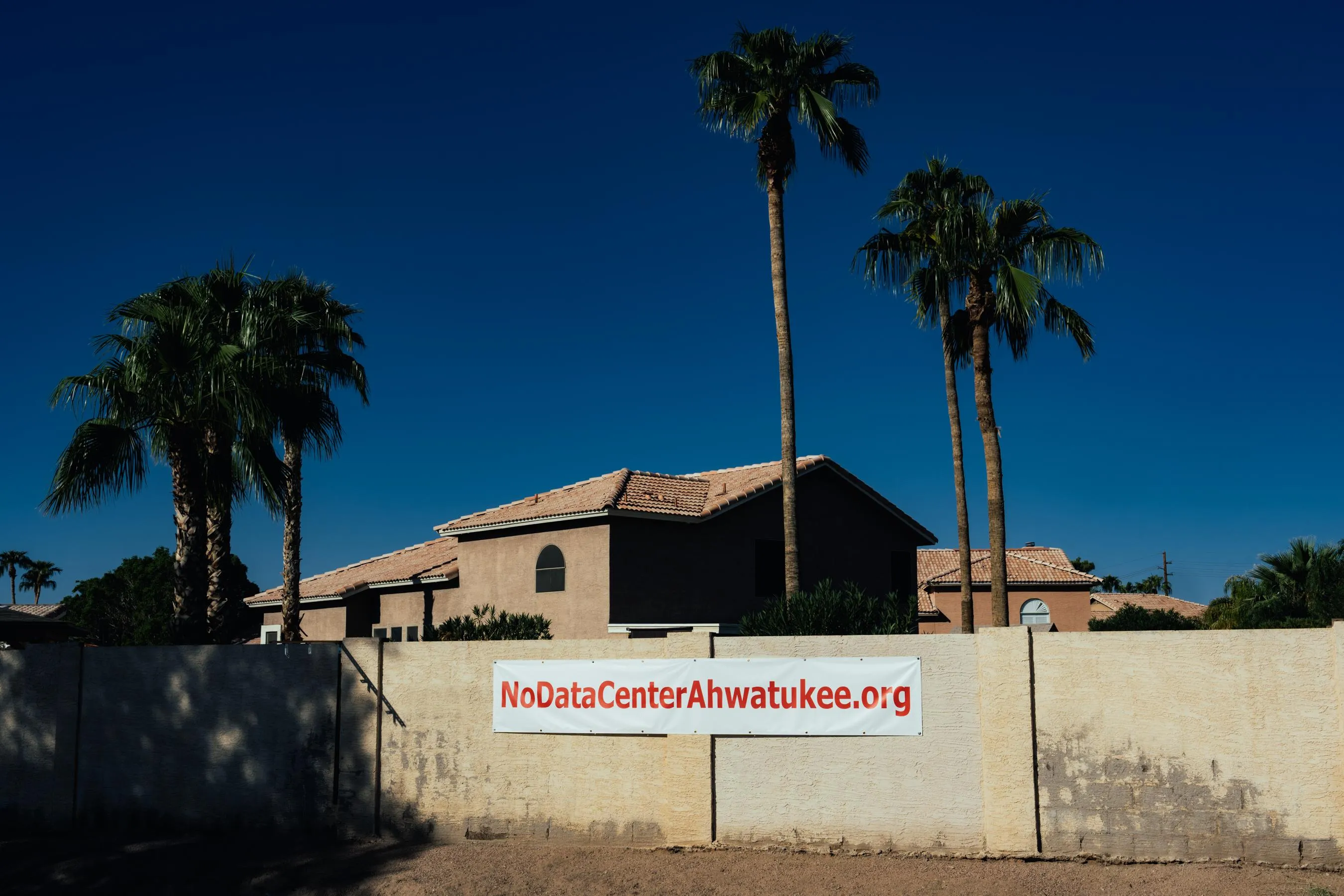
该联盟的诉讼被驳回,但数据中心的反对方找到了其他表达不满的途径。他们在拉扎勒斯与西尔文律师事务所的办公室内举行了一场抗议——该律所代表比尔公司处理其与县政府的往来事务。当施工队伍在现场破土动工时,数十人赶到现场,一边堵住车辆,一边高喊:“我们尊重工人,我们不尊重这项工程。”数据中心的反对者未能完全阻止施工,但设法拖慢了进度。
The coalition’s suit got tossed, but the data center’s opponents found other ways to voice their displeasure. They staged a protest inside the offices of Lazarus and Silvyn, the law firm representing Beale in its dealings with the county. When construction crews broke ground on the site, dozens of people were there, blocking vehicles while chanting, “We respect the workers, we don’t respect the work.”The data center’s opponents haven’t been able to stop construction altogether, but they’ve managed to slow it.
在“不要沙漠数据中心”组织的观察员发现艾姆斯建筑公司的承包商在使用市政所有的消防栓后,官员们要求比尔公司向市政府提供水权额度,以补充用于控制扬尘的约651,702加仑饮用水。(当地多项法令要求施工队伍喷水,以减轻扬尘造成的空气污染。)比尔公司发言人伯卡特表示,承包商“遵循了标准程序,市政府也按正常业务流程为其签发了临时用水许可。”
After observers affiliated with No Desert Data Center noticed that contractors with Ames Construction were using city-owned hydrants , officials demanded that Beale give the city water credits to replenish the approximately 651,702 gallons of drinking water used for dust control. (A host of local ordinances require construction crews to spray water to mitigate the air pollution caused by blowing dust.) Burkart, the Beale spokesperson, said the contractor “followed standard procedures and the City issued a permit for temporary water per the normal course of business.”
在艾姆斯公司停止使用市政供水后,皮马县环境质量部的官员又两次认定承包商违反了其“扬尘排放许可”,每次违规最高可处以1万美元罚款。而当艾姆斯公司转而向图森市一家绿色废弃物处理设施取水时,抗议者用大量电话轰炸该分包商,直到其所有者取消了合同。
After Ames stopped using city water, officials with the Pima County Department of Environmental Quality also found the contractors in violation of their “fugitive dust permit” on two separate occasions , each of which could carry a fine of up to $10,000. And when Ames turned to a Tucson green waste facility for water, protesters flooded the subcontractor with phone calls until its owner dropped the contract.
然而,这些基层反对都不足以真正阻止蓝色项目。为便于施工,亚利桑那州水资源部批准了一项在场地建设两口水井的请求,允许该设施每年抽取多达3100万加仑地下水。伯卡特表示,这部分水仅用于施工。伯卡特称,一旦数据中心投入运营,用水量“将限于日常家庭用途,例如洗手间、员工厨房以及健康和安全方面”。
None of this grassroots opposition, however, has been enough to actually stop Project Blue. To facilitate construction, the Arizona Department of Water approved a request to build two wells on the site, allowing the facility to draw up 31 million gallons of groundwater a year. Burkart said this water will only be used for construction. Once the data center is up and running, Burkart said, water use “will be limited to ordinary domestic purposes, such as restrooms, employee kitchens and health and safety.”
一些地方领导人此后致力于重建社区信任。在8月一次争议性会议之后,图森市议会实施了新的、严格的数据中心限制,使其成为该市受监管最严格的开发项目之一。但居民要求更多,并发誓将继续出席,直到获得全面禁令。即使县政府近来也出人意料地持开放态度。9月,皮马县监事会对新数据中心项目实施了为期120天的暂停令。
Some local leaders have since worked to regain the community’s trust. After a contentious meeting in August, the Tucson City Council implemented new, stringent limits on data centers , making them one of the most regulated developments in the city. But residents want more, and they’ve vowed to keep showing up until they get a full ban. Even the county government has been surprisingly amenable of late. In September, the Pima County Board of Supervisors imposed a 120-day moratorium on new data center projects.
但这并不意味着其他开发项目已被排除。3月,该县宣布将把贝尔土地出售部分收益用于聘请一名经济开发人员。该职位年薪15万美元,目标是将外国直接投资引入图森。看来,这座城市正在寻找属于自己的克里斯汀·麦凯——也许还会有一家台积电。
But that doesn’t mean other developments are off the table. In March, the county announced it would be putting some of the proceeds of the Beale land sale toward hiring an economic developer. The goal of the job, which comes with an annual salary of $150,000, would be to bring foreign direct investments to Tucson. The city, it seems, is looking for a Christine Mackay of its own — and maybe a TSMC, too.
丽贝卡·陈在大多数亚利桑那人之前就已深知台积电的前景。她自2015年起一直居住在凤凰城,2019年开始从事房地产经纪人工作,正值台积电进驻前夕。“台积电对很多美国人来说可能不是什么家喻户晓的大名,但对亚洲人来说却是,”陈说。“对台湾人来说,台积电基本上就像苹果或特斯拉。”新冠疫情让整个行业陷入狂热:大多被困在家中的美国人渴望空间与阳光,纷纷涌向阳光地带,亚利桑那州也不例外。
Rebecca Chen understood the promise of TSMC well before most other Arizonans. A Phoenix resident since 2015, she started working as a Realtor in 2019, just before the company arrived. “TSMC may not be a huge household name for a lot of Americans, but it is for Asians,” Chen said. “TSMC is basically like Apple or Tesla for Taiwanese.”The covid-19 pandemic sent the industry into a frenzy: Americans, largely confined to their homes, wanted space and sunshine and relocated to the Sun Belt in droves, and Arizona was no exception.
不过,陈知道,这与台积电将带来的影响相比,根本不算什么。她通过一位加州的行业朋友结识了第一位台湾客户,随后推荐客源便络绎不绝。她为客户进行线上看房,通过视频通话展示房屋;一些台积电员工甚至未见实地就购买了房子。
Still, Chen knew this was nothing compared to what TSMC would bring. She was introduced to her first Taiwanese client by an industry friend in California, and soon the referrals were piling up. She sold homes virtually, showing them to clients via video call; some TSMC workers bought houses sight unseen.
“我觉得自己远不止是一名房地产经纪人,”陈告诉我。“我更像是他们的向导。”她帮助客户办理水电账单、办理驾照,并推荐餐饮和购物场所。“我自己也是移民,”她解释道,所以她深知在一个新地方安顿下来有多难。亚利桑那州的台湾移民来到美国冒了很大的风险,在极端的本土主义反弹时期,将未来押在一个陌生地方的新项目上。这是一次信仰的飞跃,而且看起来已经取得了成功。
“I feel like I’m way more than a Realtor,” Chen told me. “I’m like a guide to them.”She’s helped clients set up utility bills, get their driver’s licenses, recommended places to eat and shop. “I’m an immigrant myself,” she explained, so she knows how hard it can be to feel settled in a new place. Arizona’s Taiwanese immigrants have risked a lot in coming to America, staking their futures on a new project in an unknown place at a time of extreme nativist backlash. It’s a leap of faith, and it appears to have worked out.
台积电在亚利桑那州的存在,让一种一些人以为已经在美国消失的生活方式重获新生:夫妻中的一方(通常是男性)在工厂工作,收入足以养家,生活富裕。可以将其视为上世纪中叶理想生活的新变奏——由工业制造支撑的郊区田园生活,只是多了一层全球化色彩。
TSMC’s presence in Arizona has revived a way of life some thought had vanished in America: a prosperous household where one partner (usually male) works at a factory and earns enough to support a family. Think of it as the midcentury ideal with a new global twist, suburban idyll propped up by industrial manufacturing.
据台积电发言人威廉·莫斯介绍,台积电目前在亚利桑那州拥有超过3500名员工。莫斯表示,公司不披露外籍员工的人数,因为这一数字会随项目情况而波动。
TSMC now has more than 3,500 employees in Arizona, according to spokesperson William Moss, who said the company doesn’t disclose the number of international workers it has, which can fluctuate depending on the project.

此前有报道称,在台积电一座晶圆厂的2200名员工中,约有一半来自台湾。尽管如此,不可否认的是,台积电在亚利桑那州的存在已带动台湾移民涌入凤凰城都会区——而与此同时,特朗普政府正在对合法移民发起全面打击。
Early reports claimed that about half of TSMC’s 2,200 employees at a single fab were from Taiwan. Still, it’s undeniable that TSMC’s presence in Arizona has led to an influx of Taiwanese immigrants in the Phoenix metro area — all while the Trump administration wages a full-fledged attack on legal immigration.
台积电目前正致力于培养本地人才。5月,该公司宣布将在亚利桑那州立大学启动一项半导体技术员培训项目。该校最近还加入了白宫一项旨在壮大美国制造业劳动力队伍的倡议。
TSMC is now working to cultivate local talent. In May, the company announced it was starting a semiconductor technician training program at Arizona State University, and the university recently signed on to a White House initiative to build up America’s manufacturing workforce.
作为合作的一部分,亚利桑那州立大学将开办一所“晶圆厂学校”,由来自日本、韩国、印度和台湾的专家授课。
As part of the partnership, ASU will organize a “Foundry School” taught by experts from Japan, South Korea, India, and Taiwan.
亚利桑那州不断壮大的台湾人社区催生了新商机,进一步提振了当地经济。北凤凰城如今有了“小台北”。餐厅纷纷开业以满足这些新亚利桑那人的需求,其中一些正是新来者自己开的。似乎一夜之间冒出的建筑为他们提供住所。像陈这样的说普通话的房地产经纪人找到了一个利润丰厚的细分市场,把新建的豪华住宅卖给收入丰厚的科技从业者,包括台积电供应商的员工。
New businesses have popped up to cater to Arizona’s growing Taiwanese community, further bolstering the local economy. North Phoenix now has a Little Taipei . Restaurants have opened to cater to these new Arizonans, some opened by the newcomers themselves. Buildings have popped up seemingly overnight to house them. Mandarin-speaking real estate agents like Chen have found a lucrative niche selling luxe new-build homes to well-compensated tech workers, including employees of TSMC suppliers.
该州在其非官方日历上新增了一个节日:10月10日,即“双十节”,纪念推翻清朝的起义。凤凰城现在拥有北美规模最大的双十庆祝活动。每年,数千名观众都会对台积电赞助的无人机表演发出阵阵惊叹。中华航空于2025年开始提供凤凰城与台北之间的直飞航班。台湾星宇航空很快也跟进。我入住的那家希尔顿花园酒店距离台积电园区仅10分钟路程,早餐供应粥。斯科茨代尔现在有了一家鼎泰丰。订位很难。“我们称之为一加仑水的经济价值。”
The state has added a new holiday to its unofficial calendar: October 10th, or Double Ten Day, a commemoration of the uprising that felled the Qing dynasty. Phoenix is now home to the largest Double Ten celebration in North America. Each year, thousands of spectators ooh and aah at a drone show sponsored by TSMC. China Airlines started offering direct flights between Phoenix and Taipei in 2025. Taiwan’s Starlux Airlines soon followed suit. The Hilton Garden Inn I stayed in, located just 10 minutes from the TSMC campus, served congee for breakfast. Scottsdale now has a Din Tai Fung. Reservations are hard to get. “We call it the economic value of a gallon of water.”
其中一些变化是自然发生的,另一些则源于精心规划。经济发展官员麦凯告诉我,当地连锁超市Fry’s主动联系她的办公室,询问货架上可以上架哪些台湾顾客可能想要的产品。麦凯安排了Fry’s与台积电的会面,还安排了另一场会面,对象是一位与州交通部合作的台湾律师,以确保台湾移民的驾照在亚利桑那州有效。麦凯的办公室与成立于1972年的非营利组织“凤凰城姐妹城市”合作,组建了一支由说普通话的医生和护士组成的团队,用台湾移民的母语为他们提供服务。
Some of these changes happened organically; others resulted from meticulous planning. Mackay, the economic developer, told me that the local grocery chain Fry’s reached out to her office to ask what products Taiwanese customers might want to see on its shelves. Mackay set up a meeting between Fry’s and TSMC, and she set up another with a Taiwanese attorney who worked with the state Department of Transportation to ensure Taiwanese immigrants’ driver’s licenses would be valid in Arizona. Working along Phoenix Sister Cities, a nonprofit that started in 1972, Mackay’s office put together a team of Mandarin-speaking doctors and nurses to serve Taiwanese immigrants in their native language.
凤凰城与台北自1979年起结为姐妹城市,这一称号直到最近主要具有象征意义。正如所有姐妹城市关系一样,双方也曾发生过冲突,其中一些涉及共享资源。考虑到该行业的需求以及该州历史性的干旱,批评者质疑:在沙漠腹地建设耗水大户工厂明智吗?
Phoenix and Taipei have been sister cities since 1979, a designation that, until recently, was largely ceremonial. As is the case in all sororal relationships, there have been conflicts, some of them over shared resources. Given the industry’s demands and the state’s historic drought, critics ask, is it wise to build water-guzzling factories in the middle of the desert?
台积电因用水问题遭到的抵制远不如数据中心那么强烈,但半导体制造仍需要海量用水,且水质必须达到特定等级——不含有机或无机污染物,矿物质含量极低,实际上不建供人类饮用。亚利桑那州立大学全球水技术中心主任保罗·韦斯特霍夫告诉我,生产一加仑超纯水需要1.4至1.6加仑市政用水,因为过程中难免会有蒸发损失。
TSMC hasn’t faced nearly as much pushback for its water use as data centers have, but semiconductor manufacturing nonetheless requires massive amounts of water, and this water must be of a specific grade — free of contaminants organic or otherwise, and so devoid of minerals that it’s actually not recommended for human consumption. It takes 1.4 to 1.6 gallons of municipal water to create a single gallon of ultrapure water, since some is inevitably lost to evaporation in the process. Each chip requires 50 to 250 wash cycles, Paul Westerhoff, the director of ASU’s Global Center for Water Technology, told me.
韦斯特霍夫说,每颗芯片需要50至250次清洗循环。“如果里面有一点颗粒,或者像氯离子这样的离子,芯片就不工作,”韦斯特霍夫说,“所以他们在每个清洗循环中都需要使用大量水。”这一工艺每天需要475万加仑水,台积电通过凤凰城市政供水系统获取。《亚利桑那共和国报》报道,台积电主要使用再生废水,也使用一些地下水。
“If there’s a little particle in there, or an ion-like chloride in there, the thing doesn’t work,” Westerhoff said, “so they need to use a lot of water in each of these cleaning cycles.”This process requires 4.75 million gallons of water each day, which TSMC obtains through Phoenix’s municipal water supply. The Arizona Republic reports that TSMC mostly uses reclaimed wastewater, with some groundwater as well.
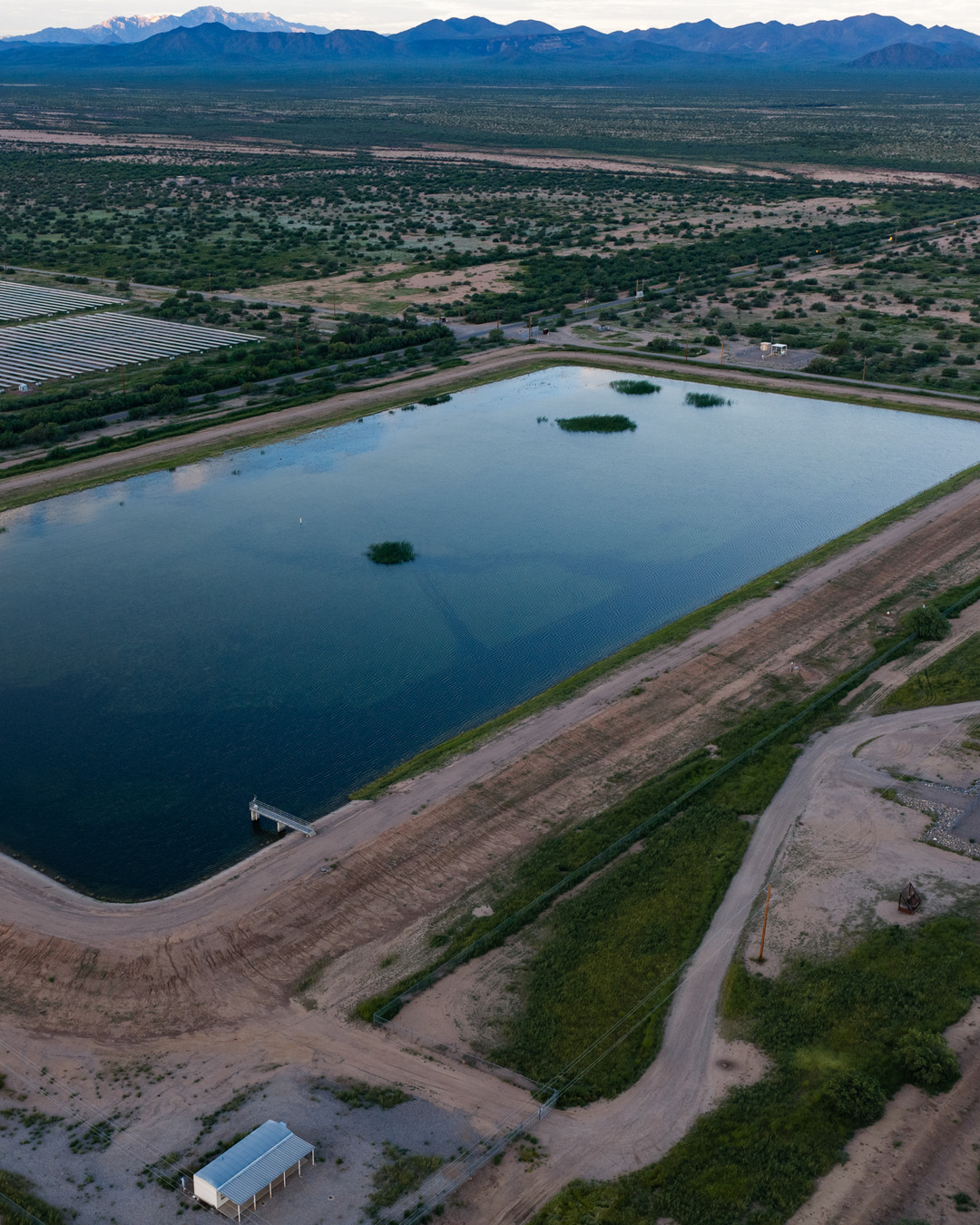
韦斯特霍夫将半导体制造过程比作洗碗。正如你不会把洗碗池里的脏水再用来洗第二轮锅碗瓢盆,芯片制造商也不能把脏水再用来清洗其他芯片。但这水并非完全浪费了。“如果你想重复利用洗碗水,也许可以把它倒在草坪上,”韦斯特霍夫说。他解释说,台积电用其回收水的 20% 左右来驱动蒸发冷却系统。韦斯特霍夫的部分职责是为台积电寻找利用多余废水的新途径——希望有一天能将其用于芯片制造工艺本身。
Westerhoff compared the process of semiconductor manufacturing to washing dishes. And just like you wouldn’t reuse your sink water to wash a second round of pots and pans, chip manufacturers can’t reuse their dirty water to wash other chips. But this water isn’t totally lost. “If you want to reuse sink water, maybe you throw it out on your lawn,” Westerhoff said. He explained that TSMC uses 20 percent or so of its recycled water to power its evaporative cooling systems. Part of Westerhoff’s role is to figure out new ways for TSMC to use its excess wastewater — hopefully, someday, as part of the chip manufacturing process itself.
亚利桑那州立大学凯尔水政策中心主任莎拉·波特解释说,虽然台积电用水的 15% 到 20% 因蒸发而损失,但其余大部分在公司的回收厂得到处理。据波特称,台积电回收了流经其亚利桑那州首座晶圆厂的 60% 到 65% 的水,并计划到 2028 年实现 90% 的再利用率。为达成这一目标,台积电正在建设一座厂内回收设施。不过,最终目标是弄清如何在制造工艺中使用再生水。韦斯特霍夫称这是“圣杯”。“说到半导体制造,那与高尔夫球场等截然不同。”
Sarah Porter, the director of ASU’s Kyl Center for Water Policy, explained that while 15 to 20 percent of the water TSMC uses is lost to evaporation, much of the rest is processed in the company’s recycling plant. According to Porter, TSMC recycles 60 to 65 percent of the water that flows through its first Arizona fab and is planning for 90 percent reuse by 2028. To get there, TSMC is building an on-site reclamation facility. The ultimate goal, however, is to figure out how to use reclaimed water in the manufacturing process. Westerhoff has called this the “holy grail.”“When we’re talking about semiconductor manufacturing, that’s very different from, say, a golf course.”
台积电能回收其消耗的大部分水,这使其区别于该州的一些传统产业。即使台积电将来用水量超过亚利桑那州一些更传统的企业,该地区的领导人也认为这种权衡非常值得。“我们称之为每加仑水的经济价值,”麦凯告诉我。“这一加仑水可以为该地区创造巨大价值,也可以毫无作为。”在麦凯看来,台积电不仅物有所值,更是功德无量。
The fact that TSMC can recycle most of the water it consumes differentiates it from some of the state’s traditional industries. And even if TSMC were to someday use more water than some of Arizona’s more conventional enterprises, the region’s leaders say the tradeoff would be well worth it. “We call it the economic value of a gallon of water,” Mackay told me. “That gallon of water can do a huge amount for the region, or it can do nothing for the region.”In Mackay’s estimation, TSMC has earned its keep and then some.
台积电带来了整个产业链。据麦凯介绍,目前已有55家台积电供应商在亚利桑那州落户,更多供应商正在赶来。与台积电合作紧密的台湾材料整合商崇越科技于2022年在凤凰城设立据点,在台积电首座晶圆厂投产前,该据点已亏损运营多年。台湾石化厂商长春集团如今在卡萨格兰德生产电子级过氧化氢,该市人口约7万,位于凤凰城和图森中间。
TSMC brought with it an entire industry. So far, 55 TSMC suppliers have set up shop in Arizona, as per Mackay, and more are on their way. Topco Scientific, a Taiwanese materials integrator that works closely with TSMC, opened an outpost in Phoenix in 2022, operating at a loss for years until TSMC’s first fab was up and running. Chang Chun, a Taiwanese petrochemical firm, now manufactures electronic-grade hydrogen peroxide in Casa Grande, a city of some 70,000 people halfway between Phoenix and Tucson.
常驻凤凰城的房地产经纪人陈瑞贝卡(Rebecca Chen,音译)已转战商业和工业地产市场,她表示该市场比以往任何时候都火热。另一家供应商应用材料去年秋天在亚利桑那州立大学(ASU)开设了一座耗资2.7亿美元的研发设施。新建项目正在陆续展开,许多都集中在台积电不断扩建的园区周边。其中包括“Halo Vista”项目,这是一个由纽约一家房地产公司开发的耗资70亿美元、占地2300英亩的总体规划社区。
Rebecca Chen, the Phoenix-based real estate agent, has moved into the commercial and industrial market, which she said is hotter than ever. Applied Materials, another supplier, opened a $270 million research and development facility at ASU last fall. New construction projects are underway, many of them clustered around TSMC’s growing campus. Among them is Halo Vista, a $7 billion, 2,300-acre master-planned community developed by a New York real estate firm .
生意兴隆。台积电报告称,其亚利桑那州工厂2025年实现利润5.14亿美元,这是其投产后的首个完整年度。过去十年间,凤凰城都会区平均时薪从22.85美元攀升至33.48美元,增幅跑赢通胀。
Business is booming. TSMC reported $514 million in profit at its Arizona site in 2025, its first full year of production. And the average hourly wage in the Phoenix metro area climbed to $33.48 from $22.85 a decade earlier, outpacing inflation.
台积电园区九天的用水量超过“蓝色计划”预计全年的用水量,但台积电以数据中心无法比拟的方式带动了州经济。数据中心开发商过去向地方政府推销项目时,常强调其不创造太多长期就业岗位;社区能获得基础设施和税收,却避免了人口快速增长带来的拥堵。但现在,在AI高管们连年警告其构建的产品可能让入门级工作化为乌有——甚至可能引发真正的末日——之后,更多社区开始把数据中心视为两败俱伤的选择。
The TSMC complex uses more water in nine days than Project Blue is expected to consume in a year, but TSMC has also boosted the state economy in a way no data center could. Data center developers used to pitch the projects to local governments by emphasizing the fact that they don’t create many permanent jobs; communities would get infrastructure and tax revenue but none of the congestion that comes with rapid population growth. But now, after years of AI executives warning that the product they’re building could vaporize entry-level work — and potentially cause a literal apocalypse — more communities see data centers as a lose-lose proposition.
台积电的芯片让生成式AI热潮成为可能,但与数据中心和AI本身不同,芯片制造真正创造了就业岗位。
TSMC’s chips make the generative AI boom possible, but unlike data centers and AI itself, they actually create jobs.
“当我们谈论半导体制造时,这与比如说高尔夫球场大不相同,”波特说。事实上,亚利桑那州的高尔夫球场历史上用水量远超州政府允许的限额,其中大部分水源来自正在迅速枯竭的科罗拉多河。《亚利桑那共和国报》的一项调查发现,该州高尔夫球场在2002年至2022年间每年消耗近390亿加仑水。“那部分水,”波特补充道,“并非再生水。”
“When we’re talking about semiconductor manufacturing, that’s very different from, say, a golf course,” Porter said. Arizona’s golf courses, in fact, have historically used far more water than the state allows, much of it sourced from the rapidly drying Colorado River. An investigation by The Arizona Republic found that the state’s golf courses consumed nearly 39 billion gallons each year between 2002 and 2022. “That water,” Porter added, “is not reclaimed.”
台积电每年可用水高达17亿加仑,其中大部分被回收利用,而亚利桑那州活跃管理区内的高尔夫俱乐部和球场仅在2020年一年就消耗了超过410亿加仑水——这些水大多因蒸发而流失。即便如此,高尔夫球场仅占亚利桑那州总用水量的2%,或市政用水量的9%。就总体用水而言,果岭和半导体制造商,用一个贴切的说法来说,都只是九牛一毛。
Where TSMC can go through as much as 1.7 billion gallons of water a year, much of which is recycled, golf clubs and courses in Arizona’s active management areas consumed upwards of 41 billion gallons of water in 2020 alone — and that water is largely lost to evaporation. And still, golf courses use just 2 percent of Arizona’s water, or 9 percent of water in municipal areas. When it comes to overall water use, putting greens and semiconductor manufacturers are, to use an apt turn of phrase, a drop in the bucket.
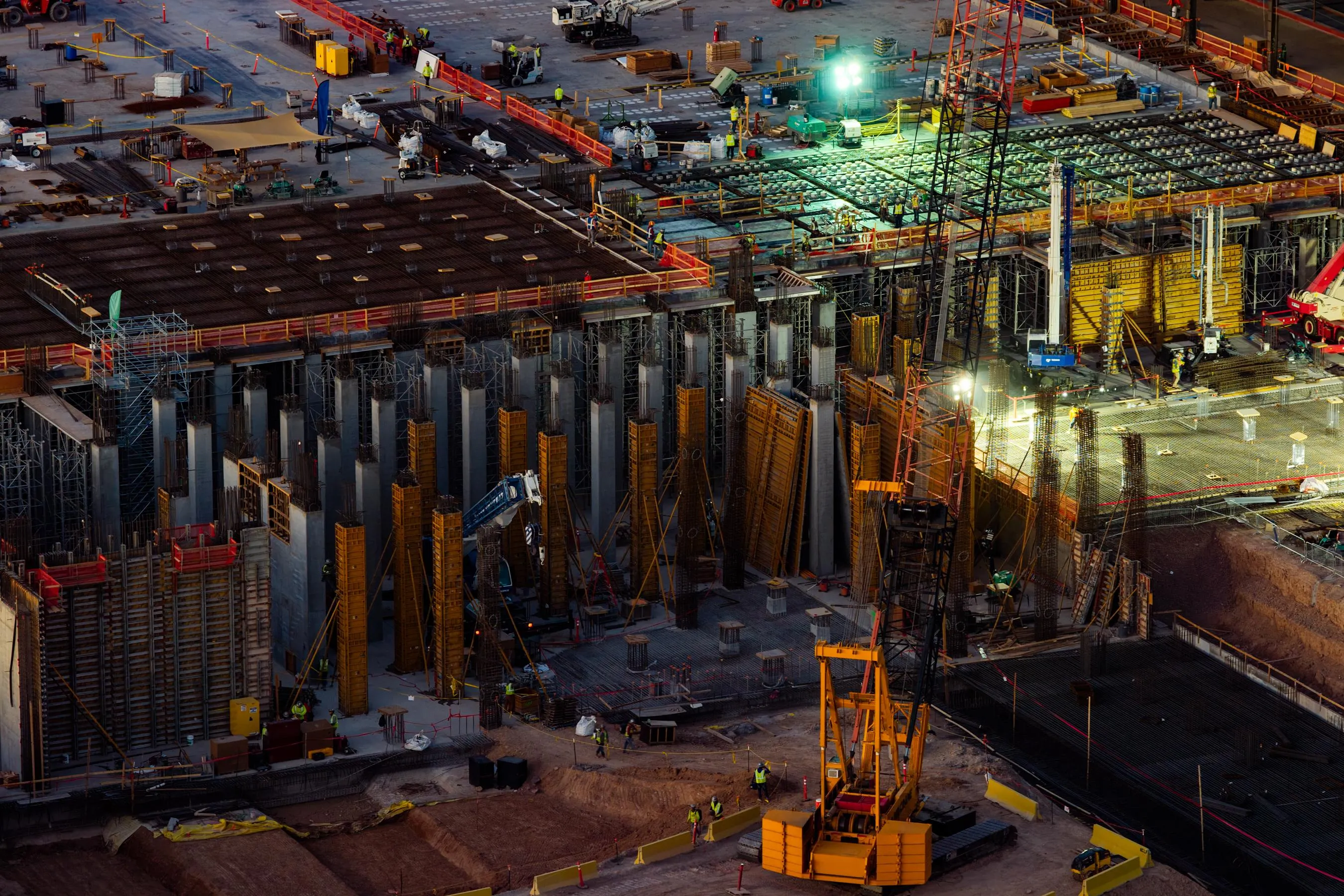
但半导体制造的批评者表示,该行业用水量只是问题的一部分。“水质问题和水量问题——或者说用水和水污染问题——是两回事,”芯片社区联合组织的联盟主任朱迪思·巴里什告诉我。该联盟主要由劳工和环保团体组成,成立于《芯片与科学法案》出台之后,该法案为国内半导体制造拨款527亿美元。其目标是确保社区而非企业从科技繁荣中获益。
But critics of semiconductor manufacturing say that the amount of water the industry uses is just part of the problem. “There’s water quality, and there’s water quantity — or water use and water contamination,” Judith Barish, the coalition director of CHIPS Communities United, told me. The coalition, made up largely of labor and environmental groups, was founded in the wake of the CHIPS and Science Act, which designated $52.7 billion in funding for domestic semiconductor manufacturing. Its goal is to ensure that communities, not corporations, reap the benefits of the tech boom.
半导体制造涉及使用数百种不同的全氟和多氟烷基物质,即PFAS,这些物质通常被称为“永久化学品”,因为它们不会自然降解。这些化学品的持久性意味着它们在制造过程中不会被降解,而制造过程可能涉及数百甚至数千个步骤。但正是使PFAS对芯片制造如此不可或缺的特性,也使它们对人类如此危险。一些研究人员将“永久化学品”与肝肾问题、高胆固醇、出生缺陷以及多种癌症联系起来。
Semiconductor manufacturing involves the use of hundreds of different per- and polyfluoroalkyl substances, or PFAS, which are commonly referred to as forever chemicals because they don’t naturally break down. The durability of these chemicals means they won’t be degraded during the manufacturing process, which can involve hundreds or even thousands of steps. But the qualities that make PFAS so essential to chipmaking are precisely what make them so dangerous to people. Some researchers have linked forever chemicals to liver and kidney issues, high cholesterol, birth defects, and various cancers.
“永久化学品”的使用并不局限于芯片制造,也不局限于广义的科技行业——PFAS已被发现存在于不粘锅、牙线、洗发水、经期护理产品、食品包装,甚至食物本身中——但半导体行业因其制造工艺的特性,使用了大量对人体健康有害的化学品。
The use of forever chemicals isn’t limited to chip manufacturing, or to the tech industry writ large — PFAS have been found in nonstick pans, dental floss, shampoo, menstrual care products, food packaging, and even food itself — but the semiconductor industry, by nature of the manufacturing process, uses a significant amount of chemicals that are detrimental to human health.
一些研究人员将芯片制造与甲状腺和肝脏疾病、生育问题以及癌症联系起来——这一结果尤其具有讽刺意味,考虑到AI鼓吹者声称该技术将在我们有生之年治愈癌症。在80年代制造业鼎盛时期,在芯片厂工作的女性流产的可能性是未在芯片厂工作的女性的两倍,她们的孩子也更容易出现出生缺陷。而且,由于半导体制造的每个步骤都需要数千加仑的水,这些化学品最终会变成液体废物。
Some researchers have linked chip manufacturing to thyroid and liver diseases, fertility problems, and cancer — an especially ironic outcome, given AI boosters’ claims that the technology will cure cancer within our lifetimes. Women who worked in chip fabs during the ’80s manufacturing heyday were twice as likely to suffer miscarriages than women who didn’t, and their children were also more likely to experience birth defects. And because each step of semiconductor manufacturing requires thousands of gallons of water, these chemicals ultimately become liquid waste.
单个芯片厂每天可产生数万至数十万加仑的废水,一位双分子研究人员将其排放物描述为一种名副其实的“永久化学品汤”。
A single fab can produce tens or hundreds of thousands of gallons of wastewater a day, discharge one bimolecular researcher described as a veritable “soup” of forever chemicals.
传统废水处理方法往往无法检测出“永久性化学物质”,而且大多数半导体制造商并不被要求监测或检测PFAS(全氟和多氟烷基物质)。更棘手的是,芯片工厂使用的确切化学配方属于严守的商业机密。但台积电表示,已“持续优化”其内部PFAS检测系统,并正在开发从废水流中去除PFAS的技术。该公司还表示,正在研究如何以及何时能在制造工艺中使用非PFAS替代品。
Traditional wastewater treatment methods often fail to detect forever chemicals, and most semiconductor manufacturers aren’t required to monitor or test for PFAS. Compounding the problem, the exact chemical cocktails used in chip fabs are closely guarded trade secrets. But TSMC says it has “continuously optimized” its in-house PFAS detection systems and is developing technologies to remove PFAS from its wastewater streams. The company also says it’s studying how and when it can use non-PFAS alternatives in the manufacturing process.
波特指出,与图森不同——那里的地下水因军事基地和制造业而受到污染——凤凰城没有太大的PFAS问题,市领导有意维持这一现状。波特说,凤凰城要求台积电在将水排回市政废水系统前进行处理。而且亚利桑那州所有城市都必须遵守环境保护局(EPA)制定的标准。
And Porter pointed out that unlike Tucson, where groundwater has been contaminated by military bases and manufacturing, Phoenix doesn’t have much of a PFAS problem, and city leaders are interested in keeping it that way. Phoenix requires TSMC to treat its water before putting it back into the municipal wastewater system, Porter said. And all Arizona cities are required to comply with standards set by the Environmental Protection Agency.
尽管如此,对于巴里什等组织者来说,废水处置仍是一个担忧。虽然台积电和其他芯片制造商必须遵守城市和EPA的标准,但唐纳德·特朗普自重返白宫以来,已大幅削弱EPA职能,并放宽了饮用水中PFAS的限制。但对芯片制造商的让步在很大程度上是两党共同推动的。《在美国建设芯片法案》——由参议员马克·凯利(民主党-亚利桑那州)发起,并由总统乔·拜登签署成为法律——豁免了半导体制造业的关键环境审查。
Still, for organizers like Barish, wastewater disposal remains a concern. While TSMC and other chip manufacturers have to comply with city and EPA standards, Donald Trump has largely defanged the EPA and eased restrictions on PFAS in drinking water since returning to office. But concessions for chip manufacturers have been largely bipartisan. The Building Chips in America Act — sponsored by Sen. Mark Kelly (D-AZ) and signed into law by President Joe Biden — exempted semiconductor manufacturing from key environmental review.
亚利桑那州民竭尽全力减少用水量,并致力于扭转几十年来工业污染对图森及周边社区地下水造成的污染。即便如此,专家表示,由全氟和多氟烷基物质(PFAS)造成的污染可能需要数代人才能清理干净。随着该州经济日益与科技产业挂钩——科技产业不仅消耗大量水资源,还会产生工业废物——一些居民担心亚利桑那州将变得更加干旱,而工业发展的承诺正在加剧干旱。
Arizonans have gone to great lengths to reduce their water consumption and to roll back the industrial pollution that has tainted groundwater in Tucson and surrounding communities for decades. Still, experts say the mess caused by PFAS could take generations to clean up . And as the state’s economy becomes increasingly tied to tech — which not only uses huge amounts of water but also produces industrial waste — some residents fear an even more parched Arizona, a drought exacerbated by the promise of industry.
罪魁祸首并非人口增长或重工业,至少不是大多数人所理解的那种方式。罪魁祸首是农业。
The culprit there isn’t population growth or heavy industry, at least not in the way most people think of it. It’s agriculture
亚利桑那州历史性的特大干旱早在科技产业在大峡谷州站稳脚跟之前就已酝酿成形。这是一个近乎荒诞的简单供需问题,其后果却复杂且仍充满不确定性。落基山脉夏季愈发炎热干燥,导致科罗拉多河——亚利桑那州超过三分之一水源的来源——水量枯竭。与此同时,亚利桑那州的含水层枯竭速度远超其补给速度。后者是需求端问题,前者是供给端问题。两者叠加,酿成了一场酝酿百余年的危机。
Arizona’s historic megadrought was set in motion well before any part of the tech industry gained a foothold in the Grand Canyon State. It’s an almost cartoonishly simple issue of supply and demand, one whose consequences are complex and still uncertain. Hotter and drier summers in the Rocky Mountains are drying up the Colorado River, the source of more than one-third of Arizona’s water. At the same time, Arizona’s aquifers are being drained far faster than they can be replenished. The latter is a problem of demand, the former one of supply. Together, they add up to a crisis over a century in the making.
1922 年的《科罗拉多河协定》——这份决定如何向七个州分配河水的协议——同时高估了长期水供应,低估了需求。1922 年的立法者无法预见到本世纪中叶的人口爆炸式增长,也无法预见到气候变化的严重程度。但仅凭这一点无法解释亚利桑那州当前的水资源困境。还有亚利桑那州地下水层枯竭的问题。罪魁祸首并非人口增长或重工业,至少不是大多数人所理解的那种方式。
The 1922 Colorado River Compact — the agreement that determines how much of the river’s water to allocate to seven states — simultaneously overestimated the long-term supply of water and underestimated the demand. Legislators in 1922 could not have foreseen the midcentury population boom or the severity of climate change. But this alone does not explain Arizona’s current water woes. There’s also the matter of Arizona’s dwindling aquifers. The culprit there isn’t population growth or heavy industry, at least not in the way most people think of it.
而是农业,它本身就是一种开采式、高度工业化的过程。亚利桑那州如今被浪漫化的“五大支柱产业”很大程度上是从外地引入的,它们继续消耗的水量远超普通观察者的想象或预期。没有水——大量的水——就无法在沙漠里种植棉花和柑橘,也无法养牛。
It’s agriculture, an extractive, hyperindustrialized process unto itself. Arizona’s now romanticized five C’s were largely brought to the state from elsewhere, and they continue to use far more water than a casual observer imagines or expects. You can’t grow cotton and citrus in the desert, nor can you raise cattle, without water — lots of it.
过去十年里,一种大宗农作物日益成为该州水资源困境的替罪羊:苜蓿。这种作物越来越多地由对冲基金和外国投资者主导。它的存在显得格格不入却又无处不在,在一片片黏土色的土地中冒出一道道绿色。沿着连接图森和菲尼克斯的动脉——10 号州际公路,每隔几十英里,周围单调的土色景观就会被一片片苜蓿田打断。
Over the past decade, one commodity crop, increasingly dominated by hedge funds and foreign investors, has become a sort of scapegoat for the state’s water woes: alfalfa. Its presence is incongruous and inescapable, shocks of green in a sea of clay. Every few dozen miles, the earth-toned monotony that surrounds I-10, the artery connecting Tucson and Phoenix, is interrupted by fields of the stuff.
这种植物——严格来说属于豆科——作为牛饲料种植,支撑着该州最古老、最被浪漫化的产业之一。然而最近,资金雄厚的外来者开始插手这门生意,种植苜蓿生产干草供海外牲畜食用。直到 2011 年,亚利桑那州的苜蓿作物几乎全部在州内消费。随后 Fondomonte 公司进驻。
The plant — technically a legume — is grown as cow feed, fueling one of the state’s oldest and most romanticized industries. More recently, however, deep-pocketed outsiders started getting in on the game, growing alfalfa to produce hay for herds overseas. Until 2011, almost all of Arizona’s alfalfa crop was consumed inside the state. And then Fondomonte moved in.
沙特阿拉伯乳制品公司 Almarai 的子公司 Fondomonte 于 2014 年在 10 号州际公路旁购买了一块 1.4 万英亩的土地,中东政策委员会称这是“在土地丰富、资金匮乏的国家开发农场资源”战略的一部分。其他外国投资者很快跟进。阿联酋的 Al Dahra 在拉帕兹县开设了自己的苜蓿农场,该县位于亚利桑那州与加利福尼亚州的边界;一家总部位于明尼苏达州的大型奶企在科奇斯县买下了 5 万多英亩土地。
Fondomonte, a subsidiary of the Saudi dairy company Almarai, bought a 14,000-acre plot of land just off the I-10 in 2014, as part of what the Middle East Policy Council described as a strategy of “developing farm resources in land-rich, cash-poor countries around the world.”Other foreign investors soon followed. The United Arab Emirates-based Al Dahra opened an alfalfa farm of its own in La Paz County, on the state’s border with California; a massive Minnesota-owned dairy bought up more than 50,000 acres in Cochise County.
人们可以把这些外来投资看作是自首批天主教传教士抵达以来支撑亚利桑那州经济的畜牧业的延续——或许是升级。但这些工业化大农场消耗的水量前所未有,而水资源却从未如此稀缺。十多年来,亚利桑那州民一直敦促政府采取行动应对这些工业化苜蓿农场。今年,他们终于如愿。1 月,舆论反弹声势大涨,州长凯蒂·霍布斯削减了 Fondomonte 的取水权。尽管如此,该公司只是众多企业中的一家。总体而言,动物饲料行业在亚利桑那州占有重要地位,仅苜蓿一项在某一年就占收获作物的 35%。
One could look at this outside investment as a continuation — or perhaps an escalation — of the cattle economy that has sustained Arizona since the arrival of the first Catholic missionaries. But these industrial megafarms are consuming more water than ever before, at a time when the resource has never been more scarce. For over a decade, Arizonans have urged the government to do something about these industrial alfalfa farms. This year, they finally got their way. In January, the backlash became so pronounced that Gov. Katie Hobbs reduced Fondomonte’s water access . Still, the company is just one among many . All told, the animal feed industry has a significant presence in Arizona, where alfalfa alone accounted for 35 percent of crops harvested in a single year.
“这是美国西部开发方式留下的遗产,”波特说。“我认为尊重历史背景很重要,但其中大部分用水方式不可持续。要摆脱这种局面,唯一途径是发展不同的经济活动——比如数据中心和芯片制造。”
“It’s a legacy of the way the West was settled,” said Porter. “I feel like it’s important to respect the historical context, but most of that water use is not sustainable. And the only way to move away from that is to have different economic activities — like data centers and chip manufacturing.”
授予“蓝色项目”用于建设的每年3100万加仑水量,与Fondomonte公司2023年消耗的110亿加仑相比微不足道,而且这些水来自不同的水源。农村农场依赖地下水;亚利桑那州城郊的数据中心依赖市政供水,其中大部分来自科罗拉多河。“蓝色项目”的用水配额仅占图森积极管理区管辖水量的一小部分,该区是州政府指定的、实施特定节水措施的区域,其中包括一项要求开发商证明能为其项目保证100年供水的规定。2024年,该积极管理区管辖水量约为32.6万英亩英尺,其中大部分计划用于居民用水。
The 31 million gallons per year granted to Project Blue for construction pales in comparison to the 11 billion gallons Fondomonte guzzled in 2023, and this water comes from different places. Rural farms rely on groundwater; Arizona’s urban and suburban data centers rely on municipal water, much of it sourced from the Colorado River. And Project Blue’s water allotment adds up to a tiny fraction of the water governed by the Tucson Active Management Area, a state-designated region with specific conservation measures in place, including a provision requiring developers to prove they can guarantee a 100-year supply of water for their projects. The active management area comprised about 326,000 acre-feet in 2024, most of which was slated for residential use.
然而,在亚利桑那州及其他地区的数据中心辩论中,占据主导地位的既不是 AI 安全、空气污染,也不是对 AGI 导致经济崩溃的担忧,而是水资源问题,即便那些其他议题也被提出来了。更广泛地说,近期对数据中心用水量的担忧,可能源自记者郝凯伦(Karen Hao)2025 年畅销书《AI 帝国》(Empire of AI)的出版,该书追溯了 OpenAI 的崛起——尽管其新闻价值不容忽视,但书中对某一数据中心用水量的估算却高出了 1000 倍。
And yet it’s not AI safety, air pollution, or fears of AGI-enabled economic collapse but water that dominates the data center debate in Arizona and elsewhere, even when those other issues are raised, too. More broadly, recent concerns over data centers’ water usage may stem from Empire of AI , a 2025 bestseller by journalist Karen Hao that traces the rise of OpenAI — and, for all its journalistic merits, significantly overestimates one data center’s water usage by a factor of 1,000.
部分作为对郝凯伦新书的回应,也部分源于对数据中心建设的广泛抵制,AI 行业已转入防御姿态,但几乎没人买账,即便它们讲的是实话。嘲笑山姆·奥特曼(Sam Altman)那番自证清白的言论很容易——他声称种植一颗杏仁所需的水,比处理 3.8 万次 ChatGPT 查询还要多——或者拿他那套随意的算法说事,但总体情绪确实是真实的。
Partly in response to Hao’s book, and to the widespread backlash to data center construction, the AI industry has gone on the defensive, but hardly anyone is buying what they’re selling, even when they’re telling the truth. It’s easy to make fun of Sam Altman’s self-exculpatory assertion that it takes more water to grow a single almond than to make 38,000 ChatGPT queries, or to quibble with his lazy math, but the general sentiment is nonetheless true.
全球范围内,农业消耗约 70% 的淡水;亚利桑那州也是如此,尽管 2023 年农业仅占该州国内生产总值的 0.4%。有人可能会辩称,与数据中心不同,农场对人类生存至关重要——尽管全球种植的大多数作物用于生物燃料或饲养牲畜,而非直接供人食用。
Globally, agriculture uses about 70 percent of the world’s fresh water; the same is true in Arizona, though agriculture accounted for just 0.4 percent of the state’s gross domestic product in 2023. One could argue that, unlike data centers, farms are necessary for human life — although most of the crops grown around the world are used for biofuels, or to feed livestock , not people.
但许多当地人认为,任何用于人工智能的水都太多了。无沙漠数据中心联盟鼓励亚利桑那州居民超越水资源问题,将其反对“蓝色计划”的斗争与反对各种形式开采型工业的更大、更复杂的斗争联系起来,敦促州和地方政府优先发展能够使土地恢复活力,而非进一步破坯土地的产业。联盟成员将数据中心描述为为“残酷产业”提供动力的关键基础设施,强调科技、大规模监控以及特朗普政府移民打击之间的联系。
But many locals maintain that any amount of water used for AI is too much. The No Desert Data Center Coalition encourages Arizonans to look beyond the issue of water, tying its fight against Project Blue to a bigger, more fraught battle against extractive industry in all its forms, urging the state and local governments to prioritize industries that revitalize the land instead of further destroying it. Coalition members describe data centers as crucial infrastructure that powers the “cruelty industry,” emphasizing the connections between tech, mass surveillance, and the Trump administration’s immigration crackdown.
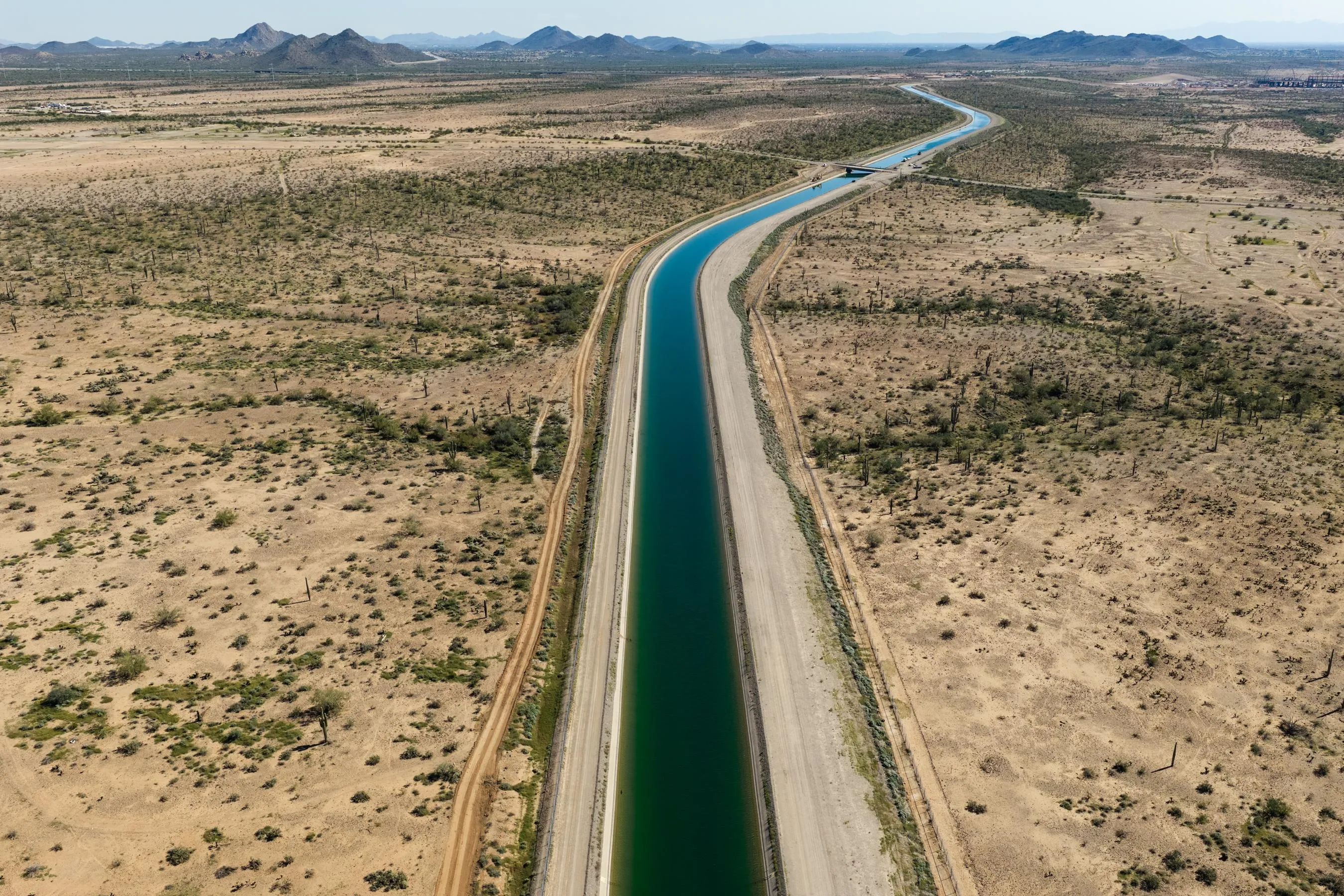
不过,对数据中心的更广泛反对似乎总是回到了水资源问题上。在干旱严重的亚利桑那州,这一担忧尤为迫切,该州在八月底失去了高达三分之一的科罗拉多河配额。图森市约70%的水源来自科罗拉多河,该市已为此做了多年准备。自2003年以来,该市一直利用其多余的科罗拉多河水——这些水通过一条长达326英里的输水渠网络流入城市——来补充阿夫拉谷含水层。
Still, the broader opposition to data centers seemingly always comes back to water. The concern is especially acute in the drought-stricken state, which lost up to one-third of its Colorado River allotment in late August. Tucson, which sources about 70 percent of its water from the Colorado River, has been preparing for this moment for years. Since 2003, the city has used its excess Colorado River water, which flows to the city through a 326-mile network of aqueducts, to recharge the Avra Valley aquifer .
图森市最近扩建了其地下水处理厂,开设了一座专门设施,以清除含水层中的“永久化学品”。通过节水努力,图森市已储备了足够维持其居民预计47年使用的地下水,但当地人表示,这些水应供他们及其家人使用,而非用于让加利福尼亚州的科技公司获利。反对“蓝色计划”的人士围绕一个简洁的口号团结起来:不给数据中心一滴水。“这个镇议会从未遇到过它不喜欢的开发项目。”
Tucson recently expanded its groundwater treatment plant, opening a dedicated facility to cleanse the aquifer of forever chemicals. Through its conservation efforts, Tucson has banked enough groundwater to sustain its residents for an estimated 47 years, but locals say that water should be used for them and their families, not to enrich tech companies in California. The opposition to Project Blue has rallied around a succinct slogan: NOT ONE DROP FOR DATA. “This Town Council has never met a development they didn’t like”
尽管反对声浪高涨,却几乎没有削弱比尔的雄心。在“蓝色计划”风波正酣之际,有消息曝出,这位开发商正考虑在马拉纳建设一个数据中心园区。马拉纳是位于图森西北20英里处的一座乡村小镇。去年10月,比尔向镇议会提交申请,请求将两块相邻的300英亩地块重新分区。其中一块归耶稣基督后期圣徒教会所有,另一块则属于与镇议员赫布·凯有关联的一个信托基金。赫布·凯是一名镇议员,拥有三十多年的公共服务经历。
Widespread opposition has done little to temper Beale’s ambitions. In the midst of the Project Blue saga, news broke that the developer was looking into building a data center campus in Marana, a rural town 20 miles northwest of Tucson. Beale submitted an application to the Town Council last October, asking it to rezone two adjoining 300-acre plots. One of the properties was owned by the Church of Jesus Christ of Latter-day Saints. The other belongs to a trust connected to Herb Kai, a member of the Town Council who boasts more than three decades in public service.
凯氏家族是镇上最大的地主。家族的奠基人是广东移民约翰·凯,他于20世纪30年代迁居马拉纳。在子孙后代的记忆中,约翰精明而又坚韧。他通过改换身份,躲过了针对华裔移民的种族主义联邦禁令。在马拉纳,他靠为镇上农民往返图森运送蔬菜为生。攒够钱后,他买下了属于自己的土地,在上面种植棉花。凯慢慢扩大了手中的地产,并分散投资,也由此帮助昔日沉寂的马拉纳变成了一座繁华的小镇。
The Kais are the biggest landowners in town. The patriarch, Cantonese immigrant John Kai, moved to Marana in the 1930s. John, whose descendants remember him as savvy and tenacious, evaded the racist federal ban on Chinese immigrants by assuming a new identity. In Marana, he earned a living hauling vegetables to and from Tucson for the town’s farmers. Eventually he had enough money to buy a plot of his own, where he cultivated cotton. Kai slowly built up his holdings and diversified his investments, and in so doing helped transform once-sleepy Marana into a bustling little town.
如今,马拉纳是亚利桑那州南部发展最快的社区之一。自2020年以来,当地人口增长了近25%,目前徘徊在6.5万左右,但镇上的领导人仍认为还有很大的增长空间。这座小镇的面积将近波士顿的三倍,人口却只有波士顿的十分之一——至少目前如此。
It is now one of the fastest-growing communities in southern Arizona. Its population has increased by nearly 25 percent since 2020, now hovering around 65,000, but its leaders still think there’s plenty of room to grow. The town is nearly three times the size of Boston and has one-tenth of the population — at least for now.
马拉纳居民杰姬·麦圭尔告诉我:“你去和人聊聊,他们会说,这个镇议会从来没有不喜欢的开发项目。”
“You’ll talk to people and they’ll say this Town Council has never met a development they didn’t like,” Marana resident Jackie McGuire told me.
网络安全分析师麦圭尔15年前从加利福尼亚州搬到马拉纳。她依然怀念旧金山湾区近乎完美的气候和轻松就能吃到全美最好的越南菜,她那亮粉色的头发在这个小镇显得格格不入,这里的大多数人都很保守,许多人是摩门教徒。但她热爱这片沙漠和自己在这里建立的生活。她说,现在镇议会即将毁掉最初吸引她来到马拉纳的一切。尽管从未参与过地方政治,麦圭尔还是成了12月份一场镇议会会议上数十名反对比尔提案发声的马拉纳居民之一。
McGuire, a cybersecurity analyst, moved to Marana from California 15 years ago. She still misses the near-perfect climate of the Bay Area and the easy access to the best Vietnamese food in the country, and her bright pink hair looks out of place in the town, where most people are conservative and many are Mormon. But she loves the desert and the life she has built there. And now the Town Council, she said, is poised to destroy exactly what drew her to Marana in the first place. Though she had never been involved in local politics, McGuire was one of dozens of Marana residents to speak out against Beale’s proposal at a Town Council meeting in December.
“我在这里生下孩子,也在这里抚养他们长大,”麦圭尔说。“小镇在创建公共空间方面做得非常出色,让人们愿意走出家门社交。”她说,数据中心将是一个“眼中钉”,但她反对的理由并不纯粹是审美上的。麦圭尔在大萧条前几年曾在华尔街工作,她担心人工智能泡沫即将破裂。“有一件事我觉得很奇怪,比尔没提他们是一家叫蓝猫头鹰的公司的子公司,”麦圭尔说,该公司目前因证券欺诈陷入集体诉讼。
“I had my children here. I’m raising my children here,” McGuire said. “The town has done a phenomenal job of creating public spaces where people want to come out of their houses and socialize.”The data center, she said, would be an “eyesore,” but her opposition to it isn’t purely aesthetic. McGuire, who worked on Wall Street in the years leading up to the Great Recession, is worried that the AI bubble is about to burst. “One thing I find curious that Beale hasn’t mentioned is that they’re a subsidiary of a company called Blue Owl,” which is currently embroiled in a class action lawsuit for securities fraud, McGuire said.
“顺便说一句,”她补充道,“我靠云计算谋生。人工智能泡沫破裂将实质性影响我偿还房贷的能力,我将不得不转型。我不希望整个马拉纳镇都面临这种境地。”
“For what it’s worth,” she added, “I make a living on cloud computing. This AI bubble bursting is going to materially impact my ability to pay my mortgage, and I will have to pivot. I don’t want that for the entire town of Marana.”
镇议会没有听取麦圭尔的警告,也没有听从其他恳请他们否决比尔提案的人的意见。比尔的承诺极具诱惑力:未来十年将带来 4.07 亿美元的税收收入,其中三分之一以上将直接流向马拉纳。镇领导声称,数据中心将符合马拉纳的最大利益。事实上,镇议会曾在 2024 年通过一项条例,限制数据中心开发。根据该条例,镇内建设的任何设施均不得使用马拉纳的供水进行冷却,并须遵守设计和噪音要求。
The Town Council did not heed McGuire’s warnings, nor did they listen to the other people who pleaded that they reject Beale’s proposal. Beale’s promises were enticing: $407 million in tax revenue over the next decade, more than one-third of which would go directly to Marana. A data center, the town’s leaders claimed, would be in Marana’s best interest. The Town Council had in fact passed an ordinance in 2024 restricting data center development. Any facility built in the town would be prohibited from using Marana’s water supply for its cooling systems and would have to adhere to design and noise requirements.
开发商还必须从公用事业供应商处获得文件,证明有足够的电力为数据中心供电。该项目将创造就业岗位,而且是好工作。多个行业工会的成员出席镇议会会议,公开表示支持数据中心。比尔公司的员工也到场了,他们带着写有“支持数据中心”的标语牌,分发给支持者。无人领取。除凯因回避而未参与表决外,议会一致投票通过了土地重新分区。
Developers would also have to get documentation from the utility provider with proof that there’s sufficient electricity to power a data center. There would be jobs, good ones. Members of various trade unions attended the Town Council meetings and spoke out in support of the data center. Beale employees were present, too, and they brought signs that said “Yes for data centers” to distribute to supporters. No one took them. With the exception of Kai, who recused himself from the proceedings, the council unanimously voted to rezone the land.
“我看到不止一个人说:‘我真不敢相信,我居然要投粉红色头发的自由派一票,就为了赶走这个他妈的蠢数据中心。’”马拉纳居民进行了反击:他们在请愿书上收集了约 2800 个签名,要求就数据中心项目举行公投,却因技术性原因被镇政府驳回。居民起诉了镇政府,比尔也提起了诉讼。在这场风波中,麦圭尔和另外三名数据中心反对者决定竞选镇议会议员。
“I saw more than one person be like, ‘I can’t believe I’m going to have to vote for a liberal with pink hair just to get rid of this stupid fucking data center.’”Marana residents fought back: They collected around 2,800 signatures on petitions asking for a referendum on the data center, only to have the town reject them on a technicality. Residents sued the town, and so did Beale. In the middle of all this, McGuire and three other data center opponents decided to run for Town Council.
他们的竞选口号是“为人民的马拉纳”。他们举行市政厅会议,挨家挨户敲开了数百扇门。麦圭尔的政治立场和个人风格与大多数马拉纳居民格格不入,她告诉我,在与选民交谈时,她专注于地方政策。“我看到不止一个人说:‘我真不敢相信,我居然得投个粉红头发的自由派一票,才能赶走这个他妈的蠢数据中心,’”麦圭尔对我说。与其他挑战者不同,她赢了。
Their tagline was “Marana for the People.”They held town halls and knocked on hundreds of doors. McGuire, whose politics and presentation are out of step with those of most Marana residents, told me she focused on local policies when talking to voters. “I saw more than one person be like, ‘I can’t believe I’m going to have to vote for a liberal with pink hair just to get rid of this stupid fucking data center,’” McGuire told me. Unlike the other insurgent candidates, she won.
如今作为镇议会成员,麦圭尔依然担心数据中心对社区的长远影响。除了水电消耗,她指出,为数据中心提供动力的芯片,其使用寿命比科技公司的财务报表所暗示的要短。换句话说,芯片本身的折旧速度将快于其财务模型所考虑的程度。比尔拒绝就这一特定批评置评,但伯克哈特强调了该项目将为马拉纳带来的税收收入。他还指出该项目的用水足迹很低。建设完成后,马拉纳设施每年将使用约 660 万加仑水。
McGuire, now a member of the Town Council, still worries about the long-term effects a data center will have on her community. Beyond the water and power use, she noted that the chips that power data centers have a shorter shelf life than tech companies’ financials would suggest. In other words, the chips themselves will depreciate more quickly than their financial models take into account. Beale declined to comment on this particular line of criticism, but Burkart emphasized the tax revenue the project will bring to Marana. He also noted the project’s low water footprint. After construction is complete, the Marana facility will use roughly 6.6 million gallons a year.
数据中心建设的成本与不确定性极其巨大,以至于一些大型科技公司既缺乏现金,也没有意愿一次性全额支付。麦奎尔表示,比尔在亚利桑那州的两个项目建设总成本将达 1200 亿美元,资金将通过私募股权和债务融资解决,但比尔反驳了这一数字。据伯克特称,这两个项目总成本为 86 亿美元。债务融资在科技行业并不罕见,但数据中心建设所需资本量太大,即便是大型金融机构也难以独立承担。
The costs and uncertainties of data center construction are so massive that some major tech companies lack the cash, or the desire, to pay for them outright. McGuire said Beale’s two projects in Arizona would cost a combined $120 billion to build, money that would be funded with private equity and debt, a figure Beale rebuts. According to Burkart, the two projects will cost a combined $8.6 billion. Debt financing isn’t unusual in the tech industry, but the data center buildout requires so much capital that even major financial firms can’t go it alone.
英伟达最近联合包括黑石、贝莱德和高盛在内的六大金融机构组成财团,为 AI 算力融资 5000 亿美元;这种非典型的融资推进被形容为更多是一系列合作伙伴关系和谅解备忘录,而非已落地的交易。对于希望借 AI 浪潮发展的小城镇来说,这同样是一场冒险。普利策奖得主、历史学家利亚夸特·阿哈迈德将新的 AI 经济比作 19 世纪末的铁路繁荣,当时少数公司凭借优厚的政府合同按自己的意愿重塑了国家,却在此过程中导致全球经济崩溃。
Nvidia recently worked with a consortium of six major financial firms that included Blackstone, BlackRock, and Goldman Sachs to finance $500 billion for AI compute; this atypical financing push has been described as more a series of partnerships and memos of understanding than closed deals. For small towns hoping to ride the AI wave, it’s also a risky one. Pulitzer Prize-winning historian Liaquat Ahamed has compared the new AI economy to the railroad boom of the late 19th century, when a handful of companies, armed with generous government contracts, remade the country in their own image and tanked the global economy in the process.
铁路的出现造就了今天的亚利桑那州。它将散布在沙漠中的农场和牧场与国际市场、以及全球资本的反复无常连接在了一起。
The advent of the railroad made Arizona what it is today. It connected the homesteads and ranches scattered throughout the desert to international markets, and to the whims and caprices of global capital.
八月初的一个炎热星期三早晨,我走出空调车,踏入了西部荒野。那里有矿工小屋、警长办公室、一座废弃的农舍、一座教堂,还有一家酒馆,据了解,过去曾在这里发生过枪战,将来也会再次发生。有一口小小的、已无法使用的水井,一座歌剧院和一间木匠工作室,一家裁缝铺、一家铁匠铺、一家银行。还有一个牧场建筑群,隔壁就是一家“东方咖啡馆”,紧挨着殡仪馆。这里是一个小小的文明,是不适宜居住的沙漠中的一片绿洲,四面环山。不算完全是鬼镇,但同样人迹罕至。
On a blazing Wednesday morning in early August, I stepped out of my air-conditioned car and into the Wild West. There was a miner’s cabin and a sheriff’s office and an abandoned farmhouse, a church, and a saloon where, I understood, gunfights had broken out in the past and would someday break out again. There was a small, inoperable well, an opera house and a carpenter’s studio, a dressmaker, a blacksmith, a bank. There was a ranch complex and an “Oriental Cafe” right next door to the undertaker. Here was a small civilization, an oasis in the inhospitable desert, surrounded on all sides by mountains. Not quite a ghost town, but nonetheless devoid of people.
当我走进凤凰城北部先驱生活历史博物馆的大厅时,柜台后的女人问我是否确定想待在那里。除了电话博物馆——我本来也无法参观,因为栖息在场地内的野生孔雀又闯了进来,而且心情很糟——整个场馆都在室外。那天室外气温高达105华氏度。通常出没于这个小镇的志愿演员们也没有来。太热了。在亚利桑那州成为州之前很久,过度消耗水资源就已写入其基因。
When I walked into the lobby of the Pioneer Living History Museum in north Phoenix, the woman behind the counter asked if I was sure I wanted to be there. Aside from the telephone museum — which I wouldn’t be able to peruse anyway, since the feral peacock that lives on the property had gotten in again, and he was in a foul mood — the whole thing was outside. Outside that day was 105 degrees. The volunteer actors who typically populate the little town weren’t there. Too hot. Well before it became a state, overconsumption of water was encoded into Arizona’s DNA.
一条人行道铺设得笔直平整,在拓荒时代肯定不存在,它把我引到了一栋建于19世纪90年代的维多利亚式豪宅门前,这栋房子最初是为J·马里恩·西尔斯及其家人建造的。虽然房子黄色的外墙漆在亚利桑那州烈日下已经开裂,但很明显,西尔斯一家过去过得不错。一块匾牌上夸耀说,西尔斯家是该市最早建造的木结构房屋之一。
A paved sidewalk that certainly didn’t exist in the pioneer days led me to the door of a well-appointed Victorian home built in the 1890s for a J. Marion Sears and his family. Though the paint’s yellow exterior now cracks under the intense Arizona sun, it was clear the Searses had lived well. The Sears home, a placard boasted, was one of the first wood-framed homes to be erected in the city.
在铁路于1887年将轨道延伸到凤凰城之前,木材很难弄到。在那之前,所有货物都必须运进城,通常由骡队运送,而西尔斯正是靠此发了一笔小财。他是一名南方邦联退伍军人,1878年抵达亚利桑那领地,以当货车车夫和牧场主为生。尽管他们住在沙漠中,西尔斯家族的庄园却硕果累累:整齐的果园为他们提供苹果、梨、杏、无花果和杏仁。
Lumber was hard to come by before the railroad’s tracks reached Phoenix in 1887. Before then all goods had to be freighted into the city, typically by teams of mules, and in fact that was how Sears had made a small fortune. A Confederate veteran, he arrived in the Arizona Territory in 1878 and made a living as a freighter and cattle rancher. Though they lived in the desert, the Sears family homestead was fruitful: Tidy orchards provided them with apples, pears, apricots, figs, and almonds.
这种丰饶并不罕见,但正如托马斯·E·谢里丹在《亚利桑那:一部历史》中详细所述,它是脆弱的。西尔斯家族和其他白人定居者一样,依靠一套复杂的运河网络引水灌溉庄稼,第一条运河由斯威林灌溉运河公司于1867年建造。该公司的老板杰克·斯威林是个勤劳嗜酒的企业家,常常用液体吗啡来佐酒。不过,他并不是个特别有天赋的工程师,但这倒也无关紧要,因为斯威林既没有设计也没有建造那些帮助白人定居者在盐河谷落脚的运河。
This bounty was not unusual, but, as detailed in Thomas E. Sheridan’s Arizona: A History , it was precarious. The Sears family, like other white settlers, tended to their crops with water sourced from an intricate network of canals, the first of which was built by the Swilling Irrigation and Canal Company in 1867. Its owner, Jack Swilling, was a hardworking, hard-drinking entrepreneur who often supplemented his whiskey with liquid morphine. He was not, however, a particularly talented engineer, a limitation that ultimately didn’t matter much, because Swilling neither designed nor built the canals that helped white men settle the Salt River Valley.
那项工作是几个世纪前由霍霍坎人完成的,他们是前哥伦布时期的民族,利用盐河和吉拉河的水源,在沙漠腹地建立了繁荣的农业文明。到16世纪,霍霍坎人已经衰落。他们的后代四散各地,运河闲置下来,最终干涸,直到斯威林想到要重新利用它们。
That work had been done centuries ago by the Hohokam, a pre-Columbian people who tapped into the Salt and Gila rivers to build a thriving agricultural civilization in the middle of the desert. By the 16th century the Hohokam had fallen. Their descendants scattered; their canals sat idle and eventually went dry until Swilling thought to revive them.
亚利桑那州的人工智能热潮并非新鲜事;与其说是新事物,不如说是同样的东西,只是规模更大。
Arizona’s AI boom isn’t something new; rather, it is more of the same, albeit on a grander scale
斯威林的创新掀起了亚利桑那州新一轮发展浪潮。拓荒者蜂拥而至该领地,投机者也随之而来,他们与其说是想从土地上勉强维持生计,不如说是想从地下的财富中发大财。土地并未产出多少贵金属,但铜矿资源丰富,旧金山和纽约的投资者很快就开办了矿山和冶炼厂。整个领地,家族农场被资本挤出。牲畜联合体首先到来,随之而来的还有苜蓿。
Swilling’s innovation kicked off a new wave of development in Arizona. Homesteaders flocked to the territory, as did speculators who were less interested in eking a living out of the land than getting rich off what lay beneath it. The earth didn’t yield much in the way of precious metals, but it was rich in copper, and it wasn’t long until investors from San Francisco and New York opened up mines and smelters. Across the territory, family farms were crowded out by capital. The cattle conglomerates came first, and with them came alfalfa.
农业联合体种植小麦和大麦,经过一些植物学实验后,又种植了成千上万棵柑橘树,直到这一切在1893年的全国性经济大萧条中枯竭,当时一场持续两年的干旱已经耗尽了运河及其水源的河流。经过几年干旱,亚利桑那州得到了联邦政府的救助,政府修建了一座水库,以便盐河谷的居民不再经历匮乏。西奥多·罗斯福于1911年为以他名字命名的大坝揭幕,并预言,一旦驾驭了水的力量,该山谷总有一天会成为“世界上最富饶的农业地区之一”。远在成为州之前,过度消耗水资源就已被写入亚利桑那州的基因。
Agricultural conglomerates planted wheat and barley and, after some botanical experimentation, tens of thousands of citrus trees, until it all dried up in the national depression of 1893, two years into a drought that drained the canals and the rivers that fed them. After a few parched years Arizona was bailed out by the federal government, which built a reservoir so the people of the Salt River Valley would never again experience privation. Theodore Roosevelt christened his namesake dam in 1911 and predicted that, having harnessed the power of water, the valley would someday be “one of the richest agricultural areas in the world.”Well before it became a state, overconsumption of water was encoded into Arizona’s DNA.
得益于工程技术的壮举,亚利桑那州的经济一直稳步前行,直到第一次世界大战,军事化的工业需求将这个沙漠州转变为经济强国。突然之间,对亚利桑那州生产的一切产品都出现了无法满足的需求:用来给军队供应的柑橘和牛,用来喂牛的苜蓿,用于飞机轮胎的棉花,用于制造的铜。财富增长了。“苜蓿是国王,”《亚利桑那共和报》1917年宣称,“棉花是王后,每头奶牛都是公主。”
Propped up by feats of engineering, Arizona’s economy steadily plugged along until the first World War, when the industrial demands of militarization transformed the desert state into an economic powerhouse. Suddenly there was insatiable demand for everything Arizona produced: citrus and cattle to feed the troops, alfalfa to feed the cattle, cotton for airplane tires, copper for manufacturing. Fortunes grew. “Alfalfa was King,” the Arizona Republican declared in 1917, “Cotton was Queen, and every Dairy Cow was a Princess.”
当战争结束,十年后大萧条摧毁经济时,一切再次破产。又经过一场战争,经济才得以复苏。事物开始好转的第一个迹象出现在1939年,当时欧洲爆发的新战争使金属价格飙升。即使在美国于1941年参加第二次世界大战之前,联邦政府就已开始将亚利桑那州视为军事训练基地,在沙漠中建设飞行学校和空军基地。亚利桑那州的工业经济是两次世界大战的产物——而台积电在该州的投资则是与中国的贸易战的一部分,这是一场21世纪的军备竞赛,其最终目标不是核弹,而是批评家称其类似于核弹的东西。
When the war ended and the Depression tanked the economy a decade later, it all went bust again. It took another war to revive the economy. The first indication that things were turning around came in 1939, when a new war in Europe sent metal prices soaring. Even before the United States entered World War II in 1941, the federal government had started looking to Arizona as a training ground for the military, building out flight schools and Air Force bases in the desert. Arizona’s industrial economy is the product of two world wars — and TSMC’s investment in the state is part of a trade war with China, a 21st-century arms race where the end goal is not a nuclear bomb but something critics say is akin to it.
从这个角度来看,亚利桑那州的人工智能热潮并非新事物;相反,它更多是同样的东西,只是规模更大。
Looked at this way, Arizona’s AI boom isn’t something new; rather, it is more of the same, albeit on a grander scale.
“想到我们过去在哪里、过去做过什么,真是疯狂,”凤凰城前经济开发官员麦凯对我说。“你会消失在沙漠里。我可以骑着马从皮马的印第安本德一直骑到维德河,一座建筑都看不到。”那条路线如今经过三座高尔夫球场、一家医院、一个室内水上乐园、一个水族馆,以及无数个住宅区和商业街。1890年,盐河谷人口为1.1万。
“It’s crazy to think about where we used to be and what we used to do,” Mackay, Phoenix’s former economic developer, told me. “You’d disappear out into the desert. I could ride my horse to Indian Bend in Pima all the way to the Verde River without seeing a building.”That route now passes three golf courses, a hospital, an indoor water park, an aquarium, and countless subdivisions and strip malls. The Salt River Valley had a population of 11,000 in 1890.
五十年及多个灌溉项目之后,凤凰城的人口刚刚超过6.5万。去年,该大都会区报告的人口超过500万。令人震惊的是,这种发展并非导致亚利桑那州水资源危急短缺的原因。人口增长并未导致亚利桑那州用水量增加。不仅亚利桑那州平均每人今天的用水量少于1980年代,而且该州总用水量自那时起也下降了16%,这一下降几乎完全归因于农业需求的减少。
Fifty years and several irrigation projects later, just over 65,000 people lived in Phoenix. Last year, the metropolitan area reported a population of more than 5 million. Shockingly, this development isn’t to blame for Arizona’s perilous lack of water. Population growth hasn’t led to an increase in Arizona’s water consumption. Not only does the average Arizonan consume less water today than in the 1980s, but the state’s overall water use has also dropped by 16 percent since then, a decline almost entirely attributable to reduced agricultural demand.
但当支撑该州生命的河流和含水层正在干涸时,资源节约只能起到有限作用,当地人当然很愤怒,因为他们被要求减少自身用水,而地方官员却欢迎新的耗水产业。
But resource conservation can only go so far when the rivers and aquifers that sustain life in the state are drying up , and locals are understandably furious that they’re being asked to reduce their own water consumption while local officials welcome new water-intensive industries.
先驱生活历史博物馆周围的土地大多仍未开发。这里的过去保持不变,并被悉心维护,以纪念那些让沙漠绽放的坚韧先驱。这是亚利桑那州的历史。而就在五英里外,台积电的工程师们制造出支撑人工智能产业重塑我们所知生活的芯片的地方,亚利桑那州的未来就在那里。
The land immediately surrounding the Pioneer Living History Museum remains largely undeveloped. Here the past remains unchanged and lovingly maintained in honor of the rugged pioneers who made the desert bloom. This is Arizona’s history. And just five miles south, where TSMC’s engineers manufacture the chips that enable the AI industry to reshape life as we know it, lies Arizona’s future.