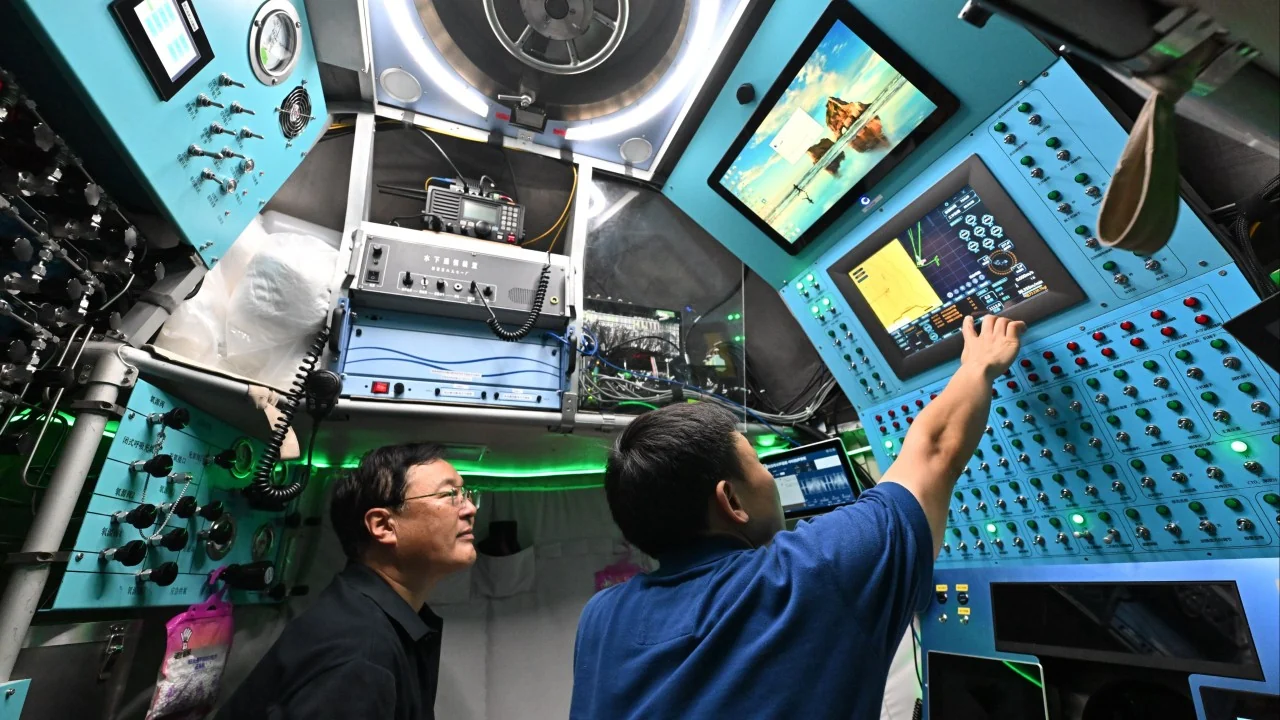
中国在升级后的“蛟龙”号潜水器进行7000米(2.3万英尺)深海试验的同时,展示了人工智能技术,凸显了类似系统在支持核动力潜艇上的决策和应急响应方面的潜力。
China has showcased artificial intelligence (AI) technology alongside 7,000-metre (23,000-feet) deep-sea trials of its upgraded Jiaolong submersible, highlighting the potential for similar systems to support decision-making and emergency responses aboard nuclear-powered submarines.
据国家通讯社新华社10月27日报道,中国载人潜水器在西太平洋菲律宾海盆的三次下潜中达到了7056.9米的最大深度。
The Chinese crewed submersible reached a maximum depth of 7,056.9 metres during three dives in the Philippine Basin in the western Pacific Ocean, according to state news agency Xinhua on October 27.
此次试验是在一次重大升级之后进行的,升级引入了人工智能驱动的海底分析以及一套独立的故障诊断系统,旨在在水下作业期间为潜航员提供协助。
The trials followed a major upgrade that introduced AI-powered seabed analysis and a separate fault-diagnosis system designed to assist pilots during underwater operations.
这些进展凸显了人工智能在水下作业中日益增长的潜力,而这一领域正成为中国与美国之间战略竞争的新兴领域。
The developments highlight the growing potential of AI in underwater operations, an emerging area of strategic competition between China and the United States.
两国都在探索人工智能的军事应用,尽管其在核相关决策中的作用仍存在争议。
Both countries are exploring military applications of AI, although its role in nuclear-related decision-making remains controversial.
潜艇面临特殊挑战,因为在水下时无法依赖持续的卫星通信,迫使艇员在有限的外部支持下处理复杂信息并做出关键决策。
Submarines present particular challenges because they cannot rely on continuous satellite communications while submerged, forcing crews to process complex information and make critical decisions with limited external support.
人工智能可以帮助分析声呐信号、识别潜在威胁、检测设备故障,并比单独工作的人类操作员更快地建议应对措施。
AI could help analyse sonar signals, identify potential threats, detect equipment faults and recommend responses faster than human operators working alone.
这些能力在执行长时间水下任务的核动力潜艇上可能尤其有价值,因为设备故障可能需要立即采取行动而无法获得外部技术援助。
Such capabilities could prove particularly valuable aboard nuclear-powered submarines conducting lengthy underwater missions, where equipment failures may require immediate action without external technical help.
为“蛟龙”号开发的系统之一提供了人工智能如何支持此类行动的一个潜在范例。
One of the systems developed for Jiaolong offers a potential example of how AI could support such operations.
据新华社10月25日发布的另一篇报道,“蛟龙”号配备了一套故障诊断与决策支持系统,当潜水过程中设备发生故障时,该系统可提供故障排除程序、以往的故障记录和技术文档。
According to a separate Xinhua report published on October 25, Jiaolong is equipped with a fault-diagnosis and decision-support system that provides troubleshooting procedures, previous fault records and technical documents when equipment malfunctions during a dive.
“这是一个故障诊断与决策支持系统,”蛟龙号潜航员张毅对新华社表示,“我们根据项目要求和实际作业需求研发了它。”该系统覆盖推进、控制等设备,帮助潜航员在故障变得更严重之前识别问题并应对紧急情况。
“This is a fault diagnosis and decision-support system,” Zhang Yi, a Jiaolong pilot, told Xinhua. “We developed it based on the project’s requirements and actual operational needs.”The system covers equipment including propulsion and control systems, helping pilots identify problems and respond to emergencies before faults become more serious.
“快速识别和排除潜在隐患极其重要,”张毅说,“处理下潜过程中的风险、保障人员安全同样重要。”类似的决策支持技术最终可能被改造应用于核动力潜艇,帮助艇员在水下长时间任务中诊断设备故障并选择合适的应对措施。
“Quickly identifying and eliminating potential hazards is extremely important,” Zhang said. “So is dealing with risks during dives and ensuring the safety of personnel.”Similar decision-support technology could eventually be adapted for nuclear-powered submarines, helping crews diagnose equipment malfunctions and select appropriate responses during prolonged underwater missions.
基于人工智能的预测性维护还可以帮助在部件失效之前发现异常运行状况,从而有可能减少意外故障。
AI-based predictive maintenance could also help detect abnormal operating conditions before components fail, potentially reducing unexpected breakdowns.
除故障诊断外,中国研究人员还开发了另一套人工智能系统,旨在帮助蛟龙号解读其水下周边环境。
Beyond fault diagnosis, Chinese researchers have developed another AI system designed to help Jiaolong interpret its underwater surroundings.
中国国家深海基地管理中心的研究人员开发了一套智能探测系统,使用多模态大人工智能模型,能够分析蛟龙号摄像机拍摄的图像。
Researchers at China’s National Deep Sea Base Management Centre have developed an intelligent exploration system using a multimodal large AI model capable of analysing images captured by Jiaolong’s cameras.
“我们利用多模态大人工智能模型开发了这套智能深海探测系统,”该中心博士后研究员李金鹏对新华社表示。“它利用人工智能算法实时解读蛟龙号拍摄的影像,”他说。
“We developed this intelligent deep-sea exploration system using a multimodal large AI model,” Li Jinpeng, a postdoctoral researcher at the centre, told Xinhua. “It uses artificial intelligence algorithms to interpret footage captured by Jiaolong in real time,” he said.
研究人员利用超过80万张深海生物和海底物质图像对该系统进行了训练,使其能够识别水下影像中的物体,并自动记录其名称、地理坐标、时间和深度。
Researchers have trained the system using more than 800,000 images of deep-sea organisms and seabed materials, enabling it to identify objects in underwater footage and automatically record their names, geographical coordinates, time and depth.
当系统出错时,研究人员可以手动更正信息,并将其反馈给模型,以进一步学习和改进。
When the system makes mistakes, researchers can manually correct the information and feed it back into the model for further learning and improvement.
“用户还可以通过对话与系统交互,”李某说。“它将为他们的问题提供答案。”该软件还能以三维方式重建潜水器的下潜轨迹,分析海洋物种丰度,并生成海底生态系统报告。
“Users can also interact with the system through dialogue,” Li said. “It will provide answers to their questions.”The software can also reconstruct the submersible’s diving trajectory in three dimensions, analyse marine species abundance and generate reports on seabed ecosystems.
尽管该系统是为科学探索而开发,但类似的AI技术通过训练专门模型来识别声学数据中的模式而非图像,有可能被改编用于军事应用。
Although developed for scientific exploration, similar AI techniques could potentially be adapted for military applications by training specialised models to recognise patterns in acoustic data rather than images.
声呐系统从舰船、海洋生物和周围海洋环境中采集大量信号,这使得快速分类在水下作战中显得尤为重要。
Sonar systems collect large volumes of signals from vessels, marine life and surrounding ocean conditions, making rapid classification particularly important in underwater warfare.
AI有可能帮助潜艇船员区分不同的水下噪声来源并识别可疑的声学模式,从而减轻人工操作员的负担。
AI could potentially help submarine crews distinguish between different sources of underwater noise and identify suspicious acoustic patterns, reducing the burden on human operators.
然而,中国该系统目前侧重于视觉分析,而非基于军用声呐的目标识别。尽管新华社在“蛟龙”号深海试航期间强调了其AI能力,但并未披露该技术在何种具体深度下接受测试。
However, the Chinese system currently focuses on visual analysis rather than military sonar-based target recognition. Although Xinhua highlighted Jiaolong’s AI capabilities during its deep-sea trials, it did not disclose the specific depths at which the technology was tested.
深海试航还展示了“蛟龙”号升级设备的可靠性,包括国产化研发的组件。
The deep-sea trials also showed the reliability of Jiaolong’s upgraded equipment, including domestically developed components.
“这充分验证了‘蛟龙’号升级改装和关键部件国产化替代后的可靠性与安全性,”国家深海基地管理中心研究员孙永福告诉新华社。“它巩固并增强了我国载人深潜装备的技术优势,”孙永福说。
“This fully verified the reliability and safety of Jiaolong following its upgrades and the replacement of key components with domestically developed alternatives,” Sun Yongfu, a researcher at the National Deep Sea Base Management Centre, told Xinhua. “It has consolidated and strengthened China’s technological advantages in crewed deep-sea exploration equipment,” Sun said.