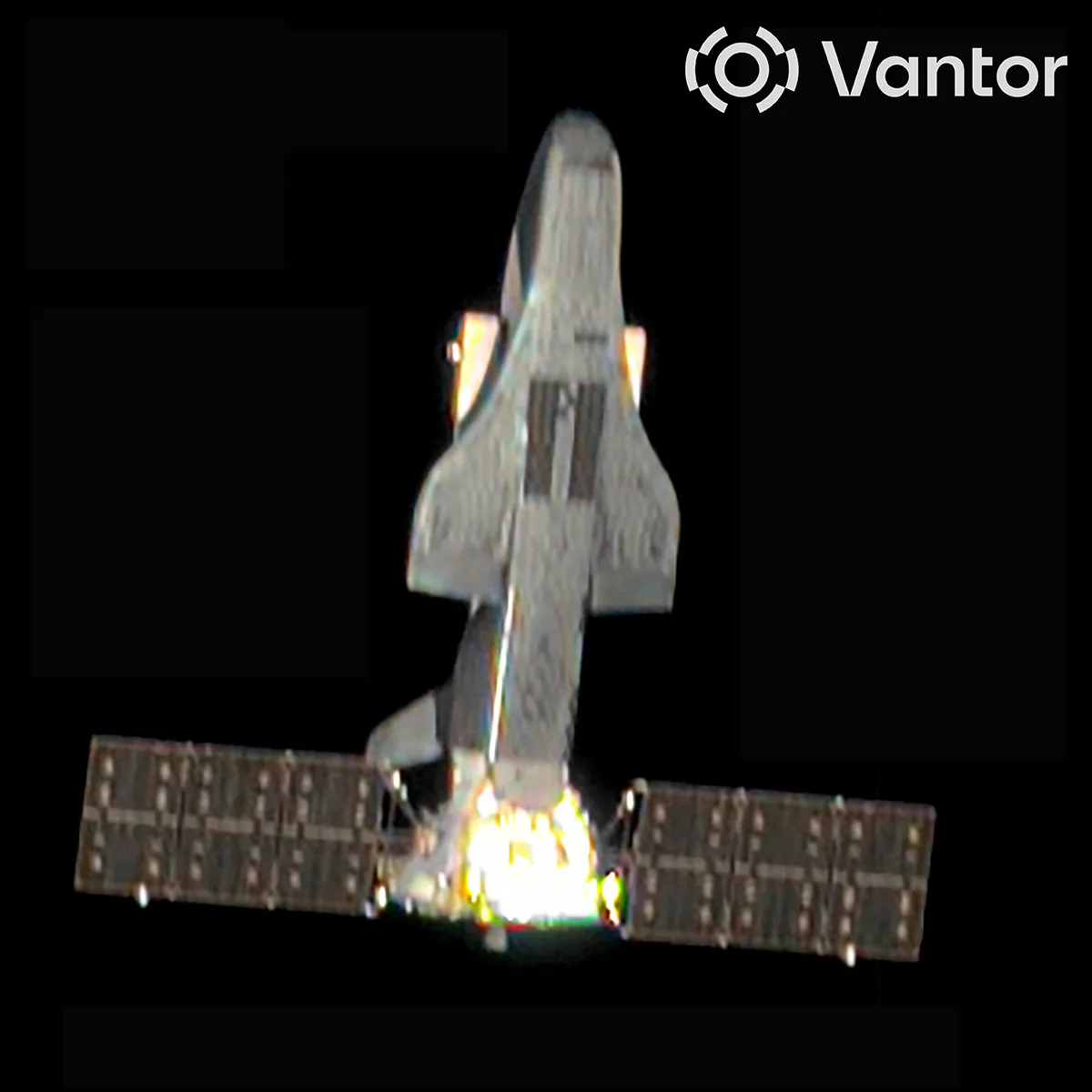
中国空间飞机采用三角翼、有效载荷舱门、深色隔热罩,以及带有发电太阳能电池板的后置服务舱。换言之,这艘有翼飞船的设计在很大程度上是美国太空军X-37B空间飞机的复制品。
The Chinese spaceplane has delta wings, payload bay doors, a dark heat shield, and a rear-mounted service module with power-generating solar arrays. In other words, the design of the winged ship is, to a great degree, a copy of the X-37B spaceplane flown by the US Space Force.
这张照片由一家名为Vantor的商业成像卫星公司拍摄,该公司在2024年被称为Maxar。Vantor是几家向美国军方和美国情报机构提供世界各地地点侦察图像的公司之一。同一批地球成像卫星也可以将望远镜对准太空中的物体。
The photo was taken by a commercial imaging satellite owned by a company called Vantor, known as Maxar in 2024. Vantor is one of several companies that provide reconnaissance imagery of locations around the world to the US military and US intelligence agencies. The same Earth-imaging satellites can point their telescopes at objects in space.
在国防情报局评估之前,显示中国空间飞机整体形状的低分辨率图像已公开。一名美国太空军官员在2024年韩国举行的一次会议上透露了Maxar的观测结果,但五角大楼直到周一才向公众公布全分辨率图像,当时该图像出现在一份关于美国面临的太空威胁的非密级国防情报局评估中。
Lower-resolution views of a Chinese spaceplane showing the vehicle’s general shape were publicly available before the Defense Intelligence Agency assessment. A US Space Force official revealed Maxar’s observation at a 2024 conference in South Korea, but the Pentagon did not release the full-resolution image to the public until Monday, when it appeared in an unclassified DIA assessment of threats to the United States in space.
捕获与释放 国防情报局报告并未透露中国空间飞机在轨道上做什么的太多新信息。中国自2020年以来已发射四次空间飞机任务,持续时间长达九个月。第四次任务于2月发射,目前仍在轨道上。公众尚不清楚中国是否拥有一架或多架此类空间飞机。
Catch and Release The DIA report doesn’t reveal much new about what the Chinese spaceplane does in orbit. China has launched four spaceplane missions since 2020, with durations of up to nine months. The fourth mission is in orbit today after launching in February. It is not publicly known whether China has one or more such spaceplanes in its inventory.
太空军有两架X-37B轮流飞行,迄今八次任务中最长的一次从发射到着陆持续了两年半。美国官员已发布X-37B飞行器的照片,公布了其设计和尺寸信息,并披露了它们携带进入轨道的一小批实验。X-37B在太空中的大部分活动均属机密。
The Space Force has two X-37Bs flying in rotation, with the longest of their eight missions to date running two-and-a-half years from launch until landing. US officials have released photos of the X-37B vehicles, published information about their design and dimensions, and disclosed a handful of experiments they have carried into orbit. Most of the X-37B’s activities in space are classified.
与X-37B类似,中国的空间飞机在常规火箭的有效载荷整流罩内发射,进入轨道后作为卫星运行。该空间飞机像NASA航天飞机的微型无人驾驶版本一样飞行,并在每次任务结束时重返大气层,自主在陆地跑道着陆。地面团队随后对其进行翻新,以备再次飞行。
Like the X-37B, China’s spaceplane lifts off inside the payload shroud of a conventional rocket, then operates as a satellite once in orbit. The spaceplane flies like a miniature unpiloted version of NASA’s Space Shuttle and reenters the atmosphere for an autonomous land runway landing at the end of each mission. Ground teams then refurbish it for another flight.
国防情报局(DIA)在其报告中表示,空间飞机的“增强机动性”使其“比传统卫星更适合某些任务”。迄今为止,中国空间飞机仅在距地球几百英里的低地球轨道(LEO)飞行过。美国太空军的X-37B飞行中,有一架曾飞升至2.4万英里以上的高度,随后利用大气制动为重返大气层和着陆做准备。
The “enhanced maneuverability” of spaceplanes makes them “more suitable for certain missions than traditional satellites,” the DIA said in its report. So far, the Chinese spaceplane has only flown in low-Earth orbit (LEO) at an altitude of a few hundred miles. One of the Space Force’s X-37B flights soared to an altitude of more than 24,000 miles before using aerobraking to set up for reentry and landing.
像中国空间飞机和X-37B这样的飞行器,还可以从其货舱中部署小型卫星。最近,中国展示了在轨道上捕捉物体的能力,或许是使用机械臂。据天体物理学家、太空飞行活动编目专家乔纳森·麦克道尔(Jonathan McDowell)对公开轨道跟踪数据的分析,目前在轨的飞行器在6月释放了一颗子卫星,并在7月重新捕获,随后在8月和9月再次重复了这一过程。
Spaceplanes like China’s and the X-37B can also deploy small satellites from their cargo bay. Most recently, China demonstrated an ability to catch an object in orbit, perhaps using a robotic arm. The vehicle now in space released a sub-satellite in June and recaptured it in July, then did the same thing again in August and September, according to an analysis of open source orbital tracking data by Jonathan McDowell, an astrophysicist who catalogs spaceflight activity.
一瞥即逝 中国空间飞机的官方名称甚至是个谜。西方出版物常称其为“神龙”,引用的是关于2000年代中国研制机器人空间飞机的报道。根据安全世界基金会(Secure World Foundation)发布的一份事实资料,中国官方媒体仅将该飞行器称为“可重复使用实验航天器”(Chongfu Shiyong Shiyan Hangtian Qi,简称CSSHQ)。
A Fleeting Glance The official name of the Chinese spaceplane is even a mystery. It is often called Shenlong in Western publications, citing reports from the 2000s about China’s development of a robotic spaceplane. Chinese state media only refer to the vehicle as Chongfu Shiyong Shiyan Hangtian Qi, or CSSHQ, which means reusable experimental spacecraft, according to a fact sheet published by the Secure World Foundation.
国防情报局未披露麦克斯尔(Maxar)观察中国空间飞机的具体情况,例如时间、地点或距离,但地球观测通常利用摄像头在轨道交汇时观察太空中的其他物体,这一新兴领域被称为非地球成像(NEI)。
The DIA did not disclose the exact circumstances of Maxar’s observation of the Chinese spaceplane, such as its timing, location, or distance, but Earth observations often use cameras to view other objects in space as their orbits intersect, an emerging field known as non-Earth imaging (NEI).
NEI 允许商业运营商和政府分析师检查卫星。这对于获取有关机密或专有卫星设计的信息特别有用,为国际和企业间谍活动开辟了一条通往高空领域的新途径。
NEI allows commercial operators and government analysts to inspect satellites. This is especially useful for gleaning information about classified or proprietary satellite designs, extending a new avenue for international and corporate espionage to the high frontier.
Maxar 等商业公司在 NEI 领域展示的能力,不同于近期一些军用航天器的行动,例如俄罗斯的“宇宙-2612”卫星,它在本月初曾故意机动接近一颗美国注册的雷达成像卫星。商业 NEI 观测来自偶然相遇,通常发生在极高速度下。
The capability exhibited by Maxar and other commercial companies in the NEI field is distinct from the recent actions of some military spacecraft, such as Russia’s Kosmos 2612, which deliberately maneuvered to approach a US-registered radar imaging satellite earlier this month. Commercial NEI observations come from chance encounters, often at extremely high speed.
“激光武器” 美国国防情报局(DIA)对太空威胁的评估包括关于中国追求反卫星技术(即“反太空”武器)的最新情况。该情报机构报告称,中国军方很可能认为定向能武器(DEW)“是理想的反太空系统”,因为它们可用于永久或暂时使卫星瘫痪。激光在太空的一个潜在用途是致盲对手卫星上的传感器。
Pew-Pew With DEWs The DIA’s assessment of space threats includes an update on China’s pursuit of anti-satellite technology, or “counterspace” weapons. The intelligence agency reported the Chinese military likely considers directed-energy weapons (DEWs) “ideal counterspace systems” because they can be used to permanently or temporarily disable a satellite. One potential use for lasers in space would be to dazzle a sensor on an adversary’s satellite.
DIA 表示:“中国拥有多种不同功率等级的地基激光武器,可用于干扰、降级或损坏近地轨道(LEO)上的卫星。”“到 2020 年代末,中国可能部署基于太空的定向能系统和功率更高的地基定向能系统,能够威胁更高轨道上的卫星。”DIA 指出了中国的地基反卫星导弹试验,以及该国去年历史性地演示了在地球同步轨道上为卫星加注燃料,该轨道位于赤道上空约 22,000 英里(36,000 公里)处,这是除近地轨道外其他国家均未实现的壮举。
“China has multiple ground-based laser weapons with varying power levels to disrupt, degrade, or damage satellites in LEO,” the DIA said. “By the late 2020s, China may field space-based directed energy systems and higher-powered ground-based directed energy systems capable of threatening satellites in higher orbits.”The DIA noted China’s testing of ground-based anti-satellite missiles and the country’s historic demonstration last year of satellite refueling in geosynchronous orbit, a regime some 22,000 miles (36,000 kilometers) over the equator, something no other country has achieved above LEO.
中国还测试了可将航天器捕获出轨的机械臂,并目前运营着一个不断壮大的卫星舰队,称为“通信技术试验卫星”(TJS),它们例行接近外国航天器。
China has also tested a robotic arm that could snag a spacecraft out of orbit, and now operates a growing fleet of satellites called TJS that routinely approach foreign spacecraft.
美国太空军在同步轨道上也部署了一组检查卫星,并最近采购了更多可加注燃料的同类卫星,以克服机动能力的限制。空军部长特洛伊·梅因克上月透露,五角大楼已在太空部署了武器,使美国成为首个承认拥有轨道武器的国家。
The US Space Force also has a constellation of inspector satellites in geosynchronous orbit and recently procured more that could be refueled, overcoming maneuverability limitations. Air Force Secretary Troy Meink revealed last month that the Pentagon has fielded weapons in space, making the United States the first nation to acknowledge possession of orbital weapons.
据美国情报官员称,俄罗斯正在推进自己的轨道作战计划,其中包括在太空部署核武器的野心。
Russia is pursuing its own orbital combat program, which includes an ambition to deploy a nuclear weapon in space, according to US intelligence officials.
一种更为常规的俄罗斯武器系统,被称为“尼维利尔”,旨在从一颗卫星发射弹丸撞击另一颗卫星。俄罗斯军方曾在2020年利用“尼维利尔”系统模拟过一次攻击。今年4月,俄罗斯将一组小型卫星发射至靠近一颗商业雷达遥感卫星的轨道,该卫星由ICEYE公司所有,为乌克兰提供侦察图像。美国官员称,本月初,其中一颗俄罗斯卫星曾接近ICEYE卫星“数十米”距离,随后又退离。本文最初发表于Ars Technica。
A more conventional Russian weapons system, known as Nivelir, is designed to fire projectiles from one satellite to smash into another. The Russian military simulated an attack using the Nivelir system in 2020. In April, Russia launched a fleet of small satellites into an orbit close to a commercial radar remote sensing satellite owned by ICEYE that provides reconnaissance imagery to Ukraine. One of the Russian satellites moved within “tens of meters” of the ICEYE satellite earlier this month before backing away, US officials said. This story originally appeared on Ars Technica.