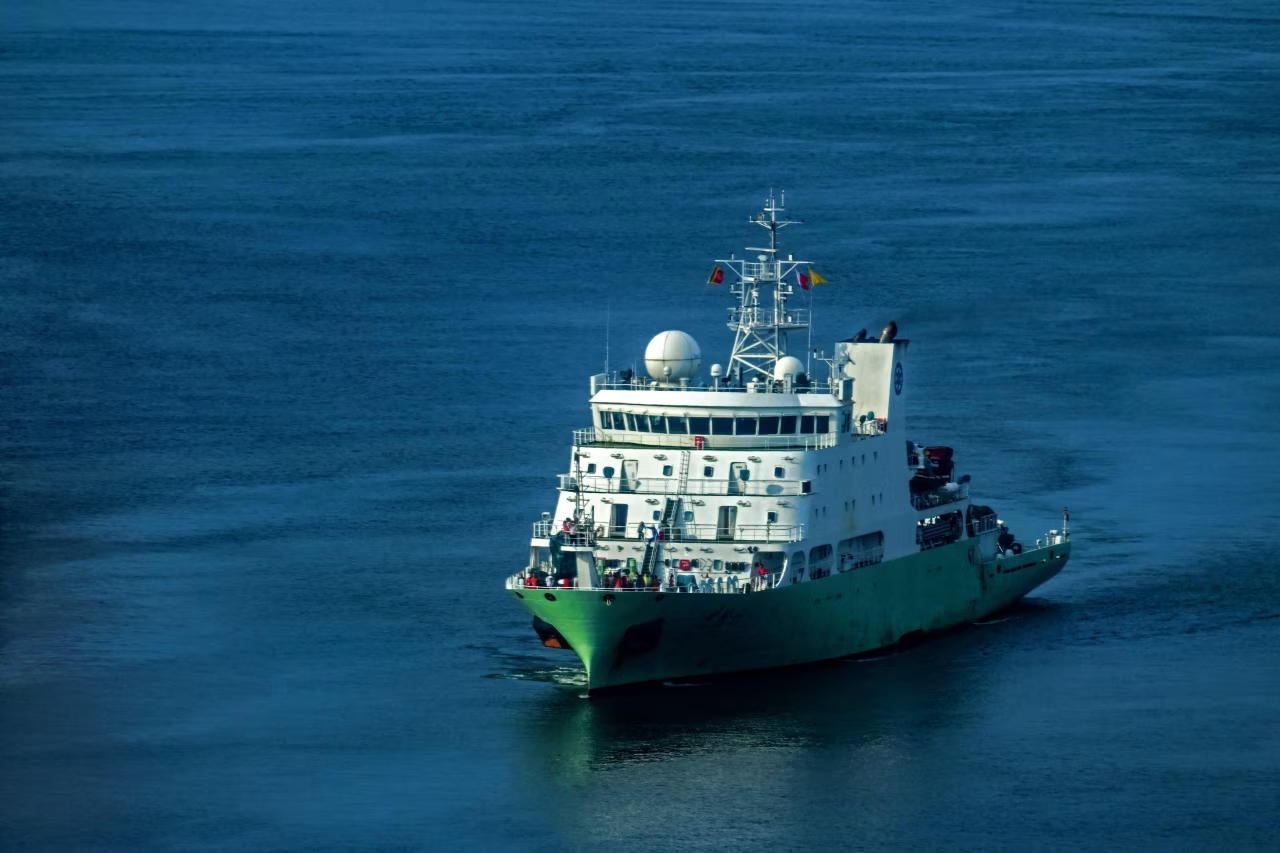
台湾高雄——中国加快了对台湾周边水域的测绘,派遣数十艘船只收集数据,这些数据可能对潜艇和水下无人机在争夺这个自治岛屿的冲突中航行和探测对手至关重要。
KAOHSIUNG, Taiwan—China has accelerated the mapping of waters near Taiwan, sending dozens of ships to gather data that could be critical for submarines and subsea drones to navigate and detect rivals in a fight over the self-ruled island.
最近海洋研究活动的激增有可能提升中国夺取台湾的能力,北京声称对台湾拥有主权,并威胁必要时以武力夺取。
The recent flurry of maritime research has the potential to advance China’s ability to seize Taiwan, which Beijing claims as its own and threatens to take by force if necessary.
台湾于8月向其规模较小的科研船队增添了两艘船,以便在投资建设水面无人机武器库以强化岛屿防御的同时,测绘这一潜在的海上战场。
Taiwan responded in August by adding two ships to its small research fleet as it works to map this potential maritime battleground while it invests in an arsenal of nautical drones to improve the island’s defenses.
台湾总统赖清德在新船下水仪式上表示:“只有更完整地掌握我们自己的海洋环境,才能保障国家安全。”但在测绘、造船和组建无人机武器库方面,中国遥遥领先。
“Only by gaining a more complete understanding of our own maritime environment can we safeguard national security,” Taiwan’s President Lai Ching-te said at the launch. But China is far ahead—in mapping, shipbuilding and assembling a drone arsenal.
近几个月来,中国科研船在台湾以东水域尤为活跃,勘测美军在台海冲突中介入时需要穿越的水域。
In recent months, Chinese research ships have been particularly active to the east of Taiwan, surveying waters that the U.S. Navy would need to cross to intervene in a conflict over the island.
《华尔街日报》对船舶追踪数据的分析显示,中国船只在台湾南部和东部的大片海域呈“割草机”模式来回航行,帮助北京完成对环岛水域的全貌描绘。
A Wall Street Journal analysis of ship-tracking data shows Chinese vessels sailing back and forth in a lawnmower pattern over swaths of ocean to Taiwan’s south and east, helping Beijing to complete its portrait of waters surrounding the island.
台湾海巡署表示,中国科研船的作业有助于“战场环境准备”。中国国务院台湾事务办公室未就中国的科研活动回应提问。
Taiwan’s coast guard said the work by Chinese research vessels aids “battlespace preparation.”Beijing’s Taiwan Affairs Office didn’t respond to questions about China’s research.
中国船只例行勘测从太平洋到印度洋的海床和水文条件,收集的数据可用于科学研究和海底采矿,也可用于军事用途。
Chinese vessels routinely survey the sea floor and water conditions from the Pacific to the Indian Ocean, gathering data that can be used for science and sea mining but can also be put to military use.
华盛顿智库哈德逊研究所国防概念与技术中心高级研究员兼主任布莱恩·克拉克表示,中国想要海底地形轮廓的详细数据,以帮助其潜艇和水下无人机行动,这些装备可用于封锁台湾或阻止美国干预。
China wants details of the bottom contour to help its submarines and underwater drones, which could be used in a blockade of Taiwan or to prevent U.S. intervention, said Bryan Clark, senior fellow and director of the Center for Defense Concepts and Technology at the Washington-based think tank Hudson Institute.
水下航行器可以利用详细的海底地图自主导航,无需返回水面连接卫星系统。这使它们能够更长时间地隐蔽行动。
Undersea vehicles can use detailed maps of the sea floor to navigate autonomously without returning to the surface to link with satellite systems. That enables them to operate unseen for longer periods.
尤其是在日本和菲律宾于5月表示将就台湾以东海域重叠的海上边界举行会谈之后,中国在台湾周边进行的研究有所增加。两国一直在加强防务合作,以应对它们所认为的来自北京的威胁。
Chinese research around Taiwan increased in particular after Japan and the Philippines said in May that they would hold talks about overlapping maritime boundaries in waters to the east of Taiwan. The two countries have been increasing their defense cooperation in response to perceived threats from Beijing.
中国声称台湾周边海域是其领土,称上述会谈非法,并启动了一系列海警演习以主张其权利。
China, which claims the waters surrounding Taiwan as its own territory, called the talks illegal and launched a series of coast guard exercises to press its claim.
“中国正利用边界会谈作为借口,来做它很可能本来就想做的事情:那就是加大对台湾的压力,”研究过中国科考船的传统基金会智库研究助理艾伦·张说。
“China is capitalizing on the boundary talks as a pretext for what it likely wanted to do anyway: that is, to ratchet up the pressure on Taiwan,” said Allen Zhang, a research assistant at the Heritage Foundation think tank who has studied China’s research ships.
“北京长期以来一直为其灰色地带战术——即未达到致命武力的胁迫性活动——寻求法律掩护,而科考船非常符合这一模式,”张说。
“Beijing has long sought legal cover for its gray-zone tactics—coercive activities short of lethal force—and research vessels fit that mold quite well,” Zhang said.
尽管台北在测绘中国科考船禁入的近岸海域方面具有优势,但北京已将海洋学提升为国家战略优先事项,投资于船舶和先进水下无人机。据台湾海巡署称,中国运营着120多艘科考船。
Though Taipei has an edge in mapping waters close to shore that are off limits to Chinese research vessels, Beijing has elevated oceanography to a national strategic priority, investing in ships and advanced underwater drones. China operates more than 120 research vessels, according to Taiwan’s coast guard.
“他们下饺子似的下水科研船,”国立台湾大学海洋研究所副教授苏志杰说,该所运营台湾的一艘科研船之一。“台湾现在要追赶真的很难,”苏志杰说。
“They are launching research ships as fast as dropping dumplings into a pot,” said Su Chih-chieh, an associate professor at National Taiwan University’s Institute of Oceanography, which operates one of Taiwan’s research ships. “Taiwan is having a really hard time catching up right now,” said Su.
台湾目前只有五艘船在积极执行本土海洋科研任务:三艘由大学管理,一艘由政府支持的台湾海洋研究院管理,还有一艘由台湾海军管理。
Taiwan has only five ships actively carrying out its own maritime research: three managed by universities, one by the government-backed Taiwan Ocean Research Institute and one by Taiwan’s navy.
今夏新下水的两艘船将由另一家机构运营,隶属政府的海洋委员会,该委员会管理台湾海巡署。
The two ships launched this summer will be run by yet another institute, under the government’s Ocean Affairs Council, which manages Taiwan’s coast guard.
“我们想把这些零散的拼图逐渐收集起来,加入我们自己的投入,建立一个海洋数据库,”位于高雄的国家海洋研究院院长陈中伶说,该院计划于2029年下水自有大型科研船。
“We want to take these fragmented pieces, gradually gather the data, add our own input, and build a marine database,” said Chen Chung-ling, president of the National Academy of Marine Research in Kaohsiung, which plans to launch its own large ship in 2029.
陈中伶将台湾的科研努力描述为维护台湾的政治意愿表达。“你越了解海洋,就能从中获得越多,”她说。
Chen describes Taiwanese research efforts as an expression of political will to safeguard Taiwan. “The more you understand the ocean, the more you can get from it,” she said.
但台湾的科研船主要服务于学术界,其研究兴趣不一定与国防需求一致,台湾海洋研究院院长廖德宇说。“我们其实对周围海域知之甚少,”廖德宇在该院高雄总部表示。
But Taiwan’s research ships primarily serve academics with interests that aren’t necessarily aligned with defense needs, said Liao Te-yu, director general of the Taiwan Ocean Research Institute. “We actually understand very little about the waters surrounding us,” Liao said at the institute’s Kaohsiung headquarters.
北京的科研船只是中国在岛周边海上力量的一个组成部分。10月中旬,台湾侦获六艘中国海洋调查船、六艘中国海警船和四艘渔船,台湾认为这些渔船属于中国的海上民兵。
Beijing’s research vessels are just one part of the Chinese maritime presence around the island. In mid-October, Taiwan identified six Chinese survey vessels, six Chinese coast-guard ships and four fishing boats that Taiwan believes are part of China’s maritime militia.
时任台湾国家安全会议副秘书长李文在推特上发文称,这些船只“是各机关协同行动的明确例证”。
The ships were “clear examples of coordinated activities” between Chinese agencies, Lii Wen, deputy secretary-general of Taiwan’s National Security Council, tweeted at the time.
据分析人士称,中国的科研船还被用来记录海底电缆分布,这是冲突中另一个潜在目标。
China’s research vessels are also used to document telecommunications cables, another potential target in a conflict, according to analysts.
“他们正试图摸清海底基础设施的布局,因为他们很可能希望具备在胁迫行动中切断台湾与外界通信联系的能力,”前美国海军潜艇兵克拉克说。近年来,中国船只已多次切断台湾的海底电缆。
“They’re trying to see what the undersea infrastructure looks like, because they probably want the ability to cut off Taiwan from outside communications if they can as part of a coercion campaign,” said Clark, a former U.S. Navy submariner. Chinese ships have severed Taiwan’s cables several times in recent years.
战略与国际研究中心(CSIS)10月发布的一项研究发现,与中国有关的科考船在公海上“在关键基础设施附近停留的观测时间占比,与其他47个国家的科考船相比显著偏高”。CSIS未来实验室副研究员何塞·M·马西亚斯三世表示,中国科考船“科研”号今夏曾在台湾东北和西南海域的海底电缆附近活动。该研究还发现,同一艘船2024年曾在白令海海底电缆附近以及关岛与台湾之间的海底电缆附近被发现。
An October study by the Center for Strategic and International Studies found that China-linked research vessels on the high seas “spent a disproportionately large share of their observed time near critical infrastructure compared with research vessels from 47 other countries.”One Chinese ship, the Ke Xue, was active this summer near undersea cables northeast and southwest of Taiwan, said Jose M. Macias III, an associate fellow at CSIS’s Futures Lab. The same ship was seen in 2024 near cables in the Bering Sea and between Guam and Taiwan, the study found.