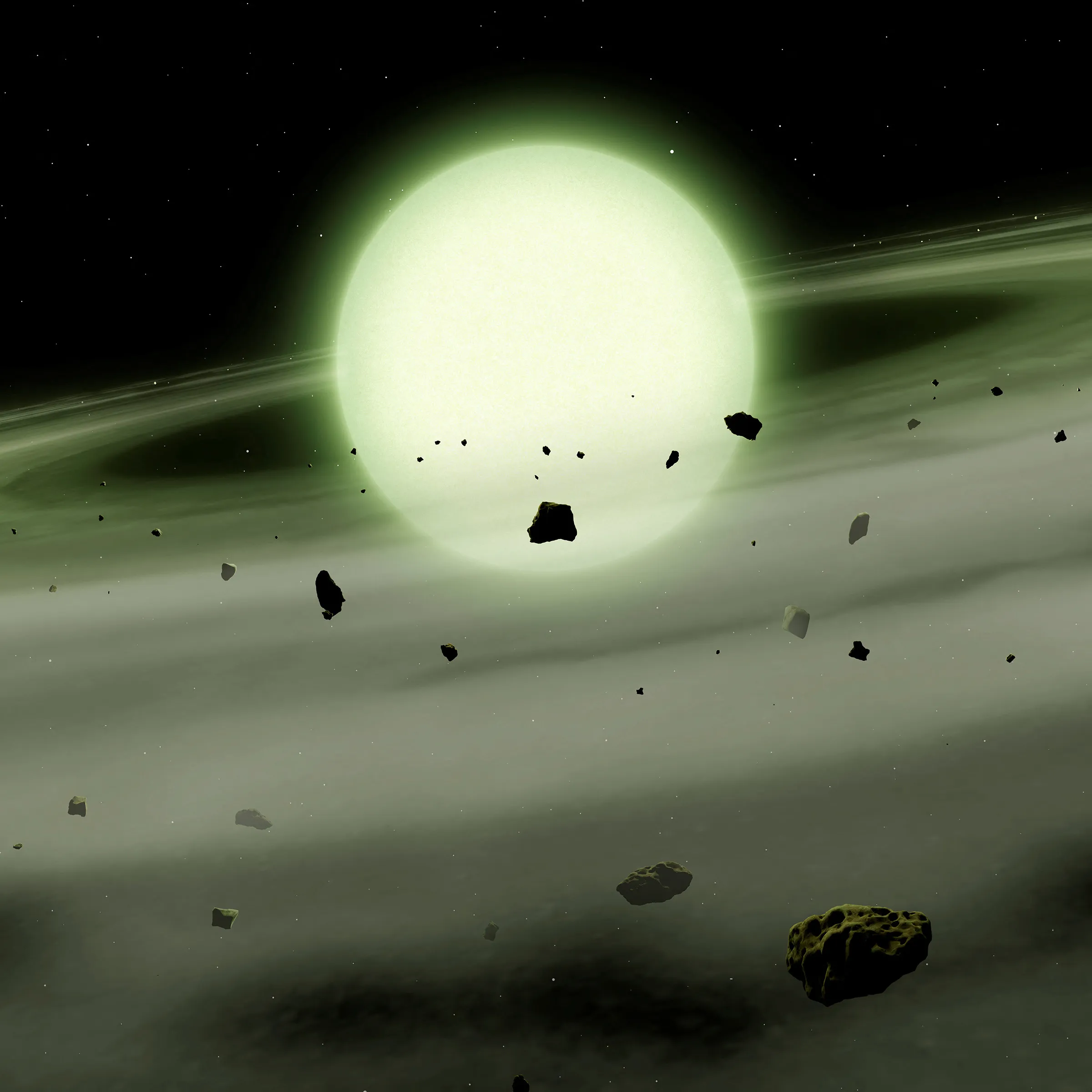
在生命接近尾声时,质量与太阳相仿的恒星会膨胀并变成红巨星。随后,它们会抛出气体外壳,形成我们能通过望远镜欣赏的行星状星云。恒星原有的位置则会留下一个白矮星——这是一个高度致密的物体,体积与地球相仿,质量却与太阳相当。
At the end of their lives, stars with a mass similar to the sun expand and turn into red giants. Subsequently, they shed their gaseous envelope, creating a planetary nebula that we can admire through telescopes. In place of the star, a white dwarf remains—a highly condensed object the approximate volume of the Earth but the mass of the sun.
最初,白矮星的温度极高,因此最早被发现的白矮星闪烁着白色至浅蓝色的光芒。它们的名字也由此而来。但根据发表在《皇家天文学会技术与仪器》杂志上的一项新研究,白矮星的世界实际上要丰富多彩得多——有些恒星会变成粉红色、绿色,甚至是紫色。
Initially, white dwarfs have extremely high temperatures, and so the first ones discovered shone from white to light blue. That’s how they got their name. But according to a new study published in the journal RAS Techniques and Instruments, the world of white dwarfs is actually far more colorful—with some stars turning pink, green, and even purple.
研究人员假设,密度是决定性因素。温度最低的白矮星的大气层密度可达每立方厘米约1克。这大约与水的密度相当,听起来可能不算什么,但对于一颗恒星来说,这样的密度已经相当惊人,约为太阳大气层密度的100万倍。在这种条件下,碳、钙和钠等任何微量元素都会与周围致密的氦等离子体相互作用,并吸收更广泛波长的光。
The researchers posit that density is the deciding factor. The atmospheres of the coolest white dwarfs can reach a density of approximately 1 gram per cubic centimeter. That’s roughly the same density as water, which may not sound like much, but it’s packed for a star, this being about a million times denser than the sun’s atmosphere. Under these conditions, any trace elements like carbon, calcium, and sodium interact with the surrounding dense helium plasma and absorb light across a wider range of colors.
来自古代行星系统的物质也发挥了作用。距离最近的行星可能会在红巨星阶段的炽热拥抱中消亡。其他行星,尤其是小行星,开始相互碰撞并向这颗死去的恒星迁移。这些天体的碎片随后会融入白矮星的大气层中。
Material from ancient planetary systems also plays a role. The closest planets can perish in the fiery embrace of the red giant phase. Other planets, and especially asteroids, begin to collide and migrate toward the dead star. Fragments of these bodies then integrate into the white dwarf's atmosphere.
通过业余爱好者的望远镜,白矮星看起来和任何其他微弱的恒星一样。然而,如果近距离观察,它们的颜色会丰富得多。富碳白矮星往往呈粉红色或紫色。根据计算,大气层中富含破碎小行星或其他天体物质的白矮星将呈现出黄色,在某些情况下还会呈现出绿色。温度最低的白矮星通常呈婴儿蓝,这是由氢原子和氦原子在其极度致密的大气层中碰撞引起的。
Through a hobbyist’s telescope, a white dwarf looks just like any other faint star. However, if observed up close, their colors would be much more varied. Carbon-rich white dwarfs tend to be pink or purple. According to calculations, white dwarfs whose atmospheres have been enriched with material from shattered asteroids or other bodies will exhibit yellow and, in some cases, green shades. The coolest white dwarfs are often a baby blue, which is caused by hydrogen and helium atoms colliding in their extremely dense atmospheres.
WD J1330+6435恒星就是一个例子。它的温度约为4000摄氏度,积累了来自其行星系统的岩石物质,使其大气层富含钙、锂和钠。这些元素使其呈现出浅黄绿色,使其成为我们银河系中已知的首颗绿色恒星。
One example is the star WD J1330+6435. With a temperature of around 4,000 degrees Celsius, it has accumulated rocky material from its planetary system, enriching its atmosphere with calcium, lithium, and sodium. These elements give it a light chartreuse color, making it the first known green star in our galaxy.
另一颗白矮星WD J1011+2845的大气层中含有大量的碳。它的绝大部分辐射都集中在超过600纳米的波长上,这使其呈现出三文鱼粉色。与此同时,白矮星WD J902-2010则更偏向于泡泡糖粉的色彩光谱。
Another white dwarf, WD J1011+2845, has a massive amount of carbon in its atmosphere. Almost all of its radiation is concentrated at wavelengths exceeding 600 nanometers, giving it a salmon-pink color. Meanwhile, the white dwarf WD J902-2010 leans toward the more bubblegum end of the spectrum.
然而,没有理由指望白矮星会被重新命名,因为事实上大多数此类恒星仍然是白色的。在这项研究中,作者检查了位于地球65光年范围内的152颗白矮星。其中只有五颗表现出不寻常的颜色,这表明宇宙中大约有三十分之一的白矮星会发出异常颜色的光。
However, there’s no reason to expect white dwarfs to start getting renamed, because most of these stars are, in fact, white. For this study, the authors examined 152 white dwarfs located within 65 light-years of Earth. Only five of them showed unusual coloration, suggesting that approximately one in thirty white dwarfs in the universe shines with unusually colored light.
*这似乎是一个意料之中的结果,但科学家此前曾假设白矮星主要呈蓝色。这种假设可能反映了夜空抽样中的偏差。最热的白矮星通常也是最亮的,因此可以从更远的距离被观测到。由于它们更容易被观测,许多研究最终导致蓝色恒星的比例被高估了。
This might seem like an expected result, but scientists previously assumed that white dwarfs were predominantly blue. That assumption may reflect bias in sampling the night sky. The hottest white dwarfs are also typically the brightest and can, therefore, be seen from greater distances. Because they’re easier to observe, many studies end up over-representing blue stars.
虽然你无法用肉眼看到最近的白矮星,但你至少可以朝它的方向看去。天狼星B是地球夜空中最亮恒星的伴星。在冬季,天狼星很容易被发现,在东方地平线上方明亮地闪烁。天狼星B属于“较无趣”的白矮星群——它的温度徘徊在25,000开尔文左右,呈现出浅蓝色。
While you won’t be able to see the nearest white dwarf with the naked eye either, you can at least look in its direction. Sirius B is the companion to the brightest star in Earth’s night sky. During winter, Sirius is easy to spot shining brightly above the eastern horizon. Sirius B belongs to the group of “more boring” white dwarfs—its temperature hovers around 25,000 Kelvin, giving it a light blue color.
这篇报道最初发表在《连线》杂志捷克和斯洛伐克版上,由捷克语翻译而来。
This story originally appeared on WIRED Czech Republic and Slovakia and has been translated from Czech.