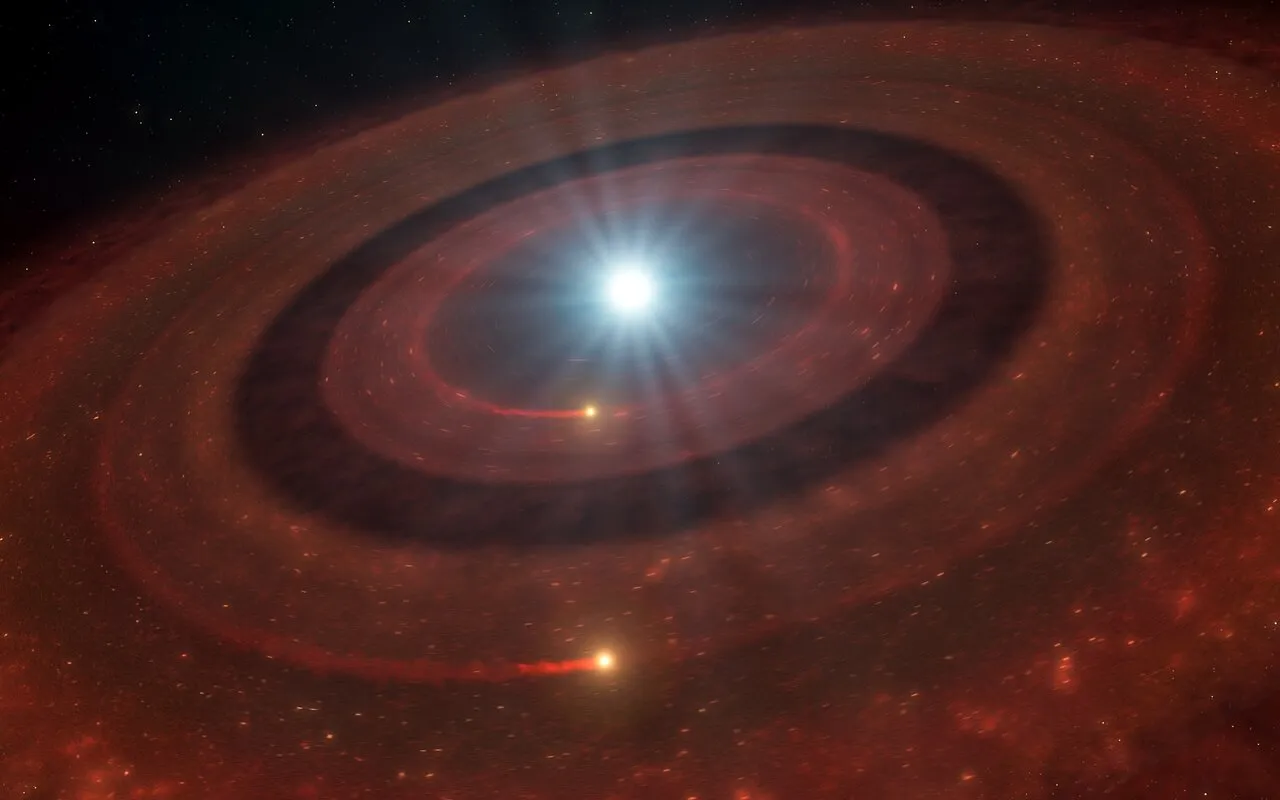
白矮星J1328−1450距离地球约1,600光年。天文学家此前已通过星图目录得知它的存在,但利用欧洲南方天文台的甚大望远镜(没错,这确实是它的真名)进行的最新观测表明,它被一个结构异常的碎屑盘所包围:两个由间隙隔开的截然不同的气体环。
The white dwarf J1328−1450 is located about 1,600 light-years from Earth. Astronomers were already aware of it thanks to star-mapping catalogs, but new observations taken with ESO’s Very Large Telescope (yes, that’s its real name) revealed that it is surrounded by a disk of debris with an unusual structure: Two distinct rings of gas separated by a gap.
根据该天文台的说法,这个物质盘很可能是曾环绕J1328−1450运行的行星系统的残余。在经历红巨星阶段并随后变成白矮星的过程中,这颗恒星可能摧毁了它的一些行星,并使其他岩石天体暴露在极端环境中。部分释放的物质最终在这颗死星周围形成了一个气体和尘埃盘。
According to the observatory, this disk of material is likely the remnant of the planetary system that once orbited J1328−1450. As it passed through a red giant phase and subsequently became a white dwarf, the star may have destroyed some of its planets and left other rocky bodies exposed to an extreme environment. Some of the released material ended up forming a disk of gas and dust around the dead star.
塑造该系统的过程可能会在我们自己的太阳系中重演。在大约50亿年后,太阳将耗尽其燃料并膨胀为红巨星。在此阶段,它可能会吞没附近的天体,比如最近的行星。然后它会脱落其外层,留下一个白矮星。任何在此次演化中幸存下来的岩石天体都可能会碎裂,并在死星周围形成一个碎屑盘,就像天文学家现在在J1328−1450中所观察到的那样。
The process that shaped this system could repeat itself in our own. In about 5 billion years, the sun will exhaust its fuel and expand into a red giant. During this phase, it could engulf nearby bodies, like the closest planets. It will then shed its outer layers, leaving behind a white dwarf. Any rocky bodies that survive this transformation could break apart and form a debris disk around the dead star, like the one astronomers are now observing in J1328−1450.
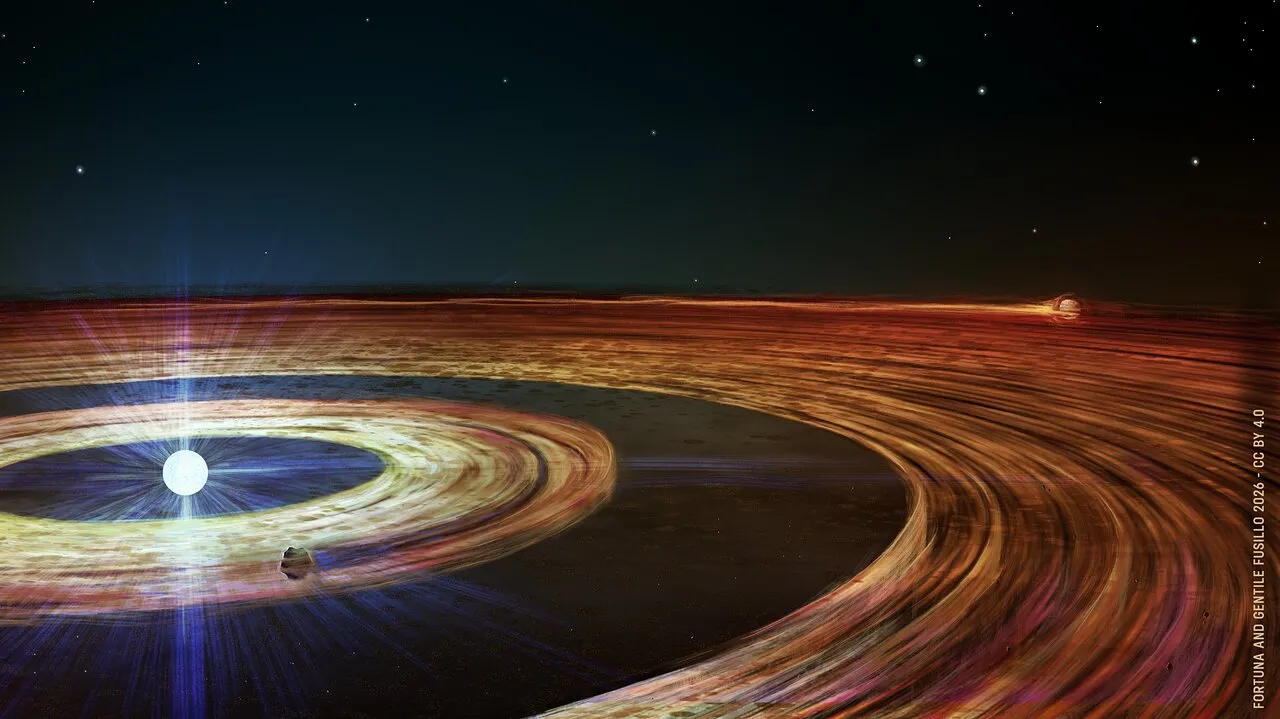
但白矮星的两个碎屑环暗示了另一种可能性。它们的结构似乎是由天文学家尚未能直接识别的天体塑造的。数据表明,在这颗恒星演化之后,该系统残余中可能至少幸存了两个行星天体。
But the white dwarf’s two debris rings hint at another possibility. Their structure appears to be shaped by bodies that astronomers have not yet been able to identify directly. The data suggest that, following the star’s transformation, at least two planetary objects may have survived among the remnants of that system.
研究人员认为这两个天体的尺寸可能大不相同。距离白矮星较近的那颗直径仅有几公里,而较远的那颗可能和冥王星甚至月球一样大。它们与周围物质的相互作用将能解释这两个环的形成,尽管目前尚未证实它们作为独立天体存在。另一种可能性是,该结构源自一个类似行星的天体的不同部分,例如其地壳和地核。
Researchers believe these two bodies could be very different in size. The one closest to the white dwarf would measure just a few kilometers in diameter, while the more distant one could be as large as Pluto or even the moon. Their interaction with the surrounding material would explain the formation of the two rings, although it has not yet been confirmed that they exist as separate objects. An alternative possibility is that the structure originates from different parts of a single planet-like body, such as its crust and core.
这个故事最初发表在WIRED en Español上,是由西班牙语翻译过来的。
This story originally appeared on WIRED en Español and has been translated from Spanish.