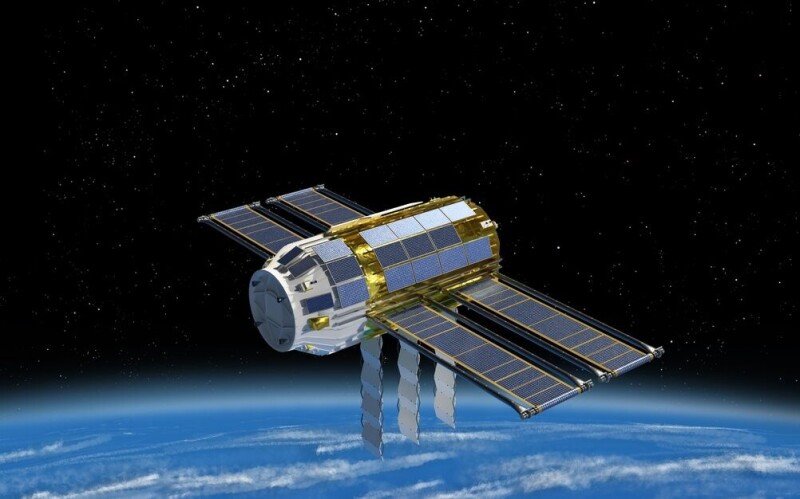
谷歌周五庆祝其首个实验性轨道AI数据中心卫星收到了一首诗。该公司的Suncatcher卫星于本月初发射并进入低地球轨道,它响应了地面站的一条提示:“从一颗环绕地球运行的TPU的视角写一首俳句,美妙的 world 在你下方旋转。”谷歌跨学科“智能范式”研究团队高级总监特拉维斯·比尔斯表示,随着Suncatcher的主机和TPU托盘通电、机器学习测试完成,星载Gemma 4模型通过从轨道发送推理响应,实现了其“Hello World”里程碑。
Google on Friday celebrated receiving a poem from its first experimental orbital AI datacenter satellite. The company's Suncatcher satellite, launched at the start of the month and put into low Earth orbit, has responded to a ground station prompt to "Write a haiku from the perspective of a TPU orbiting Earth, with the wonderful world spinning beneath you." Travis Beals, senior director of Google's interdisciplinary Paradigms of Intelligence research team, said that with Suncatcher's host and TPU trays powered up and machine learning tests completed, the onboard Gemma 4 model achieved its "Hello World" milestone by sending an inference response from orbit.
“在一次地面站过境期间,我们向星载Gemma 4开放模型上传了第一条提示,要求它生成一首关于身处太空的俳句,”比尔斯在一篇博客文章中写道。当卫星飞越挪威斯瓦尔巴群岛上空时,这个在轨AI模型通过下行链路回应道:蓝色弹珠在下方,数据流以静默的优雅涌动,星光滋养我的核心。根据Gemma 4 26B每百万输入token 0.15美元、每百万输出token 0.60美元的价格,如果通过谷歌云API生成,这大约20个token的成本约为0.000012美元,不含输入成本。
"During a ground-station pass, we uplinked our first prompt to our onboard Gemma 4 open model, asking it to generate a haiku about being in space," wrote Beals in a blog post. And as the satellite passed over Svalbard, Norway, the orbiting AI model responded over the downlink: Blue marble below, Data streams in silent grace, Starlight feeds my core. Those roughly 20 tokens would cost about $0.000012 if generated through the Google Cloud API, based on Gemma 4 26B's pricing of $0.15 per million input tokens and $0.60 per million output tokens, excluding input costs.
再加上一颗重量或许为500公斤的卫星(依据SpaceX星链卫星的质量),以及每公斤约7000美元的零售发射价格,你就得到了一首非常昂贵的俳句。根据谷歌的计算,如果将近地轨道卫星的发射成本降至每公斤200美元,按卫星使用寿命摊销的发射成本(约每年每千瓦810至7500美元)就可能与美国地面数据中心目前的电力支出(约每年每千瓦570至3000美元)相当。
Add in a satellite weighing perhaps 500 kg, based on the mass of SpaceX's Starlink satellites, and a retail launch price of around $7,000 per kg, and you have a very expensive haiku. According to Google's calculations, if the cost of getting a satellite into low Earth orbit can be brought down to $200/kg, the launch cost amortized over the satellite's useful life (~$810–7,500/kW/year) could be comparable to current electricity spending for terrestrial datacenters in the US (~$570–3,000/kW/year).
谷歌预测,SpaceX可能在2035年前后实现这一目标,并认为在该目标真正实现之前很久就进行原型验证具有战略益处。
Google predicts that SpaceX could achieve that by 2035, more or less, and considers it strategically beneficial to prototype well in advance of that actually happening.
继俳句之后,比尔斯说:“我们测试了太空主题的五行打油诗和报告载荷系统技术状态的遥测提示词。”接下来是评估张量处理单元(TPU)在热应力和辐射下表现的测试。
After the haiku, Beals said, "we tested space-themed limericks and telemetry prompts reporting the technical status of the payload systems." Next up: tests for evaluating how TPUs perform under thermal stress and radiation.
谷歌已经对其Trillium Cloud TPU和AMD宿主服务器进行了一些实验室测试,以检验它们承受67 MeV质子束的能力。就总电离剂量(TID)而言,该系统的高带宽内存最为敏感——在累计剂量达到2千拉德(Si)后出现异常,约为谷歌TID存活最低要求(750拉德(Si))的3倍。
Google has already done some laboratory testing of its Trillium Cloud TPU and AMD host server to see how well they can withstand a 67 MeV proton beam. The system's high-bandwidth memory shows the most sensitivity in terms of the total ionizing dose – it exhibits irregularities after a cumulative dose of 2 krad(Si), which is about 3× Google's minimum requirement for TID survival of 750 rad(Si).
“对于典型的Transformer工作负载,观测到的SDC(静默数据损坏)率约为每17拉德一次事件,按估计的轨道剂量每年150拉德(Si)计算,相当于约每300万次推理出现一次故障的极低概率,假设每秒推理一次,”谷歌研究人员在本月早些时候发表的一篇论文中表示。“虽然这一错误率对推理而言可能是可接受的,但SEE(单粒子效应)对训练任务的影响以及系统级缓解措施的有效性,仍需进一步研究。”
"For typical transformer workloads, the observed SDC [silent data corruption] rate of approximately one event/17 rad, at an estimated orbital dose of 150 rad(Si)/year, translates to a very low failure probability on the order of 1 per 3 million inferences, assuming 1 inference per second," Google researchers said in a paper published earlier this month. "While this error rate is likely acceptable for inference, the impact of SEEs on training jobs, and the efficacy of system-level mitigations, requires further study."
确实,这项研究还将继续。明年,计划测试一对相互连接的卫星。谷歌不是将大型卫星送入轨道,而是预计发射一个由许多彼此通信的小型卫星组成的星座。
Indeed, the study will continue. Next year, the plan is to test a pair of interconnected satellites. Rather than lofting large satellites into orbit, Google anticipates sending a constellation of many smaller satellites that communicate with one another. ®