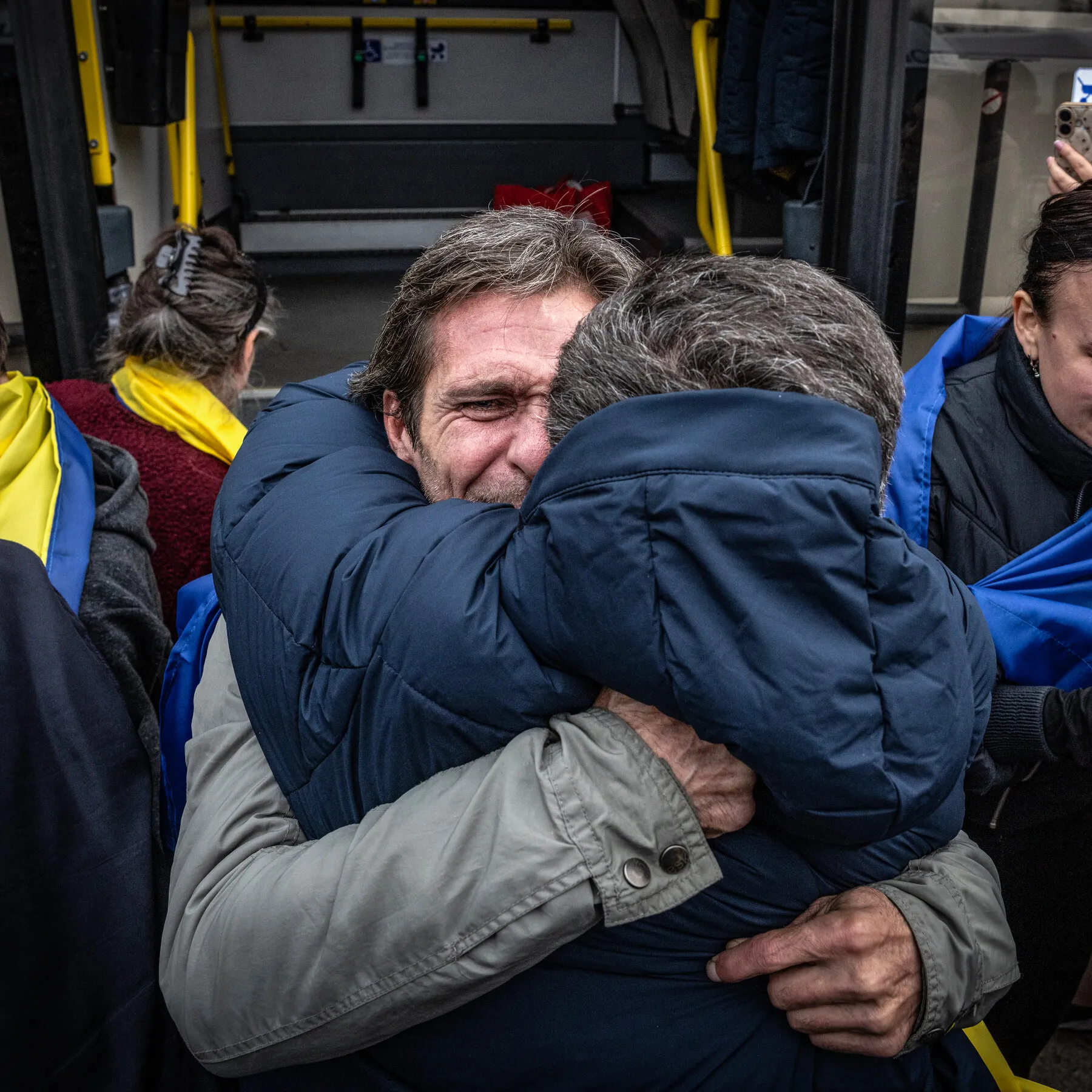
“我们是从地狱里出来的”:一座乌克兰城市的撤离者讲述生存故事在经历了数年的战区生活和惊心动魄的24小时旅程后,疲惫的平民在安全撤离奥列什基后与家人和朋友团聚。周六,乌克兰人从前线城镇奥列什基撤离。图片来源……一名少女认出了父亲,发出一声嘶哑的尖叫。他是数百名逃脱者之一:他们经历了数年的俄罗斯占领、在致命无人机战中饥饿度过的数月,随后在一位第一夫人和教皇的斡旋下达成停火,并踏上了返回亲人身边的漫漫长途。
‘We Are Coming From Hell’: A Ukrainian City’s Evacuees Tell Survival Stories Safely out of Oleshky after enduring years in the combat zone and a harrowing 24-hour journey, weary civilians reunited with family and friends. Ukrainians evacuated from the frontline town of Oleshky, Ukraine, on Saturday. Credit... Supported by A rasping scream rang out as a teenager recognized her father. He was one of the hundreds of people who had escaped: years of Russian occupation, months of hunger under a deadly drone war, and then a truce backed by a first lady and the pope and an odyssey back to their loved ones.
周六,一队大巴将撤离者从饱受战火蹂躏的乌克兰城市奥列什基送出战区,乘客们挥手、擦泪,随着车辆驶入停车场,他们的旅程画上了句号。
A fleet of buses brought the evacuees from the embattled Ukrainian city of Oleshky out of the war zone on Saturday, the passengers waving and wiping tears as they swung into the parking lot and ended their journey back.
撤离者裹着乌克兰国旗,小心翼翼地走下大巴,在经历了24小时的旅程后显得疲惫不堪,这段旅程将他们从前线带经俄罗斯和白俄罗斯,再返回乌克兰。许多人因数月食物匮乏而消瘦,因缺乏睡眠而眼眶乌黑。
Draped in Ukrainian flags, the evacuees stepped down gingerly from the buses, weary after a 24-hour journey, which took them from the front line and through Russia and Belarus before returning to Ukraine. Many were gaunt from living months with little food, dark rings round their eyes from lack of sleep.
“我们是从地狱里出来的,”75岁的奥列克桑德尔·斯季奥平点着一支烟说。“那是个杀戮区。”由于被困在靠近前线的地方,俄罗斯士兵就住在他们中间,自2022年俄罗斯入侵乌克兰以来,奥列什基居民已在占领下生活了四年多。
“We are coming from hell,” said Oleksandr Styopin, 75, lighting a cigarette. “It’s a kill zone there.”Trapped close to the front line, with Russian soldiers living among them, the residents of Oleshky have been living under occupation for more than four years since Russia invaded Ukraine in 2022.
退休电气工程师斯季奥平说,今年他们的处境恶化了,因为乌克兰大幅增加了对该地区俄军的无人机袭击。
Their predicament worsened this year, when Ukraine drastically increased its drone attacks on Russian forces in the area, said Mr. Styopin, a retired electrical engineer.
他说,道路遭到炮火袭击,物资断绝,因为越来越少的司机敢于冒险运送。一些居民试图开车去附近的拉登斯克镇购买补给,但许多人在路上被无人机击中车辆而丧生。他说,俄罗斯士兵的尸体就躺在路上,因为没人敢冒险去收尸。
The roads came under fire and supplies dried up as fewer and fewer drivers dared to risk the trip. Some residents tried to drive to the nearby town of Radensk to buy provisions, but many were killed on the road when drones struck their vehicles, he said. Bodies of Russian soldiers were left lying in the road, he said, since no one would risk collecting them.
斯季奥平先生偶尔会推着自行车去附近的商店,尽可能多地买些食物带回来。他说,有一次他路过一个女孩烧焦的尸体,尸体就躺在她自己的自行车旁边。“我想那是踩到地雷了,”他说。他说,一些无人机曾贴近悬停,似乎在观察他,随后便放他走了。但他说,它们却穷追不舍地猎杀俄罗斯士兵。
Mr. Styopin would push his bike to a local store once in a while and stock up on as much food as he could carry. Once he passed the burned body of a girl beside her own bicycle, he said. “That was from a mine, I think,” he said. Some drones hovered close as if to look at him, and then let him be, he said. But they hunted down the Russian soldiers relentlessly, he said.
“它们把他们死死钉在原地,根本不敢迈出大楼一步,”他说起那些俄罗斯士兵时说道。他说,一群士兵搬进了他所在楼里的一套公寓。
“They pinned them down so hard, they could not step out of the building,” he said of the Russian soldiers. A group of soldiers had moved into an apartment in his building, he said.
一些撤离者在回忆毁灭与失去时,语气轻松得近乎幽默,讲述着他们所经历的苦难。
Some of the evacuees described the hardships they endured with a lightness that verged on humor as they recalled destruction and loss.
“既没电也没水。后来房子被炸了。接着食物断了绝,”65岁的哈琳娜·洛赫维诺夫斯卡说。
“There was no electricity and no water. Then the house got bombed. Then the food ran out,” said Halyna Lohvynovska, 65.
“我们什么都习惯了,”她丈夫伊万·洛赫维诺夫斯基笑着说。他说他们家被击中好几次。“砸到头上东西了,就换个屋;房子毁得更厉害了,就换个房子。”撤离者中有一些年轻家庭,甚至还有年幼的孩子。
“We got used to everything,” her husband, Ivan Lohvynosky, said with a smile. Their house was hit several times, he said. “When something fell on your head, you moved to another room. When the house was destroyed more, you moved house.”There were some young families and even young children among those evacuated.
24岁的弗拉季斯拉夫和姐姐、母亲一起出来了。他瘦削、警惕,出于安全考虑拒绝透露姓氏,他说。
Vladyslav, 24, came out with his sister and mother. Thin and watchful, he declined to give his surname for security, he said.
他说,一家人之所以留在奥列什基,是因为担心俄罗斯当局会阻止他离开;他已到了在乌克兰服兵役的年龄。他说,他们靠在自家菜园种蔬菜、养几头牲畜活了下来。在一些同行撤离者眼中,这已是难得的好运。
The family had stayed in Oleshky because they had been scared that the Russian authorities would prevent him from leaving; he was of the age to be drafted into the military in Ukraine. They survived by growing vegetables in their garden and raising a few animals, he said. To some of their fellow evacuees, that was good fortune.
“过去两年太可怕了。我们什么也吃不上,”53岁的阿纳托利·洪恰罗夫说。他61岁的哥哥瓦列里有三年没收到他的消息,因为通讯太差了。只有住在靠近河边的家庭才能接收到乌克兰的手机信号。
“The past two years were terrible. We had nothing to eat,” said Anatolii Honcharov, 53. His 61-year-old brother, Valerii, had not heard from him for three years because communications were so bad. Only families who lived close to the river could pick up a Ukrainian cellphone signal.
斯季奥平说,最近几个月局势变得如此危险,以至于他不敢走出公寓。他说,他坐在那里听收音机,一支烟永远夹在牙缝里。
Things became so dangerous in recent months, Mr. Styopin said, that he did not dare leave his apartment. He sat listening to the radio, a cigarette permanently clamped between his teeth, he said.
他的妻子在2022年全面入侵伊始离开,去纽约皇后区和儿子汇合,曾多次打电话催促他离开。“如果我试图离开,我会踩到地雷,”他告诉妻子。
His wife, who left at the onset of the full-scale invasion in 2022, joining their son in Queens, New York, called him many times urging him to leave. “If I try to leave, I will step on a mine,” he told her.
“过去两个月我一直生活在无人机的盘旋之下,”他补充道。“这不仅仅是恐惧,”他说,“这是一种始终潜伏在你内心深处的内在恐惧。”但奥列什基的困境引起了国际关注,有助于推动这场双方都争取一切优势的战争中罕见的局部停火。教皇利奥十四世在接受肺癌手术仅三天后,与俄罗斯总统弗拉基米尔·V·普京通话,呼吁停火以撤离该城市,随后美国第一夫人梅拉尼娅·特朗普于上周五宣布了一项局部停火。
“For the last two months I was living with a drone above my head,” he added. “It’s more than fear,” he said, “it’s an internal dread that’s always present inside you.”But the plight of Oleshky drew international attention, helping to push for a rare localized truce in a war where each side has pressed for every advantage. Pope Leo XIV, just three days after surgery for lung cancer, spoke with President Vladimir V. Putin of Russia and called for a cease-fire to evacuate the city, and then the American first lady, Melania Trump, announced a local truce last Friday.
当停火于周二生效时,俄罗斯士兵似乎排除了道路上的地雷,并清理了街道上的尸体。
When the cease-fire began on Tuesday, Russian soldiers appeared to demine the roads and clear the streets of the dead.
“俄罗斯人清理了一切,”斯季奥平说。“有一辆被毁的装甲运兵车,里面有尸体,”他补充道。“有一具尸体碎成了两半,一半在这里一半在那里。俄罗斯人把它们全带走了。”许多居民不信任人道主义车队的消息。有几人说,他们早前曾试图乘坐车队离开,但车辆遭到炮击后不得不撤回。
“The Russians cleared up everything,” Mr. Styopin said. “There was a destroyed armored personnel carrier with bodies inside,” he added. “There was a body in pieces, half here and half there. The Russian took them all away.”Many residents did not trust the news of a humanitarian convoy. Several said they had tried to leave in convoys early in the war only to retreat after the vehicles came under fire.
但斯季奥平收拾了行李。随后,周五早上当他离开家时,一次爆炸将他震退。他说,在俄罗斯人排雷过程中发生了一次爆炸,弹片撕裂了他的手提箱。
But Mr. Styopin packed his things. Then, on Friday morning as he was leaving his home, a blast knocked him back. During the Russians’ demining an explosion went off, and shrapnel ripped into his suitcase, he said.
他回去找了另一个箱子,然后冒着大雨奔跑了一英里多赶往大巴车。
He went back to find another case and then rushed through heavy rain for more than a mile to the bus.
“我心如火焚,”他说。“我以为我得爬着过去才能离开。”弗拉季斯拉夫说,他和家人不敢相信他们真的能逃脱。
“My heart was burning,” he said. “I thought I would crawl there in order to leave.”Vladyslav said he and his family feared to trust that they would truly escape.
“过去这四天,我们都不相信能活着出来,”他说。“我们以为这不过是又一次挑衅——他们会宣布停火,然后在路上把我们炸死,”他解释道。“我们很害怕,但还是走了,因为可能不会再有下一次机会了。”许多撤离者及其家属表示,他们对这次将他们转移到安全地带的行动如此严肃和规模之大感到惊讶,并称这让他们对战争结束燃起了希望。弗拉迪斯拉夫站在停车场里环顾四周,看上去仍有些茫然。
“These last four days, we didn’t believe we would make it out,” he said. “We thought it was just another provocation — they would declare a cease-fire and then blow us up along the way,” he explained. “We were terrified, but we went anyway, because there might not be another chance.”Many of the evacuees and their families said they were surprised at the scale of the seriousness of the operation to get them to safety, and said it raised hopes for an end to the war. Standing in the parking lot looking around, Vladyslav still looked uncertain.
“我还没太弄明白自己现在的心情,”他说。“是幸福。重新回到自己的旗帜下,听到自己的语言。”卡洛塔·加尔是资深记者,报道乌克兰战争。戴维·古滕费尔德是《纽约时报》驻明尼阿波利斯的视觉记者。
“I can’t quite make sense of my mood yet,” he said. “Happiness. Being back under my own flag, hearing my own language.”Carlotta Gall is a senior correspondent, covering the war in Ukraine. David Guttenfelder is a Times visual journalist based in Minneapolis.