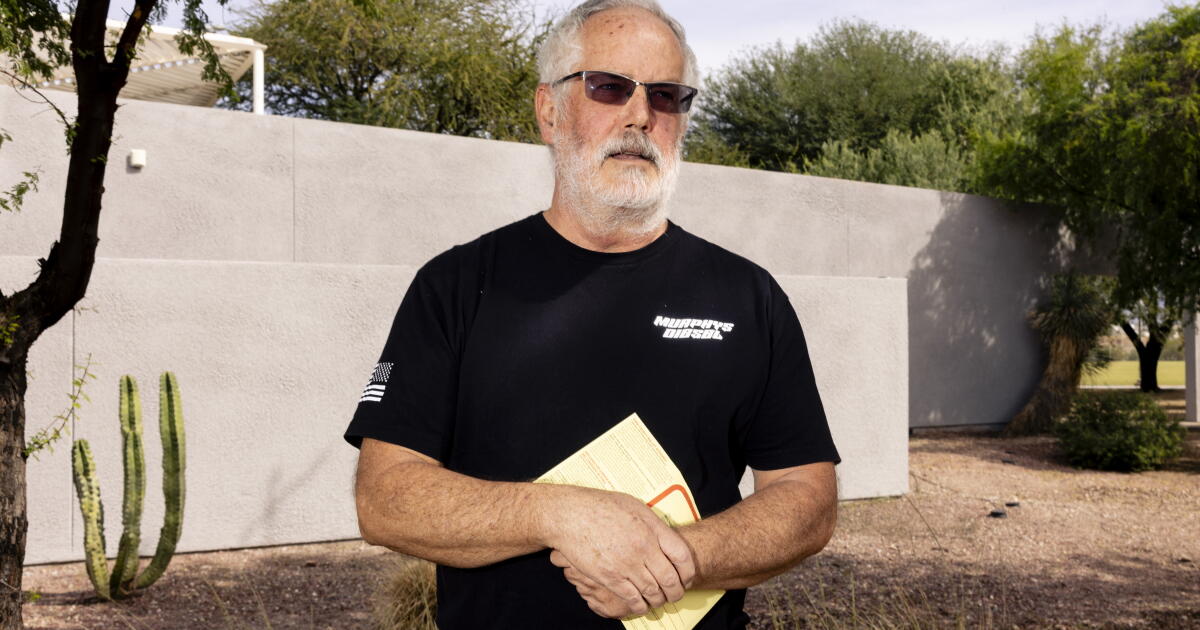
迈克尔·福克正走向皮马县分馆图书馆投递选票,途中停下脚步谈论周二的中期选举。皮马县位于亚利桑那州中南部,是全美竞争最激烈的国会选区之一。66岁的退休人员福克是政治独立人士,他把票投给了民主党人乔安娜·门多萨,尽管他对她知之甚少。但福克对特朗普总统了如指掌,且深恶痛绝。“从一开始,当他登上政治舞台,他就向那些长期被压制的人、美国的偏执分子,明确传达了信息,他给了他们发声的机会,并告诉那些人:‘你们这样想没问题。’”
福克挥舞手臂,仿佛一堵移动的火墙,“然后这就像野火一样蔓延开来,这也是为什么我们会有这么多针对棕色人种和非法移民的法律。”
格雷戈里·科龙承认,他对门多萨的对手、共和党现任议员胡安·西斯科马尼也不太熟悉。但67岁的计算机程序员科龙曾三次为特朗普投票,并认为总统正引领国家走向正确方向。“我认为,例如揭露欺诈是件大事。科技正在腾飞。我对此完全充满期待,”科龙说,当时他在奥罗山谷的一家购物中心闲逛,等待爱车雷克萨斯更换轮胎。
“我认为经济强劲。股市表现良好。就业形势也不错。”基于这个原因,科龙把票投给了西斯科马尼,生怕民主党若控制国会会发生什么。“特朗普发起的改革,”科龙说,“必须继续下去。”
门多萨和西斯科马尼几个月来对亚利桑那州南部的选民发起猛攻,以源源不断、刺鼻的广告轰炸淹没他们的感官,搅浑了电波。
两位对手及其盟友在该选区共投入数千万美元,两党均将其列为头号优先事项。然而,很大程度上,门多萨和西斯科马尼不过是替身,他们的参选不过是总统及其反对派的代理人战争。另一位奥罗谷居民劳拉·伦特纳承认西斯科马尼做过一些好事。这位民主党人说,他不是坏人。“但他持续支持特朗普,对我来说这就抵消了一切,”这位73岁的退休牙科卫生员说。
伦特纳认为,共和党议员该站出来“别再怕特朗普和他的选民了”。亚利桑那州第六国会选区以图森东部及其郊区为核心,向北延伸至菲尼克斯,向东达新墨西哥州,向南直抵美墨边境。这片干旱土地上崎岖山脉纵横,幽美峡谷纵深,辽阔旷野中中型城市和小城镇如绿洲般从沙漠中拔地而起。近年来,这片版图成为全美争夺最激烈的政治战场之一。
2020年,拜登以不到一个百分点的优势拿下该选区。四年后,特朗普以同样微弱的优势将其翻红。竞选第三个任期的西斯科马尼已两次险胜。这一次,他面对的新对手是门多萨,一名海军陆战队老兵、前国会助理。该选区拉美裔人口占比显著——西斯科马尼和门多萨都是墨西哥裔美国人——且拥有大量老年人、退伍军人和现役军人。
门多萨大力强调自己的海军和海军陆战队服役经历。“经受战火考验,准备好领航”,她的竞选广告牌如此宣称,其中一块就矗立在华楚卡堡陆军基地附近。(他的广告牌则打出“退伍军人支持西斯科马尼”。)门多萨猛烈抨击现任议员是特朗普的“软骨头”工具,在铺天盖地的广告轰炸中把总统推到最前沿。
Michael Falk was heading into the Pima County branch library to drop off his ballot when he stopped to discuss Tuesday’s midterm election.
西斯科马尼的铺天盖地的广告宣扬他的两党合作精神——他来自共和党建制派——并将门多萨描绘成失控左派的工具。从这个意义上说,他们的竞选活动浓缩了这场中期选举的拉锯战,正如以往每一次中期选举一样,本质上都是对椭圆形办公室主人的公投。对特朗普支持者而言,这意味着要为通胀和与伊朗的战争等棘手问题辩解,这两大拖累正拖垮总统和同党共和党人。
Pima County, in south-central Arizona, is home to one of the most competitive congressional races in the country.
特朗普选民表示,物价上涨是拜登执政时期留下的后遗症,是必要的牺牲,或是会过去的不便。呼应总统的说法,他们称创纪录的汽油价格是一种权衡——而且是划算的权衡——目的是防止伊朗制造核武器。“我希望汽油价格能降下来,”共和党人苏珊·萨默斯在韦尔买菜时停下闲聊说道。这个旧铁路小镇已成为退休人士如74岁的萨默斯——加州圣贝纳迪诺州立大学前行政人员——以及不介意开约25英里去图森上班的通勤者的目的地。
但萨默斯接着说,她愿意接受更高的汽油价格,“因为我认为阻止一个狂热政权获得实际上会在更长远威胁我们的核武器很重要。一旦有某种解决……价格会在一定程度上下降,会让很多人生活轻松些。”梅里琳·普伦蒂斯,78岁,是另一位从隔壁州搬来的“难民”。在护理行业工作一辈子后,她从南加州搬到了本森(人口5500)。
Falk, a 66-year-old retiree and political independent, was casting his vote for the Democrat, JoAnna Mendoza, even though he hardly knows a thing about her.
她赞扬特朗普展示了其他总统缺乏的决心。“他们是恐怖分子的支持者,而我们国内有恐怖分子细胞,”普伦蒂斯谈到伊朗时说。“没人想谈这个。其他总统都不想碰它。”如果总统的支持者往往显得处于守势——辩解、合理化、呼吁耐心——那么特朗普的批评者则怒火中烧。
在塞拉维斯塔,72岁的安·尼科尔斯是一名倾向民主党的独立选民,她几乎说不出话来,因为愤怒的情绪太多,语速都跟不上。“别忘了关税是如何毁了经济的,”她说,“内塔尼亚胡诱骗特朗普对伊朗宣战,这场战争如何毁了经济、推高了油价,政府里的猖獗腐败,环境保护局简直可以改叫环境污染局,试图毁掉教育部,还有个一窍不通的蠢货掌管医疗卫生。”
But Falk knows — and loathes — a good deal about President Trump.
尼科尔斯停下来调整了一下N95口罩。她在胡阿丘卡堡陆军基地当了几十年医学图书管理员。尼科尔斯说,她投给门多萨的一票,是为了给特朗普套上缰绳,开始扭转他过去两年造成的部分破坏。然而,尽管她充满激情,但如果周二真的出现“蓝色浪潮”,那将是错误的假设,以为这意味着选民对民主党充满敬重或溢于言表的喜爱。
63岁的克莱顿·萨拉特是一名退休演员兼编剧,他在韦尔的食品银行分发装满杂货的箱子——蔬菜、蛋白质食品、一条面包——途中停下来,表达了对特朗普和民主党的双重不满。“我认为我们现在的政府靠残酷生存、靠残酷延续,”他说,一边源源不断的汽车驶来领取物资。“看到我们的世界、我们的领导人表现得像个八岁小学生,如果在学校这么干早就该受罚了,这让我很难过。”与此同时,萨拉特说,他不确定民主党到底主张什么,除了反对特朗普之外。
倾向民主党的独立选民亚当·汤普森说得更直白。“我不喜欢任何一个党,”他说。这位39岁的男子住在坦克韦德,在亚利桑那州中南部各地跑动,给大型零售商送苏打水和零食。最近他对特朗普特别愤怒。
汤普森问道,为什么要花费如此多的时间和资源在海外事务上?他说:“我们需要照顾这里的人。伊朗的战争、中东的战争无助于我把饭端上餐桌。我拼命工作。但归根结底,我必须付出这个代价,因为……我们忙着为别人打仗。” 最大的问题是,有多少灰心的特朗普选民会放弃投票。他们的冷漠程度和缺席率将决定民主党是迎来一个“好夜晚”还是“完美夜晚”。
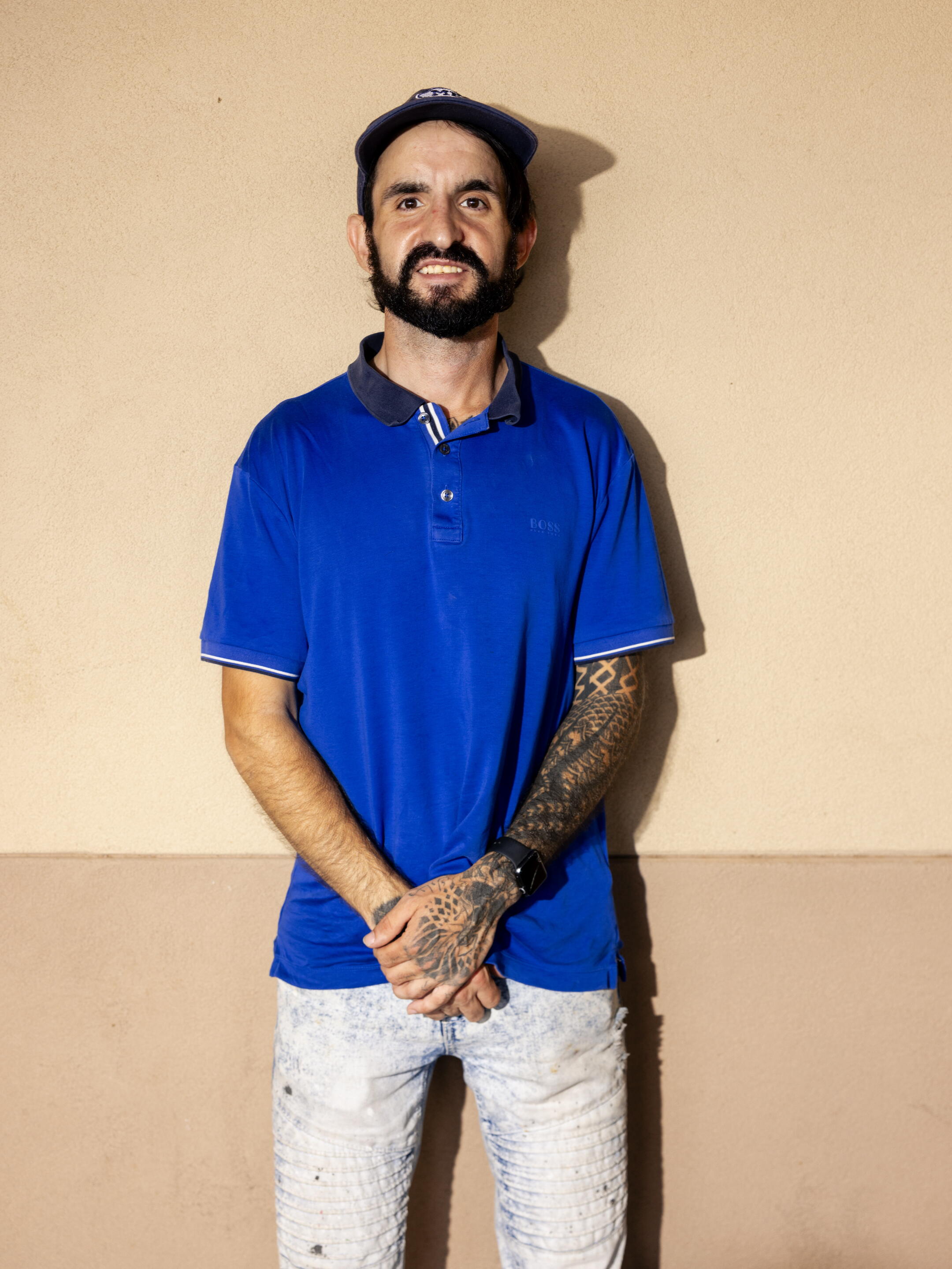
35岁的纹身师、自由意志主义者亚历克斯·拉格伯格曾三次投票给特朗普。他最初被特朗普看似真实的个性和纽约房地产开发商的背景所吸引。“他是个不错的选择,因为他不是政客,”拉格伯格在卡萨格兰德的一家墨西哥超市外说道。但他接着说,事实证明,特朗普所谓的创业才干并非拉格伯格原本所想,也不是特朗普自夸的那样。
“把国家当企业来管起初挺好,但确实没多大帮助,”拉格伯格说,“我们没看到多少变化。”他说自己并没有特别的动力去投票,或者在西斯科马尼和门多萨之间做选择,尤其是两人还在互相大肆泼脏水。
里克拒绝透露姓氏,因为他不想因自己的观点而遭骚扰,他已经下定决心。他说自己彻底不投票了——永远不投。这位67岁的退休政府职员、右倾自由意志主义者,很早就对政治和政客感到厌倦。“民主党、共和党,”他说,“都是一回事。”他在2024年投了特朗普一票,给政治制度最后一次机会。现在呢?特朗普承诺“不发动新战争。结果呢?”里克反问,“新战争来了。税收依然太高。医保?医保烂透了。”所以不,他说,他不打算理会这次选举了。
当里克走出韦尔旧货店时,他仍对特朗普、门多萨、西斯科马尼以及那一伙人气愤不已。他紧紧握着刚买的东西——一张雷·普赖斯金曲精选集。这位乡村歌手有一首歌似乎恰如其分地概括了里克的心态:《你辜负了我》。他并非孤例。
“From the very beginning, when he stepped on the political stage, he made it quite clear to the people who were silenced for a long time, the bigots of the United States, he gave them a voice, and he told those people, ‘It’s OK for you to think the way that you do.’ “And then that just took off like wildfire,” Falk said, sweeping his arm like a moving wall of flame, “and that's why we have all these laws that are against brown people and illegal people.” Gregory Corron confessed he’s not too familiar with Mendoza’s opponent, the Republican incumbent Juan Ciscomani. But Corron, a 67-year-old computer programmer, voted for Trump three times and believes the president is moving the country in the right direction. “I think, for instance, exposing fraud is a big thing. Technology is taking off. I’m totally excited about that,” said Corron, who was killing time at a strip mall in Oro Valley while the tires on his Lexus were being replaced. “I think the economy is strong. The stock market is doing well. Employment is doing well.” For that reason, Corron cast his ballot for Ciscomani, fearful of what might happen if Democrats take control of Congress. “The reforms that Trump started,” Corron said, “need to continue.” Mendoza and Ciscomani have assaulted the voters of southern Arizona for months, overwhelming their senses and curdling the airwaves with a ceaseless barrage of acrid advertising. Together, the two rivals and their allies have spent tens of millions of dollars on the contest, which both parties have made a top priority. And yet, to a large degree, Mendoza and Ciscomani are mere stand-ins, their candidacies serving as little more than proxies for the president and his opposition. Laura Lentner, another Oro Valley resident, allowed as how Ciscomani has done some good things. He is not, the Democrat said, a bad man. “But his continued support of Trump negates it all for me,” said the 73-year-old retired dental hygienist. It’s about time, Lentner suggested, Republican lawmakers stand up and “stop being afraid of [Trump] and his constituents.” Arizona’s 6th Congressional District is anchored in eastern Tucson and its suburbs, sprawling north toward Phoenix, east to New Mexico and south all the way to the U.S.-Mexico border. The arid landscape is creased with rugged mountain ranges, cleaved by scenic canyons and filled with vast stretches of open space interrupted by midsize cities and small towns that spring like oases from the desert floor. In recent years, the terrain has been some of the hardest-fought political turf in the nation. Joe Biden carried the district in 2020 by less than a percentage point. Four years later, Trump flipped it by the same tiny margin. Ciscomani, bidding for a third term, has won two nail-biters. He’s facing a fresh opponent in Mendoza, a Marine veteran and former congressional staffer. The district has a significant Latino population — Ciscomani and Mendoza are Mexican American — and a sizable number of seniors, veterans and military personnel. Mendoza has leaned into her Navy and Marine Corps service. “Battle Tested. Ready To Lead,” her billboards declare, including one near the Ft. Huachuca Army base. (His signs tout “Veterans For Ciscomani.”) Mendoza has attacked the incumbent as a “spineless” tool of Trump, putting the president front and center in her avalanche of advertising. Ciscomani’s incessant ads tout his bipartisanship — he hails from the establishment wing of the Republican Party — and portray Mendoza as a tool of the unhinged left. In that way their campaigns distill the push-pull of this midterm election, which, like every one before, amounts to a referendum on the occupant of the Oval Office. For Trump supporters, that means explaining away vexations like inflation and the war with Iran, twin anchors dragging down the president and fellow Republicans. Higher costs, Trump voters said, are a hangover from Biden’s time in office, a needed sacrifice or an inconvenience that will pass. Echoing the president, they said the record-breaking cost of gas was a trade-off — and a good one — to keep Iran from building a nuclear weapon. “I wish gas prices were lower,” said Susan Summers, a Republican who stopped to chat while grocery shopping in Vail. The old railroad town has become a destination for retirees like Summers, 74, a former administrator at Cal State San Bernardino, and for commuters who don’t mind the roughly 25-mile drive to Tucson. But, Summers went on, she’s willing to accept higher gas prices “because I think it was important to stop a fanatical regime from acquiring nuclear weapons that would actually threaten us in the longer range. Once there is some kind of resolution ... prices will come down somewhat and it will make life easier for a lot of people.” Merilyn Prentice, 78, is another refugee from the state next door. She moved to Benson (population 5,500) from Southern California after a career in nursing. She praised Trump for demonstrating a resolve that other presidents lacked. “They’re terrorist supporters, and we have terrorist cells in this country,” Prentice said of Iran. “No one wants to talk about that. None of the other presidents wanted to touch it.” If backers of the president often seemed defensive — justifying, rationalizing, urging patience — Trump critics were seething. In Sierra Vista, Ann Nichols, 72 and a Democratic-leaning independent, could scarcely get the words out fast enough as she cataloged her outrage. “Let’s not forget how the tariffs have wrecked the economy,” she said, “how the war that [Israeli Prime Minister Benjamin] Netanyahu tricked Trump into declaring on Iran has wrecked the economy, driven up gas prices, and the rampant corruption in the government, and how the Environmental Protection Agency might as well be known as the Environmental Pollution Agency, and the attempt to wreck the Education Department, and we've got a twit who knows nothing about medicine in charge of medicine.” Nichols paused to adjust her N95 mask. She spent decades as a medical librarian at the Ft. Huachuca Army base. Her vote for Mendoza, Nichols said, was a vote to leash Trump and start undoing some of the damage he’s inflicted over the last two years. For all that passion, however, it would be wrong to assume a blue wave — should one come Tuesday — means there’s great regard or overflowing affection for Democrats. Clayton Surratt, 63, a retired actor and screenwriter, was passing out boxes of groceries — veggies, protein, a loaf of bread — at the food bank in Vail when he paused to share his unhappiness with both Trump and the Democratic Party. “I think our current government thrives and lives on cruelty,” he said as a steady stream of cars pulled up for delivery. “It upsets me to see our world, our leaders, acting in ways that we would punish an 8-year-old at school if they behave that way.” At the same time, Surratt said, he’s not sure what Democrats stand for, beyond opposition to Trump. Adam Thompson, a Democratic-leaning independent, was blunter still. “I don’t like either party,” he said. The 39-year-old lives in Tanque Verde and travels throughout south-central Arizona, delivering soda and snack foods to major retailers. He’s particularly upset these days with Trump. Why, Thompson asked, are so much time and resources being devoted to matters overseas? “We need to take care of the people here,” Thompson said. “The war in Iran, the war in the Middle East is not helping me put food on my table. I work my ass off. But at the end of the day, I have to pay that price because … we’re so busy fighting wars for other people.” The big question is how many discouraged Trump voters sit the election out. Their level of apathy and absenteeism will spell the difference between a good and a great night for Democrats. Alex Lagerberg, a 35-year-old tattoo artist and libertarian, is a three-time Trump voter. He was initially attracted by his seeming authenticity and background as a New York real estate developer. “He was a good option because he was not a politician,” Lagerberg said outside a mercado in Casa Grande. But, he continued, it turns out that Trump’s supposed entrepreneurial prowess wasn’t all Lagerberg thought it was, or that Trump purported it to be. “Treating the country like a business was a good thing for a little bit, but it really hasn’t helped,” Lagerberg said. “We haven’t seen much change." He’s not particularly motivated to vote, Lagerberg said, or decide between Ciscomani and Mendoza, especially with the two heaving so much mud at each other. Rick, who declined to give his last name because he doesn’t want to be hassled for his opinion, has made up his mind. He’s done voting — forever. The 67-year-old retired government worker, a right-leaning libertarian, soured on politics and politicians long ago. “Democrat, Republican,” he said, “it’s all the same thing.” He voted for Trump in 2024, giving the political system one last shot. And now? Trump promised “no new wars. What do we have?” Rick asked. “New wars. Taxes are still too high. And Medicare? Medicare sucks.” So no, he said, he’s not bothering with the election. As he left Vail’s thrift shop, steamed about Trump, Mendoza, Ciscomani and the whole lot, Rick clutched his purchase, a compilation of Ray Price’s greatest hits. One song by the country singer seemed to sum up Rick's attitude: “You Done Me Wrong.” He’s not alone.