当有人在政治风波中为自己的立场辩护时说出“我问了 Gemini”,这有多让人放心?如果你是韩国总统,显然并不怎么让人放心。
How reassuring is it to hear “I asked Gemini” from someone defending their position amid a political furor? If you’re the president of South Korea, apparently not very.
韩国总统李在明在 X 上发帖称,他曾向 Alphabet 旗下谷歌的 AI 工具求证,以反驳批评者认为邀请两个调查机构的官员出席内阁会议可能损害其独立性的说法,此举引发强烈反弹。这场舆论反弹揭示了 AI 热潮中一个近乎滑稽的阶段,其动力一半来自猜疑,一半来自炒作。
President Lee Jae Myung kicked off an outcry after posting on X that he had checked with Alphabet Inc.’s Google AI tool to rebut critics who said inviting officials from two investigative bodies to a cabinet meeting could undermine their independence. The blowback revealed an almost comedic stage of the AI boom, fueled in equal measure by suspicion and hype.
一个押注 AI 将成为未来增长引擎的国家的总统竟然真的在用 AI,这难道应该让人如此震惊?如果有什么不同的话,李在明的行为倒像个典型的韩国人。据大韩商工会议所今年早些时候发布的一份报告,韩国大企业约三分之二的员工在工作中使用该技术。其他调查显示的比例甚至更高。根据微软公司的指数,韩国在过去一年中记录了最大的 AI 普及增幅。
Should it be so shocking that the president of a nation betting on AI as a driver of future growth actually uses it? If anything, Lee is behaving like a typical South Korean. About two-thirds of employees at large companies use the technology at work, according to a Korea Chamber of Commerce and Industry report released earlier this year. Other surveys put the figure even higher. South Korea has recorded the largest gains in AI diffusion over the past year, according to Microsoft Corp.’s index.
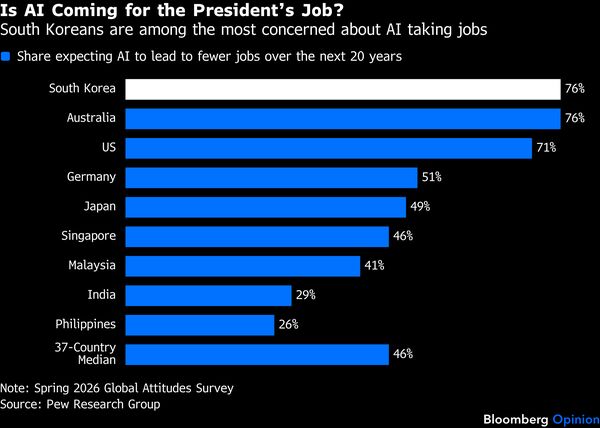
具有讽刺意味的是,皮尤研究中心对 37 个国家的调查发现,韩国也是对 AI 夺走工作岗位感到焦虑程度最高的国家之一。甚至在就职前,李在明就因表示他在数据研究和分析上更依赖 ChatGPT 而非助手而登上头条。(不过,作为一个经常咨询多种工具的人,他为什么这次用 Gemini 确实是个合理的问题。)总统办公室表示,他只是用 AI 核实事实,并非询问如何施政。
Ironically, a 37-country Pew survey found it also has some of the highest levels of anxiety about AI taking jobs. Even before taking office, Lee made headlines for saying he relied on ChatGPT more than his aides for data research and analysis. (Though, as someone who regularly consults several tools, why Gemini this time is a fair question.) His office said that he was merely verifying facts with AI, not asking how to govern.
这可能属实,但并未平息批评。终极的讽刺在于,批评者现在也转而求助于 Gemini。李在明发帖后不久,一些政客拿出他们自己的 Gemini 回复进行反驳,这些回复似乎与李在明得到的答案不同。
That may be true, but it hasn’t quelled the critics. The ultimate irony is that they’re now turning to Gemini, too. Shortly after Lee’s post, some politicians fired back with their own Gemini responses that appeared to differ from his.
这是大语言模型的一个已知弱点。虽然随着模型改进,极度不准确回答(即“幻觉”)的发生率有所下降,但研究表明,输出结果仍可能因提示词的措辞方式不同而出现显著差异。在请求聊天机器人调解政治争论前,这一点值得铭记。
That’s a known weakness of large language models. While rates of wildly inaccurate responses, or hallucinations, have fallen as models have improved, research shows that outputs can still vary substantially depending on how a prompt is framed. That’s worth keeping in mind before asking a chatbot to mediate a political argument.
然而,在这场风波中,网络评论人士和一位前改革党领袖反复发出的最响亮质疑很简单:如果总统要靠询问Gemini来施政,为什么不直接用AI取代他?李某表示,他只是在核实事实,并非将决策外包。但这一讽刺击中了要害。占据韩国社交媒体的对比Gemini截图乍看荒诞,却也暴露了公众信任的局限——技术革命飞速前行,监管规则却远远落后。
Yet one of the loudest lines of attack in this saga, echoed by many online commentators and a former Reform Party leader, was simple: If the president is going to govern by asking Gemini, why not just replace him with AI? Lee said he was merely checking facts, not outsourcing decisions. But the jab struck a nerve. The dueling Gemini screenshots that have consumed Korean social media may look absurd, but they also expose the limits of public trust in a technological revolution racing ahead of the rules governing it.
喧嚣之下藏着一个更棘手的问题:我们愿将多少领导人的判断外包给机器?科技界常见的论调是,随着AI接管繁琐工作,人类判断将变得更宝贵。我们可能没意识到的是,这种决策能力本身也极易受机器塑造。
And beneath the noise lies a harder question: How much of a leader’s judgment are we willing to outsource to machines? A common refrain from the tech industry is that as AI takes over tedious work, human judgment will become more valuable. What we might not realize is just how easily that decision-making can be shaped by machines, too.
Anthropic PBC的一项新研究发现,即使是专家也会深受AI影响。在一项实验中,专业分析师在处理一个真实的统计任务时,有86%的情况会顺从AI智能体随机分配的关键分析选择“倾向”。当被要求解释偏好理由时,77%的分析师使用了智能体自身的论据,有时甚至逐字照搬,而仅有15%承认受到了其影响。
Even experts can be heavily influenced by AI, a new Anthropic PBC research found. In an experiment, professional analysts working on a realistic statistical task went along with an AI agent’s randomly assigned “lean” on key analytical choices 86% of the time. When asked to explain their preferences, 77% of analysts used the agents’ own arguments, sometimes verbatim, while only 15% acknowledged its influence.
这比发现明显的事实错误(比如工具把数字弄错)要难得多。论文指出,判断性决策往往没有唯一的正确答案,因此无论选择哪个选项,工作看起来都可能完全合理。“事后询问专家也未必有帮助,因为他们可能察觉不到智能体的影响,”Anthropic 报告称。从白宫到董事会,我们对 AI 侵蚀我们的决策能力的担忧,应当不亚于对其抢走我们工作的担忧。
That’s harder to catch than an outright factual error, like a tool getting a number wrong. Judgment calls often have no single correct answer, so the work can look perfectly sound whichever option is chosen, the paper argues. “Asking experts afterward may not help either, because they may not notice the agent’s influence,” according to the Anthropic report. From the White House to the boardroom, we should worry as much about AI coming for our decision-making as our jobs.
有几种方法可以应对。研究人员建议设计智能体以呈现相互竞争的选项,在提供建议前先询问用户的看法,并让 AI 的表达听起来不那么确定。但这些都不是简单的修补方案,有些甚至可能违背最初求助 AI 的初衷。
There are several ways to push back. The researchers suggest designing agents to present competing options, asking users for their own views before offering advice, and having AI sound less certain. But none is an easy fix, and some might defeat the point of turning to AI in the first place.
这家世界领先的 AI 实验室的另一项建议?机构“可能出于安全或韧性的考虑,希望保护人类的技能和监督角色。”听起来不错。Anthropic 说得没错,但问题在培养下一代时变得更棘手。如果人们在学习职业时,由机器承担更多艰难的判断性决策,他们可能永远无法培养出我们指望人类保留的辨别力。随着对 AI 导致技能退化的担忧加剧,我担心的不是专家突然丧失能力,而是初级从业者根本无法获得这些能力。
Another recommendation from the world-leading AI lab? Institutions “may want to protect human skills and oversight for reasons of safety or resilience.”How nice. Anthropic is right, but that problem gets thornier when it comes to training the next generation. If people learn their professions with machines making more of the tougher judgment calls, they may never develop the discernment we’re counting on humans to retain. As concerns about AI-driven deskilling mount, I’m less worried about experts suddenly losing their abilities than about entry-level workers never acquiring them.
一些研究人员将这种将决策逐步移交给机器的过程称为“失权”。这是人类能动性缓慢、隐蔽的侵蚀。
Some researchers call this gradual handoff of decicing to a machine “disempowerment.”It’s the slow, insidious erosion of human agency.
AI 让治理更高效的途径多种多样。用聊天机器人研究如何解读法律,并不等于把行政部门交给它。就目前而言,我更会怀疑那些否认使用这些工具的在职者。李在明不是第一个谈论使用 AI 的世界领导人,当然也不会是最后一个。值得肯定的是,他公开了自己的做法,这已超越了其他人。但未来,如果使用者自己无法意识到机器在多大程度上左右了他们的判断,单靠披露只能走这么远。
There are myriad ways that AI can make governing more efficient. Using a chatbot to research how to interpret the law isn’t the same as handing over the executive branch. And, at this point, I’d be more suspicious of someone in office denying their use of these tools. Lee isn’t the first world leader to talk about using AI and he certainly won’t be the last. To his credit, he disclosed what he was doing, which is more than can be said for others. But in the future, disclosure will only go so far if users themselves can’t recognize how much a machine is swaying their judgment.
归根结底,辅助在哪里结束、影响从哪里开始,正变得越来越难以区分。随着 AI 深入首尔之外的更多政府,这条界线可能在我们决定如何划定它之前就已消失。
Ultimately, where assistance ends and influence begins is becoming harder to distinguish. As AI moves deeper into governments far beyond Seoul, the line may disappear before we decide where to draw it.