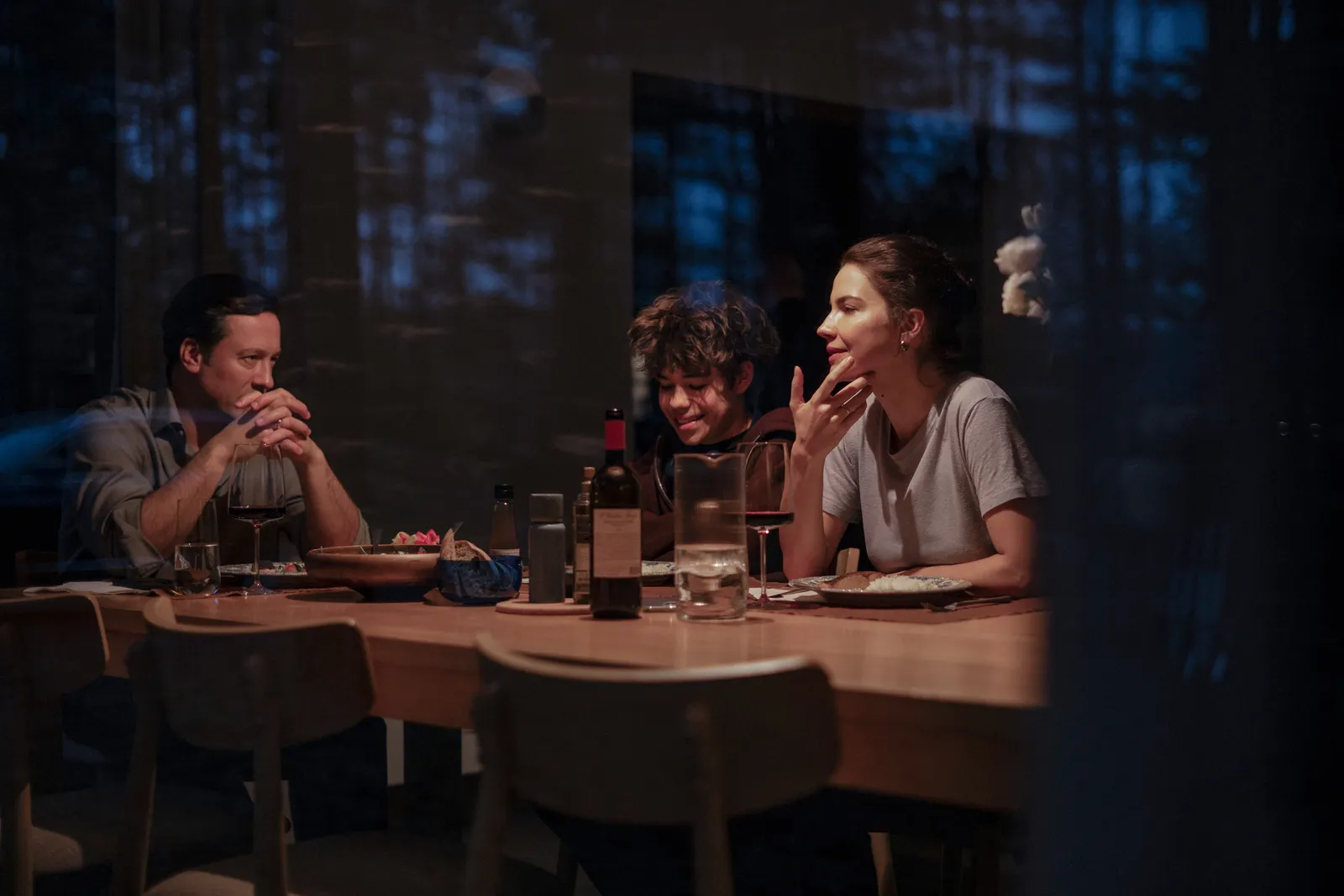
格列布是一位成功的商人,一个出人头地的俄罗斯“穆日克”——富有、强壮、务实——在一座中等规模的省会城市拥有一家物流公司。员工们尊敬他的能力和雷厉风行的作风;作为回报,他照顾着他们,是一位严厉却关怀备至的家长式人物。在家里,情况截然不同。他的妻子加林娜,一位高贵的美人,完美诠释了笼中羽鸟的角色,却为此痛苦不堪,笨拙地四处摸索着出路。他们在情感上疏离,却又不可避免地相互依赖,在他们品味高雅的湖畔住宅里相互环绕、窥视。
Gleb is a successful businessman, a Russian muzhik made good—wealthy, sturdy, practical—who owns a logistics company in a midsize, provincial city. His employees respect his competence and his no-nonsense direction; in turn, he looks after them, a stern but caring paternal figure. At home, things are different. His wife, Galina, a noble beauty, excels at the role of the plumed bird in a cage and yet suffers for it, fumbling around awkwardly for an escape. They are emotionally estranged but inexorably codependent, circling and watching each other in their tasteful lakefront home.
两个威胁要颠覆格列布生活的困境在安德烈·兹维亚金采夫的新片《牛头怪》早早浮现。兹维亚金采夫是这一代最受赞誉的俄罗斯导演,其前两部电影均入围奥斯卡最佳国际影片奖。《牛头怪》设定在虚构城市克拉斯诺博尔斯克,时间为2022年秋季,俄罗斯入侵乌克兰半年后,弗拉基米尔·普京宣布所谓的“部分动员”,即征兵。
Two dilemmas that threaten to upend Gleb’s life emerge early in “Minotaur,” the new film by Andrey Zvyagintsev, the most celebrated Russian director of his generation, whose previous two movies were nominated for Best Foreign Language Film at the Academy Awards. “Minotaur” is set in the fictional city of Krasnoborsk in the fall of 2022, half a year into Russia’s invasion of Ukraine, when Vladimir Putin announced a so-called partial mobilization, or military draft.
在格列布公司的总部,工人们围在一部手机旁,观看俄罗斯-格鲁吉亚边境的混乱场面。成千上万试图逃离国家以躲避征召入伍的俄罗斯男子试图过境,造成巨大的交通拥堵。“他妈的,”格列布的一名员工说。他们当中已有七人离开;其他人也在计划离开。
At the headquarters of Gleb’s company, workers huddle around a phone, watching a chaotic scene at the Russia-Georgia border. Thousands of Russian men fleeing the country to avoid being called up to fight are trying to cross, causing an enormous traffic jam. “Holy fuck,” one of Gleb’s employees says. Seven of them have already left; others are planning to.
这是影片为数不多地展现“特别军事行动”的镜头之一——这是俄罗斯对乌克兰战争的官方称呼。其他镜头则很隐晦,未经训练的眼睛很容易错过:一辆停着的汽车后窗贴着“Z”标贴——这是入侵初期的象征,后来被用作表示支持的标志;在一个十字路口,镜头停留在一位推着轮椅伤残退伍军人的女子身上。“战争在边缘展开,”兹维亚金采夫最近对我说,“那正是冲突伊始所决定的心境、氛围。一切都被压低了声音——一切都是禁忌。”
This is one of the few glimpses that the film offers of the Special Military Operation, as Russia’s war in Ukraine is known in official parlance. The others are subtle, likely to be missed by an untrained eye: a parked car has a “Z” decal—an early symbol of the invasion adopted as a show of support—on its rear window; at a crosswalk, the camera lingers on a woman pushing a wounded veteran in a wheelchair. “The war unfolds on the periphery,” Zvyagintsev told me recently. “That was exactly the state of mind, the atmosphere, that defined the start of the conflict. Everything was hushed up—everything was taboo.”
起初,格列布被一桩更私人的家庭琐事吞噬。他怀疑加林娜出轨。两人有过鬼鬼祟祟的短信往来,加林娜也有过去城里的可疑行程。夫妻俩上床睡觉时,中间隔着一层冰冷的距离。一次与朋友的酒宴先是变得尴尬,回家后更演变成丑陋的争吵。“我厌倦了做你的影子,”加林娜说。这条剧情线借用自1969年法国心理惊悚片《不忠的妻子》(La Femme Infidèle),由克洛德·夏布洛尔执导。就像那部电影中的丈夫一样,格列布着手去揭开他早已知晓的真相。
At first, Gleb is consumed by a more domestic matter. He suspects that Galina is cheating on him. There are furtive text exchanges and suspicious trips to town. The couple gets into bed with an icy distance between them. A boozy dinner out with friends turns awkward and then, back home, ugly. “I’m tired of being your shadow,” Galina says. The plotline is borrowed from “La Femme Infidèle” (“The Unfaithful Wife”), a 1969 French psychological thriller, directed by Claude Chabrol. Like the husband in that film, Gleb sets out to uncover what he already knows.
与此同时,乌克兰战争也正逼近他。克拉斯诺博尔斯克市长要求格列布和其他几位当地企业领袖从各自的员工中提供一定数额的男性配额,投入入侵行动。莫斯科的上级已明确表达需求,市长忠实地传达下来。“我们不是来讨价还价的,”他说。无从得知格列布对战争的看法。重要的是这对他个人的切身影响。“他们难道不能不靠我们就完成吗?”他问市长。
The war in Ukraine, meanwhile, is closing in on him, too. The mayor of Krasnoborsk is demanding that Gleb and a handful of other local business leaders draw upon their employees to provide a quota of men for the invasion. The higher-ups in Moscow have made their needs clear, and the mayor dutifully transmits them. “We aren’t here to bargain,” he says. It’s impossible to know what Gleb thinks about the war. What matters is the narrow personal implications. “Can’t they achieve this without us?” he asks the mayor.
不行——征兵名单必须在下周四前上交,否则国家将自行大肆抓捕男性。“他保持沉默,”兹维亚金采夫说,指的是格列布。“只是坐在那里,一副毫无表情的扑克脸。”
They can’t—draft lists must be submitted by next Thursday or the state will start sweeping up men on its own. “He stays silent,” Zvyagintsev said, of Gleb. “Just sitting there with a total poker face.”
兹维亚金采夫并非一位公开政治立场的电影人,但他的影片对当代俄罗斯生活的描绘毫不留情。“他是一位一丝不苟的导演,对调度绝对居于核心地位,”法国电影史学家乔埃尔·查普龙告诉我,他最早于二〇〇〇年代初结识兹维亚金采夫。演员瓦尔瓦拉·什米科娃在兹维亚金采夫的两部影片中饰演过配角,其中包括《米诺陶洛斯》。
Zvyagintsev is not an overtly political filmmaker, but his movies are unsparing in their portrayal of life in contemporary Russia. “He’s a meticulous director, for whom mise en scène is absolutely central,” Joël Chapron, a French film historian who first met Zvyagintsev in the early two-thousands, told me. Varvara Shmykova, an actress who has had supporting roles in two of Zvyagintsev’s films, including “Minotaur,” said that Zvyagintsev doesn’t believe in the “magic of cinema,” in which miracles happen spontaneously during filming.
她说,兹维亚金采夫不信“电影的魔力”,即奇迹在拍摄过程中自发发生。相反,她说,他“以教科书般的精确度构图并拍摄每一帧”。什米科娃继续说道,悖论在于,所有这种控制却产生出一种令人毛骨悚然的真实感:“他设法将生活本身的感觉转移到了银幕上。”
Rather, she said, he “composes and shoots each frame with textbook precision.”The paradox, Shmykova continued, is that all this control produces something that feels uncannily genuine: “He manages to transfer the feeling of life itself onto the screen.”
饰演加林娜的伊里斯·列别杰娃称兹维亚金采夫的创作过程是一个“巨大的拼图,一幅流动的马赛克”。她讲述拍摄早期一个场景时的情形:格列布开车送她饰演的角色去一家咖啡馆。他怀疑她理发前要喝咖啡的计划是为了掩饰与情人幽会。兹维亚金采夫“预先想象好了一切该是什么样子,”列别杰娃说。“这棵树必须站在这里,高度必须恰到好处,树叶必须以恰到好处的方式摆动。
Iris Lebedeva, who plays Galina, called Zvyagintsev’s process an “enormous puzzle, a moving mosaic.”She told me about shooting an early scene in which Gleb drives her character to a café. He suspects that her plan to get a coffee before a haircut is cover for a rendezvous with a lover. Zvyagintsev had “imagined how it all should be beforehand,” Lebedeva said. “That this tree has to stand here and be exactly this tall, with its leaves moving in just this way. That far off in one corner, behind a window, people should sit drinking coffee from exactly this kind of cup. That a couple with a little dog should walk past, at precisely this rhythm.”
“在远处的一个角落里,在一扇窗后,人们应该坐着喝咖啡,用的正是这种杯子。一对带着小狗的情侣应该走过,步伐正是这种节奏。”随着场景的展开,她接着说:“我意识到,尽管我饰演主角,但在画面里,我并不比那棵树、那些路人、或者那栋特定的建筑更重要。所有这一切的存在,都是为了构建一个更大的整体。”
As the scene unfolded, she went on, “I realized that, even though I was playing the lead, I was no more important in the frame than that tree, or these passersby, or that particular building. All of it exists in order to create a larger whole.”
迄今为止,没有其他俄罗斯独立故事片专门探讨战争这一题材。“人们害怕谈论现实,害怕谈论当下——他们根本不知道如何撰写关于这些题材的剧本,也不知道如何拍摄这样的电影,”俄罗斯影评人、兹维亚金采夫的朋友安东·多林告诉我。“如果我们经历的不是战争,而是一场生态灾难,安德烈大概也会是唯一一个拍摄这类题材电影的人。现实令他痛苦,但他并不畏惧现实。”
To date, no other independent Russian feature film has devoted itself to the subject of the war. “People are afraid to talk about reality, afraid to talk about the present—they simply don’t know how to write a screenplay or direct a film about these subjects,” Anton Dolin, a Russian film critic and a friend of Zvyagintsev’s, told me. “If, instead of war, we were living through, let’s say, an ecological catastrophe, Andrey would probably be the only one making a film about that, too. Reality is painful for him, but he’s not afraid of it.”
最终,格列布被迫向国家献祭:十四名应征入伍者奔赴战场。这个数字呼应了片名的典故。根据希腊神话,雅典每九年必须送十四名青年进入克里特岛的牛头人迷宫,作为祭品被吞噬。其寓意是:权力以臣民为代价来维护自身。兹维亚金采夫转述了格列布被卷入俄罗斯战争机器时的反应:“该死,为什么非得我来处理这事?”他接着说,格列布“想待在中立地带,不想卷入,不想被吸进这场噩梦。”
Ultimately, Gleb is forced to make an offering to the state: fourteen draftees for the war. The number is a gesture at the movie’s titular allusion. According to Greek mythology, every nine years Athens had to send fourteen young people to the Minotaur’s labyrinth, in Crete, where they were devoured as sacrificial victims. The implication is that power preserves itself at the expense of its subjects. Zvyagintsev paraphrased Gleb’s reaction to being drawn into Russia’s war effort: “Damn, why do have to deal with this?”Gleb, he went on, “wants to stay on neutral ground, to not get involved, to keep from getting sucked into this nightmare.”
兹维亚金采夫和我今年夏天在尤尔马拉会面,这是一个位于波罗的海畔、风景迷人的拉脱维亚度假小镇。他曾在拉脱维亚首都里加拍摄《牛头人》,距离此地仅三十分钟车程,如今他在一条安静小巷租下的一栋房子里住了一个月,一条小径穿过一片松林通向海岸。
Zvyagintsev and I met this summer in Jurmala, a charming Latvian resort town on the Baltic Sea. He had filmed “Minotaur” in Riga, Latvia’s capital, a thirty-minute drive away, and was now spending a month at a rented house on a quiet lane, with a footpath leading through a patch of pine trees to the shore.
《弥诺陶洛斯》将于秋季在美国院线上映,北美上映日期为11月20日,而兹维亚金采夫当时正在撰写一本关于他导演生涯的书。他把我的来访当作受欢迎的消遣,我们在几个下午的大部分时间里,坐在木制躺椅上,啜饮一壶茶,品尝当地草莓。
“Minotaur” would have its theatrical release in the fall—November 20th in the United States—and Zvyagintsev was at work on a book about his directorial career. He treated my visits as a welcome distraction, and we spent the better part of several afternoons sitting in wooden deck chairs, nursing a pot of tea, and munching on local strawberries.
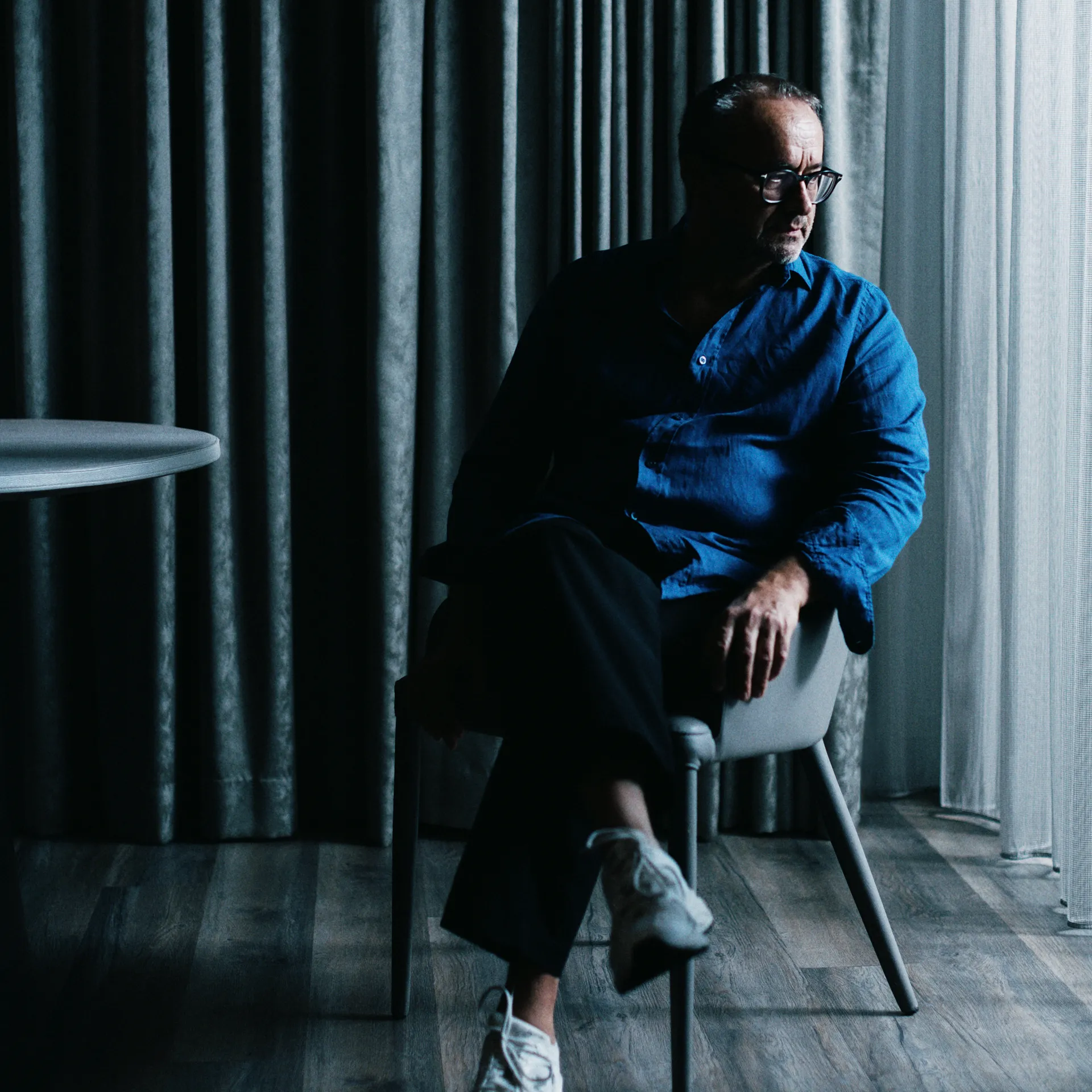
扎维金采夫六十二岁,留着淡淡的银色胡须,戴着厚重的黑框眼镜。他的目光炽烈却本质上温和——他常常会检查我是否感到寒冷、饥饿,或需要搭车。他的阅读量令人敬畏,符合俄罗斯知识分子的气质——有一次在花园聚会上,我看到他在读《波斯人》这部埃斯库罗斯戏剧的译本——但并不显得高傲或装腔作势。扎维金采夫不同于许多著名的俄罗斯电影导演,他并非出生于该国的文化精英阶层:他在西伯利亚的新西伯利亚长大,由一位在当地学校教授俄语和文学的单亲母亲抚养。
Zvyagintsev is sixty-two years old, with a shadow of a silver beard and chunky black eyeglasses. His gaze is intense yet fundamentally kind—he would regularly check to see if I was cold, hungry, or in need of a ride. He is intimidatingly well read, in the way of the Russian intelligentsia—one evening, at a garden party, I spotted him reading a translation of the Aeschylus play “The Persians”—but without coming across as haughty or pretentious. Zvyagintsev, unlike many prominent Russian filmmakers, was not born into the country’s cultural élite: he grew up in Novosibirsk, in Siberia, and was brought up by a single mother who taught Russian language and literature at a local school.
扎维金采夫“出身底层”,对普通人的世界感兴趣,多林告诉我。“在机械师和水管工的生活中,他看到了一些神话般的东西。”
Zvyagintsev “comes from below,” and is interested in the world of ordinary people, Dolin told me. “In the lives of mechanics and plumbers, he sees something mythological.”
有一个晚上,我在一家拥有长露台、俯瞰海面的餐厅遇见扎维金采夫。我提前到达,等候时他给我发了一条短信,告诉我该坐哪里:“问一下角落的那张桌子是否空着——不是对角线那边,整个后面那张,而是正对入口的那张。那个位置不错:靠窗,可以看到日落,空气也比房间中间更好。”晚餐时,我询问他在新西伯利亚的童年。
One evening, I met Zvyagintsev at a restaurant with a long terrace overlooking the sea. I arrived early, and, as I waited, he sent me a text message about where we should sit: “Ask whether the table in the corner is free—not the one diagonally across, all the way in the back, but just opposite the entrance. That spot is nice: it’s by the window, you get the sunset, and there’s more air than in the middle of the room.”Over dinner, I asked him about his childhood in Novosibirsk.
扎维金采夫的父亲在他五岁时离开了家庭。“一个没有固定职业的人,”扎维金采夫说。他曾是雕塑家、高中体育老师、警察。然后,有一天,他就不见了。尽管如此,扎维金采夫仍回忆起在上世纪六十年代和七十年代的苏联时期度过的相对快乐的童年:在公寓楼的院子里与朋友们踢足球,在当地青年剧院表演。当他十八岁时,父亲不请自来,出现在他与母亲同住的公寓里。他们尴尬地拥抱了一下,却几乎没有说话。
Zvyagintsev’s father abandoned the family when Zvyagintsev was five years old. “A man of no fixed occupation,” Zvyagintsev said. He was a sculptor, a high-school gym teacher, a police officer. Then, one day, he was gone. Still, Zvyagintsev recalled an otherwise happy childhood in the Soviet Union of the nineteen-sixties and seventies: hanging out in the courtyard of his apartment block, playing soccer with friends, performing at a local youth theatre. When he was eighteen, his father made an unannounced visit to the apartment where Zvyagintsev lived with his mother. They exchanged an awkward hug but barely spoke.
兹维亚金采夫后来得知,他父母那天吵了一架。他父亲问他母亲,兹维亚金采夫在做什么。她说,他正在新西伯利亚的一所戏剧学院学习表演。他父亲勃然大怒。“这是什么胡说八道?”他一边说,一边把拳头砸在厨房的桌子上。
Zvyagintsev later learned that his parents had argued that day. His father asked his mother what Zvyagintsev was up to. She said that he was studying acting, at a drama academy in Novosibirsk. His father erupted. “What kind of nonsense is that?” he said, slamming his fist on the kitchen table.
听说这次交谈,兹维亚金采夫告诉我,让他感到如释重负:“这个人不在我的生活中,真是太高兴了,我不必克服这种消极情绪。”他的母亲对他艺术追求持开放态度,并支持他二十二岁时搬到莫斯科,在那里他进入了俄罗斯戏剧艺术学院,该学院以其缩写“吉提斯”闻名,是该国历史最悠久、规模最大的戏剧学校。
Hearing about the exchange, Zvyagintsev told me, had produced relief: “What a joy that this person is absent from my life, that I don’t have to overcome this negativity.”His mother was open to his artistic pursuits and supportive of his move, at the age of twenty-two, to Moscow, where he enrolled at the Russian Institute of Theatre Arts, known by its acronym, , the country’s oldest and largest theatre school.
那是八十年代末,正值“改革”时期,国家管控放松,自由萌芽。学生们组织抵制一门必修的马克思列宁主义课程。“那时大家都知道共产主义完了,”兹维亚金采夫说。“干嘛还要听这些废话?”兹维亚金采夫有个朋友在全苏电影学院读书,这是莫斯科著名的电影学府,那里有个放映厅,能看到苏联其他地方根本找不到的影片。朋友会从后门把兹维亚金采夫偷偷带进去,看奥逊·威尔斯的《审判》、阿尔弗雷德·希区柯克的《惊魂记》之类的片子。
It was the late eighties, the time of perestroika, a period of loosening state controls and burgeoning freedoms. Students at organized a boycott of a mandatory class on Marxism and Leninism. “By then, everyone knew Communism was over,” Zvyagintsev said. “Why listen to all this bullshit?”Zvyagintsev had a friend who attended the Institute of Cinematography, Moscow’s prestigious film school, which had a theatre that screened movies otherwise impossible to find in the Soviet Union. The friend would sneak Zvyagintsev in through a back entrance to see such films as Orson Welles’s “The Trial” and Alfred Hitchcock’s “Psycho.”
一天,兹维亚金采夫去看米开朗基罗·安东尼奥尼的《奇遇》。影片名义上讲的是一名年轻女子在西西里岛外海游艇旅行中失踪。安东尼奥尼的伟大创新在于:故事线逐渐淡出,连同观众对动作、时间和戏剧性结局的常规期待一起消失。心理张力和叙事发展不来自情节,而来自沉默、时长、景观和运动。“我的脑子彻底震住了,”兹维亚金采夫说。“我当时就明白了,一部电影即使几乎没有任何动作发生,也可以极其丰富、极其有意义。”
One day, Zvyagintsev attended a screening of Michelangelo Antonioni’s “L’Avventura,” which is nominally about the disappearance of a young woman during a yacht tour off Sicily. Antonioni’s great innovation was that the story line fades away, along with conventional expectations about action, time, and dramatic resolution. Psychological tension and narrative development come not from plot but from silence, duration, landscape, and movement. “My mind was blown,” Zvyagintsev said. “I understood then that a film can be incredibly rich and meaningful even when hardly any action happens.”
毕业后,兹维亚金采夫找了一份清洁工的工作。“你得早起,扫扫烟头,剩下的时间全归你了,”他说。他大多数下午都在新开放的电影博物馆度过,那里举办德国表现主义和法国新浪潮回顾展,定期放映法斯宾德到黑泽明等现代作家的作品。自己拍电影的念头依然遥不可及——那是有正规文凭和关系的人干的事。但后来,兹维亚金采夫二十七岁时,苏联解体了,连同那个自上而下的僵硬管理体制和国家包办分配工作的制度一起消失了。“那是个伟大的时代,”他说。“大家可以随心所欲,想尝试什么就尝试什么。”
After graduation, Zvyagintsev found a job as a , a street cleaner. “You’d get up early in the morning, sweep up some cigarette butts, and the rest of the day belonged to you,” he said. He spent most afternoons at the newly opened Museum of Cinema, which hosted retrospectives on German Expressionists and the French New Wave, and regularly showed the works of modern auteurs, from Fassbinder to Kurosawa. The idea of making films of his own still seemed far-fetched—that was for people with the right diplomas and connections. But then, when Zvyagintsev was twenty-seven, the Soviet Union collapsed, taking with it a rigid system of top-down management and state-directed job assignments. “It was a tremendous time,” he said. “Everyone was free to do as they pleased, try out what they liked.”
后来,他开始执导广告片——为一家鞋店、一家花岗岩加工厂、斯巴达克足球俱乐部拍摄。通过为独立电视网 REN TV 拍摄的一组宣传片,他结识了德米特里·列斯内夫斯基,后者与母亲共同经营该频道。当时,列斯内夫斯基正在为《黑屋》寻找导演,这是一部心理剧集,每一集都在一个封闭、压抑的空间里展开。列斯内夫斯基告诉我,这种极简形式是不得已而为之,“因为我们没钱拍真正的电影。”
Eventually, he began to direct commercials—for a shoe store, a granite workshop, the soccer club Spartak. Through a campaign for REN TV, an independent television network launched in the mid-nineties, he met Dmitry Lesnevsky, who ran the channel with his mother. At the time, Lesnevsky was looking for directors to work on “The Black Room,” a psychological drama series, with each episode unfolding in a confined, claustrophobic space. The minimalist format was a necessity, Lesnevsky told me, because “we didn’t have the money to make real films.”
他给兹维亚金采夫几个剧本,兹维亚金采夫选中了一个关于一位富有的银行家和他的保镖的故事。他用几千美元的预算迅速拍完了这一集。“令我惊讶的是,从这个相当荒诞可笑的前提出发,竟然呈现出了风格、空气、氛围——后来我们在安德烈的电影里看到的一切,”列斯内夫斯基说。兹维亚金采夫记得列斯内夫斯基对他说:“干得好,你把屎变成了糖。”
He gave Zvyagintsev a handful of scripts, and Zvyagintsev picked one about a wealthy banker and his bodyguard. He filmed it quickly, on a budget of a couple of thousand dollars. “To my amazement, from this rather absurd and ridiculous premise appeared something with style, air, atmosphere—everything we would see later in Andrey’s films,” Lesnevsky said. Zvyagintsev remembers Lesnevsky telling him, “Good job, you turned shit into candy.”
列斯内夫斯基又雇他拍了两集。“我不能自居为安德烈·兹维亚金采夫的发现者,”他对我说,“像他这样有天赋的人来到这个世界时,使命早已注定,迟早都会完成。”安德烈亚·曼泰尼亚的意大利文艺复兴杰作《哀悼死基督》描绘了基督躺在大理石殡床上,以其极端的透视缩短法著称。基督的双脚最接近观众,头部和躯干被放大到超出正常比例。这种效果极具肉体感,是对死亡迫切性的自然主义式直面。兹维亚金采夫在新西伯利亚戏剧学院的美术史课上第一次看到了这幅画。
Lesnevsky hired him to make two more episodes. “I can’t take credit for discovering Andrey Zvyagintsev,” he told me. “People with talent like his arrive to this world with their mission already defined, and sooner or later they carry it out.”“Lamentation Over the Dead Christ,” an Italian Renaissance masterwork by Andrea Mantegna which shows Christ lying on a marble funeral slab, is known for its extreme foreshortening. Christ’s feet are closest to the viewer, and his head and torso are enlarged beyond normal proportions. The effect is highly corporeal, a naturalistic confrontation with the immediacy of death. Zvyagintsev first saw the painting in an art-history class at the drama academy in Novosibirsk.
这启发了《回归》开场九分钟处的一个构图镜头,那是兹维亚金采夫的首部长片:两兄弟踮着脚走进走廊,得知失踪十二年的父亲已经回家。
It inspired a framing shot that comes nine minutes into “The Return,” Zvyagintsev’s first full-length feature: two brothers tiptoe into a hallway, having learned that their father, who has been missing for twelve years, has come home.
这部电影的摄影指导米哈伊尔·克里奇曼参与了兹维亚金采夫之后所有的项目,他告诉我,他们花了将近一个小时更换镜头,以获得完全正确的透视,最终将摄像机架在两兄弟发现父亲熟睡的卧室外。兹维亚金采夫将这个镜头描述为影片的“音叉”,一种确立基调的方式。“我需要找到某种东西,”他告诉我,“一种将故事提升至平庸之上的方式,使其超越日常现实,触及神话。”
Mikhail Krichman, the film’s director of photography, who has worked on all of Zvyagintsev’s subsequent projects, told me that they spent close to an hour swapping out lenses to get the perspective exactly right, and ultimately set up the camera outside the bedroom where the brothers discover their father asleep. Zvyagintsev described the shot as the film’s “tuning fork,” a way to establish its tone. “I needed to find a certain,” he told me. “A way to lift the story above the mundane, so that it would transcend everyday realism and reach for the mythical.”
《回归》根据列斯涅夫斯基获得的另一个剧本拍摄,取景地在拉多加湖附近,圣彼得堡以北。那里的景观点缀着废弃建筑,是消失文明的腐朽遗物:一座矗立在平静湖面上的跳水台,一座摇摇欲坠的木制瞭望塔。父亲带着两个儿子——伊万和安德烈——去露营,这趟旅行变成了一种类似《圣经》般的追寻,一次意志与信仰的考验。
“The Return,” based on another script procured by Lesnevsky, was filmed near Lake Ladoga, north of St. Petersburg. The landscape is dotted with abandoned structures, decaying artifacts of a vanished civilization: a diving platform looming over a glassy lake, a rickety wooden observation tower. The father takes his two sons—Ivan and Andrey—on a camping trip that becomes something of a Biblical quest, a test of will and belief.
就像上帝创造世界一样,情节在七天内展开。小儿子伊万怀疑且质疑父亲,而大儿子安德烈忠诚且信任——这是人与神关系的两种原型。“两个新手经历着入会仪式,”兹维亚金采夫说。影片以悲剧收场:一场既是牺牲又是赎罪的死亡。我们永远不知道父亲的名字。
The action, like God’s creation of the world, takes place over seven days. Ivan, the younger son, is doubtful and skeptical of his father, whereas Andrey, the elder, is faithful and trusting—the twin archetypes of man’s relation to the divine. “Two neophytes going through an initiation rite,” Zvyagintsev said. The film ends in tragedy: a death that is both sacrifice and atonement. We never learn the father’s name.
《回归》在俄罗斯影评界普遍遭到差评。一位影评人写道,这部电影揭示的不过是“平庸的真理”,平庸到仿佛“被秃鹫啄得干干净净的动物骨架”。列斯涅夫斯基担心,该片注定只会在REN电视台播一两次,随后便实际上消失不见。兹维亚金采夫收到了一条意外的评价:一位自称是他同父异母妹妹的女子写信说,他们的父亲在西伯利亚的电视上看了这部电影。散场后,他拿着一支烟走到公寓阳台上,在一个寒冷的秋夜,一待就是两个小时。
“The Return” was largely panned by critics in Russia. One wrote that the film revealed nothing more than a “commonplace truth,” and was so banal that it resembled “the skeleton of an animal picked clean by vultures.”Lesnevsky feared that the project was destined to air once or twice on REN TV and then effectively disappear. Zvyagintsev received one unexpected review: a woman who introduced herself as his half sister wrote to say that his father had seen the film on TV in Siberia. After it ended, he’d taken a cigarette out to the balcony of his apartment, where he’d stayed, on a frosty autumn evening, for the next two hours.
2003年9月,《回归》在威尼斯电影节展映,不仅斩获最佳处女作奖,还摘得电影节最高奖金狮奖。两个月后,兹维亚金采夫接到克里姆林宫来电,邀请他与时任总统、正值首个任期的普京会面。“会有茶点,大家坐下来聊聊天,”兹维亚金采夫回忆那次传唤时说。在普京官邸的一个会客室里,面对一组电视摄像机,两人进行了一场按剧本进行、仅持续几分钟的对话。“他说‘祝贺你’,仅此而已,”兹维亚金采夫说。“摄制组离开了。”
In September, 2003, “The Return” was shown at the Venice Film Festival, where it won not only an award for best début but also the Golden Lion, the festival’s top prize. Two months later, Zvyagintsev got a call from the Kremlin, inviting him to meet with Putin, who was then in his first term as President. “There will be tea, something to eat—you’ll sit down and have a chat,” Zvyagintsev said, recalling the summons. In a reception room at Putin’s residence, facing a suite of television cameras, the two had a scripted conversation that lasted barely a few minutes. “He said, ‘Congratulations,’ and that was it,” Zvyagintsev said. “The camera crews left.”
随后,两人乘专车前往莫斯电影制片厂——该国规模最大、历史最悠久的电影制片厂——参加一个会议。“就是两个人之间普通的、人性的交谈,”兹维亚金采夫谈起那段车程时说。“普京还不是后来的那个样子。他当时还是个未知数。”在莫斯电影制片厂,普京主持一场大会,周围坐满了俄罗斯影坛的泰斗级人物。“他们全坐在那儿,等着听陛下要说什么,”兹维亚金采夫说。
Afterward, he and Putin were chauffeured to a meeting at Mosfilm, the country’s largest and most historic movie studio. “It was an ordinary, human conversation between two people,” Zvyagintsev said, of the drive. “Putin wasn’t yet what he later became. He was still mostly an unknown quantity.”At Mosfilm, Putin presided at a large table, surrounded by titans of Russian cinema. “They were all sitting there, waiting to hear what His Majesty was going to say,” Zvyagintsev said.
“我觉得整个会议的情境莫名其妙。”后来,克里姆林宫官员建议兹维亚金采夫参加各种公共委员会或倡议活动,但他一概婉拒。“纯粹是装饰性的、空洞的忙碌,”他如此评价道。“或许听起来很天真,但我从未把自己视作一个政治动物。”
“I found the whole context of the meeting befuddling.”Later, Kremlin officials suggested that Zvyagintsev take part in various public committees or initiatives, but he always declined. “Purely decorative, empty busywork,” he called it. “Perhaps it sounds naïve, but I have never considered myself a political animal.”
兹维亚金采夫对官方权力的漠视,使他在俄罗斯艺术家中显得格格不入,尤其是在普京时代。电影制作成本高昂,对业内许多人来说,俄罗斯政府既是资金来源,也是强有力的推动者。“别的导演多半会乐得尿裤子,”列斯内夫斯基说。
Zvyagintsev’s indifference to official power made him unusual for a Russian artist, especially in the age of Putin. Filmmaking is expensive, and for many people in the industry the Russian government is both a source of funding and a powerful facilitator. “Plenty of other directors would have pissed themselves with happiness,” Lesnevsky said.
“但对安德烈来说,这很尴尬,仿佛沙皇朝他那边傲慢地点一下头,就有玷污他艺术表达纯粹性的风险。”
“But for Andrey it was awkward, as if one imperious nod from the tsar in his direction risked casting a shadow on the purity of his artistic expression.”
2004年6月4日,马文·希梅耶驾驶媒体后来称为“杀人推土机”的车辆,在科罗拉多州格兰比的街道上横冲直撞了两个小时。希梅耶在镇上经营一家消音器修理店,长期以来一直与当地政府就财产和分区问题陷入纠纷。他最终败诉,随后花费数月时间将一台推土机改装成简易装甲车,加装钢板和枪眼。当“杀人推土机”陷入一栋倒塌建筑的废墟中无法动弹时,他的暴行才告终;随着警方逼近,希梅耶开枪自杀。
On June 4, 2004, Marvin Heemeyer drove what the media later dubbed the “Killdozer” on a two-hour rampage through the streets of Granby, Colorado. Heemeyer owned a muffler shop in the town and had been engaged in a long-running series of property and zoning disputes with local authorities. He eventually lost, and then spent several months converting a bulldozer into an improvised armored vehicle, adding steel plates and gun ports. His spree ended when the Killdozer got stuck in the wreckage of a collapsed building; as police approached, Heemeyer shot himself.
兹维亚金采夫在一次纽约之行中听说了这个故事。“这个最初的冲动,这种基本冲突,给我留下了深刻印象,”他告诉我。“复仇的渴望,对报复的渴求,对正义的渴求。”
Zvyagintsev heard about the story during a trip to New York. “This initial impulse, the basic conflict, made quite an impression,” he told me. “The desire for revenge, a thirst for retribution, for justice.”
回到莫斯科后,他和常合作的编剧奥列格·涅金开始起草剧本,这最终成了他的第四部长片《利维坦》,讲述一个男人与不可战胜的体制对抗的故事,核心是他为保住家园、对抗腐败地方官僚的拆迁而战。在早期版本中,兹维亚金采夫设想了一个终场:俄罗斯版的希梅耶——尼古拉冲出车库,驾驶推土机推翻一台挖掘机。
Back in Moscow, he and Oleg Negin, a frequent collaborator, began drafting the screenplay for what would become his fourth feature, “Leviathan,” a story of a man’s confrontation with an indomitable system, framed around his battle to save his home from demolition at the hands of corrupt local bureaucrats. In an early version, Zvyagintsev imagined a final scene in which Nikolay, the Russian Heemeyer, bursts out of his garage riding a bulldozer and uses it to topple an excavator.
但这感觉既技术过于复杂——“谁会给我们一台挖掘机去毁坏?”兹维亚金采夫说——又在基调上不对头。他的世界观更残酷。“在安德烈的电影里,上帝沉默且从不干预,”兹维亚金采夫的长期制片合作伙伴亚历山大·罗德尼安斯基说。
But that felt both too technically complex—“Who was going to give us an excavator to destroy?”Zvyagintsev said—and tonally wrong. His world view is harsher. “In Andrey’s films, God is silent and never intervenes,” Alexander Rodnyansky, Zvyagintsev’s longtime producing partner, said.
“没有人获得奇迹,也没有人听到来自天堂的声音,没有人得救。”
“No one is granted miracles or hears a voice from Heaven, and no one is saved.”
兹维亚金采夫创作该片的参考素材之一,是德国作家海因里希·冯·克莱斯特在19世纪初创作的中篇小说《米夏埃尔·科尔哈斯》。书中同名主角是一名马贩子,遭萨克森贵族成员冤屈。他向法院申诉,却因该贵族的政治关系而被驳回。绝望之下,科尔哈斯发动武装起义,迅速被镇压,故事以他被斩首告终。“在任何社会里,总会存在某种贵族阶层,”兹维亚金采夫说。“有些人被允许做某些事,而另一些人则不被允许。”
One of Zvyagintsev’s references for the film was an early-nineteenth-century German novella, “Michael Kohlhaas,” by Heinrich von Kleist, in which the title character, a horse trader, is wronged by a member of the Saxon aristocracy. He turns to the courts, but his appeals are quashed because of the aristocrat’s political connections. Desperate, Kohlhaas mounts an armed uprising, which is quickly put down, and the story ends with his beheading. “There is always an aristocracy of some kind, in every society,” Zvyagintsev said. “There are people who are allowed to do certain things, and people who aren’t.”
在《归来》之后,兹维亚金采夫拍摄了《放逐》,这是一部晦涩的影片,被视为某种程度上的“二部曲低谷”,讲述一对关系破裂的夫妇逃往一处未具名的乡间。随后是《伊莲娜》,这是一部节奏紧凑的戏剧片,背景设在莫斯科,曾获《纽约客》好评,称其为“一个充满掠食性野兽的丛林”。该片获得评论界成功,标志着兹维亚金采夫电影词汇的一个重要转折:他保留了寓言维度,却将情节扎根于当代俄罗斯粗粝、可辨识的现实质感之中。
After “The Return,” Zvyagintsev had made “The Banishment,” an elusive film that was considered something of a sophomore slump, about a troubled couple who abscond to an unnamed countryside. Next came “Elena,” a propulsive drama set in Moscow which a favorable review in the described as “a jungle teeming with predatory wildlife.”The film was a critical success and marked an important turn in Zvyagintsev’s cinematic vocabulary: he retained an allegorical dimension but grounded the action in the gritty, recognizable texture of contemporary Russia.
对于《利维坦》的取景地,兹维亚金采夫曾考察过莫斯科郊外的几个城镇,甚至远至白俄罗斯的一些地方。但始终觉得不太合适,直到兹维亚金采夫的长期合作美术指导安德烈·庞克拉托夫发现了捷里别尔卡——一个位于俄罗斯科拉半岛北部海岸的偏远北极渔村,兹维亚金采夫称其为“古老现实的前哨”。海岸线险峻,布满巨石的海滩和花岗岩峭壁直插冰冷的海水。
For the location of “Leviathan,” Zvyagintsev considered several towns outside Moscow, and some as far away as Belarus. Nothing felt quite right, though, until Andrey Ponkratov, Zvyagintsev’s longtime production designer, discovered Teriberka, a remote Arctic fishing settlement on the northern coast of Russia’s Kola Peninsula, which Zvyagintsev called an “outpost of archaic reality.”The coastline is severe, with boulder-strewn beaches and granite cliffs stabbing into icy waters.
远离海岸,苔原荒凉,是一片广阔的苔藓、地衣和裸露的岩石。2012年兹维亚金采夫首次造访捷里别尔卡时,一位当地司机告诉他,初夏时节能从岸边看到座头鲸。兹维亚金采夫认为这是个征兆:“我们带着一部叫《利维坦》的电影而来,结果发现这地方真有鲸鱼。”
Away from the shore, the tundra is barren, a broad expanse of moss, lichen, and exposed rock. When Zvyagintsev first visited Teriberka, in 2012, a local driver told him about humpback whales that, in early summer, are visible from shore. Zvyagintsev thought it was a sign: “We came with a film called ‘Leviathan,’ and it turns out this place has actual whales.”
影片的核心母题源自《约伯记》,讲述了一位正直敬畏上帝的人,却似乎毫无缘由地遭遇悲剧与苦难。圣经故事隐晦地提到利维坦,一种超越人类控制的巨大海兽:“地上再没有可与它比较的,它是被造为无所畏惧的。”在兹维亚金采夫眼中,现代俄罗斯宛如另一种“利维坦”的化身——即托马斯·霍布斯设想的那种,主权国家作为一个巨大的权力,受托于臣民以保护他们免受混乱与暴力侵害。
The film’s central motif came from the Book of Job, the story of an upright, God-fearing man who faces tragedy and suffering seemingly without reason. The Biblical story speaks elliptically of a Leviathan, a giant sea creature beyond human control: “Upon earth there is not his like, who is made without fear.”To Zvyagintsev, modern Russia looked like the embodiment of yet another “Leviathan”—that of Thomas Hobbes, who imagined the sovereign state as an immense power entrusted by its subjects to protect them from disorder and violence.
在兹维亚金采夫的电影里,国家机器非但不保护个体,反而将其碾压。兹维亚金采夫坚称这是一种普遍动态,“只是在俄罗斯更加赤裸,直接暴露在表面上。”《利维坦》无可置疑地是对俄罗斯国家贪婪腐败与愤世嫉俗的批判。在一个法庭场景中,法官飞快地宣读有利于当局的判决,语调单调几近难以辨认。
In Zvyagintsev’s film, the state machine, rather than protect the individual, crushes him. That’s a universal dynamic, Zvyagintsev insisted, “only in Russia it’s more blatant, visible right on the surface.”“Leviathan” is unmistakably a critique of the venality and cynicism of the Russian state. In a courtroom scene, a judge races through a ruling that favors the authorities, reading it in a nearly unintelligible monotone.
兹维亚金采夫从“暴动小猫”案的判决中汲取了灵感。这个女性朋克团体的成员因2012年在莫斯科的正教主教座堂举行抗议活动,被捕并被指控“因宗教仇恨而实施的流氓罪”。“我被判决的速度震惊了,法官宣读判决书的速度快得难以置信,”兹维亚金采夫告诉我。他让饰演法官的女演员阿拉·叶明采娃观看了庭审录像。“我需要你像那样演,”他对她说。
Zvyagintsev had taken inspiration from the verdict in the trial of Pussy Riot, the feminist punk collective whose members were arrested and charged with “hooliganism motivated by religious hatred” after staging a protest in Moscow’s central Orthodox cathedral, in 2012. “I was struck by the speed of it, the way the judge rattled through the decision so incredibly fast,” Zvyagintsev told me. He asked the actress playing the judge, Alla Emintseva, to watch the footage. “I need you to do it like that,” he told her.
在2014年戛纳电影节《利维坦》首映之前,兹维亚金采夫和罗德尼安斯基在俄罗斯文化部组织了一场私人放映,该部为影片提供了超过100万美元的预算。这笔资金与其说是财务上的必要,不如说是一场政治赌注。“在我看来,片头字幕中仅仅出现‘在俄罗斯联邦文化部支持下制作’这几个字,就会保护我们,提供一定程度的掩护,”罗德尼安斯基说。
Before “Leviathan” premièred, at the Cannes Film Festival, in 2014, Zvyagintsev and Rodnyansky hosted a private screening at the Russian Ministry of Culture, which had provided more than a million dollars of the film’s budget. The funding was less a financial necessity than a political wager. “It seemed to me that simply having the words ‘Made with the support of the Ministry of Culture of the Russian Federation’ in the opening credits would protect us and provide a certain degree of cover,” Rodnyansky said.
当时的文化部长弗拉基米尔·梅金斯基是一位保守派意识形态家。看完影片后,他把兹维亚金采夫叫进办公室。“你为什么非要用黑刷子描绘俄罗斯?”他问道。“为什么不用更明亮的色彩?”兹维亚金采夫回答说,艺术家只是呈现他周围的现实。“掌权的不是我们——是你们,”他说。“当生活变得更好,当国家发生变化时,就会有光明的一面,我那时也会反映出来。”
The Minister of Culture at the time, Vladimir Medinsky, was a conservative ideologue. After watching the film, he called Zvyagintsev into his office. “Why do you insist on painting Russia with a black brush?” he asked. “Why not use brighter colors?”Zvyagintsev replied that an artist merely represents the reality around him. “We’re not in charge—you are,” he said. “When life gets better, when things in the country change, then there will be a brighter side, and I’ll reflect that, too.”
几周后,《利维坦》在戛纳电影节获得最佳编剧奖。随后又赢得金球奖最佳外语片奖并获得奥斯卡提名。在俄罗斯,这部影片被广泛观看——在影院上映前网上流传的盗版拷贝被下载了超过100万次——并引发激烈辩论。文化部与该片划清界限。“兹维亚金采夫恨什么、恨谁,或多或少是清楚的,”梅金斯基在接受一家亲克里姆林宫报纸采访时说。
Weeks later, “Leviathan” won the award for best screenplay at Cannes. It went on to win a Golden Globe for Best Foreign Film and earn an Oscar nomination. In Russia, the film was viewed widely—a pirated copy that circulated online before the theatrical release was downloaded more than a million times—and fiercely debated. The culture ministry distanced itself from the movie. “What and whom Zvyagintsev hates is more or less clear,” Medinsky said in an interview with a pro-Kremlin newspaper.
“但他爱谁?名声、红地毯和小金人。”一名议员呼吁国家追回资助《利维坦》制作的资金,称该片“是一堆旨在制造俄罗斯国家和俄罗斯社会负面形象的恐俄刻板印象”。在我们的交谈中,兹维亚金采夫对这场争议保持了一种超然的态度。
“But whom does he love? Fame, red carpets, and statuettes.”A lawmaker called on the state to claw back the money it had given to produce “Leviathan,” which he said was “a collection of Russophobic stereotypes aimed at creating a negative image of the Russian state and Russian society.”In our conversations, Zvyagintsev maintained a certain detachment from the controversy.
“一部电影一旦完成,字幕已定,母版已批——就这样,你自由了,”他对我说。“从那时起,每个人都通过自己经历的透镜来观看它。”梅金斯基则在《利维坦》上映后改变了国家的电影资助政策。“我看不出有什么必要动用文化部资金来制作那些向我们民选政府吐唾沫的电影,”他说。“我说的是那些把俄罗斯看作‘烂泥潭’的人——俄罗斯是个屎坑。”
“Once a film is finished, the closing credits are in place, the master print is approved—that’s it, you’re free,” he told me. “From then on, everyone watches it through the lens of their own experience.”Medinsky, for his part, changed the state’s policies for film funding in the wake of “Leviathan.”“I see no point in using Ministry of Culture funds to produce movies that spit on our elected government,” he said. “I’m talking about those individuals whose films take the view of Rashka govnyashka”—Russia is a shithole.
2022年2月俄罗斯入侵乌克兰的那天清晨,兹维亚金采夫正身处德国的一间病房里。前一年6月,莫斯科疫情暴发期间,他的妻子安娜·马特维耶娃——一名摄影师兼电影剪辑师——染上了病毒,兹维亚金采夫因患有长期肺部疾病且担心生病,便搬去办公室居住。一周后,他决定接种一针“卫星-V”,即俄罗斯的疫苗。几天内,他的体温飙升,浑身酸痛、极度疲惫。
On the morning of Russia’s invasion of Ukraine, in February, 2022, Zvyagintsev was in a hospital room in Germany. The previous June, during a wave in Moscow, his wife, Anna Matveeva, a photographer and a film editor, had caught the virus, and Zvyagintsev, who had a long-standing lung condition and was fearful of falling ill, went to stay in his office. After a week, he decided to get a shot of Sputnik V, Russia’s vaccine. Within days, his temperature had spiked and he was racked with body aches and exhaustion.
医生送了一些血液样本去化验。“每一项指标都极其异常,”马特维耶娃告诉我。医生告诉兹维亚金采夫,他极可能原本无症状感染,因接种疫苗而加重了病情。
His doctor sent some blood samples for analysis. “Every single measure was wildly abnormal,” Matveeva told me. Zvyagintsev was told he likely had an asymptomatic infection that had been exacerbated by the vaccine.
至今,他的确切诊断仍是个谜。“我不是想听起来像个反疫苗者,”兹维亚金采夫说,“但请自行得出结论。”无论病因如何,兹维亚金采夫正经历细胞因子风暴,即免疫细胞触发可能致命的炎症反应。他住进莫斯科的一家医院,医生为他进行了血浆置换,并静脉输注单克隆抗体以抑制炎症。两周后,医生让他回家。几天后,他颈部的一处血栓破裂。他对马特维耶娃说:“亲爱的,我完了。我要死了,”随即倒地不起。
To this day, his precise diagnosis remains a mystery. “I don’t mean to sound like an anti-vaxxer,” Zvyagintsev said, “but draw your own conclusions.”Whatever the cause, Zvyagintsev was undergoing a cytokine storm, in which immune cells trigger a potentially deadly inflammatory response. He checked into a hospital in Moscow, where doctors performed a plasma transfer and delivered an intravenous infusion of monoclonal antibodies, to stem the inflammation. After two weeks, they sent him home. Several days later, a blood clot burst in his neck. He told Matveeva, “Honey, I’m fucked. I’m dying,” and then collapsed.
一辆救护车把他送到了另一家医院,在那里他感染了细菌。检查显示他的肺部有92%受损;他被置于呼吸机上。马特维耶娃与医生们进行了会诊。他们建议进行肺移植,这是一种高风险手术,即使成功,长期预后也不明朗。一名医生把马特维耶娃拉到一边,私下对她说。他说她应该考虑把丈夫送到德国接受专业医疗护理。
An ambulance brought him to a different hospital, where he contracted a bacterial infection. Tests showed that he had damage to ninety-two per cent of his lungs; he was placed on a ventilator. Matveeva consulted with the doctors. They suggested a lung transplant, a risky procedure that, even if it was successful, lacked a clear long-term prognosis. One doctor pulled Matveeva aside to speak with her privately. He said that she should consider taking her husband to Germany for specialized medical care.
“我实话告诉你,”他说,“我们这里没法处理这种情况。”8月17日,也就是兹维亚金采夫最初生病约七周后,他被空运到德国汉诺威,那里大学医院的医生让他进入了药物诱导昏迷状态。“一大片黑暗的模糊,”他向我形容那段经历。他们使用了一种噬菌体——一种靶向细菌的病毒——使他的血液指标恢复正常。一个月后,他醒来时无法动弹手臂和腿。“我就躺在那里,动弹不得,”他说。
“I’m telling you honestly,” he said. “We’re not able to manage it here.”On August 17th, about seven weeks after Zvyagintsev first fell ill, he was flown to Hannover, Germany, where doctors at a university hospital put him into a medically induced coma. “A huge dark blur,” he told me, of the experience. They used a bacteriophage, a type of virus that targets bacteria, to bring his blood markers back to normal. A month later, he woke up unable to move his arms and legs. “I was just lying there, motionless,” he said.
兹维亚金采夫随后花了三个月时间,重新学习不靠导管呼吸、坐起、自己进食。随后战争爆发了。他与许多俄罗斯文化界人士一道,公开反对入侵行动。“我无话可说,没有建设性的想法,没有主意,只有一个宣言,”他在一段视频讲话中说道,声音嘶哑微弱。“不支持战争。”后来,他对那些可能选择保持沉默的同行艺术家说道:“如果你们连自认为该说的话都说不出口,那你们到底在这里干什么,白白占据着世界上的空间?”
Zvyagintsev spent the next three months learning to breathe without a tube, to sit up, to feed himself. Then the war broke out. He joined a number of Russian cultural figures in speaking out against the invasion. “I have no words, no productive thoughts, no ideas, just one proclamation,” he said in a video address, his voice hoarse and weak. “No to war.”Later, he addressed fellow-artists who might be tempted to remain silent: “What are you even doing here, taking up space in the world, if you can’t speak about what you believe ought to be said?”
那年夏天,他带着马特维耶娃和当时十二岁的儿子彼得尔搬到了巴黎。兹维亚金采夫当时仍需坐轮椅,但最终过渡到使用助行器。法国电影史学家夏普龙将他介绍给了法国电影制片公司兼发行商MK2的负责人纳塔纳埃尔·卡尔米茨。“当他意识到自己活下来了,就想继续前行,”夏普龙说。“这意味着拍电影,这是他唯一会的事。”在会面中,卡尔米茨注意到兹维亚金采夫的步态依然不稳。“他差点丧命,离开了家园,身无分文,还要在法国养家糊口,”卡尔米茨告诉我。“当然他专注于重新工作。”
That summer, he moved to Paris with Matveeva and their son, Petr, who was twelve at the time. Zvyagintsev was still in a wheelchair, but he eventually progressed to using a walker. Chapron, the French film historian, introduced him to Nathanaël Karmitz, the head of MK2, a French film studio and distributor. “When he understood that he survived, he wanted to go on,” Chapron said. “Which meant making movies, the only thing he knows.”At their meeting, Karmitz noticed that Zvyagintsev’s gait was still unsteady. “He almost died, left his home, had no money, and a wife and kid to support in France,” Karmitz told me. “Of course he was focussed on working again.”
当时兹维亚金采夫最近的一部电影是《不爱》(Loveless),讲述了一对疏远的夫妇叶夫盖尼娅和鲍里斯,以及他们十二岁儿子的失踪,该片曾入围奥斯卡最佳外语片奖。在最后一场戏中,分居生活的叶夫盖尼娅和鲍里斯正观看同一档国家电视台的广播节目,那是一段歇斯底里的宣传片段,宣称所谓的法西斯分子在乌克兰夺取了政权。
Zvyagintsev’s most recent film at that time, “Loveless,” about the estrangement of a married couple, Zhenya and Boris, and the disappearance of their twelve-year-old son, had been nominated for Best Foreign Language Film at the Oscars. In the final scene, Zhenya and Boris, living apart, are watching the same state-television broadcast, a hysterical propaganda segment about supposed fascists taking power in Ukraine.
很难不将叶夫盖尼娅和鲍里斯互相伤害的倾向,与俄罗斯政府的暴力行径联系起来,尤其是针对乌克兰的暴力。《不爱》于2017年上映,比入侵早了五年,放在今天看,它带有一种黑暗的预兆感。“重点不在于宣传让人们失去了同理心,”兹维亚金采夫告诉我。“这只是让他们继续保持那种状态。”
It’s hard not to connect Zhenya and Boris’s inclination to wound each other with the violence of the Russian government, especially toward Ukraine. “Loveless” came out in 2017, five years before the invasion, and, viewed today, it carries a dark sense of foreboding. “The point isn’t that propaganda makes people lose their empathy,” Zvyagintsev told me. “It simply helps them remain in that condition.”
在《无爱》之后,兹维亚金采夫开始筹备一个关于俄罗斯寡头的项目,讲述他因与国家关系过近而走向毁灭。他将其命名为《朱庇特》,取自罗马神话中的众神之王,象征着至高无上的权力与权威。据该片制片人伊利亚·斯图尔特透露,俄罗斯最富有的寡头之一罗曼·阿布拉莫维奇设立的一只基金曾表示愿意协助为该片融资。
After “Loveless,” Zvyagintsev began developing a project about a Russian oligarch whose proximity to the state leads to his downfall. He called it “Jupiter,” after the Roman king of the gods, a figure of supreme power and authority. According to Ilya Stewart, the film’s producer, a fund established by Roman Abramovich, one of Russia’s wealthiest oligarchs, had signalled a willingness to help finance the film.
但在开机前三个月,该基金拒绝提供支持。“我们被告知经济账算不过来,”斯图尔特说。“事后看来,我认为显而易见,大家都害怕了,即使从未直接说出来。”兹维亚金采夫曾希望在法国让《朱庇特》起死回生,但卡米茨认为成本太高,且“过于超前”,不适合大众观众。“我担心观众无法对寡头这一形象产生共鸣,”他说。
But, three months before shooting was set to begin, the fund declined to provide support. “We were told the economics didn’t make sense,” Stewart said. “In hindsight, I think it’s obvious that people were scared, even if they never said so directly.”Zvyagintsev had hoped to resurrect “Jupiter” in France, but Karmitz thought that it would be too expensive and “too visionary” for a general audience. “I feared people wouldn’t relate to the figure of the oligarch,” he said.
于是兹维亚金采夫回到多年前的一个构思——翻拍一部法国经典。他曾请夏普隆列出二十世纪六十年代和七十年代以婚姻危机为核心的标志性法国影片。夏普隆推荐了九部,其中包括弗朗索瓦·特吕弗和雅克·德雷的作品。最终,兹维亚金采夫选定了夏布洛尔的《不忠的妻子》。他回忆道,多么有趣的片名——电影还没开演,一切仿佛已尽在不言中,“仿佛要毁了悬念”。
So Zvyagintsev instead returned to an idea that he’d had years earlier—remaking a French classic. He’d asked Chapron for a list of iconic films from the nineteen-sixties and seventies that centered on a marital drama. Chapron suggested nine titles, including films by François Truffaut and Jacques Deray. Eventually, Zvyagintsev settled on Chabrol’s “La Femme Infidèle.”What an interesting title, he recalled thinking—it says it all before the film has even begun, “as if to ruin the intrigue.”
悬念将不得不来自于观看人物相互窥视的体验,而非核心谜团。“一种游戏,”兹维亚金采夫说。
Suspense would have to come not from a central mystery but from the experience of watching the characters observe one another. “A kind of game,” Zvyagintsev said.
兹维亚金采夫清楚影片将以俄罗斯为背景,并像《埃琳娜》《利维坦》《无爱》那样,在当代故事之上叠加神话与寓言。当他最初构思这个点子时,那是近十年前,那可能意味着许多事情;但在2023年,那只能意味着战争。
Zvyagintsev knew that he would set the film in Russia, and, as with “Elena,” “Leviathan,” and “Loveless,” would overlay myth and allegory on a contemporary story. When he’d first conceived of the idea, nearly a decade earlier, that could have meant any number of things; in 2023, it could mean only war.
在普京宣布“部分动员令”后的几周里,兹维亚金采夫接到了一位熟人的电话,那是一位在俄罗斯地方颇有成就的商人。“我觉得他想跟人分享这件事,也许是想在自己的圈子里说,但找不到人倾听,”兹维亚金采夫说。“所以他跟我说了。”那位商人说,他被叫到市长办公室,被告知必须从自己的工人中提供名字,填入征兵名单。
In the weeks following Putin’s partial mobilization, Zvyagintsev had got a call from an acquaintance, a successful businessman in the Russian provinces. “I had the sense that he wanted to share this story with someone, maybe in his own circle, but didn’t find anyone,” Zvyagintsev said. “So he told me.”The businessman said that he had been called to the mayor’s office and told he must provide names from among his workers for the draft lists.
兹维亚金采夫问这位熟人是怎么回应的。“他说了类似‘哎呀,安德烈,你懂的’这样的话,然后话音就拖长了,没再说下去,”兹维亚金采夫回忆道。兹维亚金采夫对我说,具体细节关乎那位商人的良知。但他听到的已经足够了。
Zvyagintsev asked the acquaintance how he had responded. “He said something along the lines of ‘Well, Andrey, you know,’ and trailed off,” Zvyagintsev recalled. The details were a matter for the businessman’s conscience, Zvyagintsev told me. But he had heard enough.
对于兹维亚金采夫来说,在欧洲拍电影意味着要重新学习他惯用的许多流程。在俄罗斯,他的制片人罗德尼安斯基曾保护他免受筹资过程中那些棘手且不体面环节的困扰。“他把我惯坏了,”兹维亚金采夫说。“只要他说行,那就足够了。”但在欧洲,兹维亚金采夫这类艺术院线剧情片的资金是零敲碎打凑齐的,通过联合出品方、公共补贴、广播机构和私人投资者的组合来筹措。
For Zvyagintsev, making a movie in Europe meant relearning much of his usual process. In Russia, Rodnyansky, his producer, had protected him from the fraught and unseemly aspects of securing financing. “He spoiled me,” Zvyagintsev said. “If he said yes, then that was enough.”But, in Europe, art-house dramas of the type Zvyagintsev makes are financed piecemeal, through an arrangement of co-producers, public subsidies, broadcasters, and private investors.
“东西要花多少钱,怎么找钱付款,怎么寻找外部投资人并向他们推介创意——这些在他以前的俄罗斯根本不存在,”卡尔米茨说。“安德烈不得不学习一套完全全新的体系。”
“How much do things cost, how to find the money to pay for them, how to find outside investors and present your ideas to them—none of that existed for him back in Russia,” Karmitz said. “Andrey had to learn an entirely new system.”
最终,《牛头怪》成了一部法德拉三国联合出品的影片,此外还有欧洲的俄语私人投资人注资。接着是找谁合作的问题。“安德烈是个习惯使然的人,”卡尔米茨说。“无论是工作方式、合作伙伴,还是大家共同创作艺术的模式,都是习惯使然。”兹维亚金采夫的老搭档、编剧涅金仍留在俄罗斯。于是他邀请西蒙·利亚申科协助编剧,后者曾是一名IT高管,两人曾在一些副业项目上合作过。
In the end, “Minotaur” became a French-German-Latvian co-production, with additional money from private Russian-speaking investors in Europe. Then, there was the question of whom he would work with. “Andrey is a man of habit,” Karmitz said. “Habits in terms of how he works, the people he works with, how they make art together.”Negin, Zvyagintsev’s longtime writing partner, was still in Russia. So he asked Simon Lyashenko, a former I.T. executive with whom he had collaborated on some side projects, to help write the script.
利亚申科告诉我:“他如此信任我,让我感到肩上压着同样巨大的责任。”兹维亚金采夫最初考虑出演《牛头怪》的许多演员都在俄罗斯。他告诉我,其中一些人在私下交谈时表示,无法参与一部诚实面对战争的电影。“每个人只是想道个歉,”他说。当我试图联系在《利维坦》中饰演尼古拉的演员阿列克谢·谢列布里亚科夫时,他拒绝接受采访,随后删除了我们的短信记录。
Lyashenko told me, “He placed such trust in me, which made me feel an equally enormous responsibility toward him.”Many of the actors Zvyagintsev had initially considered for roles in “Minotaur” were in Russia. He told me that a number of them, in private conversations, said that they couldn’t participate in a film that honestly addressed the war. “Each simply wanted to apologize,” he said. When I tried to contact the actor who played Nikolay in “Leviathan,” Alexey Serebryakov, he declined to speak with me, then deleted our text exchange.
兹维亚金采夫并不感到意外。“艺术家必须想办法生存,避免被列入黑名单,保住工作能力,”他说。
Zvyagintsev wasn’t surprised. “Artists have to find a way to survive, stay off blacklists, preserve their ability to work,” he said.
其他人走得更远。在《利维坦》中饰演市长的罗曼·马佳诺夫在2024年去世前,成了一名直言不讳的战争支持者。他对一家俄罗斯报纸说,离开国家的文化界人士“向祖先的坟墓吐唾沫”,他们“面临着黯淡的未来”。当我告诉兹维亚金采夫马佳诺夫的转变时,他似乎很惊讶。“真的吗?”他问道。“当然令人失望,但我不评判任何人。”他说,在俄罗斯,这样的人处于“依附地位”。“这实际上是一种农奴制。什么都没变。”
Others went further. Roman Madyanov, who played the mayor in “Leviathan,” became an outspoken supporter of the war before his death, in 2024. He told a Russian paper that cultural figures who leave the country “spit on the graves” of their forebears and “have a bleak future ahead of them.”Zvyagintsev seemed surprised when I told him about Madyanov’s turn. “Seriously?” he asked. “It’s disappointing, of course, but I don’t judge anyone.”Such people in Russia are in a “dependent position,” he said. “It’s a form of serfdom, really. Nothing has changed.”
最终,兹维亚金采夫选定了一位名叫德米特里·马祖罗夫的演员饰演格列布,即影片的主角。马祖罗夫45岁,是一位资深的职业演员,拥有超过一百部银幕作品。他向我坚称,对他来说,《牛头怪》不是一部关于战争的电影,也不是关于战争对俄罗斯社会影响的电影,而是一种室内剧——“一个爱情故事”,他称之为。“这是关于我的角色为他的妻子、为他的儿子、为维护他的家庭而战,以他力所能及的任何有缺陷的方式。”
Ultimately, Zvyagintsev cast an actor named Dmitry Mazurov as Gleb, the film’s lead character. Mazurov is forty-five, a veteran journeyman with more than a hundred screen credits. He insisted to me that, for him, “Minotaur” is not a film about the war, or its effect on Russian society, but, rather, a kind of chamber piece—“a love story,” he called it. “It’s about my character fighting for his wife, for his son, for the preservation of his family, in whatever flawed way he can.”
我在莫斯科联系上了马祖罗夫,他就住在那里。他承认格列布与市长的困境具有政治维度,但表示2022年的动员“只是我们经历的又一个生活阶段”,是一个“历史事实”,对于他如何演绎格列布“并没有带来任何特殊的意义”。《牛头怪》“是一部艺术作品,一个非常深刻有趣的故事,”他告诉我。“它肯定不是宣言。”
I had reached Mazurov in Moscow, where he lives. He acknowledged the political dimension of Gleb’s dilemma with the mayor, but said that the mobilization of 2022 was “just another period of life that we lived through,” a “historical fact” that “didn’t carry any special significance” for how he played Gleb. “Minotaur” was “a work of art, a very deep and interesting story,” he told me. “It certainly isn’t a manifesto.”
里加拥有革命前的建筑和排列整齐的苏联时代预制房楼群,提供了一个相当逼真的俄罗斯复制品。后期制作只添加了少量视觉特效:汽车上的俄罗斯车牌,以及承诺给任何参军入伍者提供49.5万卢布奖金的广告牌。在片场,兹维亚金采夫没有谈论战争,那时战争已持续了近四年。“显然,战争是可怕的,”饰演格列布所在公司人力资源总监的什梅科娃告诉我。
Riga, with its pre-Revolutionary buildings and rows of Soviet-era prefab housing blocks, provided a rather faithful replica of Russia. Only a few visual effects were added in post-production: Russian license plates on the cars and billboards offering four-hundred-and-ninety-five-thousand-ruble bonuses to anyone who joined the Russian Army. On set, Zvyagintsev didn’t discuss the war, which by then had been going on for almost four years. “Obviously, the war is horrific,” Shmykova, who plays the H.R. director at Gleb’s firm, told me.
但她接着说:“我认为我们根本不需要听他在这个话题上高谈阔论,就能知道他的观点。”
But, she went on, “I don’t think any of us needed to hear him pontificate on the subject to know what his views were.”
《米诺陶》中的核心事件是一段近二十分钟的暴力场面及其后果,既血腥又滑稽,且全程没有对白。导演兹维亚金采夫对我说:“这正是导演们梦寐以求的挑战。我想把这段拉长,尽可能扩展,展示每一个细节。” 该场景作为对战争更为弥散的恐怖的亲密而直观的类比。兹维亚金采夫说:“它把一切赤裸呈现,所有人都能看到血液的流淌。”
The central event in “Minotaur” is a nearly twenty-minute sequence of violence and its aftermath, gruesome and slapstick, all without dialogue. “It’s the kind of challenge that directors dream of,” Zvyagintsev told me. “I wanted to stretch that section out, make it as expansive as possible, show every detail.”The scene serves as an intimate and visceral analogy to the more diffuse horrors of war. “It lays it all bare,” Zvyagintsev said. “Everyone can see the blood being spilled.”
《米诺陶》于去年五月在戛纳首映时,获得了十分钟的掌声并赢得了大奖——该影展的第二高荣誉大奖。兹维亚金采夫知道自己可以发表简短的获奖感言。“这可能是唯一一次机会,能够说出真正重要的事,”他说。“这不会改变任何事。但你仍然必须说出来。”
When “Minotaur” premiéred, last May, at Cannes, it received a ten-minute ovation and won the Grand Prix, the festival’s second-highest honor. Zvyagintsev knew that he’d get to deliver a short acceptance speech. “A chance, maybe the only one, to say what really mattered,” he said. “It won’t change anything. But you still have to do it.”
当晚上台时,兹维亚金采夫先是依次致谢。随后语气转变:“还有一个人我想亲自呼吁,”他说。“前线两侧的数百万人只梦想一件事:让屠杀停止。唯一能够阻止这场屠戮的人是俄罗斯联邦总统。请结束这场血腥屠杀,整个世界都在等待。”
Onstage that evening, Zvyagintsev ran through a standard list of thanks. Then his tone shifted. “There is someone else I would like to address personally,” he said. “Millions of people on both sides of the front line dream of only one thing: for the massacres to stop. The only person who can stop this butchery is the President of the Russian Federation. Put an end to this carnage. The whole world is waiting for it.”
两天后,普京的新闻秘书德米特里·佩斯科夫在克里姆林宫的新闻发布会上回应了这段演讲,称兹维亚金采夫“没有权利”谈论战争,因为他没有谴责乌克兰的“血腥屠杀”。兹维亚金采夫随后向独立俄罗斯媒体《梅杜莎》发表评论:“是的,完全正确。”“我对此无话可说,就像今天一亿俄罗斯人对此无话可说一样。”
Two days later, Dmitry Peskov, Putin’s press secretary, addressed the speech at a Kremlin briefing, saying that Zvyagintsev had “no right to speak” about the war because he had not condemned Ukraine for its “bloody slaughter.”Zvyagintsev responded by giving a comment to Meduza, an independent Russian news outlet. “Yes, quite right,” he said. “I have no say in this, just as a hundred million Russians today have no say.”
在于尔马拉,兹维亚金采夫告诉我,“在《弥诺陶洛斯》中,我站在哪一边是显而易见的——当然不是站在制造这场地狱的人一边。”但他坚持说,他的观点是人道主义的,而非政治性的。“我希望保持在所有政党、联盟、协会之外,”他说。“我知道的是,你不能杀害另一个人。你不能用坦克向公寓楼开火。”他提到了格莱布的困境:“将十四个人送上死亡之路,本质上与那些将整支军队送上战场的人所做的事没有区别。”
In Jurmala, Zvyagintsev told me, “It is obvious which side I am on in ‘Minotaur’—certainly not on the side of the people who unleashed this hell.”But he insisted that his was a humanistic view, not a political one. “I want to remain outside all parties, alliances, associations,” he said. “What I know is that you must not kill another human being. You can’t fire a tank at an apartment building.”He mentioned Gleb’s dilemma: “The act of sending fourteen people to their deaths is fundamentally the same thing as what was done by those who sent an entire army to war.”
罗卡贝拉别墅是一座带柱廊的美好时代风格建筑,坐落在法国港口城市土伦附近的斜坡山丘上,俯瞰着梯田花园和一处通往地中海的私人小湾。今年八月的一个早晨,我在别墅的客厅里会见了兹维亚金采夫,这是一个通风明亮的空间,以亚麻和藤制品装饰,高大的法式门向大海敞开。他正踱步,双臂背在身后,神情不悦。
The Villa Rocabella, a colonnaded Belle Époque confection, sits on a sloping hillside near the French port city of Toulon, rising above terraced gardens and a private cove that opens onto the Mediterranean. One morning this August, I met Zvyagintsev in the villa’s living room, an airy space softened by linen and rattan, with tall French doors looking out to the sea. He was pacing, his arms clasped behind his back, and looked displeased.
兹维亚金采夫最初是在2019年访问这座别墅的,当时他正在为《木星》寻找拍摄地点,并再次希望能拍摄这部电影。(“寡头的形象已变得更加普遍,”卡米茨对我说。)但在这几年间,罗卡贝拉别墅已易主。兹维亚金采夫觉得它看起来更破旧、更朴素、更廉价。“它开始有点像疗养院了,”他说。一些艺术品和家具已不见踪影;曾经衬托出通往大海景色的一对棕榈树也消失了。“那些棕榈树传达着某种东西,”兹维亚金采夫对我说。“它们传达了关于这个地方的不同寓意。”
Zvyagintsev had first visited the villa in 2019, while scouting locations for “Jupiter,” which he was again hoping to make. (“The figure of the oligarch has become more universal,” Karmitz told me.) But, in the intervening years, Villa Rocabella had changed owners. Zvyagintsev thought it looked shabbier, plainer, cheaper. “It’s starting to feel a bit like a sanatorium,” he said. Some art work and furniture had disappeared; a pair of palm trees that once framed the vista out to the sea were gone. “Those palms said something,” Zvyagintsev told me. “They conveyed something different about the place.”
兹维亚金采夫的美术指导庞克拉托夫也在场,两人一起走进房间。“你进入一个空间,应该立刻明白这个人是谁,”庞克拉托夫说。“安德烈喜欢不言自明的镜头——没有对白,只有沉默,但我们能对正在发生的事情形成印象。”在别墅里,他和兹维亚金采夫低声交谈,指着楼上的一扇窗户,寡头曾在那里看着一名女子在花园里散步,还指着一个玻璃围合的起居室,兹维亚金采夫称其为“圆形厅”。
Ponkratov, Zvyagintsev’s production designer, was also there, and the two men walked from room to room together. “You should enter a space and understand right away who this person is,” Ponkratov said. “Andrey loves shots that speak for themselves—no dialogue, simply silence, but we form an idea about what is happening.”In the villa, he and Zvyagintsev spoke in whispers, gesturing at an upstairs window where the oligarch would watch a woman walking in a garden, and at a glass-enclosed sitting room that Zvyagintsev called “the rotunda.”
庞克拉托夫对我说,关于这位寡头,“最好不要把他塑造成某个粗俗、没品味的暴发户。他说话得体,受过教育。”兹维亚金采夫迅速插话:“现在先别谈概念。”他告诉我,鉴于这部电影之前的一次失败开拍,他不愿透露太多细节。“我宁愿‘木星’在任何地方都不被提及,”他说。
At one point, Ponkratov told me, of the oligarch, “It’s better not to make him some vulgar, tasteless nouveau-riche guy. He speaks well. He’s educated.”Zvyagintsev quickly interjected: “Let’s not talk about the concept for now.”He told me that, given the film’s earlier false start, he was wary of revealing too much about it. “I’d prefer ‘Jupiter’ to be mentioned nowhere at all,” he said.
那天又热又闷,十九世纪末的别墅,无论多么奢华,都没有空调。(“我们不得不在十一月拍摄,”兹维亚金采夫说。)过了一会儿,他走到外面,在一张俯瞰大海的石凳上坐下。他似乎比在室内察看时更自在。他告诉我,电影用一种“合成的声音”说话,他指的就是传达场景意义的氛围。但这种氛围不会自行出现。“即使拍摄时偶然发生的事情,也不会偶然出现在最终剪辑中,”他说。
The day was hot and muggy, and late-nineteenth-century villas, however extravagant, don’t come with air-conditioning. (“We’ll have to shoot in November,” Zvyagintsev said.) After a while, he walked outside and took a seat on a stone bench overlooking the sea. He seemed more at ease than he had surveying the interior. Cinema, he told me, speaks in “a synthetic voice,” by which he meant the atmosphere that communicates the meaning of a scene. But it doesn’t materialize on its own. “Even something that happened accidentally while you were shooting doesn’t end up in the final cut by accident,” he said.
“一切都是经过选择的——一切都有原因。”我们又聊了聊艺术中的偶然性,以及该为意外留多少空间。“我对任何问题都不会立刻给出直接的答案,”他说。“我得去寻找。”
“Everything is chosen—everything has a reason.”We talked a bit more about serendipity in art, how much to allow for the unexpected. “I never have a direct answer to any question right away,” he said. “I have to find it.”
当地摄制组来到别墅拍摄几组试镜,以便兹维亚金采夫研究色彩和光线,看看后期制作中可能做哪些调整。他们在门厅布置场景,门厅粉刷成淡粉色,有一条通往二楼的宏伟分梯。摄制组拍摄的内容与电影故事无关,但画面中仍需要有人,以便调整色彩和对比度。蓬克拉托夫自愿参与,与他一起的还有与兹维亚金采夫合作撰写《木星》剧本的利亚申科。兹维亚金采夫告诉他们站在哪里、如何入场、走到哪里。他挺直了身姿,带着一丝讥笑宣布:“摄影机会让人自律。”
A local camera crew had come to the villa to take a few test shots, so that Zvyagintsev could study the color and light and see what might be altered in post-production. They set up in the foyer, which was painted a soft pink and had a grand split staircase leading up to the second floor. The crew were not shooting anything to do with the film’s story, but they still needed people in the frame for color and contrast. Ponkratov volunteered, as did Lyashenko, who was working with Zvyagintsev on the script for “Jupiter.”Zvyagintsev told them where to stand, how to enter, where to walk. His posture straightened, and he announced, with a smirk, “The camera disciplines you.”