新加坡:几年前,当她的两个大孩子开始使用社交媒体时,米歇尔·洪女士将其视为孩子们学习视频录制和剪辑等技能的机会。
SINGAPORE: When her two elder children started using social media a few years ago, Ms Michelle Hon saw it as an opportunity for them to pick up skills such as video recording and editing.
如今,她的两个大孩子分别14岁和12岁,连同最小的10岁孩子,都在使用Instagram、Snapchat和TikTok等平台发布内容并与朋友聊天。47岁的洪女士有一条主要规则:孩子们不能在网上添加陌生人或与陌生人聊天。
Now aged 14 and 12, her children – along with her youngest, aged 10 – use platforms such as Instagram, Snapchat and TikTok to post content and chat with friends. Ms Hon, 47, has one main rule: They cannot add or chat with strangers online.
“除此之外,我认为我相当灵活。当然,有时我会进行抽查,但不提前通知,”这位企业主说。
"Beyond that, I think I'm fairly flexible. And of course, sometimes I do spot checks, but unannounced," said the business owner.
她的做法反映了家长们更广泛的偏好,即让孩子在有保障的情况下使用社交媒体,而不是将他们完全拒之门外。
Her approach reflects a wider preference among parents for letting children navigate social media with safeguards rather than shutting them out.
新加坡数码发展与信息部(MDDI)在与超过2000名家长和青年进行交流后表示,约80%的家长和近70%的青年支持分级访问,而非全面禁止。
About 80 per cent of parents and nearly 70 per cent of youths support tiered access over an outright ban said the Ministry of Digital Development and Information (MDDI) following an engagement with more than 2,000 parents and youths.
该部表示,这些发现加强了政府提出的适龄访问方案,同时配合平台变革,为年轻人提供更强的保护。政府计划明年推出立法,涉及年龄验证以及针对青少年的社交媒体更安全的设计。
The ministry said the findings reinforce the government's proposed approach of age-appropriate access, alongside platform changes that give young people stronger protections It intends to introduce legislation next year on age assurance and safer design of social media for teenagers.
但即使新加坡正在为儿童的社交媒体引入更多保障措施,专家表示,仅靠限制无法让孩子在网上安全,家长扮演着至关重要的角色。分级访问还是全面禁止?
But even as Singapore moves towards more safeguards on social media for children, experts say restrictions alone will not keep children safe online and that parents have a crucial role to play. TIERED ACCESS OR OUTRIGHT BAN?
通过分级或适龄访问社交媒体,年轻用户将通过年龄验证措施和平台设计面临更多限制,这些限制将随着他们年龄增长而逐步放宽。
With tiered or age-appropriate access to social media, younger users will face more restrictions through age assurance measures and platform design, to be gradually eased as they grow older.
这些限制包括不当内容、不必要的联系以及自动播放和每日时限等功能。
These include restrictions on inappropriate content, unwanted contact and features such as autoplay and daily time limits.
许多年轻人形容他们初次接触社交媒体的经历令人不知所措,这是对无限制访问采取“断崖式”做法的风险,YouthTech Institute(青年科技研究所,一家由青年主导的慈善科技运动)倡导主管周素珊女士表示。
Many youths describe their first experiences on social media as overwhelming, which is the risk of a cliff-edge approach to unrestricted access, said Ms Zoe Toh, the head of advocacy at YouthTech Institute, a youth-led charitable tech movement.
分级方式“保留了年轻人的自主权”,她说,这对于让他们逐步建立判断力至关重要,从而日后能够更好地独立在这些空间中导航。
A tiered approach "retains autonomy for youths", she said, which is crucial for allowing them to gradually build judgment that will later enable them to better navigate these spaces on their own.
周素珊女士表示,适合年龄段的实施方式的一个例子是,一种社交媒体版本可能只允许年龄较小的年轻人访问朋友的内容,并排除基于算法的信息流。
An example of age-appropriate implementation is a version of social media that might only allow younger youths to access content by their friends and exclude algorithm-based feeds, said Ms Toh.
她补充说,在YouthTech的报告中,年轻人压倒性地强调了保留决定自己线上体验方式的能力的重要性,并拒绝全面禁止。
In YouthTech’s report, youths overwhelmingly cited the importance of keeping their ability to decide how their experience online should be and rejected an outright ban, she added.
虽然越来越多国家已对儿童实施社交媒体禁令——澳大利亚、印度尼西亚和马来西亚是最近的例子——但专家们一致认为,禁令可能弊大于利。
While more countries have enforced social media bans for children –Australia Indonesia and Malaysia are recent examples – experts agree that a ban can do more harm than good.
“禁令就像锁上厨房——它阻止了(接触)垃圾食品,但并没有教任何人如何正确饮食,”Promises Healthcare心理学家方珺女士表示。
"A ban is like locking the kitchen – it stops (access to) the junk food, but it doesn't teach anyone how to eat right," said Ms June Fong, a psychologist at Promises Healthcare.
她指出,禁令往往适得其反,严格的限制会导致孤立、叛逆,以及孩子们在最终获得上网权限时不知道如何安全使用互联网。
She noted that bans tend to backfire with strict restrictions leading to isolation, rebellion and children who don't know how to use the internet safely when they eventually get access.
方珺女士补充说,禁令滋生秘密,并假设社交媒体只有害处,而实际上,对许多年轻人来说,尤其是那些感到孤立的人,社交媒体可以是通往社区的生命线。
Ms Fong added that bans breed secrecy and assume that social media is only harmful, when it can be a lifeline to community for many young people, especially those who feel isolated.
另一方面,分级访问可以与儿童的成长和发展相匹配,让他们随时间推移获得并行使自主权,而不是突然获得。
Tiered access, on the other hand, can match children's growth and development, letting them earn and exercise autonomy over time instead of abruptly.
“问题不是‘他们是否应该拥有访问权?’——而是‘我们是否教会了他们如何使用它?’”方珺女士说。
"The question isn't 'Should they have access?' – it's 'Have we taught them how to use it?'" said Ms Fong.
“立法实施禁令更容易。但‘循序渐进并设置护栏’才是真正能保护他们的方式。”年龄保障措施 不过,分层方法在实施中可能面临挑战。专家表示,关键在于确保年龄保障措施到位并有效运作。
"A ban is easier to legislate. But 'gradual with guardrails' is what actually protects them." AGE ASSURANCE MEASURES Still, a tiered approach can come with challenges in implementation. The key is in ensuring that age assurance measures are in place and work effectively, experts said.
年龄保障通常包括年龄验证,即依赖经过验证的身份证明文件来源,以及年龄估算,即利用人工智能和面部年龄分析来确定用户可能的年龄。MDDI此前表示,年龄验证被认为更可靠,也更容易执行。
Age assurance typically includes age verification, which relies on a verified source of identity documentation, and age estimation, which uses artificial intelligence and facial age analysis to determine a user’s likely age. MDDI has previously said that age verification is seen as more reliable and easier to enforce.
即便如此,卓女士表示,这些措施可能被规避。YouthTech调查的约72%的青年表示,他们会或已经绕过年龄检查,并且伪造年龄以进入社交媒体“非常普遍”。
Even so, Ms Toh said these measures can be circumvented. About 72 per cent of youths engaged by YouthTech said they would or had already bypassed age checks, and that faking one's age to access social media is "very normalised".
目前,在新加坡的大多数主要社交媒体平台上创建账户时,用户必须声明自己年满13岁。
Currently, users must declare that they are at least 13 years old when creating accounts on most major social media platforms in Singapore.
此外,卓女士表示,还存在如何实施年龄保障措施以确保用户得到准确验证的挑战。
Additionally, there is the challenge of how age-assurance measures should be implemented to ensure that users are accurately verified, said Ms Toh.
例如,在澳大利亚,青年们曾使用化妆来规避用于估算用户年龄的面部扫描,她说。
In Australia, for example, youths have used makeup to circumvent the facial scans used to estimate a user's age, she said.
中三学生郭文杰大部分空闲时间都在YouTube上度过,每天在Instagram上花费约一小时。他说,一些“对社交媒体使用非常依恋”的青年可能不会遵守限制。
Secondary 3 student Evan Kuek, who spends most of his free time on YouTube and about an hour a day on Instagram, said that some youths who are "very attached" to their social media use would probably not respect restrictions.
“他们可能会越狱手机,或者做类似的事情,”他补充道,指的是移除手机制造商施加的软件限制和安全控制的过程。
"They might jail-break their phones or something like that," he added, referring to the process of removing software restrictions and security controls imposed by mobile phone manufacturers.
青年们还告诉YouthTech,他们更倾向于使用政府支持的身份识别方法进行年龄验证。
Youths have also told YouthTech that they prefer government-backed identification methods for age verification.
“这表明,在采取适当保障措施的前提下,可以利用现有的可信基础设施,同时解决青年对数据隐私的担忧,”卓女士说。专家表示,保障措施也必须考虑到儿童发展阶段的差异。
"This suggests an opportunity to leverage existing trusted infrastructure while addressing youths' concerns over data privacy, provided appropriate safeguards are in place," said Ms Toh. Experts said the safeguards must also account for differences in children's stages of development.
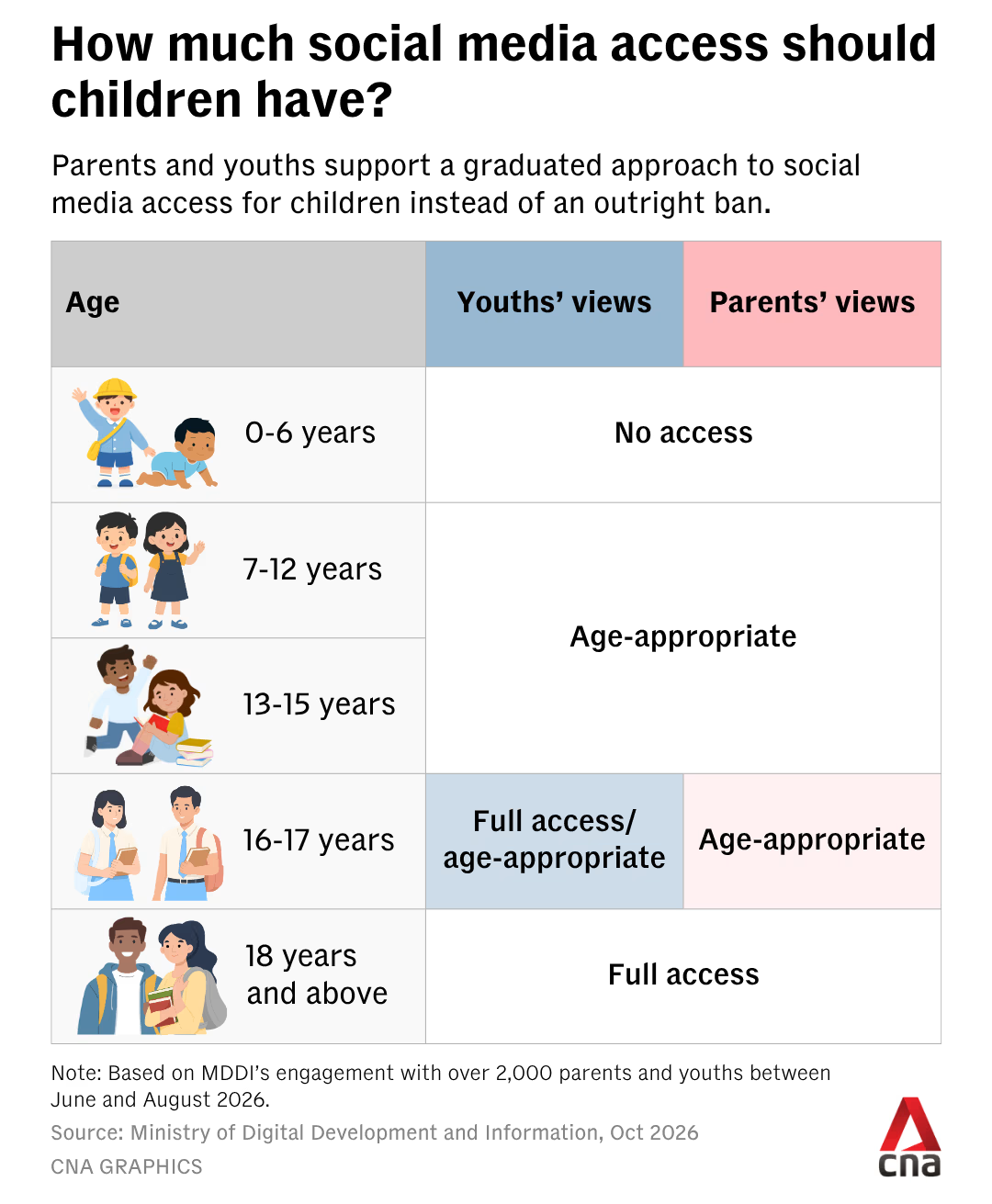
在MDDI与家长和青少年的互动中,两组人都认为,零至六岁的儿童不应接触社交媒体,而七至十五岁的儿童应获得适龄接触。
In MDDI's engagement with parents and youths, both groups felt children aged zero to six should have no access, while those aged seven to 15 should have age-appropriate access.
青少年普遍支持从16岁开始更广泛地接触社交媒体,认为年轻人更成熟,能够更好地独立管理自己的使用,而家长则继续支持该年龄段的适龄接触。
Youths generally supported greater access to social media from age 16, seeing young people as more mature and better able to manage their use independently, while parents continued to support age-appropriate access at that age.
TOUCH Cyber Wellness副主任陈文慧女士表示,理想情况下,13至17岁年龄段内应有更细致的区分,考虑到13岁和17岁青少年之间的发展差异。
Ms Wendy Tan, deputy director of TOUCH Cyber Wellness, said there would ideally be finer distinctions within the 13 to 17 age band, given the developmental differences between a 13-year-old and a 17-year-old.
“然而,我们认识到,国家法规也必须考虑年龄验证的可靠性、实施复杂性、一致性和可执行性,”她说。
"However, we recognise that national regulation must also consider the reliability of age assurance, implementation complexity, consistency and enforceability," she said.
“因此,一个更简单的框架是合理的起点。”她补充说,年龄验证最终必须导致“有意义”的保障措施。
"A simpler framework is therefore a reasonable starting point." Age assurance, she added, must ultimately lead to "meaningful" safeguards.
她说,一旦平台识别出未成年人,更强的隐私设置、对不必要联系的限制以及更安全的内容推荐应默认适用。
Once a platform identifies a minor, stronger privacy settings, restrictions on unwanted contact and safer content recommendations should apply by default, she said.
目标是保护儿童,同时逐步帮助他们培养判断力和自我调节能力,以实现更大的线上独立性。
The aim is to protect children while progressively helping them develop judgment and self-regulation for greater independence online.
“因此,准备和赋能家长了解这些可用的保障措施至关重要,使他们能够与孩子一起在家中实践和强化良好习惯,”她说。
"It is therefore crucial to prepare and empower parents to learn about these available safeguards, enabling them to practise and reinforce good habits at home, alongside their children," she said.
安全始于家庭 在支持社交媒体分级接入方面,家长和青少年告诉CNA,同样重要的是,首先要教会孩子如何安全地使用社交媒体。
SAFETY STARTS AT HOME In supporting tiered access to social media, parents and youths told CNA that it's equally important to ensure that children are first taught how to safely use social media.
育有三个孩子的洪女士认为,让孩子接触一些社交媒体是有好处的,而不是让他们在成年时将其视为一个“全新的世界”。
Ms Hon, the mother-of-three, believes it is good for children to have some exposure to social media, instead of experiencing it as a "brand new world" when they come of age.
“我们不能把他们包裹在气泡膜里,所以无论政府或平台采取什么限制措施,作为家长,我只会尽力教他们如何做出正确的决定,”她说。
"We can't bubble wrap them, so whatever restrictions that either the government or the platforms put in place, as a parent, I'll just try to teach them how to make good decisions," she said.
其他家长对让孩子接触社交媒体更为谨慎,但也认识到完全让孩子远离社交媒体的困难。
Other parents are more cautious about giving children access, but also recognise the difficulties of keeping them off social media entirely.
46岁的陈秀英女士表示,她曾犹豫是否给12岁和14岁的孩子买智能手机,但由于学校依赖WhatsApp,她感到不得不这样做。
Ms Chen Xiu Ying, 46, was hesitant to give her 12- and 14-year-old children smartphones – but felt compelled to do so because there was a reliance on WhatsApp at school, she said.
她对社交媒体的主要担忧是接触不当内容和诈骗。但借助iPhone内置的家长控制功能,陈女士可以为孩子安排停机时间并设置屏幕使用时间规则。
Her main concerns about social media are exposure to inappropriate content and scams. But with built-in parental controls on the iPhone, Ms Chen can schedule downtime and set screen time rules for her children.
陈女士过去曾支持禁止儿童使用社交媒体,但澳大利亚实施禁令的尝试让她三思而后行。
While Ms Chen used to be in support of a social media ban for children, Australia's attempt at implementing the ban has made her think twice.
“当潘多拉的盒子已经打开,要把所有东西都装回去就有点困难了,”她说。
"When you’ve already opened Pandora's box, it's a little bit hard to stuff it all back in," she said.
“如果你告诉孩子‘不可以就是不可以’,那反而会变得诱人。但一旦让他们尝试,就会产生想要更多的欲望。所以我们需要基于价值观来教育他们,而这要从很小的年龄开始。”陈女士认为,分级方式是“良好的第一步”,但她不指望政府成为社交媒体使用的“先锋”。“他们可以制定措施,但家长是否认真对待是另一回事,”她说。
"If you tell (children) cannot means cannot, that becomes tempting. But the moment you let them taste it, there's an appetite to want more. So we need to educate them based on values, and that starts from a very young age." A tiered approach is a "good first step" to Ms Chen, but she does not expect the government to be the "vanguard" of social media use. "They can set the measures in place, but whether parents take it seriously is another thing," she said.
中三学生埃文是一位赞成社交媒体分级访问的青年,他承认年幼的孩子“非常容易受影响,因为他们的大脑仍在发育”。不过,他表示,每个人都“应该注意自己消费的内容”。
Evan, the Sec 3 student, is one youth in favour of tiered access to social media, acknowledging that young children are "very impressionable since their brains are still growing". Nevertheless, everybody "should be mindful about the content they consume", he said.
“即使他们认为自己消费的媒体内容没问题……他们也应该不时地进行自我审视。”18岁的理工学院学生阿迪蒂亚·米什拉承认社交媒体的弊端,例如分心、沉溺于负面信息以及对即时满足的不健康依赖。
"Even if they think the media they're consuming is okay ... they should take stock every now and then." Polytechnic student Aditya Mishra, 18, acknowledged downsides of social media such as distraction, doomscrolling and an unhealthy dependence on instant gratification.
米什拉12岁开始使用Instagram,他也倾向于让孩子们有机会安全地在线上交流。在他看来,适龄措施可以在孩子年满16岁后取消。
Mr Mishra, who started using Instagram when he was 12, also favours giving children opportunities to connect online safely. In his view, age-appropriate measures could be lifted when children are above 16.
“到那时,大多数学生已经足够成熟,能够为自己做出明智的决定,同时也能优先考虑学业和个人目标。”一名自称本的青年表示,他认为孩子的成熟程度比年龄更重要。
"Most students are mature enough by then in order to make decisions for themselves wisely, and also prioritise their academics and personal goals." A youth who gave his name as Ben said he feels a child's maturity matters more than their age.
这名18岁的青年说,他大约在五岁时开始使用YouTube,每天最多花三个小时。如今,他主要使用社交媒体与朋友联系,但也认识到成瘾性算法和负面内容所带来的危害。
The 18-year-old started using YouTube when he was around five, where he spent up to three hours a day, he said. Today, he mainly uses social media to connect with friends, but recognises the perils of addictive algorithms and negative content.
“让孩子在社交媒体上负责任的最佳方式,不是法律或禁令,而是父母与孩子之间的沟通,”他说。
"The best way to have children be responsible on social media is not laws or bans, but between the parent and the child," he said.
安娜贝尔心理诊所的临床心理学家安娜贝尔·周博士表示,最有效的防护措施是全面的。
Dr Annabelle Chow, a clinical psychologist at Annabelle Psychology, said the most effective safeguards are holistic.
“我们不能将责任完全推给孩子、父母、学校或平台。正如俗话所说,养育一个孩子需要整个村庄,”她说。
"We cannot place the responsibility entirely on children, parents, schools or platforms. As the saying goes, it takes a kampung (village) to raise a child," she said.
周博士表示,父母应将健康使用社交媒体视为一项独立的技能,就像学习如何过马路或与朋友互动、玩耍一样。
Dr Chow said parents should consider the healthy use of social media as a skill in and of itself, much like learning how to cross the road or interact and play with friends.
她补充说,孩子们是通过实践和指导来学习的,而不仅仅是到了某个年龄就能掌握。
Children learn it through practice and guidance, rather than simply upon reaching a certain age, she added.
周博士说,首先了解社交媒体为孩子提供了什么很有帮助,无论是娱乐、与朋友保持联系,还是单纯为了放松。
It helps to first understand what social media provides for the child, said Dr Chow, whether it provides entertainment, a way to keep up with friends or simply to unwind.
体育、爱好和与朋友共处的时间,可以提供满足这些需求的其他方式。她表示,这并不意味着要把孩子日历上的每一小时都排满,并补充说,一些非结构化的时间也能给他们留出空间,去发现自己的兴趣并发挥创造力。
Sports, hobbies and time with friends offer other ways to meet those needs. This does not mean filling every spare hour on a child's calendar, she said, adding that some unstructured time also gives them room to discover their own interests and be creative.
“归根结底,与其把手机拿走,不如让孩子在日常生活中拥有足够多的事物,让手机不必填补每一个空缺,”她说。
"Ultimately, it is less about taking the phone away and more about giving children enough in their everyday lives that the phone does not need to fill every gap," she said.