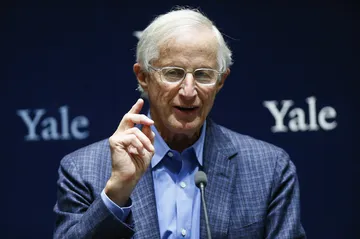
早在各国派遣特使参加联合国气候谈判之前,甚至在企业和城市高调宣扬清洁能源目标之前,耶鲁大学经济学家威廉·诺德豪斯就着手研究气候变化将如何重塑全球经济。他在10月30日去世,享年85岁,此前他凭借20世纪70年代的开创性工作创立了气候经济学这一新学科,并成为诺贝尔奖得主。
Long before countries dispatched envoys to United Nations climate negotiations, and even longer before companies and cities trumpeted clean-energy goals, Yale economist William Nordhaus set out to understand how climate change would redraw the global economy. He died on October 30 at the age of 85, after creating the new discipline of climate economics with his work in the 1970s and becoming a Nobel laureate.
“他是该领域的领军人物,展示了如何将气候变化纳入经济模型进行定价,”摩根大通公司全球气候咨询主管萨拉·卡普尼克说。“他激励我们所有人继续钻研这些问题,将物理世界转化为供决策参考的经济认知。”诺德豪斯1967年开始在耶鲁大学任教,并将关注点转向地球变暖问题。在1975年的一份工作论文《我们能控制二氧化碳吗?
“He was a leader of the field, showing how climate change could be priced into economic models,” said Sarah Kapnick, global head of climate advisory at JP Morgan Chase & Co. “He inspired us all to continue working on these problems and translate the physical world into economic understanding for decision-making.”Nordhaus started teaching at Yale University in 1967 and turned his attention to the problem of a heating planet. In a 1975 working paper, “Can We Control Carbon Dioxide?”, he considered how policymakers might decide to confront “the carbon dioxide problem.”
》中,他探讨了政策制定者可能如何决定应对“二氧化碳问题”。他是第一个建议将2摄氏度作为人为全球变暖潜在上限的人,这一建议基于对人类深层历史经历变暖程度的估算。这项工作可以说领先了二十年,同一阈值后来被载入2015年《巴黎协定》。
He was the first to suggest 2C as a potential limit for human-caused global warming, based on an estimate of how much warming humanity has experienced in its deep history. The work was arguably two decades ahead of its time, with the same threshold enshrined in the 2015 Paris Agreement.
1992年,他推出了后来成为气候经济分析核心工具的“动态综合气候经济模型”。该模型被称为DICE,迅速成为理解经济增长与污染、变暖影响与政策选择之间动态关系的默认工具。
It was in 1992 that he introduced what became the central tool of climate-economic analysis, the Dynamic Integrated Climate-Economy model. Known as DICE, the model quickly became the default tool for understanding the dynamics between economic growth and pollution, warming impacts and policy choices.
“它至今仍是分析的‘金标准’,”哥伦比亚商学院气候经济学家格尔诺特·瓦格纳说。
“It is the gold standard” for analysis even today, said Gernot Wagner, a climate economist at Columbia Business School.
DICE 将截然不同的诸多专业领域整合在一个框架中,并将其写入模型相互作用的各个组成部分:经济增长导致温室气体污染,污染主要来自为能源、农业和工业燃烧化石燃料。这些排放导致全球二氧化碳浓度升高,在大气中锁住额外热量。热量推高气温、使海平面上升并引发其他影响。所有这些都会产生经济效应,并在政策作用下反馈至经济增长和排放。
DICE brings together into one place vastly different fields of expertise, each written into the model’s interacting parts: Economic growth causes greenhouse gas pollution, which comes mostly from burning fossil fossils for energy, agriculture and industry. Those emissions lead to increased levels of global carbon dioxide that traps extra heat in the atmosphere. The heat increases temperatures, raises sea levels and triggers other impacts. All of these have economic effects that feed back, with policy, into economic growth and emissions.
该模型始终保持开放且可调整。DICE 的奠基性论文在后续经济学研究中被引用数千次,其他学者检验其方法并发现改进之处。
The model has always been open and adaptable. The foundational DICE papers have drawn thousands of citations in subsequent economics research, as others tested his methods and discovered improvements.
对 DICE 最持久的批评在于,它对污染与损害的关系做出了有缺陷的假设。气候经济学家通常以每公吨排放二氧化碳的未来损失现值成本来衡量损害。据 Wagner 称,1992 年最初的 DICE 模型估算约为每吨 5 美元至 6 美元(按当前美元价值折算)。这大约只有最新版 DICE 估值的十分之一。
The most persistent criticism of DICE is that it made flawed assumptions about the relationship between pollution and damage. Climate economists often measure damage in terms of the present cost of future losses, per metric ton of emitted carbon dioxide. The original 1992 DICE model estimated roughly $5 to $6 a ton in today’s dollars, according to Wagner. That’s about one-tenth of what the latest version of DICE puts it at.
许多独立估算的数值更高。Wagner 与多位同事于 2024 年收集了来自 147 项研究的 1823 个碳社会成本估算值。他们对 20 年研究成果的分析得出的总体平均值为每吨 283 美元。
Many independent estimates soar higher still. Wagner and several colleagues in 2024 collected 1,823 estimates of the social cost of carbon from 147 studies. Their analysis of 20 years of work settled on an overall average figure of $283 per ton.
批评者(尤其是左翼人士)还对 DICE 认定的经济上可容忍的升温程度表示愤慨。DICE 预测的 3.5 摄氏度升温,在世界致力于将全球变暖控制在 1.5 摄氏度或 2 摄氏度之际,面临着日益严峻的舆论压力。当前估算预计,到 2100 年平均升温将达到 2.6 摄氏度(相较于前工业化时期气候)。
Critics, particularly on the left, also took umbrage with how much warming DICE found to be economically tolerable. DICE projections of 3.5C faced increasingly challenging optics as the world strove to contain global warming to 1.5C or 2C. Current estimates anticipate an average warming of 2.6C by 2100, compared to the preindustrial climate.
DICE 模型将问题简化,这既是其最大优势,也是其致命弱点。“环境经济学领域的每个人都研究过这个模型,然后都会得出结论:有些要素缺失了,”瓦格纳说。他说,该学科内部的批评者往往会做出改进,“这当然就是他的模型如此显赫的原因。”诺德豪斯本人定期重新发布该模型,逐步纳入更现实的损失估算、对全球经济增长的更高预期,以及对货币时间价值看法的变化。
DICE simplifies matters, which is both its greatest asset and Achilles’ heel. “Everyone in environmental economics has studied the model and then has concluded to themselves that there are bits missing,” Wagner said. The critics within the discipline often made improvements, he said, “which is of course why his model is so prominent.”Nordhaus himself republished the model periodically, gradually accounting for more realistic damage estimates, higher expectations for global economic growth and shifting sentiments on how money changes value over time.
DICE 框架与政府政策相一致,这些政策要么对气候污染征税,要么建立“限额与交易”市场,用于买卖污染排放许可。
The DICE framework is consistent with government policies that either tax climate pollution or set up a “cap and trade” market for buying and selling pollution permits.
瓦格纳说,诺德豪斯在气候变化经济学方面的工作极具奠基性和影响力,以至于他本可能在最终于 2018 年获奖前几十年就获得诺贝尔奖。那一年,他与波士顿学院的保罗·罗默共享该奖项。
Nordhaus’s work on climate change economics was so foundational and influential that he might have won the Nobel decades before he finally did in 2018, Wagner said. He shared the prize that year with Boston College’s Paul Romer.
突破研究所创始人兼所长、环境研究非营利组织负责人泰德·诺德豪斯强调,他叔叔在 20 世纪 70 年代中期做出的飞跃令人难以置信,那比美国国家科学院发布其首份具有里程碑意义的气候科学评估还要早几年。
Ted Nordhaus, the founder and president of the Breakthrough Institute, an environmental research nonprofit, emphasizes how mind-boggling a leap his uncle made in the mid-1970s, a few years before the US National Academy of Sciences put out its first landmark assessment of climate science itself.
“实际上,他创造了我们思考这一问题的整个概念空间,”泰德·诺德豪斯说。
“Literally, he just creates the entire conceptual space in which we think about the problem,” Ted Nordhaus said.
自威廉·诺德豪斯 1975 年发表其具有远见的著作以来,基本框架没有改变。但到 2018 年,变暖已加剧,他在诺贝尔奖演讲中发出了警示。
The basics haven’t changed since William Nordhaus published his visionary 1975 work. But by 2018, warming had advanced, and he struck a cautionary note in his Nobel address.
“技术变革使人类摆脱了旧石器时代的生活水平,”他说。“在最极端的情景下,气候变化威胁要让我们在经济上回到原点。”
“Technological change raised humans out of Stone Age living standards,” he said. “Climate change threatens, in the most extreme scenarios, to return us economically whence we came.”