史前血液的痕迹可能揭示关于恐龙生物学前所未有的线索,但一直以来极难得到证实。如今,研究一块1.15亿年前恐龙骨骼的研究人员表示,他们在化石中发现了迄今最有力的红细胞证据。
Traces of prehistoric blood could reveal unprecedented clues about dinosaur biology, but they’ve been notoriously difficult to confirm. Now, researchers studying a 115 million-year-old dinosaur bone say they’ve found the strongest evidence yet of red blood cells in a fossil.
组织、细胞及其他软生物样本极少能在化石形成过程中存留下来,因此此类发现往往备受争议。自20世纪90年代末以来,已有几项研究报告称在恐龙及其他爬行动物化石中发现了类似红细胞的结构,但研究人员对其真实性争论激烈。
Tissues , cells and other soft biological samples rarely ever survive the fossilization process and thus make for controversial discoveries. A few previous studies, dating back to the late 1990s, have reported structures resembling red blood cells in dinosaur and other reptile fossils, but researchers have fiercely debated their legitimacy.
这项新研究于周一发表在《美国国家科学院院刊》上,运用新型显微成像与化学分析相结合的方法,不仅在恐龙骨骼内发现了保存下来的类似红细胞的微观结构,还发现了血红素的化学证据——血红素是血红蛋白中的一种分子,而血红蛋白是红细胞中携带氧气的蛋白质。据该研究作者称,这是首次在恐龙化石中原位(即在这些结构内部)检测到血红素。
The new study , published Monday in the journal Proceedings of the National Academy of Sciences, used a combination of new microscopic imaging and chemical analyses to find not only microscopic structures resembling red blood cells preserved within the dinosaur bone, but also chemical evidence of heme — a molecule in hemoglobin, the protein in red blood cells that carries oxygen. According to the study’s authors, it is the first time heme has been detected in situ, or within the structures themselves, in a dinosaur fossil.
保存完好的早白垩世骨骼化石与新的研究方法,有力支持了生物结构和分子可以在史前化石中存留下来这一论点,该研究第一作者、澳大利亚珀斯科廷大学有机地球化学家、约翰·科廷杰出教授克利蒂·格赖斯表示。
function imageLoadError(img) { const fallbackImage = '/media/sites/cnn/cnn-fallback-image.jpg'; img.removeAttribute('onerror'); img.src = fallbackImage; let element = img.previousElementSibling; while (element && element.tagName === 'SOURCE') { element.srcset = fallbackImage; // If we fall back to a JPG, drop any format-specific . element.removeAttribute('type'); element = element.pre
“令人振奋的意义不仅在于我们在这具恐龙身上发现了什么。而在于我们现在拥有了可应用于其他化石的方法,去探究其中究竟还隐藏着多少原始的生物信息,”格赖斯在电子邮件中说。然而,并非所有专家都确信这些微观结构真的是红细胞。
The well-preserved Early Cretaceous bone and new research approach bolster the argument that biological structures and molecules can survive in prehistoric fossils, said lead author Kliti Grice, organic geochemist and John Curtin Distinguished Professor at Curtin University in Perth, Australia. “The exciting implication is not just what we have found in this dinosaur. It is that we now have approaches that can be applied to other fossils to ask how much original biological information may still be hidden within them,” Grice said in an email. However, not all experts are convinced that the microscopic structures are truly red blood cells.
格赖斯说,如果研究人员在更多化石标本中发现类似的红细胞证据,这“可能有助于我们提出关于灭绝动物生理学更复杂的问题”。
If researchers find similar evidence of red blood cells in more fossil specimens, it “could potentially help us ask much more sophisticated questions about the physiology of extinct animals,” Grice said.
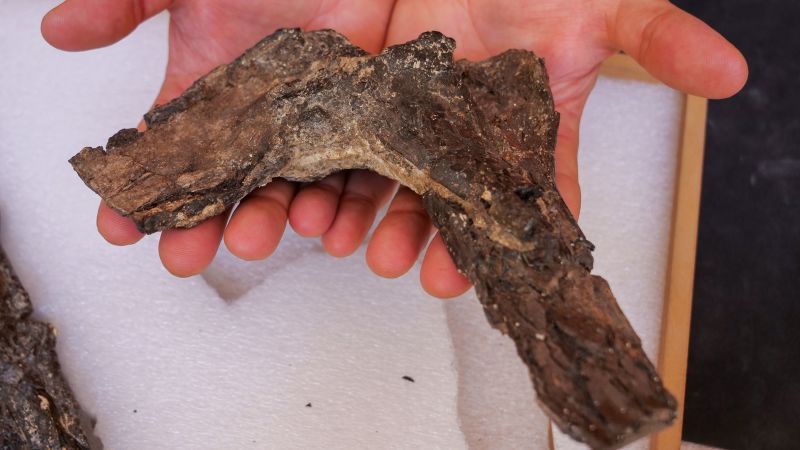
巴西塞阿拉州桑塔纳杜卡里里,Plácido Cidade Nuvens古生物学博物馆展出的兽脚类恐龙Aratasaurus(阿拉塔龙)右后肢化石局部。科廷大学供图这具化石是阿拉塔龙(Aratasaurus museunacionali)的一部分后肢,这种兽脚类恐龙生活在早白垩世。古生物学家2008年在巴西东北部的Mina Pedra Branca地质遗址、Romualdo组(罗穆阿尔多组)挖掘出这根腿骨,该岩石区以化石保存极为完好而闻名。科学家认为,静止的水体限制了氧气并减缓了埋藏于此的遗骸分解。
A portion of the fossilized remains of the right hind limb of the theropod dinosaur Aratasaurus, seen at Museu de Paleontologia Plácido Cidade Nuvens, Santana do Cariri, Ceará, Brazil. Curtin University The fossil is a partial hind limb of Aratasaurus museunacionali, a theropod dinosaur that lived during the Early Cretaceous. Paleontologists dug up the leg bone in 2008 at the geological site Mina Pedra Branca in northeastern Brazil within the Romualdo Formation, a rocky area known for its exceptionally preserved fossils. Scientists believe stagnant waters limited oxygen and slowed the decomposition of remains buried in this region.
在骨骼的血管管道——输送血管和神经纤维的微观管道中,研究作者发现了大量椭圆形微观结构,外观类似红细胞。研究团队随后结合成像和化学分析,鉴定这些结构是否含有与红细胞一致的特征信号。
Within the bone’s vascular canals — microscopic tubes that carry contain blood vessels and nerve fibers — the study authors found an abundance of oval-shaped microstructures that looked similar to red blood cells. The team then used a combination of imaging and chemical analysis to identify whether the structures contained signatures consistent with red blood cells.
格赖斯说,以往的研究可能分别描述过类红细胞结构和恐龙化石中可能的血液化学残留,但这项研究汇集了多条证据,包括这些结构的位置、外观、矿物成分及相关化学信号。
Past research may have separately described red blood cell-like structures and possible remnants of blood chemistry in dinosaur fossils, but this study brings together multiple lines of evidence, including the structures’ location, appearance, mineral composition and associated chemical signals, Grice said.
研究人员推测,该遗址的低氧埋藏条件可能限制了有机物质的分解,从而帮助这些结构得以保存。除了血红素,研究作者还在骨骼中发现了锰氧化物的痕迹,这些矿物可能进一步帮助稳定并保存了细胞。
The researchers suggest that low-oxygen burial conditions at the site may have limited the breakdown of organic material, helping the structures survive. Along with heme, the study authors found the bone contained traces of manganese oxides, minerals that may have further helped stabilize and preserve the cells.
显微镜下拍摄的、类似红细胞的结构,取自兽脚类恐龙Aratasaurus(阿拉塔龙)的化石肢骨,拍摄地点为位于澳大利亚西澳大利亚州珀斯的科廷大学实验室。 科廷大学“骨骼提供了关于解剖结构、生长、运动和进化的非凡信息。但细胞和分子层面的保存可能让我们获得另一层生物学信息:活体动物及其组织的化学成分,”格赖斯说。
Microscopic images of structures resembling red blood cells from the fossilized limb bone of the theropod dinosaur Aratasaurus, taken at a laboratory at Curtin University in Perth, Western Australia. Curtin University “Bones provide extraordinary information about anatomy, growth, locomotion and evolution. But cellular and molecular preservation potentially gives us access to a different layer of biological information: the chemistry of the living animal and its tissues,” Grice said.
不过,她强调,仅凭一个标本就得出关于Aratasaurus生理学的结论还为时过早。
However, she emphasized that it is too early to draw conclusions about the physiology of Aratasaurus based on one specimen.
“首要问题之一是,这是否是一种极其罕见的现象,还是说其他化石中类似的保存情况只是被忽视了,”她说。“因此,世界各地博物馆收藏的化石中,可能存在从未被研究过的分子和细胞信息。”
“One of the first questions is whether this is an extraordinarily rare occurrence or whether similar preservation has simply been overlooked in other fossils,” she said. “There may therefore be fossils sitting in museum collections around the world that contain molecular and cellular information that has simply never been investigated.”
格赖斯和她的团队计划将研究扩展到不同物种、不同时代和不同环境的其他化石,以更好地了解这种保存完好的分子证据有多普遍。
Grice and her team plan to expand their research to other fossils from different species, geological time periods and environments to better understand how widespread this type of well-preserved molecular evidence might be.
未来,更多的分子线索可能帮助研究人员探究恐龙如何在体内输送氧气、其组织如何运作,以及其生物学特征与现存动物相比如何。
In the future, more molecular clues could help researchers investigate how dinosaurs transported oxygen through their bodies, how their tissues functioned and how their biology compared with that of animals alive today.
但从恐龙骨中发现红细胞是否能让科学家更接近重建其 DNA,正如《侏罗纪公园》等书籍和电影所描绘的那样?史密森学会博物馆保护研究所的物理科学家蒂莫西·克莱兰德表示,并非如此。他解释说,血红素和 DNA 是不同的分子,它们在骨骼中化石化的方式也不同。发现一种证据并不意味着另一种已存活。
But does finding red blood cells from a dinosaur bring scientists any closer to recreating its DNA, as seen in books and movies like “Jurassic Park”? Not necessarily, said Timothy Cleland, a physical scientist at the Smithsonian Institution’s Museum Conservation Institute. Heme and DNA are different molecules, and they would fossilize in bone in different ways, he explained. Finding evidence of one does not mean the other has survived.
1938年3月4日:在威尔士国家博物馆(卡迪夫)中,杜鹃鸟(Dodo)骨架与一只重建模型并排展示。贝克/福克斯照片/盖蒂图片社克莱兰德在一封电子邮件中说:“这项研究为探索骨骼中血红素 b 的保存提供了新的研究方向,尤其是在像这个地点这样异常保存的场所。”他补充说:“此外,这项研究提出了一个问题,即这种保存方式是否不仅限于这只恐龙,还适用于罗穆阿尔多层地层中的其他物种以及其他异常保存地点?”
4th March 1938: A Dodo skeleton opposite a reconstructed model of the extinct bird in the National Museum of Wales, Cardiff. Becker/Fox Photos/Getty Images “This study opens new research avenues to explore heme b preservation within bone, especially in exceptional sites like this one,” Cleland said in an email, referring to the most common form of heme. “Additionally, this study begs the question, does this kind of preservation extend beyond this single dinosaur to other species within the Romualdo Formation as well as to other locations with exceptional preservation?”
作者在研究中指出,这些结构与活禽类和鳄鱼类的红细胞在大小和形状上也不同。但他们警告说,现代物种可能不是非鸟类恐龙的最佳对照——而且他们在阿拉塔萨乌鲁斯·穆塞纳尔纳尔西(Aratasaurus museunacionali)中发现的细胞可能并未保留动物活着时的原始形状。
The structures also differed in size and shape from red blood cells in living birds and crocodilians, the authors noted in the study. But they cautioned that modern species may not be the best comparison for non-avian dinosaurs — and that the cells they found in Aratasaurus museunacionali may not retain their original shape from when the animal was alive.
未参与该研究的克莱兰德表示,未来的研究可能帮助科学家更好地了解动物死亡后红细胞可能发生的变化,这可能解释阿拉塔萨乌鲁斯细胞形状异常的原因。也有可能这些结构根本不是红细胞的残余。
Cleland, who was not involved in the new study, said future research could help scientists better understand how red blood cells might change after an animal dies, which could possibly explain Aratasaurus’ odd cell shapes. It’s also possible that the structures might not be remnants of red blood cells at all.
北卡罗来纳州立大学生物科学系的退休教授玛丽·施韦策尔指出,这些发现并未达到识别化石血细胞的既定标准。她未参与该研究。
The findings do not meet established standards for identifying fossilized blood cells, said Mary Schweitzer, professor emeritus in the department of biological sciences at North Carolina State University. She was not involved in the study.
她质疑这些结构的形状和大小是否足以与恐龙亲缘生物的红细胞相匹配,以及研究作者主要发现的锰氧化物——hausmannite 的意义。Schweitzer 指出,这种物质在活体红细胞中并未被检测到。
She questioned whether the structures’ shape and size sufficiently match red blood cells in living relatives of dinosaurs as well as the significance of hausmannite, the type of manganese oxide the study authors predominantly found. Schweitzer noted that this substance is not detected in living red blood cells.
但 Grice 说,团队并不认为 hausmannite 是细胞的原始成分。相反,他们认为它是在化石化过程中形成的,可能有助于保存结构和相关分子证据。J. Wiemann然而,Schweitzer 在一封电子邮件中表示,作者使用多种分析技术是该领域的一项激动人心的进展。根据数据,她表示希望恐龙本身的一些分子仍然保存在骨骼中。
But Grice said the team does not consider hausmannite an original component of the cells. Rather, they believe it formed during fossilization and may have helped preserve the structures and associated molecular evidence. J. Wiemann Still, Schweitzer said in an email that the authors’ use of multiple analytical techniques is an exciting advancement for the field. Based on the data, she said she is hopeful that some molecules from the dinosaur itself remain preserved in the bone.
“在深层时间中保存的化石分子的可用性才刚刚开始被探索,正统观念认为这种保存是不可能的,”Schweitzer 说。“我们能对非常古老的化石进行的研究越多,就越能了解埋藏环境与降解生物之间的相互作用。”
“The usability of fossil molecules preserved in deep time is only just beginning to be explored, as conventional wisdom states preservation like this is not possible,” Schweitzer said. “The more studies we can do on very old fossils, the more we can learn about the interaction between the burial environments and the degrading organism.”
进一步的研究最终可能帮助科学家回答更大的问题,包括史前分子能揭示疾病、生物过程以及分子随时间如何演化,她补充说。
Further research could eventually help scientists answer much bigger questions, including what prehistoric molecules can reveal about disease, biological processes and how molecules have evolved over time, she added.
“如果我们能从‘不可能’转向‘如果可能’,未来会有什么不可预见的可能性!”Schweitzer 说。Taylor Nicioli 是一名驻纽约的自由记者。
“If we can get beyond ‘It can’t’ to ‘What if it can?’, there is no telling what may lie ahead!”Schweitzer said. Taylor Nicioli is a freelance journalist based in New York.
注册 CNN 的 Wonder Theory 科学通讯。通过关于迷人发现、科学进步等新闻探索宇宙。
Sign up for CNN’s Wonder Theory science newsletter . Explore the universe with news on fascinating discoveries, scientific advancements and more.