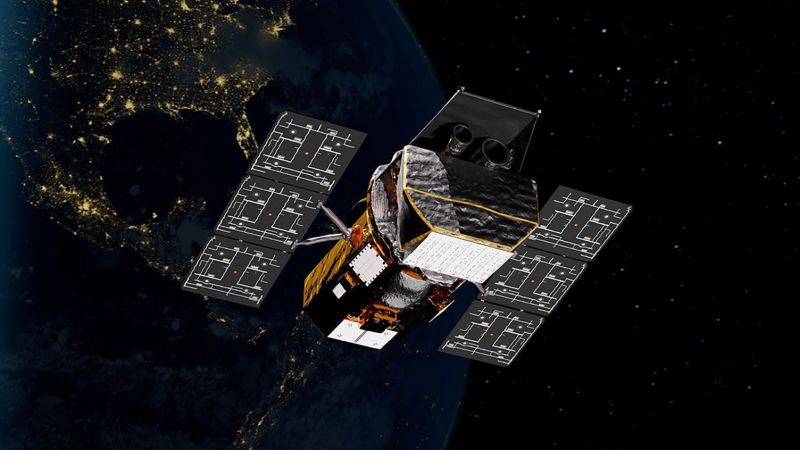
美国国家航空航天局(NASA)的尼尔·格雷尔斯“雨燕”天文台预计将于周三清晨在大气层中燃烧解体,距离其发射升空、旨在研究宇宙中最强大爆炸现象已近22年。
NASA’s Neil Gehrels Swift Observatory is expected to meet a fiery end early Wednesday morning, nearly 22 years after it launched to study the most powerful explosions in the universe.
虽然这艘重达3200磅(约1451公斤)的航天器大部分预计将在冲越地球稠密的大气层内层时烧毁,但NASA预测仍会有部分残骸坠落地面。
While most of the 3,200-pound spacecraft is expected to burn up as it blazes through the thick inner band of Earth’s atmosphere, NASA predicts some pieces of the vehicle will hit the ground.
NASA周一在一份声明中说:“对地球上任何人造成伤害的风险极低,概率约为1/2100。”
“The risk of harm coming to anyone on Earth is unlikely, approximately 1 in 2,100,” NASA said in a statement Monday.
该机构还预计,“雨燕”天文台的残骸可能落在南纬20.6度至北纬20.6度之间——即赤道以南和以北约1420英里(2285公里)范围内。该区域涵盖中美洲和南美洲大部、中非、印度南部、东南亚和澳大利亚北部,以及大片海域。
The agency also anticipates that Swift’s debris could land somewhere between 20.6 degrees south latitude and 20.6 degrees north latitude — or about 1,420 miles (2,285 kilometers) below and above the equator. That band encompasses much of Central and South America, Central Africa, southern India, Southeast Asia and northern Australia, as well as vast stretches of ocean.
“雨燕”天文台究竟何时将最终坠入地球尚不清楚。预测模型通常至少有数小时的误差范围。非营利组织航空航天公司(The Aerospace Corporation)的一个估算显示,再入大气层时间为美国东部时间上午5:19,误差为正负两小时。美国太空军的一个较新预测则将再入时间定在美东时间上午7:42,误差范围相同。
It’s not yet clear exactly when Swift will make its final descent to Earth. Prediction models typically have a margin of error of at least a few hours. An estimate from the nonprofit Aerospace Corporation put reentry 5:19 a.m. ET, plus or minus two hours. A more recent US Space Force projection predicted reentry for 7:42 a.m. ET with the same margin of error.
据联邦资助的研发中心航空航天公司称,如果“雨燕”天文台是今天发射,它将不得不遵守严格得多的关于寿命终止规划的安全准则。
If Swift were launched today, it would likely have to adhere to far stricter safety guidelines regarding end-of-life planning, according to The Aerospace Corporation, which is a federally funded research and development center.
美国航空航天公司发言人帕克·威希克表示,现行轨道碎片减缓标准于2019年更新,规定“不受控再入的预期伤亡风险须低于万分之一”。他在一封电子邮件中指出,在此语境下,“伤亡”指的是“重伤或死亡”。虽然NASA早已知道“雨燕”天文台可能不得不以不可预测的方式坠回地球,但该机构曾希望于7月发射的一项大胆救援任务能够抓住并提升“雨燕”天文台,因为大气阻力正逐渐将其从曾经稳定的轨道上拖离。
Current orbital debris mitigation standards, which were updated in 2019, mandate that “uncontrolled reentries have an expected casualty of less than 1 in 10,000,” said Parker Wishik, a spokesperson for The Aerospace Corporation. He noted in an email that, in this context, “casualty” refers to “serious injury or death.”While NASA has long known that Swift would likely have to make an unpredictable plunge back to Earth, the agency had hoped that a daring rescue mission launched in July could latch on and boost the Swift Observatory as atmospheric drag gradually pulled it from a once-stable orbit.
该任务本可将其运行寿命延长十年甚至更久,但最终这一努力失败了。该航天器最终降至距地球仅171英里(275公里)的高度,天文台正式停止收集科学数据。
It could have extended Swift’s operating life by a decade or more, but ultimately the effort failed. The spacecraft eventually dropped down to just 171 miles (275 kilometers) above the planet, and the observatory officially stopped gathering scientific data.
NASA在一份新闻稿中表示:“此时,航天器已无法补偿阻力增加带来的影响,进入了安全模式。”
“At this point, the spacecraft was no longer able to compensate for the effects of the increased drag and entered safe mode,” NASA said in a news release.
宾夕法尼亚州立大学的研究团队于10月20日向“雨燕”发送了最后的终止指令。该大学是NASA在该项目上的合作伙伴,也是该天文台任务运行中心的所在地。
A team of researchers at Penn State — NASA’s partner on the project and home to the observatory’s Mission Operations Center — sent the final kill-switch command to Swift on October 20.
过去几年太阳活动增强加速了“雨燕”的终结,太阳在2024年达到了其11年活动周期的峰值。
Swift’s demise was hastened by an increase in solar activity over the past couple of years as the sun reached the peak of its 11-year cycle in 2024.
强烈的耀斑和日冕物质抛射导致地球大气层膨胀,加剧了“雨燕”所受的阻力,使科学家预测它将在今年秋天向地球坠落。
Intense flares and coronal mass ejections caused Earth’s atmosphere to expand, which intensified the drag on Swift, leading scientists to predict it would descend toward our planet this fall.
总部位于亚利桑那州的卡塔利斯特空间技术公司(Katalyst Space Technologies)今年早些时候匆忙组织起一场最后的努力,以稳定斯威夫特天文台,仅用九个月就将这场救援任务送上了轨道。该公司迅速制造了一艘名为“链接”(LINK)的飞船,旨在抓住这架望远镜并将其重新送入稳定轨道。但“链接”于七月发射几周后,任务失败,卫星在抵达斯威夫特天文台之前,在太空中失控旋转。
Arizona-based Katalyst Space Technologies scrambled to put together the last-ditch effort to stabilize the Swift observatory earlier this year, getting the rescue mission off the ground in only nine months. The company rapidly produced a spacecraft called LINK, which aimed to grapple the telescope and lift it back into a stable orbit. But the mission failed a few weeks after LINK’s launch in July as the satellite spun out of control in space before reaching the Swift observatory.
随着斯威夫特天文台的命运已定,任务科学家们缓慢重新打开望远镜的仪器,一直收集数据和观测结果直到最后一刻。这些仪器此前已关闭数月,以节省电力并减缓飞船脱离轨道的速度。
As Swift’s fate was sealed, mission scientists slowly turned the telescope’s instruments back on to collect data and observations right up until the end. The instruments had been shut off for months to save power and mitigate how quickly the spacecraft sank out of orbit.
斯威夫特天文台自2004年11月发射以来,一直在低地球轨道上充当天体物理多功能工具,目前还没有一个既定的观测替代方案在后备等待。
The Swift Observatory, which does not have an established observational replacement waiting in the wings, has served as an astrophysics multi-tool in low-Earth orbit since it launched in November 2004.
这架以快飞鸟类命名的望远镜,能够迅速转向观察转瞬即逝的宇宙现象,例如闪耀的黑洞。该望远镜最初设计用于研究宇宙中最强大的爆炸,即伽马射线暴,但科学家们也利用它监测其他类型的宇宙闪现,以及小行星和彗星。
Named after fast-flying birds, the telescope could quickly pivot to observe blink-and-you-miss-it cosmic events such as flaring black holes. The telescope was originally designed to study the most powerful explosions in the universe, called gamma-ray bursts, but scientists have also used it to monitor other types of cosmic flashes as well as asteroids and comets.
尽管拯救斯威夫特天文台的尝试失败了,美国宇航局已暗示可能会为其他有价值的空间仪器尝试类似的寿命延长任务。上周,该机构向商业公司发出了一份征求建议书——正式名称为“提案请求书”(Request for Proposals,RFP)——询问它们如何提升、维护或以其他方式延长标志性哈勃太空望远镜的寿命。
Despite the failed attempt to rescue Swift, NASA has signaled it may try similar lifeline-extension missions for other valuable space-based instruments. Last week, the agency issued a solicitation — formally called a Request for Proposals or RFP — to commercial companies, asking how they might boost, service or otherwise prolong the life of the iconic Hubble Space Telescope.
美国国家航空航天局的分析显示,根据RFP文件,哈勃望远镜在2032年前坠出轨道的概率为10%,在2033年前脱轨的概率为50%。这台于1990年发射的深受喜爱的望远镜已经提供了天文学中最具辨识度的图像,并改变了科学家对宇宙的认识。RFP文件指出,在2040年代之前不会有哈勃的替代品。探索宇宙,获取关于令人着迷的发现、科学进展等新闻。
NASA’s analysis shows that there’s a 10% chance Hubble will plunge out of orbit by 2032 and a 50% it will deorbit by 2033, according to the RFP. The beloved telescope, launched in 1990, has delivered some of the most recognizable images in astronomy and has transformed scientists’ understanding of the cosmos. There is no replacement for Hubble expected before the 2040s, the RFP states. . Explore the universe with news on fascinating discoveries, scientific advancements and more.