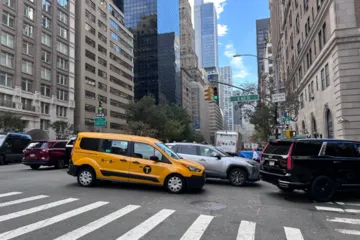
纽约市的拥堵收费实验似乎正在奏效。自大都会交通管理局于2025年1月5日起开始对驶入曼哈顿60街以南的汽车和卡车收费以来,进入拥堵区的车辆数量下降了,出行时间、紧急车辆响应时间、空气污染,以及可能的噪音污染也都下降了。拥堵区外的拥堵似乎也有所减少,一些人担心的60街以北的停车“末日”并未出现,而地铁、公交和通勤铁路进入拥堵区的乘客量增加,似乎已弥补了开车进入的人数减少。
New York City’s congestion-pricing experiment seems to be working. Since the Metropolitan Transportation Authority started charging cars and trucks to drive into Manhattan south of 60th Street on Jan. 5, 2025, the number of vehicles entering the congestion zone has dropped and so have travel times, emergency-vehicle response times, air pollution and possibly noise pollution. Congestion also seems to be down outside the zone, there’s no sign of the north-of-60th-Street parking apocalypse that some feared and increases in subway, bus and commuter-rail ridership into the congestion zone appear to have more than made up for the decline in people entering by car.
拥堵费已为大都会交通管理局的资本改善项目带来了10亿美元,且还在增加(这是截至9月的总额)。
The congestion tolls have brought in $1 billion and counting (that’s the total through September) for MTA capital improvements.
不过,情况并非一切都完美。中城和下曼哈顿部分地区的交通依然糟糕,在某些地方和某些时段,比拥堵收费实施前还要糟。上周一篇文章的标题是“纽约市拥堵区司机称交通依然糟糕——而收费‘正在把我们活活拖垮’”,该文引用了车队追踪服务GeoTab的数据,显示拥堵区37%(按长度计)的路段车速加快,16%的路段车速变慢,46%的路段没有显著变化。也就是说,这是一种改善。但进展显然是不均衡的。
It’s not that everything is now perfect. Traffic in Midtown and parts of lower Manhattan is still awful, and in some places at some times it’s worse than before congestion pricing. “NYC drivers in congestion zone say traffic’s still terrible — and its tolls ‘are eating us alive’,” was the headline on a article last week featuring data from fleet-tracking service GeoTab that showed faster speeds on 37% of congestion-zone roadways (by length), slower speeds on 16% and no significant change on 46%. That is, to be clear, an improvement. But the progress is definitely uneven.
碰巧有一种简单的方法可以进一步改善曼哈顿的交通状况:提高拥堵收费。
It just so happens that there’s a simple way to improve traffic conditions in Manhattan even more: Raise congestion prices.
汽车和轻型卡车使用EZ通行证时,高峰时段的拥堵费为9美元,非高峰时段为2.25美元,远低于最初提议的水平,也低于拥堵收费实施前研究认为的最佳水平。高峰收费计划于2028年涨至12美元,2031年涨至15美元,但这种延迟意味着通货膨胀会削弱其影响。此外,将出租车和其他营运车辆的按次收费改为按分钟收费,可能在不提高总体收费的情况下减少拥堵。
The congestion toll of $9 during peak hours and $2.25 off peak for cars and light trucks with EZ Pass is well below the levels that were originally proposed and that pre-congestion-pricing studies deemed optimal. The peak charge is scheduled to increase to $12 in 2028 and $15 in 2031, but the delay means inflation will reduce the impact. Also, switching from per-ride to per-minute charges for taxis and other for-hire vehicles could reduce congestion without raising overall tolls.
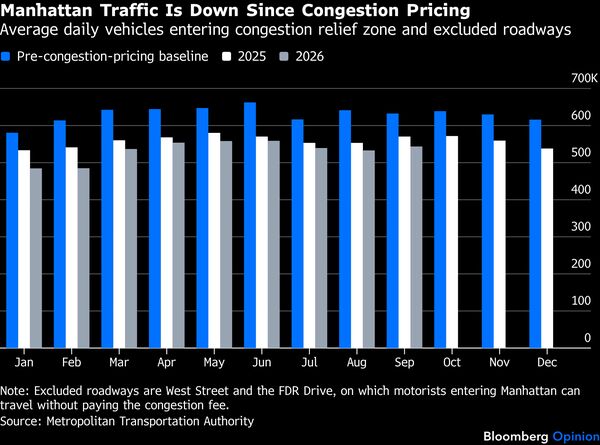
根据大都会运输署的统计,2025年,进入拥堵区及其周边它所谓的“除外道路”的车辆日均数量下降了11.4%(该机构没有征收拥堵费之前对进入拥堵区本身的交通量估算)。截至今年9月,这一数字又下降了4.7%,但这很可能更多与(1)1月和2月的暴风雪以及(2)从3月开始大幅上涨的汽油和柴油价格有关,而非(未变的)拥堵费。
By the MTA’s count, the average daily number of vehicles entering the congestion zone and what it calls “excluded roadways” on its perimeter (it has no pre-congestion-pricing estimates of traffic into the congestion zone proper) fell 11.4% in 2025. It has fallen another 4.7% this year through September, although that probably has more to do with (1) big snowstorms in January and February and (2) big increases in gasoline and diesel prices starting in March than the (unchanged) congestion toll.
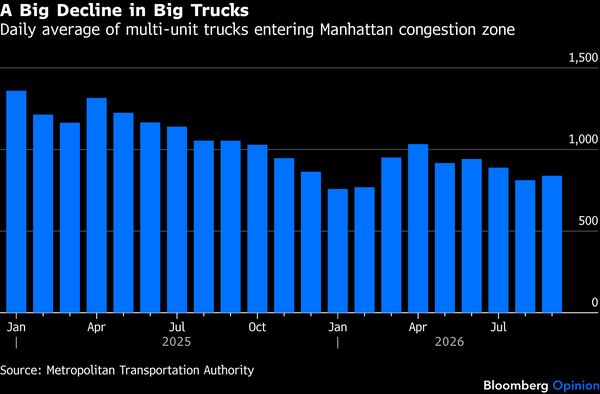
在各类车辆中,进入次数降幅最大的是多单元卡车。这类卡车在周一至周五凌晨5点至晚上9点和周末上午9点至晚上9点的高峰时段需支付21.60美元费用,其他时段支付5.40美元——而且与乘用车不同,如果同一天多次进入该区域,则必须反复支付费用。上述GeoTab统计数据显示,2024年至2025年间,该区域每辆商用车的日均行程次数增加了15%,这表明,据该公司称,卡车“正被更密集地使用,每天进行更频繁的送货或上门服务,以最大化效率并抵消通行费成本。”这似乎是一个基本积极的变化。
The vehicle type that has seen the steepest decline in entries is multi-unit trucks, which pay a $21.60 fee during the peak hours of 5 a.m. to 9 p.m. weekdays and 9 a.m. to 9 p.m. on weekends and $5.40 at other times — and, unlike passenger cars, must pay the fee again and again if they enter the zone repeatedly on the same day. The GeoTab statistics cited above show a 15% increase from 2024 to 2025 the number of daily trips per commercial vehicle in the zone, suggesting that, according to the company, trucks are “being used more intensively, making more frequent deliveries or service calls per day to maximize efficiency and offset toll costs.”Which seems like a mostly positive change.
改变人们的出行方式是拥堵收费最初的目标,这一理念通常归功于已故的哥伦比亚大学经济学家、诺贝尔奖得主威廉·维克里。其想法是将需求从一天中最繁忙的时段转移开来,如今世界各地的收费公路和公共交通系统收取差异化通行费和票价,正是为了实现这一点。像纽约这样的城市拥堵区要罕见得多,其目标不仅是在时间上转移需求,还要在交通方式上转移需求。
Changing people travel was the original goal of congestion pricing, which is generally credited to the late Columbia University economist and Nobelist William Vickrey. The idea was to shift demand away from the busiest times of the day, and toll roads and transit systems around the world now charge differential tolls and fares meant to do just this. Urban congestion zones such as New York’s are much rarer, and aim to shift demand not just chronologically but by mode of transportation.
在纽约市,拥堵收费旨在(1)劝阻人们在纽约市开车,(2)为那些无论如何仍会开车的人改善体验,(3)为公共交通基础设施投资筹集资金——这一系列目标并非完全兼容,可能会使评判成功与否变得有些困难。
In New York City, congestion pricing is intended to (1) discourage people from driving in the city, (2) improve the experience for those who do so anyway and (3) raise money for investment in transit infrastructure, a not entirely compatible set of goals that can make it a little hard to judge success.
也许衡量相互竞争的优先事项的最佳工具,仍然是“平衡交通分析器”(Balanced Transportation Analyzer,BTA)。这是一张由交通活动家、政策专家、拥堵区居民查尔斯·科马诺夫(Charles Komanoff)于2007年创建并多次更新的电子表格,用于模拟拥堵收费及其他交通选择对纽约市交通的影响。根据这套科马诺夫自称为“蒸汽朋克机械”的工具,目前实施的拥堵通行费使拥堵区内的车速较不收费时提高了4.3%,这听起来大致正确。
Perhaps the best tool for weighing the competing priorities remains the Balanced Transportation Analyzer, a spreadsheet created in 2007 and updated many times since by transportation activist, policy wonk and congestion-zone resident Charles Komanoff to model the effects of congestion charges and other transportation choices on New York City traffic. According to this “steampunk machinery” (Komanoff’s words), the congestion toll currently in place increases traffic speeds within the congestion zone by 4.3% relative to no toll, which sounds roughly correct.
如果将高峰收费提高到12美元,BTA称车速将提高5.8%。如果提高到15美元——这是纽约州州长凯西·霍楚尔(Kathy Hochul)在2024年推迟后又削减拥堵收费之前的计划——车速将提高7.1%。保持个人车辆的拥堵收费不变,但用按分钟计费取代目前针对出租车和网约车服务的各种不分时段的每次乘车费用,且所筹资金相同——这是科马诺夫的一项心头好,也很有道理——车速将提高6.4%。
Raise the peak charge to $12, and the BTA says speeds would increase 5.8%. Raise it to $15 — which was the plan before New York Gov. Kathy Hochul delayed and then reduced the congestion charge in 2024 — and speeds increase 7.1%. Leave the congestion charges for personal vehicles as is but replace the current assortment of time-insensitive per-ride fees for taxis and ride-hail services with a per-minute charge that raises the same amount of money — a pet cause of Komanoff’s that makes a lot of sense — and speeds increase 6.4%.
将30英里车道的街道改作供行人和骑车人使用,车速将提高0.1%。充分计入拥堵收费所筹资金资助的公共交通投资,车速将提高7.6%。诸如此类。
Take away 30 lane-miles of streets to be repurposed for pedestrians and cyclists, and speeds 0.1%. Give full credit for the transit investments financed by congestion pricing and speeds increase 7.6%. And so on.
找到最佳组合并不容易,部分原因在于人们的优先事项各不相同。但一个教训相当明确:如果你想减少拥堵,就需要让造成拥堵的人付费。
Finding the optimal mix isn’t easy, in part because people’s priorities differ. But one lesson is pretty clear: if you want less congestion, you need to make the congestion-causers pay.