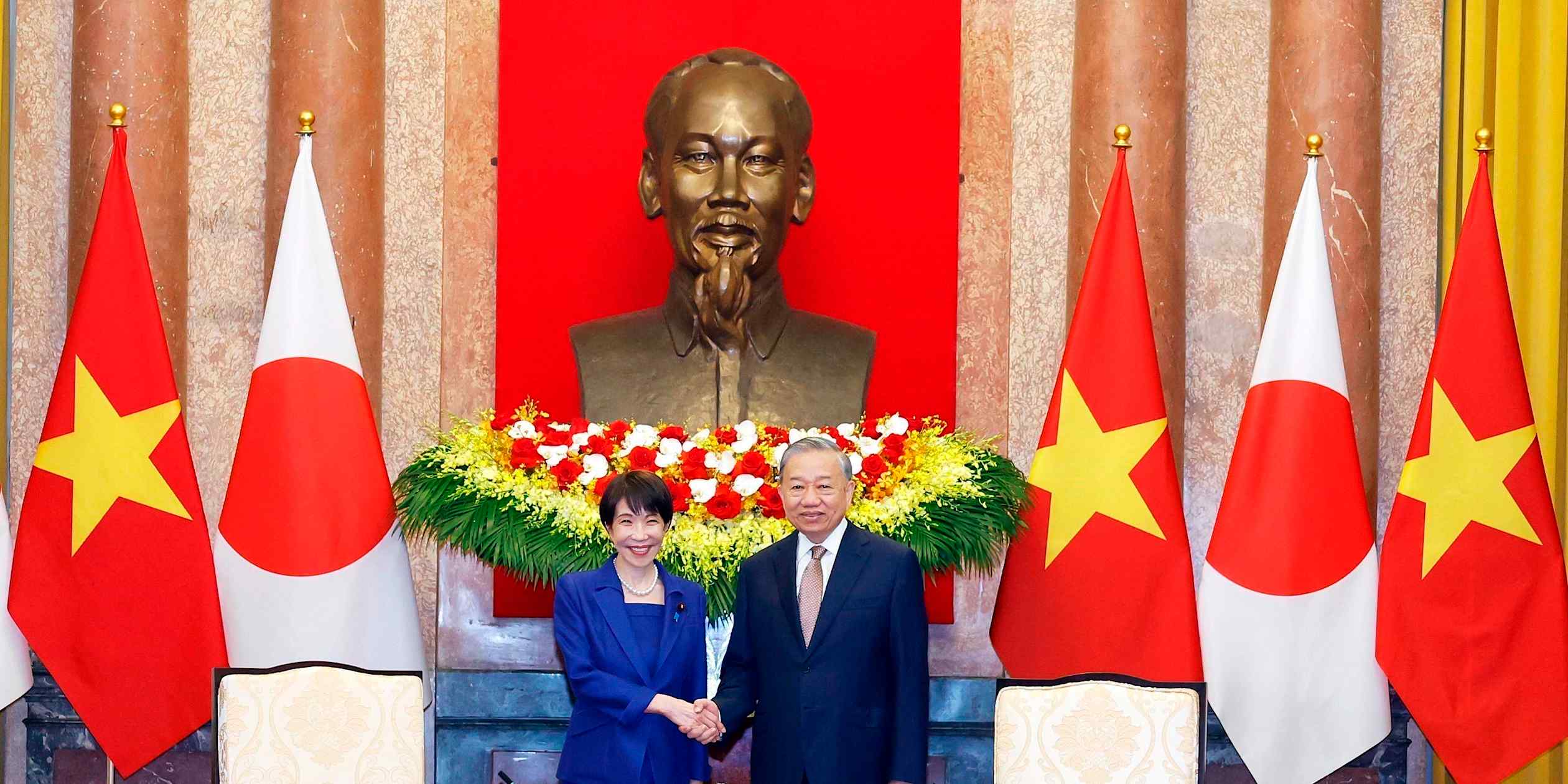
东京 —— 越南共产党总书记苏林周日抵达日本,此行正值双边关系呈现出与过去几十年建立的关系截然不同的面貌。
TOKYO -- Vietnam's Communist Party chief To Lam arrived in Japan on Sunday against the backdrop of a bilateral relationship that looks very different from the one built over previous decades.
在日越南人口激增至近 70 万,是 2012 年的 13 倍多。同期,日本在越南出口中的份额几乎减半,其曾经在发展融资中占主导地位的作用已有所退却,而来自中国和新加坡的投资则占据了优势。
The Vietnamese population in Japan has surged to nearly 700,000, more than 13 times the number from 2012. During the same period, Japan's share of Vietnamese exports has nearly halved, its once-dominant role in development finance has receded, while investment from China and Singapore has gained ground.
苏林将在日本停留至周三,这是他担任总书记后首次对日本进行正式访问,也是 11 年来首位以该身份访日的越南领导人。苏林兼任越南国家主席,预计将会见首相高市早苗,两国政府有望在小型模块化反应堆和人工智能等领域深化合作。越南官员在访问前强调了双边关系的广度。
Lam will be in Japan through Wednesday on his first official visit to the country as party chief, marking the first such visit by a Vietnamese leader holding that post in 11 years. Lam, who is also Vietnam's president, is due to meet Prime Minister Sanae Takaichi, with the two governments expected to deepen cooperation in areas including small modular reactors and artificial intelligence. Vietnamese officials have highlighted the breadth of the relationship ahead of the visit.
“日本是越南最大的政府发展援助(ODA)伙伴和劳务合作伙伴,第三大投资来源国,以及第四大旅游和贸易伙伴,”越南外交部发言人范秋莺周四表示。
"Japan is Vietnam's largest ODA (official development assistance) and labor partner, the third largest in investment and the fourth largest in tourism and trade," Vietnam's Foreign Ministry spokesperson Pham Thu Hang said on Thursday.
她说,合作已在政治、经济和人文交流渠道全面拓展,人力资源合作仍是一大亮点。然而,越南劳工在日本的经历反映了这种关系性质的变化。
She said cooperation had expanded across political, economic and people-to-people channels, with human resources remaining a particular highlight. Yet the experience of Vietnamese workers in Japan reflects the changing nature of the relationship.
“日本仍是一个有吸引力的国家,但情况与 10 年前已不同,”来自河内的 29 岁护理工人阮秋霞说,她两年前在日本“特定技能”计划下赴日工作。
"Japan is still an attractive country, but things are different from 10 years ago," said Nguyen Thu Ha, a 29-year-old care worker from Hanoi who moved to Japan two years ago under the country's specified skilled worker program.
“扣除税费、房租和食品开支后,我只能存下一点钱。换算成越南盾后,不如以前值钱了,”她指的是本国货币。
"After paying taxes, rent and food expenses, I can only save a little. And when I convert it into Vietnamese dong, it is not worth as much as before," she said, referring to her country's currency.
Ha说,一位住在东京附近千叶同一宿舍的越南熟人最近回到了河内,因为他得出结论:随着日元贬值和越南生活成本上涨,在日本的收入已不足以舒适地供养国内的配偶和两个孩子。
Ha said a Vietnamese acquaintance living in the same dormitory in Chiba, near Tokyo, recently returned to Hanoi after concluding that earnings from Japan were no longer enough to comfortably support a spouse and two children back home, as the yen weakened and living costs in Vietnam rose.
对于上几代越南人来说,日本常被视为经济机遇与发展专长的罕见结合。如今,许多人仍将其视为一个有吸引力的工作和学习之地,但他们也有了更多选择。同样的模式也体现在贸易、投资和援助方面。
For previous generations of Vietnamese, Japan was often viewed as a rare combination of economic opportunity and development expertise. Today, many still see it as an attractive place to work and study, but they also have more alternatives. The same pattern is visible in trade, investment and aid.
日本仍是越南最大的贸易伙伴之一,但其相对重要性已下降,因为美国成为越南主要的出口市场,而中国则成为更大的经济力量。
Japan remains one of Vietnam's largest trading partners, but its relative importance has declined as the U.S. became the country's dominant export market and China emerged as a bigger economic presence.
越南对美出口从2010年的143亿美元激增至2025年的1532亿美元,同期对华出货量增长约800%至705亿美元。对日出口也有所增长,但增速慢得多,从2010年的77亿美元增至2025年的268亿美元。结果,日本在越南出口中的份额几乎减半,从10.7%降至5.6%。
Vietnamese exports to the U.S. surged from $14.3 billion in 2010 to $153.2 billion in 2025, while shipments to China rose about 800% over the same period to $70.5 billion. Exports to Japan also grew, but at a much slower pace, from $7.7 billion in 2010 to $26.8 billion in 2025. As a result, Japan's share of Vietnamese exports nearly halved from 10.7% to 5.6%.
同期在越南进口方面,日本的份额也大致减半至约5%,而中国的份额从24%升至近40%。
During the same period on the Vietnamese import side, Japan's share also roughly halved to about 5%, while China's rose from 24% to nearly 40%.
“这不是日本失去影响力的问题,”日本政府系智库日本贸易振兴机构(JETRO)亚洲经济研究所研究员石冢二叶说。“越南越来越担心中等收入陷阱,”她指的是一个国家增长停滞、难以成为发达经济体的情况。“日本仍有很多东西可以提供,从摆脱出口依赖型增长模式的经验,到建设国内技术能力。”这种多元化在投资方面也同样可见。
"This is not about Japan losing influence," said Futaba Ishizuka, a researcher at the Institute of Developing Economies, a Japanese government-affiliated think tank. "Vietnam is increasingly concerned about the middle-income trap," she said, referring to a situation in which a country's growth stalls and it struggles to become an advanced economy. "Japan still has much to offer, from lessons on moving beyond an export-dependent growth model to building up domestic technological capabilities." That broadening is also visible in investment.
随着越南在1994年美国解除贸易禁令——这是越战遗留的问题——以及1995年加入东盟后向世界开放经济,包括佳能、本田、松下和丰田在内的日本制造商成为突出的投资者,带来了资金、技术和制造专长。
As Vietnam opened its economy to the world following the 1994 lifting of the U.S. trade embargo -- a legacy of the Vietnam War -- and its accession to ASEAN in 1995, Japanese manufacturers including Canon, Honda, Panasonic and Toyota became prominent investors, bringing capital, technology and manufacturing expertise.
日本仍是重要的投资来源国,但现在面临竞争激烈得多的局面。新注册的来自新加坡和中国的外商直接投资在过去十年增长快得多,反映出越南经济合作伙伴范围的扩大。
Japan remains a significant source of investment, but it now competes in a much more crowded field. Newly registered foreign direct investment from Singapore and China has grown much faster over the past decade, reflecting Vietnam's widening range of economic partners.
位于越南中部顺化市的永旺梦乐城。这家日本零售商的扩张反映出日本投资从制造业向消费和服务领域的更广泛多元化。
An Aeon Mall in Hue in central Vietnam. The Japanese retailer's expansion reflects a broader diversification of investment from Japan beyond manufacturing into consumer and service sectors.
日本投资也正变得更加多元化。在长期高度集中于制造业后,企业越来越多地拓展至零售、物流和其他服务领域。永旺于2014年在胡志明市开设越南首家购物中心,如今在全国运营近10家商场。这种对比在制造业尤为明显。据胡志明市工业园区经纪公司SuFex Trading对越南国家统计局数据的分析,2026年第一季度越南批准的338个新建或扩建制造项目中,仅有13个涉及日本投资者。这些项目在数量上仅占总数的3.8%,在金额上占2.1%,即在88.5亿美元获批制造业投资中占1.85亿美元。
Japanese investment is also becoming more diversified. After decades centered heavily on manufacturing, companies have increasingly expanded into retail, logistics and other services. Aeon, which opened its first shopping mall in Vietnam in Ho Chi Minh City in 2014, now operates nearly 10 malls across the country The contrast is particularly stark in manufacturing. Of 338 new or expanded manufacturing projects approved in Vietnam in the first quarter of 2026, just 13 involved Japanese investors, according to an analysis of Vietnam's National Statistics Office data by SuFex Trading, an industrial-park brokerage company based in Ho Chi Minh City. Those projects represented only 3.8% of the total by number and 2.1% by value, accounting for $185 million of $8.85 billion in approved manufacturing investment.
“制造业咨询明显减少,”SuFex Trading创始人兼首席执行官宫本晃说。“我们看到物流和商业服务等领域的项目更多。”宫本表示,近年来中国制造商在海防、北宁和河南等北部工业枢纽激进扩张,加剧了对工人的竞争并推高了工资。
"Manufacturing inquiries have clearly declined," said Akira Miyamoto, founder and CEO of SuFex Trading. "We are seeing more projects in areas such as logistics and commercial services." Miyamoto said manufacturers from China have expanded aggressively in northern industrial hubs such as Hai Phong, Bac Ninh and Ha Nam in recent years, intensifying competition for workers and pushing up wages.
他补充说,日本制造商发现,越来越难以依赖支撑早期对越投资浪潮的低成本劳动力模式。日本传统角色演变或许在发展援助领域表现得最为明显。
He added that Japanese manufacturers are finding it harder to rely on the low-cost labor model that underpinned earlier waves of investment into Vietnam. The evolution of Japan's traditional role is perhaps most visible in development assistance.
自1986年启动“革新”市场导向经济改革以来,在越南发展的大部分时期里,日本占据了极少其他国家能比拟的地位。日资基础设施——桥梁、高速公路、港口、城市轨道系统——成为越南现代化最显眼的象征之一。
For much of Vietnam's development following the launch of the Doi Moi market-oriented economic reforms in 1986, Japan occupied a position few other countries could match. Japanese-funded infrastructure -- bridges, highways, ports, urban rail systems -- became some of the most visible symbols of Vietnam's modernization.
日本仍是越南最大的官方发展援助(ODA)提供国,但日本的发展援助已从2010年代初的水平大幅下降,不再像过去那样定义双边关系。
Japan remains Vietnam's largest ODA provider, but Japanese development assistance has fallen sharply from levels in the early 2010s and no longer defines the relationship as it once did.
曾在日本国际协力机构(JICA)负责越南事务的前官员山本健一表示,日本的援助体系难以适应变化。
Kenichi Yamamoto, a former Japan International Cooperation Agency (JICA) official who worked on Vietnam, said Japan's aid system has struggled to adjust.
“越南在速度方面发生了剧变,”山本说。“在苏林领导下,政府精简了机构,随着国家追求高经济增长,官员们面临着推动项目快速落地的越来越大压力。但日本和JICA未能跟上这一节奏。
"Vietnam has changed dramatically in terms of speed," Yamamoto said. "Under To Lam, the government has been streamlined and officials are under growing pressure to get projects moving quickly as the country pursues high economic growth. But Japan and JICA haven't been able to keep up with that pace.
“以日元贷款项目为例,仅收集信息和开展可行性研究就可能需要约两年时间。在某些情况下,项目正式获批前可能需要约四年,”他补充道。
"With a yen-loan project, it can take around two years just to gather information and conduct a feasibility study. In some cases, it can take around four years before the project is formally approved," he added.
与此同时,越南不断增长的经济让河内拥有了更多替代选择,从私人资本到亚洲基础设施投资银行等机构的融资。
Vietnam's growing economy has meanwhile given Hanoi more alternatives, from private capital to financing from institutions such as the Beijing-headquartered Asian Infrastructure Investment Bank.
“越南现在有更多的融资选择,”山本说。“日本的影响力在相对意义上有所下降。”日本还在寻求在越南核电领域的新角色。在退出早先协助建设越南首批核电站之一的计划后,东京现在正寻求恢复在小型模块化反应堆方面的合作,重点在于日本的技术和培训。
"Vietnam has many more financing options now," Yamamoto said. "Japan's presence has declined in relative terms." Japan is also seeking a new role in nuclear power in Vietnam. After withdrawing from an earlier plan to help build one of the country's first nuclear plants Tokyo is now looking to revive cooperation around small modular reactors, focusing on Japanese technology and training.
对于早稻田大学名誉教授陈文初(Tran Van Tho,音译)而言,这种平衡的变化反映了越南的发展,而不仅仅是日本的损失。
For Tran Van Tho, professor emeritus at Waseda University, the changing balance reflects Vietnam's development rather than simply a loss for Japan.
“越南确实减少了对日本的依赖,”他说。“这部分是越南自身发展的结果,也部分是因为韩国、新加坡和中国等国家已成为新的资金和技术来源。”“日本的相对影响力必然会下降,但两国建立的信任仍是一项重要资产。”即使在关系发生变化之际,日本对寻求海外机会的越南人依然保持着吸引力。
"Vietnam has certainly become less dependent on Japan," he said. "That is partly the result of Vietnam's own development, and partly because countries such as South Korea, Singapore and China have emerged as new sources of capital and technology." "Japan's relative presence will inevitably decline, but the trust built between the two countries remains an important asset." Even amid the changing relationship, Japan has not lost its appeal to Vietnamese seeking opportunities abroad.
护理员哈(Ha,音译)没有离开的打算。她正在学习以获取资格认证,希望如果能在2028年通过国家资格考试,就能在日本长期居住。尽管日元走弱、生活成本上升,她仍认为留在日本有优势。“这里的生活更安宁,”她说。“环境整洁,食品安全。”
Ha, the care worker, has no plans to leave. She is studying to gain a certification and hopes to stay in Japan long term if she passes a national qualification exam in 2028. Despite the weaker yen and rising living costs, she still sees advantages to being in the country. "Life here is more peaceful," she said. "The environment is clean and the food is safe."