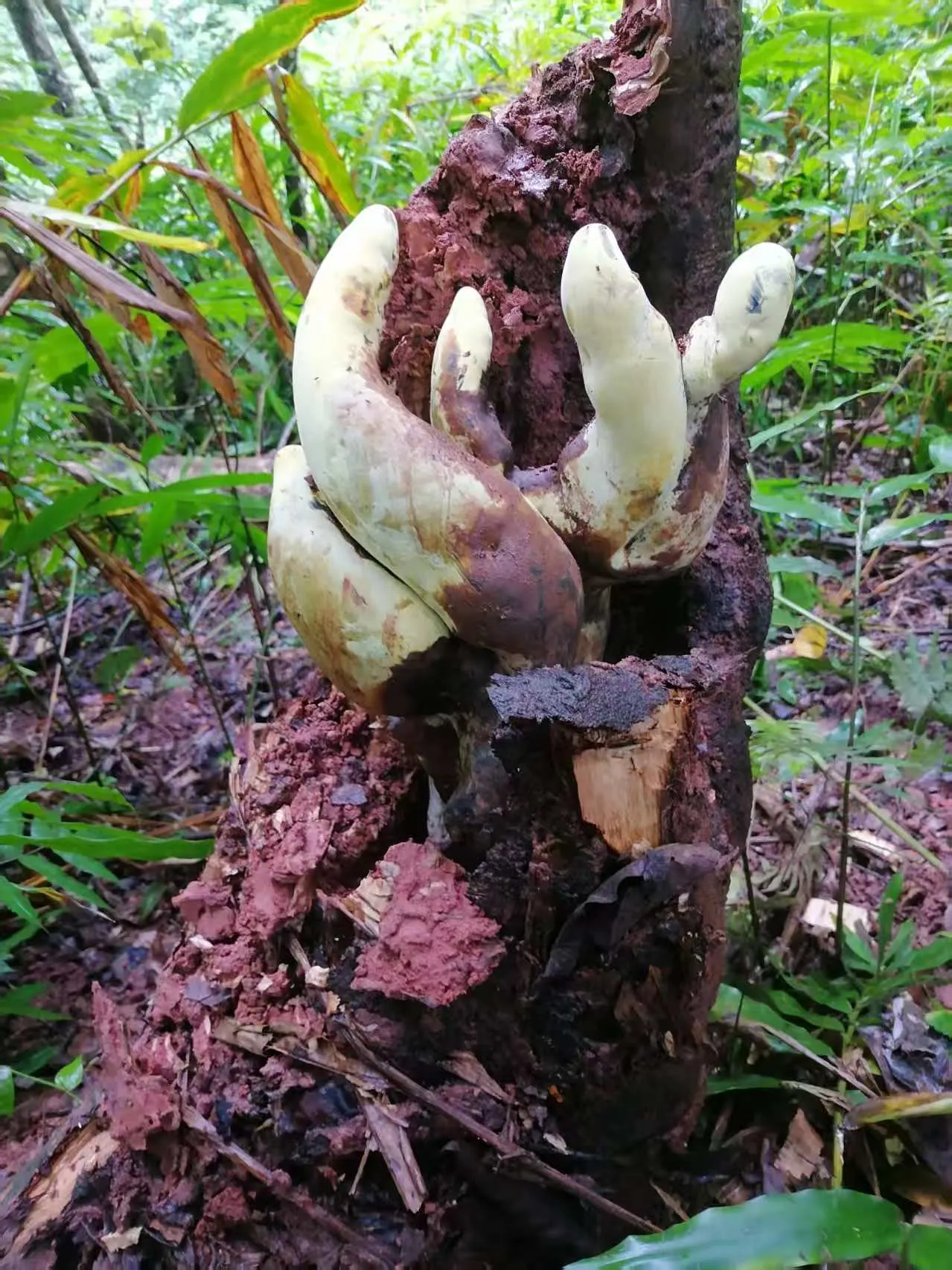
有时新物种之所以逃过探测,是因为它们体型微小,因而容易被忽略——但这巨型真菌不是。这种形状酷似一只从地面伸出的手的新真菌物种,是在云南省深林中发现的。隶属于中国科学院的昆明植物研究所研究团队将其作为新物种报告,并将其命名为 Dianjunus rex。
Sometimes new species evade detection because they’re tiny and thus easy to miss—not this giant fungus. Shaped like a hand reaching out of the ground, this new species of fungus was discovered deep in the forest in China’s Yunnan Province. A research team from the Kunming Institute of Botany, part of the Chinese Academy of Sciences, reported it as a new species they named Dianjunus rex.
该名称源于该地区古老的滇国,以及“菌”字的中文发音。D. rex 是一种子囊菌,这是真菌中最大的门,拥有 64,000 多个已知物种,而在这些物种中,这种新真菌产生的子实体体量最大。与我们通常印象中的“蘑菇”不同,子囊菌不形成菌盖和菌柄,而是产生称为子实体的结构,通过释放孢子进行繁殖。D. rex 的子实体长达 20 英寸(约 50.8 厘米),重近 5 磅(约 2.27 千克),体型巨大。
The name comes from the region’s ancient Dian Kingdom and the Chinese pronunciation of the word “fungus.”D. rex is a type of Ascomycete, which is the largest phylum of fungi with over 64,000 known species, and among them, this new fungus produces the largest masses of mushroom recorded. Unlike what we typically think of as a “mushroom,” Ascomycetes don’t form caps and stems but produce structures called fruiting bodies, which release spores to reproduce. And growing up to 20 inches and weighting nearly five pounds, D. rex’s are huge.
在子囊菌中,这种巨型真菌构成了一个全新的生物科(属和种之上更宽泛的分类等级),意味着它没有已知的近亲——至少就目前所知如此。虽然云南已记录 6,000 种真菌,但菌物学家认为,这个以生物多样性著称的省份极有可能蕴藏着 100,000 种真菌。“这一发现说明了东亚森林中还有多少真菌生物多样性有待发掘,”昆明植物研究所副教授、该论文第一作者 Indunil C. Senanayake 在新闻稿中表示。
Within the Ascomycetes, the giant fungus constitutes an entirely new biological family (the broader classification of genus and species), meaning that it has no close relatives—at least that we know of. While 6,000 fungal species have been documented in Yunnan, mycologists believe the province known for its biological diversity could easily harbor 100,000“The discovery illustrates how much fungus biodiversity remains to be discovered in East Asian forests,” Indunil C. Senanayake, an associate professor at the Kunming Institute of Botany and the lead author of the paper, said in a press release.
塞纳奈克及其研究团队在楠班热带雨林进行了调查,期间他们在濒死树木根部附近的土壤中偶然发现了生长着的大型、泛白的子实体。他们记录并收集了呈圆柱形、纺织娘形和杯状手掌等各种形态的真菌。这些子实体在成熟时似乎会长出手指状的分支。他们发现,其地上部分覆盖着白色粉末状纤维,随着真菌成熟会变成深黄色,而埋在土壤中的部分则是黑色且光滑的。
Senanayake and his research team conducted surveys in the Nanban tropical rainforest, where they came across large, whitish fruiting bodies growing in the soil near the roots of dying trees. They documented and collected fungi growing in a wide variety of shapes like cylinders, spindles, and cupped palms. The fruiting bodies appeared to develop finger-like branches upon maturity. They found that the above-ground portions are covered with white, powdery fibers that turn dark yellow as the fungi mature while the portions buried in the soil are black and smooth.
当科学家将样本带回实验室时,子实体迅速干燥。他们发现其内部致密且呈海绵状,呈白色或黄色,没有强烈的气味或味道。(请勿在家尝试此实验。)通过分析这些真菌的DNA,研究人员重建了一个“分子钟”,结果显示雷克斯类真菌(D. rex)在大约6500万年前与其他物种分化。这是白垩纪的末期,紧随人们认为已经消灭了包括恐龙在内的四分之三动植物物种的大规模灭绝事件之后。
The fruiting bodies dried rapidly when the scientists took samples back to the lab. They found that the interiors were dense and sponge-like, appearing white or yellow with no strong odor or taste. (Don’t try this experiment at home.) Analyzing the DNA of these fungi, the researchers reconstructed a “molecular clock,” which revealed that D. rex diverged from other species approximately 65 million years ago. This is the end of the Cretaceous period, immediately following the mass extinction that is believed to have wiped out three quarters of all plant and animal species, including the dinosaurs.
这意味着雷克斯类真菌和霸王龙(T. rex)从未相遇,但这个时代对真菌来说很可能是一个福音。大灭绝之后出现了大量的死植物材料,这可能为真菌和其他分解此类物质的生物提供了新的生态机遇。
That means D. rex and T. rex never met, but this era was likely a boon for fungi. Large quantities of dead plant material became available following the die off, which could have provided new ecological opportunities for fungi and other organisms that decompose such matter.
然而,基因组分析表明,雷克斯类真菌拥有的与分解相关的基因远没有科学家预期的那么多。与一些同样以植物物质为食的近亲相比,这种巨大的真菌通常只拥有大约一半数量的与分解相关的基因。
Genomic analyses, however, indicated that D. rex doesn’t have nearly as many decomposition-related genes as the scientists expected. Compared to some of its closest relatives that also feast on plant matter, the huge fungus has only about half the usual number of decomposition-related genes.
塞纳纳亚克对此有一个假设。尽管到目前为止,他们只在垂死的植物周围发现子实体,但这种真菌可能在过着一种“双重生活”——生活在健康的树木内部,然后在宿主死亡时以死去的植物材料为食。这或许可以解释 D. rex 为何能够储存足够的能量来构建巨大的子实体。
Senanayake has a theory about this. Though, so far, they have only found the fruiting bodies around dying plants, the fungus may be leading a “double life”—living inside healthy trees and then feeding on dead plant material when the hosts die. That could perhaps explain how D. rex is able to store enough energy to build the massive fruiting bodies.
这目前还只是一个假设,但这些巨大的真菌无疑需要过剩的能量才能长得这么大。塞纳纳亚克推测,这些大型子实体的好处在于,它们比周围的植物和落叶长得更高,这可能有利于在茂密的森林中通过风力传播孢子。“然而,如此庞大的结构需要大量的能量投入,这表明这种策略很可能只在生态效益大于成本的地方进化出来。”
This is just a theory for now, but the giant fungi undoubtedly do need a surplus of energy to grow so large. Senanayake hypothesizes that the benefit of these large fruiting bodies is that they tower higher than the surrounding plants and fallen leaves, which could be advantageous for wind-mediated spore dispersal in a dense forest. “However, such a large structure requires substantial energy investment, suggesting that this strategy likely evolved only where the ecological benefits outweighed the costs.”