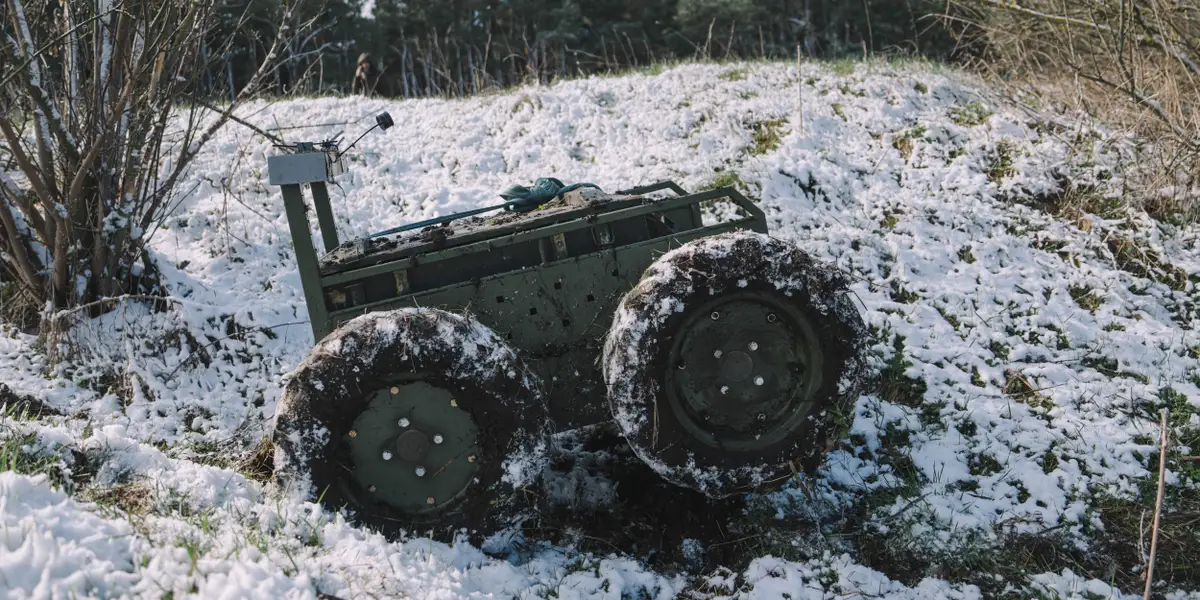
战争机器人正成为现代战场上日益增长的存在,国防制造商正推动使其更加自主,以进一步降低对士兵的风险。但制造能够自主驶入战场的无人地面车辆,面临的是自动驾驶汽车所不具备的挑战。军事武库中的机器人数量激增,尤其是在乌克兰,它们在操作员远离危险的更远处开火、攻击阵地、运送伤员。更高的自主性将使更少的士兵能操作更多车辆,让部队停留在离前线更远的地方,并让机器人在通信中断时仍能继续行动。
War robots are becoming a growing presence on modern battlefields, and defense manufacturers are pushing to make them more autonomous to further reduce the risks to soldiers. But making uncrewed ground vehicles that can drive themselves into battle presents a challenge that self-driving cars don't. The number of robots in military arsenals is soaring, particularly in Ukraine, where they fire weapons, attack positions, and carry wounded soldiers, all while their operators remain farther from danger. Greater autonomy would allow fewer soldiers to operate more vehicles, let troops stay farther from the front, and allow robots to keep going when communications are disrupted.
然而,混乱的战场与安全、测绘完善的道路截然不同。机器人必须在面对敌方攻击的同时,穿越泥泞小径、森林和危险地形。地形、条件和目标时刻在变。而且没有规则。没有限速,没有可预测的交通,也没有安全保障。
A chaotic battlefield, however, is far different from safe, well-mapped roadways. Robots have to navigate muddy tracks, forests, and dangerous terrain while facing enemy attacks. Terrain, conditions, and targets change constantly. And there are no rules. No speed limits, no predictable traffic, and no guarantee of safety.
德国防务技术公司 ARX Robotics 制造 GEREON 机器人,这些自主系统已被乌克兰使用,并被英国采购。该公司英国分部首席执行官 David Roberts 告诉《商业内幕》,就制造自动驾驶车辆而言,在民用道路上作业的公司面临的环境挑战性较小。“道路是结构化的,”他说。“它们有规则。道路足够宽,供汽车行驶。它们有标线告诉车辆该做什么、何时做。”
German defense technology company ARX Robotics makes GEREON robots, autonomous systems that have been used by Ukraine and procured by the UK. David Roberts, CEO of the company's British arm, told Business Insider that, when it comes to making self-driving vehicles, companies working on civilian roads face a less challenging environment. "Roads are structured," he said. "They've got rules. Roads are wide enough for cars to drive down. They have markings to tell a vehicle what to do and when to do it."
在战争中,“没有真正的规则,”Roberts 继续说道。“你不太清楚是否有人会突然从你面前冒出来,或藏在你面前的长草丛里。这首先就是一个构建自主性极具挑战性的环境。”
In war, "there are no real rules," Roberts continued. "You don't quite know if someone's going to step out in front of you or be in the long grass in front. It's a very challenging environment in the first place to build autonomy."
英国公司 Digital Concepts Engineering (DCE) 首席执行官 Mike McGinty,其 X 系列地面机器人已被英国陆军采购,也详细阐述了这些差异。街道是“平坦的,路面有保障。有标记。是一条轨道。
Mike McGinty, the CEO of British firm Digital Concepts Engineering (DCE), whose X-series ground robots have been procured by the British Army, also spelled out the differences. A street is "flat, of a guaranteed surface. It's marked.
“它有左边和右边。它是签过名的,”他说。“而且它是不变的。‘同一条街道明天还在那里。’”“真正的自主在越野地面上是一个极其困难的问题,”他说。“如果你看到地面上有一条线,那是个洞、一根原木、一道烧痕、一个阴影、一条鳄鱼,还是一个人?”
It's a track. It has a left and a right. It's signed," he said. And it's unchanging. "The same street's there tomorrow." "True autonomy is an extremely hard problem on cross-country ground," he said. "If you see a line on the ground, is it a hole, a log, a burn mark, a shadow, a crocodile, a person?"
这并不意味着开发自动驾驶汽车或出租车很容易。“事实是这仍然极其困难,”麦金蒂说,但为战争开发自主无人地面车辆是一项更加艰巨的任务。
That doesn't mean it's easy to develop a self-driving car or taxi. "The truth is it's still extremely difficult," McGinty said, but developing autonomous uncrewed ground vehicles for war is a much more daunting task.
自主可以指从遵循预设路线到独立导航至目的地的任何能力。乌克兰的能力有所增强,当俄罗斯电子战切断通信时,人工智能帮助机器人导航。自主性仍然有限。罗伯茨说,乌克兰的大多数机器人只是遥控操作,自主性仅存在于“非常小众的领域”,例如在失去与操作员连接时遵循航路点。他说,自主性需要超越在乌克兰展示的水平。
Autonomy can mean anything from following preset routes to independently navigating to a destination. Capabilities in Ukraine have grown, with AI helping robots navigate when Russian electronic warfare cuts communications. Autonomy remains limited. Roberts said that most robots in Ukraine are simply remote-controlled, with autonomy in "very niche areas," such as following waypoints if they lose their operator connection. He said autonomy needs to evolve beyond what has been demonstrated in Ukraine.
ARX Robotics 制造的 GEREON 机器人运行在 Mithra 上,这是一个连接其传感器、人工智能和自主功能的软件层。该公司表示:“受监管的自主允许单个士兵同时指派和监督多个系统,以更少的人员实现更多的任务产出。”
The GEREON robots that ARX Robotics makes run on Mithra, a software layer that connects their sensors, AI, and autonomy functions. The "supervised autonomy allows a single soldier to task and oversee multiple systems simultaneously, delivering more mission output with fewer personnel," the company says.
罗伯茨说:“‘指挥一辆车前往战场上的某个地点,这正是我们目前正在努力的方向。’”他说,ARX 的机器人已经能够遵循航路点、探测人员、避免碰撞并进行安全停车。下一步是在任务层面,他预测,在未来一两年内,战场管理系统将能够指挥车辆前往何处。
Roberts said the "ability to tell a vehicle to go to a certain place on the battlefield is very much where we are working at the moment." ARX's robots can already follow waypoints, detect people, avoid collisions, and make safety stops, he said. The next step is at the mission level, and he predicted that, within the next year or two, battlefield management systems will be able to tell vehicles where to go.
“我不认为这是任何人已经实际部署的东西,但我认为有许多公司正在研究这类问题。”麦金蒂说,乌克兰目前的自主水平通常允许操作员远程控制机器人,称这是DCE已经“掌握”的自主水平。“完全自主仍然是一个非常困难的技术步骤,”他说。“所以会有人去做,但不会是我们,因为我们不是做那种软件的软件公司。”DCE的机器人可以安装Marionette套件,该套件支持远程控制和自主功能,包括其他公司开发的软件。
"I don't think that this is something that anyone has actually got deployed yet, but I think there are a number of companies who are working on that sort of problem set." McGinty said Ukraine's current level of autonomy typically allows operators to control robots remotely, calling this the level of autonomy that DCE had "mastered." "Full autonomy is still a very difficult technological step," he said. "So someone will take it, but it won't be us because we're not the software company doing that." DCE's robots can be fitted with a Marionette kit, which enables remote control and supports autonomous features, including software developed by other companies.
乌克兰达芬奇狼群营机器人系统负责人亚历山大·亚布昌卡告诉《商业内幕》,乌克兰的地面机器人自主性“仍处于发展的早期阶段”,但部队希望拥有更多以保护士兵。“空中无人机和无人地面系统的未来在于自主性的发展。”多个项目正在进行中。例如,乌克兰国家支持的创新平台Brave1的资助项目要求研发“自主后勤”机器人,能够独立返回基地,并在通信中断时自主移动。
Oleksandr Yabchanka, head of robotic systems for Ukraine's Da Vinci Wolves Battalion, told Business Insider that ground robot autonomy in Ukraine "is still in the early stages of development," but units want more to protect their soldiers. "The future of both aerial drones and unmanned ground systems lies in the development of autonomy." Multiple projects are underway. Ukraine's state-backed innovation platform Brave1's grant program, for instance, calls for "autonomous logistics" robots that can independently return to base and move autonomously if communications are lost.
乌克兰已将人工智能集成到空中无人机中——这类无人机在本次战争中更为突出——以及固定武器中,并随着该国推动其无人作战系统实现更高自主性,人工智能正日益被纳入地面机器人。目标是让单个士兵能够同时监管多台设备。
Ukraine has integrated AI into aerial drones, which have been more prominent in this war, as well as fixed weapons, and it is increasingly being incorporated into ground robots as the country pushes for greater autonomy in its uncrewed warfighting systems. The aim is to enable a single soldier to oversee multiple pieces of equipment simultaneously.