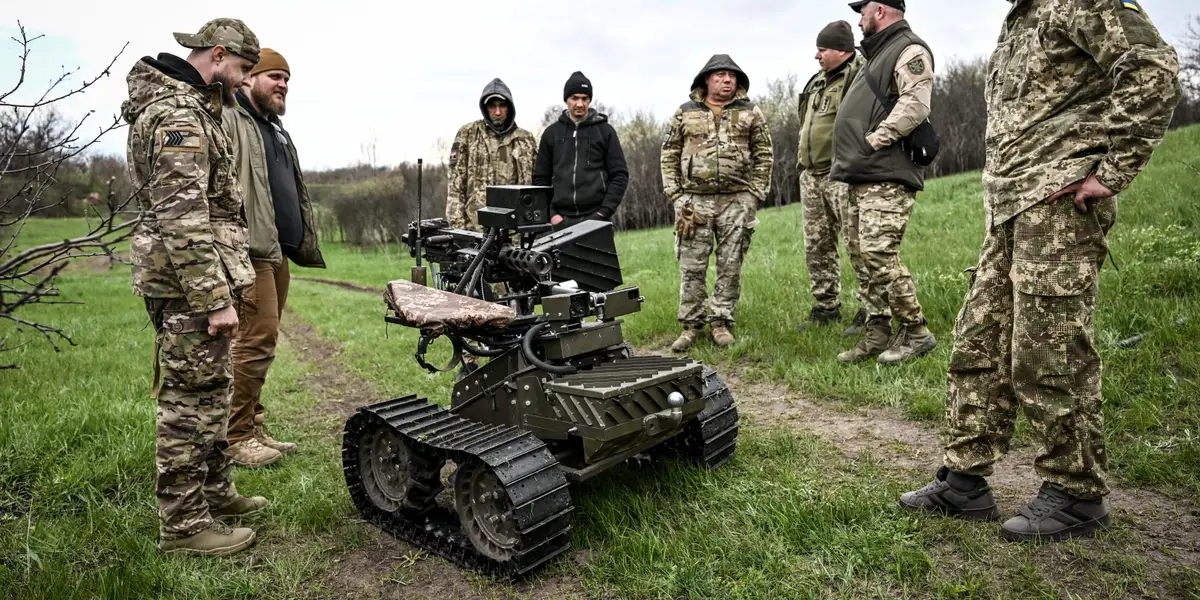
乌克兰正在使用日益增加的战争机器人车队,以将人类从危险的角色中替换下来,但士兵有时仍需要冒着生命危险来维持这些机器的运转。
Ukraine is using a growing fleet of war robots to take dangerous roles away from humans, but soldiers sometimes still need to risk their lives to keep the machines running.
据乌克兰各旅透露,乌克兰希望尽可能用机器人和无人机取代危险任务和角色中的人类士兵,并且技术已经取得了足够的进步,操作员现在可以从数十公里外控制一些战争机器人。
Ukraine wants to replace as many human soldiers in dangerous missions and roles as possible with robots and drones, and the technology has advanced enough that operators can now control some war robots from tens of kilometers away, according to Ukrainian brigades.
这可以让操作员远离俄军的火力,但尽管被称为无人地面车辆(简称UGV)的机器人可以取代执行危险任务的士兵,其他部队可能仍然需要冒险靠近战斗区域来对其进行准备、发射、维护和回收。
That can keep operators away from Russian fire, but while the robots, known as uncrewed ground vehicles, or UGVs, can replace soldiers on dangerous missions, other troops may still need to venture closer to the fighting to prepare, launch, maintain, and recover them.
乌克兰“达芬奇狼”营机器人系统负责人奥列克桑德尔·亚布昌卡在接受《商业内幕》采访时表示,对于乌克兰的机器人任务而言,“目前,人类的参与既是强制性的,也是不可或缺的”。他说:“必须有人更换电池、进行维护并排除技术故障。”
For Ukraine's robotic missions, "at present, human involvement is both mandatory and indispensable," Oleksandr Yabchanka, head of the robotic systems for Ukraine's Da Vinci Wolves Battalion, told Business Insider. "Someone must swap out batteries, perform maintenance, and troubleshoot technical issues," he said.
保持机器人功能正常可能意味着更换受损部件、修理被扎破的轮胎以及重新装填弹药。
Keeping a robot functional can mean replacing damaged parts, fixing punctured tires, and reloading ammunition.
这些机器人通常被设计为相对廉价且可消耗的,从而限制了失去一台机器的成本。由于它们的目的主要是保护士兵,部队可能会认为一辆受损的机器人不值得冒着生命危险去回收,但人类的支持对于保持车队的运转依然至关重要。
The robots are typically designed to be relatively cheap and expendable, limiting the cost of losing one. Because their purpose is primarily to protect soldiers, units may decide that a damaged robot isn't worth risking a life to recover, but human support remains essential to keeping the fleet operational.
许多机器人都被设计为可重新配置以执行不同的任务,这使得士兵可以更换设备,而不是为每项任务使用单独的机器。
Many robots are designed to be reconfigured for different missions, allowing soldiers to swap equipment rather than use a separate machine for every task.
德国防务科技同名公司英国分公司 ARX Robotics UK 的首席执行官大卫·罗伯茨在接受《商业内幕》采访时表示,该公司的一些机器人目前正在乌克兰使用,它们的1设计使得在后勤设置、通信有效载荷或部队想要使用的任何其他用途之间进行切换“只需几秒钟”。
David Roberts, the CEO of ARX Robotics UK, the British arm of the German defense technology company of the same name, told Business Insider that the company's robots, some of which are in Ukraine, are designed so that it takes "literally seconds" to swap between a logistics setup, a communications payload, or whatever troops want to use it for.
这种灵活性使得任务切换更加容易,但士兵仍需足够接近前线才能重新配置这些机器。后勤人员会尽量远离战斗,但机器人的作业半径等因素限制了可行的距离。雅布昌卡表示:“我们的理念首先是保全人员。因此,我们力求让战斗人员尽可能远离接触线和风险最高的区域——所谓的‘杀伤区’。”这对操作员和电子战专家尤为适用。
That flexibility makes it easier to switch missions, but soldiers still need to be close enough to the front lines to reconfigure the machines. Supporting soldiers will try to stay as far back from the fighting as they can, but factors like robots' range limit what's possible. Yabchanka said that "our philosophy is, above all, to preserve our personnel. Therefore, we strive to position our fighters as far as possible from the line of contact and the zones of highest risk—the so-called 'kill zones.'" This applies in particular to operators and specialists in electronic warfare.
“他们能后撤的确切距离取决于具体条件和技术能力,但总体方向正是如此。”乌克兰一些公司也会派遣员工前往靠近战斗的区域,以维持机器人运转。乌克兰无人地面载具制造商DevDroid表示,机器人“在极端条件下运行——泥泞、过热、冲击和电子战。执行几次任务后,它们需要诊断、更新或维修。”该公司派出流动小组前往各部队,包括前线地区,以保持机器人正常工作。
"The exact distance to which they can be moved back depends on specific conditions and technical capabilities, but the general direction is precisely this." Some companies in Ukraine also send their staff to areas near the fighting to keep robots running. Ukrainian UGV maker DevDroid says robots "operate in extreme conditions — dirt, overheating, impacts, and electronic warfare. After several missions, they require diagnostics, updates, or repairs." It sends mobile teams out to units, including to front-line regions, to keep robots working.
另一个挑战是,“无人地面载具的自主性仍处于发展早期阶段,”雅布昌卡说。尽管已取得技术突破,但大多数地面机器人仍严重依赖远程控制,而非自主导航和独立完成任务。一旦出现故障,这可能导致它们被困。它们对持续通信的依赖也限制了操作员在战场上能多安全地部署自己。空中无人机也存在类似动态。乌克兰正在开发技术,让飞手能离危险远得多,但保障人员仍需在更靠近战斗的地方作业。
Another challenge is that "the autonomy of UGVs is still in the early stages of development," Yabchanka said. Though there have been technological breakthroughs, most of the ground robots still rely heavily on remote control rather than navigating and completing missions independently. That can leave them stranded if something goes wrong. Their dependence on continuous communications can also limit how safely operators can position themselves on the battlefield. There is a similar dynamic in play with aerial drones. Ukraine is developing technology that allows pilots to stay much farther from danger, but support crews still need to work closer to the fighting.
一些无人机操作员可以在数百甚至数千英里外相对安全的位置控制无人机,但仍需有人在需要无人机的地区准备、武装并发射飞行器。乌克兰第413无人系统团“突袭”(RAID)的前无人机操作员、现任经验教训分析师德米特罗·“利伯”·日卢克滕科(Dmytro “Liber” Zhluktenko)对《商业内幕》表示,卫星通信技术意味着部队“只要有稳定的网络连接,就能把我们的飞行员部署到任何地方”。
Some drone operators can control their drones from relatively safe locations hundreds or even thousands of miles away, but someone still has to prepare, arm, and launch the aircraft in the area where it's needed. Satellite communications technology means units are "able to put our pilots in any place when there is a stable internet connection for them," Dmytro "Liber" Zhluktenko, a former drone operator who now serves as a lessons-learned analyst with Ukraine's 413th Unmanned Systems Regiment "RAID," told Business Insider.
他对该媒体表示:“但这并没有消除对地面小组的需求,即那些真正负责安装炸药、将无人机移出掩体等工作的人员。”
"But this doesn't remove the need for the ground groups, people who actually attach the explosive, put the drone outside of the bunker, et cetera," he said.
乌克兰正致力于通过提高机器人的射程、可靠性以及越野机动性,并改善连接解决方案来降低这些风险,从而使支援人员能够在距离前线更远的地方作业。乌克兰还越来越多地使用地面机器人来回收其他地面机器人,而不是派遣人类船员;一些公司正在设计能够更快更换的零部件和电池,以缩短士兵在前线维护这些设备的时间。
Ukraine is working to reduce those risks by improving the range, reliability, and off-road mobility of its robots, as well as connectivity solutions, allowing support crews to operate farther from the front. Ukraine is also increasingly using ground robots to recover other ground robots rather than sending human crews, and companies are designing parts and batteries that can be replaced more quickly to shorten the time soldiers spend servicing them in the field.
更高的自主性是另一个优先事项,它可能会让机器人在减少人工控制的情况下运行。一个无人系统部队本周宣布,一个机器人几乎完全靠自己成功完成了12英里的物资运输任务。该部队表示,这次任务是“战斗条件下同类任务中的首次”。
Greater autonomy is another priority, potentially allowing robots to operate with less human control. An uncrewed systems unit announced this week that a robot had successfully completed a 12-mile supply run almost entirely on its own. The unit said the mission was the "first of its kind under combat conditions."
乌克兰国防科技公司Frontline Robotics的首席业务发展官米基塔·罗日科夫(Mykyta Rozhkov)对《商业内幕》表示,“目前越来越多的系统正在获得自主功能”。亚布奇卡(Yabchanka)表示,无人机和机器人的未来“在于自主性的发展”。
Mykyta Rozhkov, the chief business development officer for Ukrainian defense tech company Frontline Robotics, told Business Insider that "right now more and more systems are getting autonomous features." Yabchanka said the future of drones and robots "lies in the development of autonomy.
因此,我们需要软件解决方案,使这些系统能够更独立地执行更多功能,从而减少其对与操作员持续连接的依赖。”尽管存在局限性,机器人正帮助乌克兰士兵避免亲自执行战场上一些最危险的任务。雅布昌卡表示:“地面机器人系统正成为部署在接触线上的大多数单位作战行动不可或缺的一部分。”
Therefore, we need software solutions that will enable these systems to perform more functions independently, thereby reducing their reliance on a continuous connection with an operator." Despite their limitations, robots are helping keep Ukraine's soldiers from having to do some of the battlefield's most dangerous jobs themselves. Yabchanka said that "ground-based robotic systems are becoming an integral part of combat operations for most units deployed along the line of contact."