
全球最大的私募资本公司正加紧争夺欧洲联盟 10 万亿欧元(约合 11 万亿美元)保险资产池中更大的份额——并做好了长期攻坚的准备。
The world’s biggest private capital firms are stepping up their hunt for a larger chunk of the European Union’s €10 trillion ($11 trillion) insurance asset pile — and settling in for a long pursuit.
一项监管改革将于 1 月 30 日生效,其中包括降低复杂证券化资产的资本费用,预计将为数字主权、国防和脱碳等欧盟关键优先领域释放数十亿欧元的额外资金。这些变化为贝莱德、阿波罗全球管理公司和太平洋投资管理公司(Pimco)等机构设定了目标:从明年起争取最多 800 亿欧元资金,它们寻求为欧洲保险公司提供投资新近解禁现金的渠道。
A regulatory revamp kicks in on Jan. 30 which includes lower capital charges on complex securitized assets, and stands to unlock billions in extra funding for critical EU priorities including digital sovereignty, defense and decarbonization. The changes give the likes of Blackstone Inc., Apollo Global Management Inc. and Pimco a target of as much as €80 billion from next year, as they seek to offer European insurers ways to invest their freshly unfettered cash.
包括前欧洲央行行长马里奥·德拉吉在内的政策制定者长期以来一直敦促欧盟放宽此领域监管,使其更接近华尔街标准。但关键在于,2008 年金融危机中不透明的抵押贷款证券所扮演的角色记忆犹新,导致监管机构高度谨慎——这种做法也已在机构投资者中扎根。
Policymakers including former European Central Bank President Mario Draghi have long urged the EU to loosen its regulations in this area to bring them closer to Wall Street. But critically, the memory of the role that opaque mortgage securities played in the 2008 financial crisis has made regulators highly cautious — and that approach has bedded in with institutional investors too.
即使欧洲经济面临进一步落后于中国和美国的风险,投资公司仍警告称,许多保险公司内生的保守主义依然存在。官僚主义、监管层的怀疑态度,以及资金饥渴的美国经济对现金的激烈争夺,也正威胁着欧洲向另类资产类别转型的步伐。
Even as the European economy risks falling further behind China and the US, investment firms are warning of built-in conservatism among many insurers. Bureaucracy, regulatory skepticism and the fierce competition for cash from the credit-hungry US economy are also threatening to slow down Europe’s shift into alternative asset classes.
“保险公司、机构投资者,它们不是快艇,”德意志资产管理公司法兰克福分部德国保险与公共养老金覆盖主管法比安·格利希表示,“投资者尽职调查、透明度和数据收集以及文档记录的要求极为繁杂,可能成为引入证券化作为新资产类别的障碍。”据标普全球评级称,被称为“偿付能力 II 期”的保险规则变更,基于保险公司现有持仓,可立即释放 800 亿欧元的监管资本。
“Insurance companies, institutional investors, they are no speed boats,” said Fabian Gerlich, head of insurance and public pensions coverage for Germany at Deutsche Asset Management in Frankfurt. “Requirements for investor due diligence, transparency and data collection as well as documentation are vast and can prove a hurdle to onboard securitization as a new asset class.”Changes to insurance rules known as Solvency II could immediately free up the €80 billion of regulatory capital based on insurers’ existing holdings, according to S&P Global Ratings.
部分规则变更不会直接影响欧洲最大的保险公司,如安联、安盛和忠意保险,这些公司获准使用内部模型计算资本费用。尽管如此,绝大多数欧洲保险公司都将受益。
Some of the rule changes won’t directly affect Europe’s largest insurers such as Allianz SE, AXA SA and Generali, who are allowed to use internal models to calculate their capital charges. Still, the vast majority of European insurers stand to benefit.

一揽子并行方案将彻底改革证券化相关规则——即将信贷和公司股权所有权转化为可交易资产。其中,银行在证券化风险敞口方面面临的资本要求将降低。
A parallel package will overhaul the rules around securitization — the creation of tradeable assets out of credit and the ownership of company stakes. Among the changes, banks will face lower capital requirements on their exposures to securitizations.
这些改革是一项长期努力的一部分,可追溯至2010年代欧洲债务危机,旨在振兴市场,并基于这样一个认识:该地区缺乏利用信贷并将资金引导至受限银行体系之外的实体经济的能力。
The reforms are part of a long effort stretching back to Europe’s debt crisis in the 2010s to revive the market, and the realization that the region had scant capacity to leverage credit and funnel funds to the economy outside of the constrained banking system.
直到现在,支持者认为,储蓄过度束缚在一个过时的风险管理体系中,导致资产持有者回避收益率更高的私募和另类投资。
Until now, proponents argue that savings have been excessively tied up in an outdated system of risk management that makes asset owners shun higher yielding private and alternative investments.
他们包括奥纬咨询前副主席、现阿波罗全球管理合伙人的Huw van Steenis,他认为《偿付能力II》令长期基础设施项目和小企业贷款组合对保险公司失去了经济吸引力。法国央行前行长Christian Noyer则在2024年的一份报告中表示,欧洲保留了过度的审慎惩罚措施,这些措施是根据已不再相关的做法校准的。
They include Oliver Wyman’s former vice chair — and now Apollo partner — Huw van Steenis who argues that Solvency II made long-term infrastructure projects and packages of small-business loans economically unattractive for insurers. Former Bank of France governor Christian Noyer, meanwhile, said in a 2024 report that Europe had retained excessive prudential penalties calibrated to practices that were no longer relevant.
黑石集团负责美国以外信贷和保险业务的丹·莱特表示:“随着保险公司评估偿付能力II改革带来的机遇,我们看到人们对证券化资产的兴趣日益浓厚,其中贷款抵押债券和私人投资级信贷是最明显的受益者。”他说:“一些保险公司会比另一些行动更快,而较慢的采纳速度对市场动态可能是有益的。”没有人指望保险公司会在一夜之间转出哪怕一小部分投资组合。它们仍需批准新的委托、建立专业能力,并确保流动性较低的投资与其负债的现金流相匹配。
“We’re seeing growing interest in securitized assets as insurers assess the opportunities created by Solvency II reform, with collateralized loan obligations and private investment-grade credit among the clearest beneficiaries,” said Dan Leiter, who oversees Blackstone’s credit and insurance business outside the US. “Some insurers will move more quickly than others, and a slower adoption can be healthy for market dynamics.”No one expects insurers to rotate even a small slice of their portfolio overnight. They will still need to approve new mandates, build expertise and ensure that less-liquid investments match the cash flows of their liabilities.
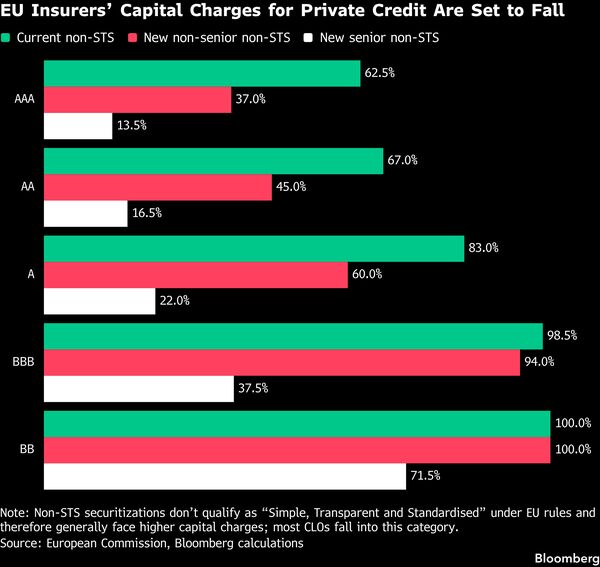
从明年起,对私募股权和高级结构化信贷部分投资的资本要求将大幅下降,某些情况下降幅将超过一半。
From next year, capital requirements for some investments in private equity and senior structured credit are set to fall sharply, in certain cases by more than half.
长期股权投资规则的放宽将使更多持仓有资格适用22%的资本要求,相比之下,普通上市股票的资本要求为39%,多数私募股权和其他非上市投资为49%。理论上,这将引导更多保险资金流向公司、私募股权和风险投资基金、基础设施以及能源转型项目。
Easier rules for long-term equity investments will allow more holdings to qualify for a 22% capital charge, compared with 39% for ordinary listed shares and 49% for most private-equity and other unlisted investments. In theory, that steers more insurer money toward companies, private equity and venture-capital funds, infrastructure and energy-transition projects.
CVC Capital Partners Plc保险解决方案主管埃德·科林奇表示:“偿付能力II修正案无疑是一个重大转变,因为欧洲保险公司过去无法像它们希望的那样,在长期股票和投资级结构化信贷上投入那么多资金。”
“The Solvency II amendments are definitely a big shift, as European insurers haven’t been able to invest as much in long-dated equities and investment-grade structured credit in the past as they would have liked to,” said Ed Collinge, head of insurance solutions at CVC Capital Partners Plc.
他表示,这些变化已经是CVC与欧洲各地保险公司定期讨论的一部分。“他们现在正在研究这是否是他们想要的东西,而答案通常是肯定的。”对高质量证券化产品降低收费,可能使保险公司成为打包抵押贷款、消费信贷和公司贷款的更大买家。银行随后可以转移部分风险,释放资产负债表空间,并向家庭和企业提供更多信贷。反过来,保险公司将获得更广泛的创收投资渠道。
The changes are already part of CVC’s regular discussions with insurers across Europe, he said. “They’re now working out whether it’s something they want, and the answer is generally yes.”Lower charges on high-quality securitizations could make insurers bigger buyers of packaged mortgages, consumer credit and company loans. Banks could then transfer some of that risk, free up space on their balance sheets and extend more credit to households and businesses. Insurers, in turn, would gain access to a broader pool of income-producing investments.
彭博新闻上月报道,政策制定者已达成初步协议,将某些证券化产品优先级部分的风险加权下限(衡量银行为覆盖意外损失所需预留资本的指标)从10%降至5%。
Policymakers have reached a preliminary agreement to cut risk-weighted floors — an indicator of the capital that banks need to set aside to cover unexpected losses — on the senior portions of certain securitizations to 5% from 10%, Bloomberg News reported last month.
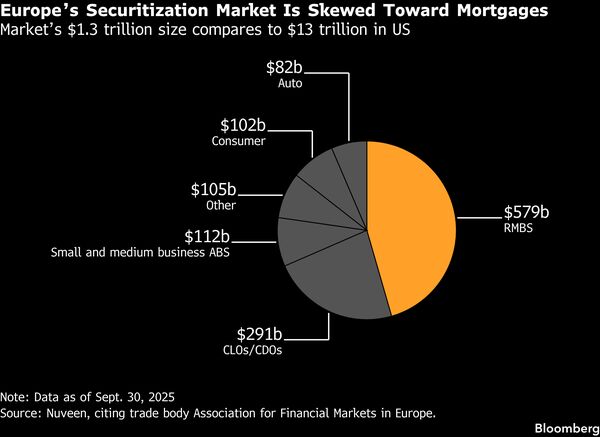
根据欧洲金融市场协会的数据,截至6月底,欧洲有近1.3万亿欧元的证券化产品尚未偿还,其中包括贷款抵押债券。尽管这同比增长了2.7%,但该市场规模仍只是美国同类市场的一小部分。
Europe had almost €1.3 trillion of securitizations outstanding, including collateralized loan obligations, at the end of June, according to the Association for Financial Markets in Europe. While that represented growth of 2.7% over a year, the market remains a fraction of its US equivalent.
然而,对私募信贷和收购公司估值的疑虑仍然很高,这加大了未来出现更广泛金融动荡的风险。欧洲部分监管机构警告称,由于这些改革,下一次危机来袭时可能会出现资本不足。
Yet doubt over valuations in private credit and buyout firms remains elevated, raising the risk of broader financial turbulence ahead. Parts of Europe’s regulatory machinery are warning that, as a result of the reforms, capital could be lacking when the next crisis hits.
欧洲保险和职业养老金管理局表示,偿付能力II的资本减免可能会侵蚀该体系的缓冲。该保险监管机构主席佩特拉·希尔克马表示,监管机构将关注企业如何使用这一好处,以及这是否与广泛的战略目标一致。欧洲央行也表达了类似的担忧。
The European Insurance and Occupational Pensions Authority has said that the Solvency II capital relief risks eroding the system’s buffers. The insurance watchdog will be paying attention to how firms use the benefit, and whether that’s aligned with the broad strategic goals, according to Petra Hielkema, chair of the organization. The ECB has voiced similar concerns.
“现实情况是,一旦这些变化生效,对偿付能力比率的影响可能看起来很小,但在当今风险相互关联、不确定性高企的环境中,支撑这一数字的实际资本将会减少,”希尔克马在回答提问时表示。“资本减免的目的并不是简单地用于为股东和管理层的派息提供资金。”欧洲推动证券化的努力中有一个核心的讽刺之处:最直接的受益者可能根本不在欧洲大陆。受人工智能建设巨大资本需求的推动,蓬勃发展的美国债务市场正以比任何欧洲市场都更快的速度创造出更高收益的投资机会。
“The reality is that once these changes take effect, the impact on solvency ratios may appear small, but there will be less actual capital in the system backing that number up in today’s environment of interconnected risks and high uncertainties,” Hielkema said in response to questions. “The capital relief is not intended to simply fund payouts for shareholders and managers.”A central irony of Europe’s efforts to boost securitization is that the most immediate beneficiaries might not be in the old continent at all. Booming US debt markets, driven by the immense capital needs of the AI build-out, are churning out opportunities for higher-yield investment at a faster rate than any European market.

Nuveen是全球最大的资产管理公司之一,管理资产达2.6万亿美元。此类美国参与者正把欧洲的保险公司进一步引向西方。
US players such as Nuveen, one of the world’s largest asset managers with $2.6 trillion under management, are pointing Europe’s insurers further west.
“美国提供了规模,使配置能够在近期发生,而欧洲市场则在寻求收复失地,”Nuveen在今年发布的营销材料中表示。
“The US provides scale where allocations can happen in the near term as the European market looks to recover lost ground,” Nuveen said in marketing materials published this year.
随着监管变化逐步落地,一个争夺资本的巨大市场的存在可能会让欧洲人集中注意力。大都会人寿投资管理公司CLO分档投资全球主管莱拉·科尔摩根表示,欧洲保险公司与美国同行的投资方式差异鲜明。
The presence of a giant market competing for capital may focus European minds as the regulatory changes bed in. The differences between the way that European insurance firms invest with their US peers is stark, according to Laila Kollmorgen, global head of CLO tranche investments at MetLife Investment Management.
科尔摩根指出,CLO占美国寿险公司投资账簿的15%,而各类证券化产品占欧盟保险公司投资账簿的比例不到1%。
Kollmorgen notes that CLOs make up 15% of US life insurance companies’ investment book while securitizations of all types make up less than 1% of EU insurers’ investment books.
这意味着,尽管仍然保守,但从如此低的基数实现增长的机会是巨大的。
That means that while still conservative, the chance for growth from such a low base is significant.
“偿付能力制度确实是世界上唯一不包含证券化、尤其是CLO的制度,”她在一次采访中表示。“针对欧洲CLO的偿付能力II将产生巨大、巨大的影响。”
“The solvency regime really was the only regime in the world that did not include securitizations and very specifically CLOs,” she said in an interview. “Solvency II for European CLOs is going to have a huge, huge impact.”