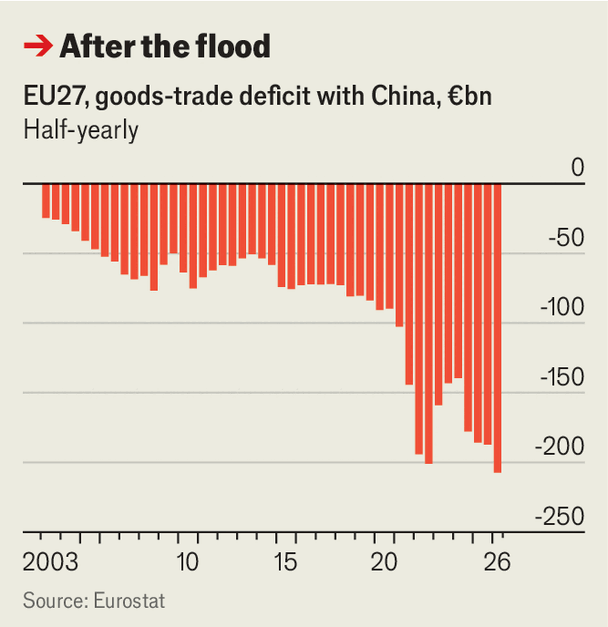
对于欧洲工业而言,中国长期以来承载着财富的承诺。这是一个唾手可得的广阔市场,尽管中国当局曾施压欧洲企业与当地公司组建合资企业,以确保国内竞争对手或供应商能够在这些合资企业的周围成长。然而,这种成长如今对曾经的受益者来说已变得难以承受。中国企业正在进军汽车、风力涡轮机以及其他此前一直被视为欧洲本土领盘的产品市场。人工智能等新技术的出现——中国在这些领域领先于欧洲——正使中国企业成为更加凶猛的竞争对手。
For Europe’s industry, China long held the promise of riches. A vast market was there for the taking, even if Chinese authorities pressed European firms to form joint ventures with locals to make sure domestic competitors or suppliers could grow around them. That growth has now become unbearable for the former beneficiaries. Chinese firms are making inroads into the markets for cars, wind turbines and other products that had hitherto been deemed Europe’s home turf. New technologies such as artificial intelligence, where China is ahead of Europe, are making Chinese companies even fiercer competitors.
警报随之拉响,德国尤其如此。因此,欧盟将在2027年收紧其贸易防御措施。欧盟已经对中国政府对其企业的补贴展开了多项调查,欧洲竞争对手称这些补贴赋予了中国企业不公平的成本优势。欧盟正在考虑采取更强有力的措施来使供应链多元化(意即:脱离中国),以降低自身对经济勒索的脆弱性。欧洲的补贴和政府采购规则可能很快会加入“购买欧洲产品”条款,以将更多的本土需求留在欧洲大陆。
Cue panic, especially in Germany. As a result, the European Union will toughen its trade defences in 2027. It has started numerous investigations into China’s government subsidies for its firms, which European rivals say give them unfair cost advantages. It is considering stronger measures to diversify supply chains (read: away from China) to make itself less vulnerable to economic blackmail. Rules for subsidies and procurement in Europe may soon include “Buy European” clauses to keep more local demand on the continent.
如果中国对其贸易措施进行过强烈的报复,欧洲正在建立一种“第二次打击”能力,例如将其部分市场排除在外。这些举措可谓力度空前。
And Europe is building a “second-strike” capability, such as a partial shut-out from its market, should China retaliate too strongly against its trade measures. It is strong stuff.
中国将如何应对?在先前的贸易摩擦中,中国曾使用定向措施来打击那些支持惩罚性行动的国家。当欧盟以行业存在不公平补贴为由对中国电动汽车征收关税时,中国便将矛头对准了白兰地(从而打击了该关税的主要支持者法国)以及部分农产品。
How will China respond? In previous trade spats, China has used targeted measures to hurt those backing punitive action. When the EU put tariffs on Chinese electric vehicles (EVs), on the basis of unfair subsidies to the industry, China went after brandy (and thus France, a leading supporter of the tariffs) and some agricultural goods.
即将到来的中国回应轮次可能会集中在欧洲对其采取行动的行业。例如,当欧盟委员会在9月对中国化学品展开调查时,中国在几天后也对欧洲化学品启动了自身的调查。如果欧洲将反补贴调查从个别企业扩大到整个行业,中国也可能会扩大其报复范围。例如,中国可能会让在华运营的欧洲企业的日子更加难过。
The coming round of Chinese responses will probably focus on the sectors where Europe acts against it. When the European Commission started an investigation into Chinese chemicals in September, for example, China opened its own investigations into European chemicals a few days later. If Europe widens its anti-subsidy investigations to whole industries instead of individual firms, China may also widen its retaliation. It could, for example, make life even more difficult for European firms operating within its borders.
话虽如此,这场贸易摩擦大概不会升级得太远。中国经济状况不佳,其领导层并不愿意增添更多压力。而且欧洲依然是对中国企业而言最为开放的大型市场;较低的关税壁垒仅使其吸引力略有下降。即便对电动汽车征收了关税,由于高昂的油价提振了欧洲的需求,中国最大的电动汽车制造商比亚迪在2026年前九个月的欧盟销量与2025年同期相比仍增长了154%。无论欧盟采取什么行动,中国都会作出对等的反应,然后继续前行。
That said, the trade spat will probably not escalate too far. China’s economy is not doing so well that its leaders are willing to add further pressure. And Europe remains the most open large market for Chinese firms; a low tariff wall makes it only slightly less attractive. Even with a tariff on EVs, sales in the EU for BYD, the largest Chinese EV-maker, increased by 154% in the first nine months of 2026, compared with the same period in 2025, as high petrol prices boosted European demand. Whatever the EU does, China will respond proportionately and then move on.
但这种在多个领域的持续报复意味着,中国和欧洲将在2027年发现彼此陷入了一场长期的、中等级别的贸易战。这将损害欧洲经济,而该经济体在面对另一次巨大的能源冲击时表现出了惊人的韧性。对中国商品征收关税非但不能惠及欧洲,反而会伤害其消费者以及全球市场的下游客户。将中国挤出去,还将加剧全球其他市场的竞争——在这些市场中,欧洲生产商正面临来自中国企业更猛烈(且未被征收关税)的竞争。
But this continuous retaliation in multiple sectors will mean that China and Europe will find themselves in a permanent, mid-level trade war in 2027. That will hurt Europe’s economy, which has been remarkably resilient in the face of another big energy shock. Tariffs on Chinese goods, far from benefiting Europe, will hurt its consumers and downstream customers in global markets. Pushing China out will also intensify competition in other markets around the world where European producers face even fiercer (and untariffed) competition from Chinese companies.
欧洲生产商因在本土受到保护免受中国竞争而获得的收益将微乎其微,不过是为欧洲企业买了一些时间罢了。
The gain for European producers from being shielded from Chinese competition at home will be of little benefit and merely buy European firms some time.
通过保护主义来提振欧洲工业这个看似轻松的选择,在欧洲会很受欢迎,但随后将慢慢让位于对微薄成果的沮丧。届时的问题在于,关税一旦实施,就很难取消。欧洲本应作为临时措施的钢铁关税最近被永久化了。要等到出现进一步的工业衰退,自由主义政策才有一线复苏的可能。■
The seemingly easy option of boosting Europe’s industry through protectionism will be politically popular in Europe, but will slowly give way to frustration at meagre results. Then the problem will be that tariffs, once in place, are difficult to reverse. Europe’s steel tariffs, supposedly a temporary measure, were recently made permanent. It will take further industrial decline before liberal policies have any chance of making a comeback. ■