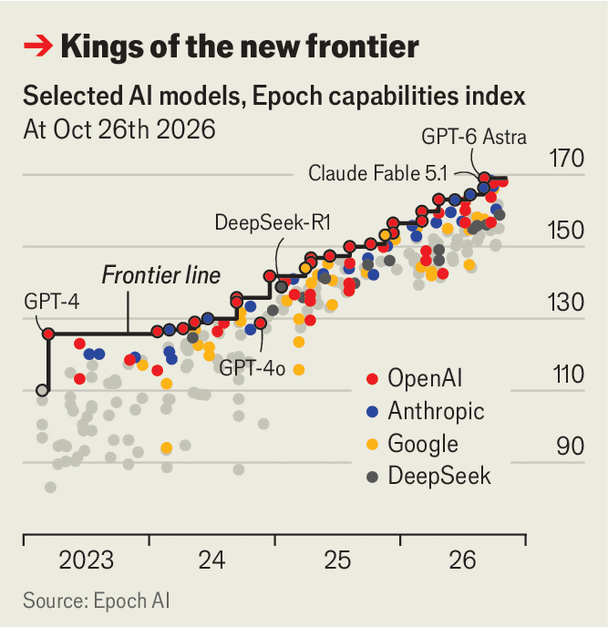
人工智能在编程领域的影响力无出其右——而这反过来又在推动 AI 自身的发展。智库 Metr 于 2026 年 11 月发布的一份报告估计,得益于 AI 工具的使用,AI 能力的增长速度比一年前快了约一倍。此类发现解释了为何许多业内人士预期 2027 年将成为 AI 系统具备构建自身继任者能力的年份。若它们能在无人类参与的情况下做到这一点,可能引发能力的快速跃升——这一现象被称为“递归自我改进”(RSI)。
Nowhere has artificial intelligence had more impact than in the field of programming—and that is now feeding back into the development of AI itself. A report in November 2026 by Metr, a think-tank, estimated that AI capabilities were growing roughly twice as quickly as they were a year earlier, due to the use of AI tools. Findings like this explain why many insiders expect 2027 to be the year AI systems become capable of building their own successors. If they can do so without any human involvement, the result could be a rapid increase in capabilities—a phenomenon known as “recursive self-improvement” (RSI).
AI 系统在编码方面正稳步变强。2026 年初,Anthropic 的编码代理 Claude Code 开始流行,但大多数用户仍对其严加管控,逐行审批单个修改,并对其任务做严格限定。然而到年底,最具前瞻性的开发者已在运行完整的“软件工厂”,向编码代理群下达高层指令,然后便不再过问。
AI systems are getting steadily better at coding. At the beginning of 2026, Claude Code, Anthropic’s coding agent, was starting to become popular, but most users still kept it on a tight leash, approving individual changes line by line, and tightly specifying what it should do. By the end of the year, however, the most forward-looking developers were running full “software factories”, issuing high-level orders to swarms of coding agents and leaving them to it.
代码非成即败,因此可以通过自动化方式提升模型的编码本领:生成无限量的编码挑战,通过则给高分,失败则给低分,反复迭代。这种方法被称为“可验证奖励的强化学习”。但这并非 AI 构建更强 AI 的唯一技术。这种训练方式偏向于有明确、可测试答案的任务,如编码或数学证明,而非答案模糊或主观的任务,如创意写作或构思法律论证。为提升这类能力,AI 研究人员正在推进一种名为“自我博弈”的旧技术的演进形式。
Because code either works or fails, improving a model’s coding prowess can be automated: generate an infinite number of coding challenges, score a system well if it passes them and poorly if it fails, and iterate. This approach is known as “reinforcement learning with verifiable rewards”. But it is not the only technique by which AI can be used to build better AI. Training systems in this way favours tasks with definite, testable answers, such as coding or mathematical proofs, over other tasks with fuzzy or subjective answers, such as creative writing or devising legal arguments. To improve those kinds of capabilities, too, AI researchers are pursuing an evolution of an older technique, called “self-play”.
自我对弈为AlphaZero等早期人工智能突破奠定了基础。AlphaZero是谷歌旗下人工智能实验室DeepMind打造的一款棋类模型,它通过与自己进行大量围棋对局并从胜利中学习来训练。在如今更复杂的自我对弈形式中,人工智能系统被置于既充当参与者又充当裁判的环境中。例如,两个被赋予撰写法律论证任务的人工智能模型可能被安排在模拟案件的对立双方,而第三个模型则担任法官。与下围棋一样,系统通过与自身竞争并从胜负中学习来改进。
Self-play underpinned early AI breakthroughs such as AlphaZero, a board-game-playing model built by DeepMind, Google’s AI lab. It was trained by playing myriad games of Go against itself and learning from its victories. In today’s more elaborate form of self-play, AI systems are set up in environments in which they act as both participants and judges. Two AI models tasked with creating legal arguments, for instance, may be put on opposite sides of a mock case, with a third AI model given the role of judge. As with playing Go, the system improves by competing with itself and learning from its wins and losses.
专家担心,递归自我改进可能剥夺人类监督强大人工智能模型训练的能力。递归自我改进的另一种途径是让AI模型直接修改其他模型,方法是调整控制其行为的“权重”。2026年底,麻省理工学院的研究人员发现,前沿AI模型无需经过明确训练就能做到这一点。研究人员表示,目前这类系统只能有意义地改进比自身简单得多的版本,但未来这可能提供一条通往递归自我改进的“原生”路径。
Experts worry that RSI could rob humanity of the ability to supervise the training of powerful AI models Yet another approach to RSI involves getting AI models to modify other models directly, by tweaking the “weights” that govern their behaviour. In late 2026 researchers at the Massachusetts Institute of Technology found that frontier AI models could do this without having been trained explicitly to do so. For now, such systems can only meaningfully improve much simpler versions of themselves, but in future this may offer a “native” path to RSI, the researchers say.
无论采取何种形式,递归自我改进都引发了紧迫的问题。专家担心,递归自我改进可能剥夺人类监督强大人工智能模型训练的能力,可能导致出现危险模型,其目标与人类目标“不一致”。在2025年初一项颇具影响力的预测研究《AI 2027》中,追求递归自我改进的决定被视为人类决定自身命运的关键时刻。预测者估计,这一决定将在2027年秋季做出。进展正按计划推进。■
Whatever form it takes, RSI raises pressing issues. Experts worry that RSI could rob humanity of the ability to supervise the training of powerful AI models, potentially resulting in dangerous models with aims that are “misaligned” with those of humans. In “AI 2027”, an influential forecasting exercise from early 2025, the decision to pursue RSI was held up as the key moment in which humanity sealed its own fate. That decision would be made, the forecasters estimated, in the autumn of 2027. Progress is right on track. ■