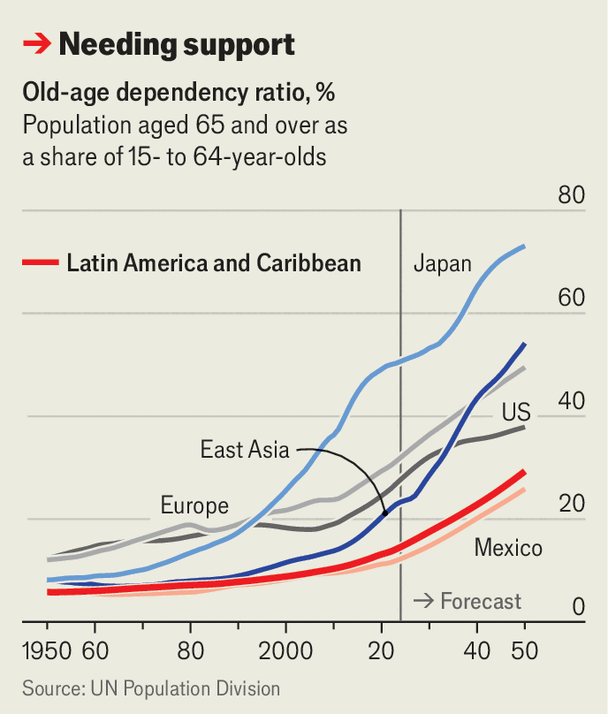
拉丁美洲通常被认为是年轻人的地方。但作为一个整体,该地区将在2027年迎来其最后一年的人口红利年份。根据联合国的数据,2028年,受抚养人数将首次在六十年内超过劳动年龄人口。到那时,该地区11%的人口将超过65岁,15%的人口将超过60岁。
Latin America is generally thought of as a place of youngsters. But, taken as a bloc, the region will in 2027 enjoy its last year of demographic bonus. In 2028 the number of dependants will outgrow the working-age population for the first time in six decades, according to the UN. By then, 11% of people in the region will be over 65, and 15% over 60.
与日本相比,这听起来可能微不足道,日本有30%的人口超过65岁;与意大利相比,意大利约有四分之一的人口超过65岁。但拉丁美洲是自2000年以来中位年龄增长最快的地区。世界其他地区人口更老,但拉丁美洲老龄化速度更快。
That may sound modest compared with Japan, where 30% of people are over 65, or Italy, where about a quarter are. But Latin America is the region where the median age has increased the most since 2000. Other parts of the world are older, but it is ageing faster.
与许多先富后老的老龄化地区不同,拉丁美洲并未先富。该地区不如欧洲或东亚大部分地区发达,也不如它们健康。许多人担心,该地区在人口红利存在期间没有充分利用它。在1965年至1990年间,当东亚乘着同样的人口红利浪潮时,其人均GDP每年增长约6%;而拉丁美洲在2000年至2024年间的人均GDP每年仅增长1.2%。东亚利用这笔意外之财投资于教育和女性就业;拉丁美洲大多没有这样做。
And unlike many ageing places that got rich first, Latin America has not. The region is less developed and less healthy than Europe or much of East Asia. Many fear it did not make full use of its bonus while it lasted. Between 1965 and 1990, when East Asia rode the same demographic wave, its GDP per person grew by around 6% a year; Latin America’s grew by only 1.2% a year between 2000 and 2024. East Asia used the windfall to invest in education and female employment; Latin America mostly did not.
用平稳或下降的财富来养活更多受抚养人是困难的。养老金不足,特别是在墨西哥等国家,超过一半的工人在非正规部门工作。日本超过60岁的人中,有96%领取公共养老金。在拉丁美洲,缴费型养老金覆盖不到一半的劳动力。非缴费型养老金成本高昂。作为GDP的百分比,该地区在医疗保健上的支出几乎与其更富裕的对手相当,尽管人均支出较少。
Supporting more dependants with flat or declining wealth is hard. Pensions are inadequate, particularly in countries such as Mexico where more than half of workers toil in the informal sector. Fully 96% of Japanese over 60 draw a public pension. In Latin America contributory pensions cover less than half of the workforce. Non-contributory pensions are expensive. As a percentage of GDP, the region spends almost as much on health as its wealthier counterparts, though less on a per-person basis.
其他地区更老,但拉丁美洲老龄化更快。老龄化社会也有社会成本。从美国来看,一些退休人员已移居中美洲和拉丁美洲,以便在老年时获得廉价护理。但很少有拉丁美洲人自己能负担得起这种护理,公共替代方案也稀缺。无偿护理工作(通常由女性承担)在一些国家估计相当于GDP的四分之一,并阻碍女性参与劳动力市场。
Other regions are older, but Latin America is ageing faster Ageing societies have social costs, too. From the United States, some pensioners have moved to Central and Latin America for cheap care in their old age. But few Latin Americans can afford such care themselves, and public alternatives are scarce. Unpaid care work (usually by women) is estimated to be equivalent to a quarter of GDP in some countries, and holds back female participation in the labour force.
一些国家正在采取行动。哥伦比亚的养老金改革将于2027年生效。其中包括,将基本覆盖范围扩展到从未拥有养老金的人。哥斯达黎加已采取措施整合移民人口。它旨在使更多移民劳动力合法化,其中58%已经就业,以此填补当地人留下的空缺。墨西哥市已通过自己的护理法,这是政府力求建立的国家体系的第一步。阿根廷正试图将女性退休年龄提高到与男性相同,目标年份为2030年。
Some countries are taking action. Colombia’s overhaul of its pensions will come into force in 2027. Among other things, it will extend basic coverage to those who never had a pension. Costa Rica has taken steps to integrate migrant populations. It aims to formalise more of its migrant workforce, of whom 58% are already employed, as a way of plugging gaps left by locals. Mexico City has passed its own care law, a first step towards the national system the government is aiming for. Argentina is trying to raise the retirement age for women to match that for men by 2030.
但这还不够。此类措施必须走得更远、更快。乌拉圭提供了一个模式:2015年,它启动了一个涵盖儿童、残疾人和退休人员的护理体系。根本性的改革是该地区长期苦苦挣扎的问题:生产率、体面的公共教育、更好的基础设施以及更快地采用新技术。
But it is not enough. Such measures must go further, and faster. Uruguay offers a model: in 2015 it launched a care system covering children, disabled people and pensioners. The underlying fixes are ones the region has long struggled with: productivity, decent public education, better infrastructure and adopting new technology faster.
或许也有积极的一面。儿童群体规模缩小意味着可以在每个孩子身上花更多钱:联合国估计,该地区的学龄人口到2050年将减少3800万,这可能是一个提高教育质量的机会。劳动力短缺正在吸引年轻移民,大多是委内瑞拉人,他们可以缓解紧张局势。该地区能否不仅应对而且繁荣,将取决于变革的速度。■
There may be some silver linings. Smaller cohorts of children mean more can be spent on each one: the UN reckons the region’s school-age population will shrink by 38m by 2050, which could be a chance to raise educational quality. Labour shortages are pulling in young migrants, mostly Venezuelans, who can ease the crunch. Whether the region can not just cope but prosper will depend on the pace of change. ■