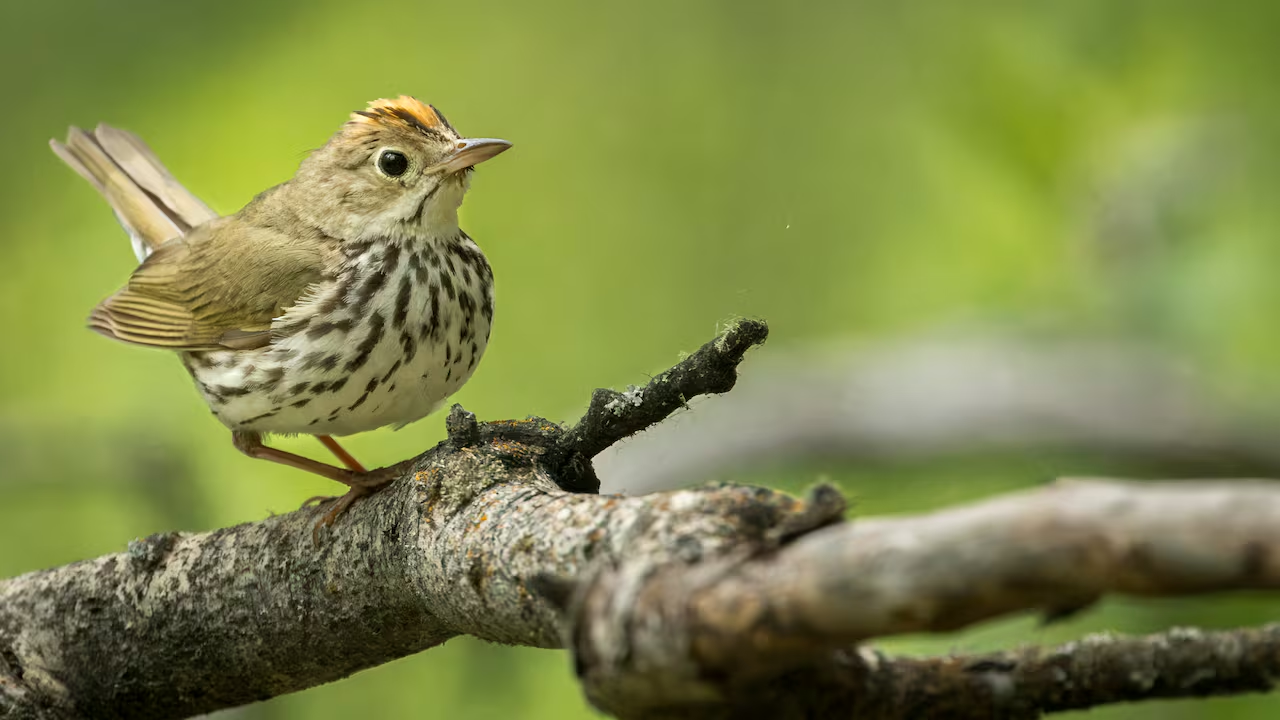
从推文到颤音,鸟鸣可以像交响乐一样丰富多样。但林鹀——这种圆滚滚、栖息地面的林莺——的曲目却严格有限。
From tweets to trills, birdsong can be as diverse as a symphony. But ovenbirds — rotund, ground-dwelling warblers — have a strictly limited repertoire.
雄鸟只有一首歌:一段快速的旋律,常被形容为“teacher-teacher-teacher”(老师-老师-老师)。
The male has a single song: a rapid melody often described as teacher-teacher-teacher.
在大多数人耳中,所有林鹀听起来都一样,但每只鸟都有自己独特的演绎。
To most ears, all ovenbirds sound the same, but each has its own, distinct take.
如今,生物学家正利用人工智能,仅凭这些标志性的鸟鸣来追踪林鹀种群的健康状况。
Now, biologists are using AI to help track the health of ovenbird populations by their signature songs alone.
本月发表在科学期刊《自然·方法》上的研究依靠 AI,在阿尔伯塔省和宾夕法尼亚州采集的录音中识别出了个体林鹀。
Research published this month in the science journal Nature Methods relied on AI to identify individual ovenbirds in recordings gathered in Alberta and Pennsylvania.
单曲循环 首席研究员、科罗拉多大学博士后研究员萨姆·拉普表示,林鹀这种“特立独行”的曲目单使其成为理想的研究物种。
One-track mind The ovenbird’s “particular” setlist made it the ideal species to study, said lead researcher Sam Lapp, a postdoctoral researcher at the University of Colorado.
“它们非常忠于演唱一首非常特定的歌曲,”拉普在接受 CBC 新闻采访时说。
“They are really pretty loyal to singing one very specific song,” said Lapp in an interview with CBC News.
“很多鸟类在一生中都会形成一种固定的声纹特征。通常,这会包含几首不同的歌曲,构成我们所谓的鸟类‘曲目库’。
“There are a lot of birds that do kind of crystallize a vocal signature over the course of their life. Often, that will incorporate several different songs into what we call a repertoire of the bird.
“但林鹀有一个很好的特性:不仅一生都保持一首非常稳定的歌曲,而且只唱这一个版本。” 林鹀在春天演唱主要鸣唱,以保卫领地和吸引配偶。这一鸣唱贯穿它们的一生,始终如一。
“But the ovenbird has this nice property of not only having one very stable song over time, but only singing one version of it.”Ovenbirds sing their primary song in the spring, to defend their territory and attract a mate. And it remains a constant refrain throughout their lives.
这项研究由拉普在匹兹堡大学生物科学系任职期间主导,研究团队使用了在宾夕法尼亚州近 130 个地点、历时四年采集的录音。
Led by Lapp during his time with the Department of Biological Sciences at the University of Pittsburgh, the research team used recordings collected from nearly 130 sites in Pennsylvania over four years.
他们训练了一个 AI 模型,提取使鸣唱独一无二的特征,并将相似的鸣唱归类在一起,前提是假设每只鸟每年春天都会回到同一片森林。
They trained an AI model to extract features that made songs unique and cluster similar ones together, assuming each bird would return to the same patch of forest every spring.
研究团队处理了9,072小时的音频,以追踪405只个体鸟类。随后,研究人员利用另一组录音对模型进行了测试,这些录音是在2016年春季繁殖季节期间,在阿尔伯塔省的混交林和北方针叶林中收集的。
The team processed 9,072 hours of audio to track 405 individual birds. The researchers then tested the model against another set of recordings, collected throughout the mixed wood and boreal forests of Alberta during the 2016 spring breeding season.
拉普表示,该模型能以高达96%的准确率将鸟鸣与个体鸟类对应起来。
Lapp said the model could link songs to individual birds with up to 96-per-cent accuracy.
这比脚环标记法省力得多,后者要求生物学家捕捉鸟类,小心翼翼地在其脚踝上套上标记,然后力争在第二年春天再次捕捉到它们。
It’s much less labour-intensive than leg banding, where biologists capture birds, carefully place markers around their ankles and then aim to catch them again the following spring.
他说,研究灵感源于与阿尔伯塔省生物学家的合作,后者试图利用麦克风阵列,在广袤地域内确定鸟类的位置。“令人惊叹”拉普说,人耳无法实时分辨个体林鹀,因为它们鸣叫的细微差别发生得太快。
He said the idea for the research came from a collaboration with Alberta biologists who were attempting to pinpoint the location of birds across vast distances using a grid of microphones. 'Kind of wondrous' Human ears cannot distinguish individual ovenbirds in real time because their vocal nuances happen too quickly, Lapp said.
但通过声谱图——声音的可视化呈现——每只鸟独特的鸣叫变得清晰可辨,拉普说。
But on spectrographs — visual representations of sound — each bird’s distinctive song comes into focus, Lapp said.
“我开始思考,如果我的眼睛能看到这些模式,我们能否教会机器识别这些模式,从而实现个体识别的自动化?
“I started thinking, if my eyes can see these patterns, can we teach a machine to be able to recognize these patterns and do an automated version of individual recognition?
“即使你痴迷鸟类、热衷于物种识别,也会感到惊讶、兴奋,甚至觉得有点不可思议:原来如此丰富的信息一直就在那里,我们只是错过了……只要你听得足够仔细,它们就存在。”阿尔伯塔大学生物学教授、该研究合著者艾琳·贝恩多年来一直关注林鹀,深知每年种群监测的艰辛。
“Even if you're obsessed with birds and really into identifying species, it's so surprising and exciting and it's kind of wondrous that this level of information exists that we’ve just been missing ... but is there if you're listening closely enough.”Erin Bayne, University of Alberta biology professor and a co-author of the study, has been keeping an ear on ovenbirds for years and knows the rigours of annual population monitoring.
攻读博士学位期间,贝恩花费数万小时追踪戴环鸟类,以至于能凭借独特的鸣叫变化分辨个体。
During his PhD, Bayne spent tens of thousands of hours tracking banded birds, to the point where he could tell individuals apart by their unique vocal variations.
“那边那只鸟在‘说’的东西,和这边那只稍有不同,”他说,“我知道谁是谁。”
“What that guy is saying over there is a little different from that guy over there,” he said. “I knew who was who.
“它们唱歌时非常有礼貌。其实挺有趣的。一只鸟唱完,另一只会等它唱完,但随后会瞬间接唱。” 同类鸟儿交流在一起 贝恩表示,这项研究表明鸟类的交流远比大多数人想象的要复杂,即使我们听不懂它们的语言,对话也在发生。
“And they're incredibly polite when they sing. It's quite funny actually. One bird will sing and then the other one will wait until he finishes, but then instantaneously will sing after that.”Birds of a feather talk together Bayne said the study shows that avian communication is far more complex than most people assume, and that conversations are happening, even if we don’t understand the language.
贝恩说,正如人类有独特的语言模式,生物学家正在了解某些动物也如何发展出自己的“声音”。
Just like humans have distinct speech patterns, biologists are learning how certain animals also develop a voice of their own, Bayne said.
“在很多方面,个体鸟类或个体动物拥有可被检测到的差异并不令人惊讶。我认为我们研究得越深入,就会越容易看出这是真的。” 虽然该模型有局限性,但研究人员希望它能提供一种侵入性更小的方式,仅通过聆听就能了解鸣禽的健康状况。
“In many ways, it's not surprising that individual birds or individual animals have something different that's detectable. I think the more we look into it, the more it's going to be quite simple to see that it's true.”While the model has limitations, the study researchers hope it provides a less invasive way to understand the health of songbirds, merely by listening in.
该 AI 系统无法准确追踪雌性褐冠林莺多变的叫声,也无法追踪幼鸟发出的简单鸣声。
The AI system cannot accurately track the varied calls of female ovenbirds or the simple vocalizations made by juveniles.
目前的程序对于监测鹊鸟和模仿鸟等物种也力不从心,这些鸟类不断模仿新声音或唱几十种不同的歌。
The current program would also fall short for monitoring species such as magpies and mockingbirds that constantly mimic new sounds or sing dozens of different songs.
它最适用于一生只唱一种固定歌曲的鸟类——约占鸣禽物种的 30%——以及某些蝙蝠和猫头鹰物种。
It would work best for birds that sing one, unchanging song throughout their lives — roughly 30 per cent of songbird species — as well as certain species of bats and owls.
研究人员将程序代码发布在开源网站上,以帮助其他生物学家追踪其他鸣禽种群甚至其他物种的生存状况。
The researchers put the program code on open-source sites, to help other biologists track the survival of other songbird populations or even other species.
未参与该研究的阿尔伯塔生物多样性监测研究所统计生态学家理查德·赫德利表示,这项技术潜力巨大。
Richard Hedley, a statistical ecologist with the Alberta Biodiversity Monitoring Institute who was not involved in the research, said it has incredible potential.
他说,AI 声学监测已用于物种层面的鸟类追踪多年,但证明它能区分个体鸟类是一项了不起的成就。他表示,现有大量声学录音资料可被以新方式利用。
While AI acoustic monitoring has been used to track birds at the species level for years, showing that it can distinguish between individual birds is an impressive feat, he said. There is a wealth of existing acoustic recordings that could be harnessed in new ways, he said.
“仅仅捕捉一只鸟就可能要花好几个小时。因此,只要在鸟的领地上放置一个麦克风就能做到这一点,这个想法真的很有前景。”
“It can take many hours just to catch a single bird. So the idea that we can just do this by putting a microphone on the bird's territory is really promising.”