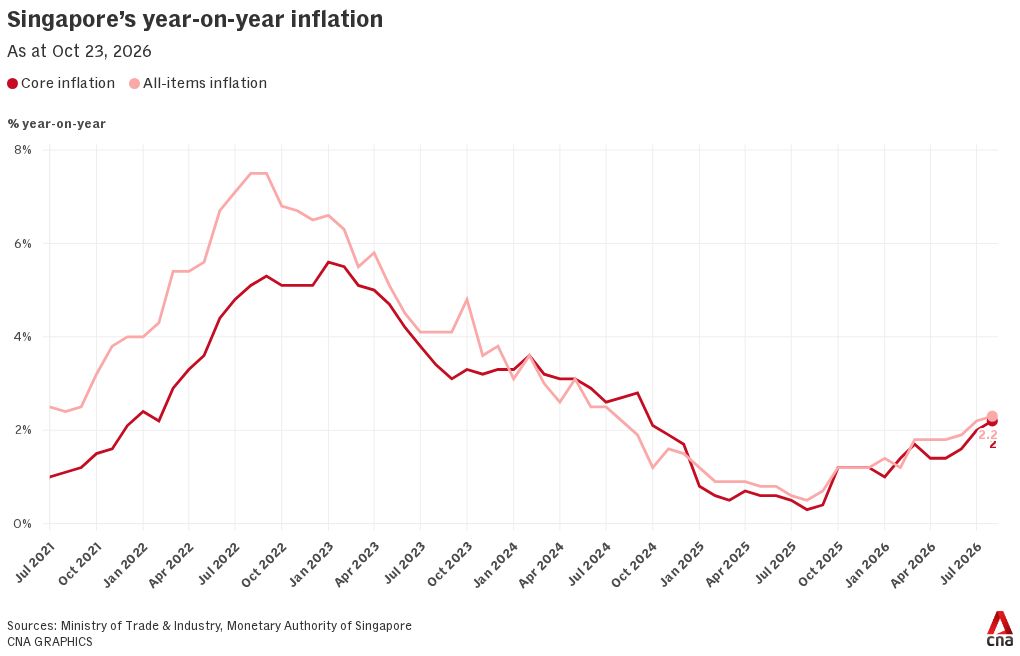
新加坡:根据周一(11月23日)公布的官方数据,新加坡核心通胀率10月同比放缓至1.5%,低于9月的2%。
SINGAPORE: Singapore’s core inflation eased to 1.5 per cent year-on-year in October, down from 2 per cent in September, according to official figures released on Monday (Nov 23).
新加坡金融管理局(MAS)和能源、贸易及工业部(METI)在一份联合新闻稿中表示,这一下降是由于服务以及电力和燃气的通胀率降低所致。环比来看,核心物价(不包括住房和私人交通)与上月持平。
The drop was due to lower inflation for services and electricity & gas, said the Monetary Authority of Singapore (MAS) and the Ministry of Energy, Trade and Industry (METI) in a joint press release. On a month-on-month basis, core prices, which exclude accommodation and private transport, remained unchanged from the previous month.
以消费者物价指数(All Items)衡量的整体通胀率,10月同比放缓至1.9%,低于9月的2.2%。
Overall inflation, as measured by the Consumer Price Index-All Items, slowed to 1.9 per cent year-on-year in October, from 2.2 per cent in September.
MAS和METI表示,这是由于服务、电力和燃气以及私人交通的通胀率降低所致。他们补充称,10月整体通胀率环比下降0.3%。
This was due to lower services, electricity & gas and private transport inflation, said MAS and METI. Overall inflation fell by 0.3 per cent on a month-on-month basis in October, they added.
各行业:多个行业的通胀率均有所放缓,其中电力和燃气行业降幅最为显著。
SECTORS Inflation eased across several sectors, with electricity and gas seeing the sharpest decrease.
该行业的通胀率从9月的8.7%降至10月的1%,原因是电力价格上涨速度放缓。这主要是因为10月的受管制电费低于9月。
Inflation in the sector fell from 8.7 per cent in September to 1 per cent in October as electricity prices rose at a slower pace. This was largely due to a lower regulated electricity tariff in October compared to September.
服务通胀率在10月放缓,原因是机票以及健康保险和医疗服务费用的涨幅减小,同比从9月的1.7%降至10月的1.1%。
Services inflation eased in October due to smaller increases in airfares as well as in the costs of health insurance and healthcare services, falling from 1.7 per cent in September to 1.1 per cent in October on a year-on-year basis.
MAS和METI表示,私人交通通胀率也有所下降,原因是汽车价格上涨更为缓慢。该行业10月的通胀率为6.7%,而9月为7.1%。
Private transport inflation was also lower due to a more gradual increase in car prices, said MAS and METI. The sector’s inflation was 6.7 per cent in October as compared to 7.1 per cent in September.
食品通胀率从9月的2.4%微降至上月的2.3%,原因是非熟食价格上涨速度放缓。
Food inflation edged down from 2.4 per cent in September to 2.3 per cent last month as the prices of non-cooked food rose at a slower pace.
然而,零售及其他商品通胀率有所回升,原因是家具价格上涨,而家用电器价格下降的速度放缓,从9月的1.2%升至10月的1.6%。
However, retail & other goods inflation picked up as furniture prices rose and household appliance prices fell at a slower pace, rising from 1.2 per cent in September to 1.6 per cent in October.
MAS和METI表示,住宿通胀保持不变,仍为0.9%,因为10月份住房租金涨幅与9月份相近。
Accommodation inflation remained unchanged at 0.9 per cent as housing rents rose at a similar pace in October as in September, said MAS and METI.
进口成本压力预计将保持坚挺。MAS和METI表示,尽管近期有所缓解,但能源商品价格仍波动且高于去年同期,因此新加坡在近期进口成本压力预计将保持坚挺。“全球和地区食品价格也预计将上涨,因为投入成本上升和不利天气模式影响粮食生产,”它们表示。
IMPORTED COST PRESSURES TO REMAIN FIRM Imported cost pressures are expected to remain firm for Singapore in the near term as energy commodities prices remain volatile and elevated compared to a year ago despite easing recently, said MAS and METI“Global and regional food prices are also expected to pick up as costlier inputs and adverse weather patterns affect food production,” they said.
“然而,随着临时供应中断的影响消退,进口通胀预计将在2027年缓解。”国内价格压力可能保持低迷,随着生产率持续提升,服务业单位劳动成本预计将保持受控。
“However, imported inflation should ease over 2027 as the effects of temporary supply disruptions fade.”Domestic price pressures are likely to stay subdued, with unit labour costs in the services sector expected to remain contained amid continued productivity gains.
“政府补贴加强,例如医疗和教育补贴,也将抑制服务通胀,”MAS和METI表示。
“Enhanced government subsidies, such as for healthcare and education, will also dampen services inflation,” said MAS and METI.
总体而言,核心通胀预计将在明年第一季度上升,随后从2027年年中开始更明显地缓解,它们补充道。
All in, core inflation is expected to pick up in next year’s first quarter, before easing more discernibly from mid-2027, they added.
“MAS核心通胀预计2026年平均为1.5%至2%,2027年平均为1.5%至2.5%,”MAS和METI表示。
“MAS Core Inflation is projected to average 1.5 per cent to 2 per cent in 2026 and 1.5 per cent to 2.5 per cent in 2027,” said MAS and METI.
CPI-All Items通胀预计2026年约为2%,明年为1.5%至2.5%。
CPI-All Items inflation is forecast to come in at around 2 per cent in 2026 and 1.5 per cent to 2.5 per cent next year.
“通胀风险仍偏向上行。全球能源或食品价格出现急剧且持续的飙升,可能使新加坡的进口成本高于预期,”MAS和METI表示。
“The risks to inflation remain tilted to the upside. A sharp and sustained surge in global energy or food prices could lift Singapore’s import costs by more than projected,” said MAS and METI.
它们补充说,如果与AI相关的繁荣外溢效应扩大,单位劳动成本上升更快,国内通胀也可能保持高位。
Domestic inflation could also stay elevated if spillovers from the AI-related boom broaden and unit labour costs rise more rapidly, they added.
“然而,全球利率高于预期或与AI相关的投资回落,可能会拖累增长,进而拖累通胀,”MAS和METI表示。
“However, higher-than-expected global interest rates or a pullback in AI-related investment could exert a drag on growth, and thus, inflation,” noted MAS and METI.
“中东的能源生产和运输也可能比预期更快恢复,导致能源价格下降幅度更大。”
“Energy production and shipments from the Middle East could also recover more quickly than projected, resulting in a greater decline in energy prices.”