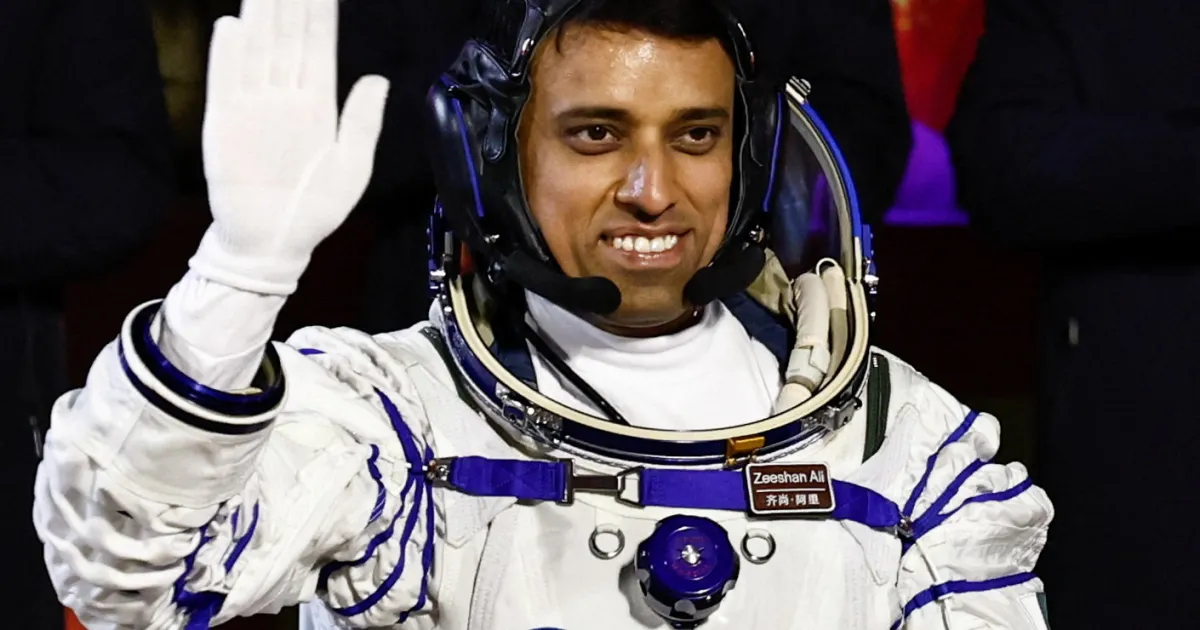
周三凌晨5时18分(格林威治标准时间0时18分),伊斯兰堡天未亮,寒气逼人。礼堂前方的大屏幕上,一枚中国火箭托着巴基斯坦首位宇航员穆罕默德·齐尚·阿里,在一柱橙色火焰中升空。
It was 5:18am (00:18 GMT) on Wednesday, before dawn in a chilly Islamabad. On the screen at the front of the auditorium, a Chinese rocket carrying Muhammad Zeeshan Ali, Pakistan’s first astronaut, rose on a column of orange flames.
随着火箭升空,巴基斯坦国歌响起。原本瘫在座位上的观众排排站起,跟着合唱。
As the rocket lifted off, Pakistan’s national anthem began. The audience, which had been slouching in their seats, rose row by row and sang along.
许多人掏出手机记录这一历史时刻,但扎伊娜布·阿巴西的目光始终紧盯着巨大的屏幕。
While many took out their phones to record the historic moment, Zainab Abbasi’s eyes remained fixed on the giant screen.
“我拿出手机想录像,但太投入当下了,竟忘了按录制键,就那样拿着合上的手机站着,”21岁的阿巴西告诉半岛电视台。
“I had my phone out to record it on video, but I was so caught up in the moment that I forgot to record, and I was just standing there with my phone closed,” Abbasi, 21, told Al Jazeera.
阿巴西是国家科技大学(NUST)物理与天文学专业二年级本科生,当时正和朋友们在巴基斯坦空间与高层大气研究委员会(SUPARCO)总部的礼堂里观看。
A second-year undergraduate student of physics and astronomy at the National University of Sciences and Technology (NUST), Abbasi was with her friends in the auditorium at the headquarters of the Pakistan Space & Upper Atmosphere Research Commission (SUPARCO).
随着火箭不断攀升,大厅爆发出掌声和“巴基斯坦万岁”的呐喊声。
As the rocket climbed higher, the hall erupted in applause and chants of “Pakistan Zindabad” (“Long live Pakistan”).
长征二号F运载火箭从中国西北部酒泉卫星发射中心发射升空,搭载中国宇航员唐洪波、吴毅,以及40岁的巴基斯坦空军飞行员阿里。
The Long March-2F rocket lifted off from the Jiuquan Satellite Launch Centre in northwest China, carrying Chinese astronauts Tang Hongbo and Wu Yi, alongside Ali, a 40-year-old Pakistan Air Force pilot.
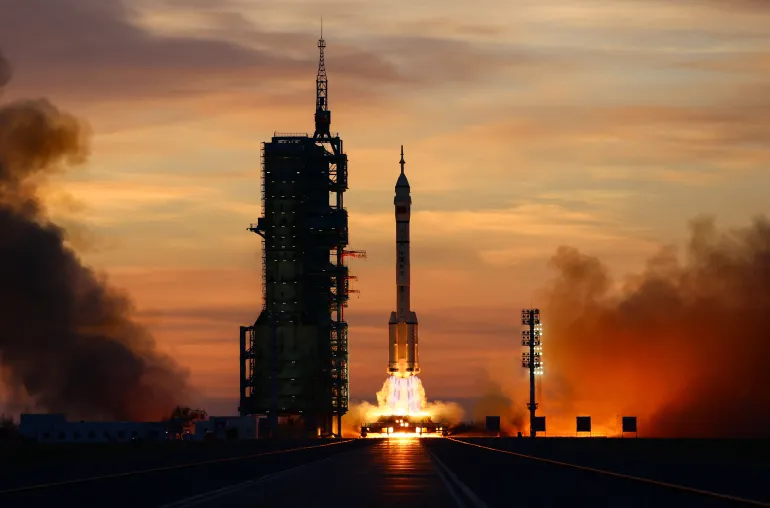
2026年11月25日,长征二号F遥24火箭搭载神舟二十四号飞船,载中国宇航员唐洪波、吴毅和巴基斯坦宇航员穆罕默德·齐尚·阿里,从甘肃酒泉卫星发射中心发射场升空,飞往中国“天宫”空间站 [Tingshu Wang/Reuters] 但发射两分钟内,大厅陷入死寂。无人说话。满场面孔紧绷。屏幕上,火箭已缩成一个小点。
A Long March 2F Y24 rocket carrying the Shenzhou-24 spacecraft with Chinese astronauts Tang Hongbo and Wu Yi, and Pakistani astronaut Muhammad Zeeshan Ali, blasts off to China’s Tiangong space station from the launchpad at the Jiuquan Satellite Launch Centre, near Jiuquan, Gansu province, China, on November 25, 2026 [Tingshu Wang/Reuters] But within two minutes of liftoff, the hall fell silent. No one spoke. Faces across the rows were tense. On the screen, the rocket had shrunk to a dot.
“我觉得大家都在期待,对我而言,还夹杂着一种潜在的焦虑,”阿巴西告诉半岛电视台。
“There was, I think, anticipation and also, for me specifically, a sort of, you know, underlying anxiety,” Abbasi told Al Jazeera.
1986年1月28日,美国“挑战者”号航天飞机在发射升空73秒后解体,机上七名机组成员全部遇难。
On January 28, 1986, the US space shuttle Challenger broke apart 73 seconds after liftoff, killing all seven crew members.
据中国载人航天工程办公室(CMSA)消息,周三发射约10分钟后,“神舟二十四号”飞船与火箭分离并进入轨道。
About 10 minutes after Wednesday’s launch, the Shenzhou-24 spacecraft separated from the rocket and entered orbit, according to the China Manned Space Agency (CMSA).
沉默持续了几分钟,直到其中一位主持人向观众祝贺发射成功。人们站起身来,互相问候或走向出口。
The silence lasted several minutes, until one of the hosts congratulated the audience on a successful launch. People got up, greeted one another or headed for the doors.
几小时后,中国载人航天工程办公室和巴基斯坦空间及高层大气研究委员会(SUPARCO)确认,飞船已于上午8时56分(格林威治标准时间03:56)对接中国“天宫”空间站。预计机组人员将于上午11时45分左右(格林威治标准时间06:45)进入空间站。
A few hours later, CMSA and SUPARCO confirmed that the spacecraft had docked at China’s Tiangong space station at 8:56am (03:56 GMT). The crew were expected to enter the station at about 11:45am (06:45 GMT).
黎明前的大厅 礼堂在上午5时(格林威治标准时间00:00)已座无虚席。找不到座位的人坐在地板上或站在墙边。
A hall before dawn The auditorium had been packed by 5am (00:00 GMT). Those unable to find a seat sat on the floor or stood along the walls.
巴基斯坦国家科技大学(NUST)数学专业大四学生泰亚巴·里亚兹说,她在凌晨4时20分左右(周二格林威治标准时间23:20)到达时,每个座位都已坐满。她原籍巴基斯坦西北部的奇特拉尔,住在大学宿舍。
Tayyaba Riaz, a final-year mathematics student at NUST, said every seat was taken when she arrived at about 4:20am (23:20 GMT Tuesday). Originally from Chitral in Pakistan’s northwest, she lives in a university hostel.
她说,当她向宿舍管理部门请求清晨外出时,对方问她要去哪里。“我当时就说,‘我要去见证历史,’”她咯咯笑着说。
When she asked hostel authorities to leave early in the morning, she said they asked where she was going. “I was like, ‘I am going to witness a history,’” she said, giggling.
礼堂里许多人手持印有阿里身穿宇航服肖像及“巴基斯坦首次载人航天任务”字样的光面卡片。巴基斯坦和中国的纸质小旗放在膝上,绿白相间的气球排列在舞台两侧。
Many in the auditorium held glossy cards bearing Ali’s portrait in a spacesuit and the words “Pakistan’s First Manned Space Mission”. Paper flags of Pakistan and China rested on laps, while green and white balloons lined the stage.
屏幕播放着发射的直播。在发射前夕,画面突然跳出YouTube界面,引发一阵轻微恐慌,担心会错过关键时刻,也引来一阵哄笑。“永远不会轮到我们”大二学生阿巴西从凌晨2时(周二格林威治标准时间21:00)起就在巴基斯坦空间及高层大气研究委员会。她家距此地40公里(25英里),周二下午7时(格林威治标准时间14:00)离家,在附近姑姑家过夜。
The screen carried a livestream of the launch. There was a brief moment of hilarity when, just before liftoff, a YouTube appeared, causing mild panic that the critical moment might be missed. ‘It will never be us’Abbasi, the second-year student, had been at SUPARCO since 2am (21:00 GMT Tuesday).
她是伊斯兰堡业余天文学家群体“巴基斯坦天文学家”(PakAstronomers)的成员。她对天文学的兴趣始于2018年前后,当时她13岁,一部名为《战斗陀螺》(Beyblade)的动画片让她了解到了星座。
She lives 40km (25 miles) away and had left home at 7pm (14:00 GMT) on Tuesday to spend the night at her aunt’s house nearby. She is a member of PakAstronomers, a group of amateur astronomers in Islamabad.
她说,家人一直支持她,尤其是她的父亲,尽管他们并不总是能理解她的热情。
Her interest in astronomy began around 2018, when she was 13, after the cartoon series Beyblade introduced her to constellations.
她说:“当我还是个孩子、对太空感兴趣时,成为一名宇航员感觉是一个遥不可及的梦想,只有美国的儿童才能实现,巴基斯坦的孩子不行。”
Her family, particularly her father, has always supported her, even if they do not always understand her passion, she said.
国立科技大学(NUST)物理系本科生、该学会副会长阿兹姆·法鲁克(Ahzam Farooq)过去常常在凌晨3点醒来观看火箭发射。
“When I was a child and interested in space, becoming an astronaut felt like a far-off dream only available to a child in America and not in Pakistan,” she said.
他说:“我的父母过去常问:‘这里面有什么?’好像我们永远不会轮到一样。”
Ahzam Farooq, a physics undergraduate at NUST and vice president of the society, used to wake at 3am to watch rocket launches.
阿丹·阿瑟(Adan Athar)是位于伊斯兰堡的空间技术研究所(IST)空间科学专业二年级学生,来自费萨尔巴德,也是费萨尔巴德天文学会的创始成员。她告诉半岛电视台,她是家里第一个对太空产生兴趣的人。
“My parents used to ask, ‘What is there in this?’ like it will never be us,” he said. Adan Athar, a second-year space sciences student at the Institute of Space Technology (IST) in Islamabad, is from Faisalabad and a founding member of the Faisalabad Astronomical Society.
她羞涩地笑着说:“是的,他们非常支持,而且他们觉得我会成为下一个宇航员。”
She told Al Jazeera she was the first in her family to take an interest in space.
五十年的观星历程 但不仅仅是巴基斯坦的年轻人关注着阿里(Ali)的太空之旅。
“Yes, they were very supportive, and they think I will be the next astronaut,” she said with a shy smile.
赛义夫-伊斯兰·库雷希(Saif-ul-Islam Qureshi)是一名72岁的电子工程师,他观测星空已有至少50年。
Fifty years of stargazing But it is not only Pakistan’s youth following Ali’s journey.
他告诉半岛电视台:“我12岁时开始用我的小双筒望远镜进行这一爱好,当时我的第一次观测目标是天上的北斗七星。”
Saif-ul-Islam Qureshi, a 72-year-old electronics engineer, has been watching the sky for at least 50 years.
北斗七星是由七颗明亮的恒星组成的星群,其中两颗末端恒星指向北极星。
“I was 12 years old when I started this hobby with my small binocular, and then my first observation was the Big Dipper in the sky,” he told Al Jazeera.
库雷希协助创立了阿巴西(Abbasi)所在的“巴基斯坦天文学家”组织。它最初被称为巴基斯坦天文学会。
The Big Dipper is a group of seven bright stars whose two end stars point towards the North Star. Qureshi helped found PakAstronomers, the group Abbasi belongs to.
该组织的成员将天文学带到了学校、学院、大学和公共公园。他说,许多人过去并不知道用肉眼就能看到行星。
It was initially called the Pakistan Astronomy Society. Its members took astronomy to schools, colleges, universities and public parks.
然而,在过去十年里,情况发生了变化。现在,就连小孩子也见多识广。
Many people did not know planets could be seen with the naked eye, he said. Over the past decade, however, that had changed.
“我们当时感觉到一场风暴正在酝酿。一场风暴正在酝酿,而且是一场积极意义上的风暴,”他说。
Even small children were now well informed.
2026年11月25日,在巴基斯坦伊斯兰堡的巴基斯坦空间与外大气层研究委员会(SUPARCO)总部,人们观看一块屏幕,上面显示巴基斯坦宇航员穆罕默德·泽ishan·阿里以及飞往中国天宫空间站的神舟二十四号载人飞行任务的发射画面[路透社] 接下来是什么?
“We were sensing that a storm was building. A storm is building, and a storm in a positive sense,” he said.
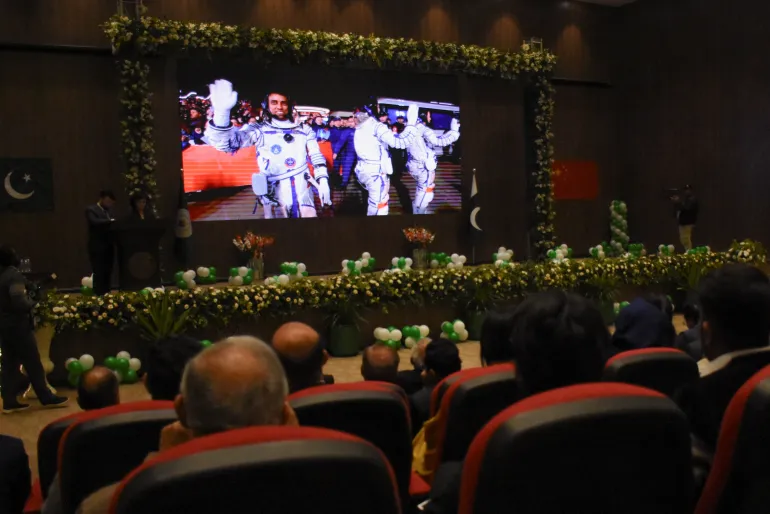
在发射前的一场讲话中,巴基斯坦空间与外大气层研究委员会主席穆罕默德·优素福·汗表示,巴基斯坦正将目光投向更远的未来。
People watch a screen displaying Pakistani astronaut Muhammad Zeeshan Ali, showing the launch of the Shenzhou-24 spacecraft mission to China’s Tiangong space station, at the Pakistan Space & Upper Atmosphere Research Commission (SUPARCO) headquarters in Islamabad, Pakistan, on November 25, 2026 [Reuters] What comes next?
“我们的雄心不止于这次发射。我们的承诺是在2035年之前登月,”他说。
In a speech before the launch, SUPARCO chairman Muhammad Yousaf Khan said Pakistan was setting its sights further ahead.
此后接受半岛电视台采访时,汗表示,第一步将是于2028年飞行的月球车。
“Our ambition is beyond just this launch. Our commitment is to reach the moon by 2035,” he said.
汗对半岛电视台表示:“既然中国人民已经到达了这里,我们也没有任何欠缺。我相信,只要我们一步一个脚印地前进,总有一天我们也会达到那个阶段。”
Speaking to Al Jazeera afterwards, Khan said the first step would be a lunar rover, due to fly in 2028.
就读于巴基斯坦国立科技大学(NUST)的物理系本科生法鲁克表示,与中国的合作可以帮助巴基斯坦避免从零开始构建其太空能力。
“If the Chinese people have reached here, there is no shortcoming in us. I believe one day, we too will reach that stage, if we keep moving step by step,” Khan told Al Jazeera.
他对半岛电视台表示:“如果我们有这种合作,我认为很好的一点是,我们可以使用中国已经建成的平台,并利用它们去做更进一步的事情。通过制造我们自己的卫星,并通过我们自己的宇航员,我们可以走向更进一步的研究。”
Farooq, the NUST physics undergraduate, said collaboration with China could help Pakistan avoid having to build its space capabilities from scratch.
对资深天文学家库雷希而言,对未来的这种兴奋在阿里升空时达到了高潮。他说,那一刻的意义远不止于阿里本人。
“If we have this collaboration, I think it’s good that we can use the already built-up platforms of China and utilise them to do something further. By making our own satellites, and through our own astronauts, we can go towards some further research,” he told Al Jazeera. For Qureishi, the veteran astronomer, that excitement for the future climaxed when Ali took off.
“坐在宇航员座位上的不是泽ishan,”他说。“坐在那里的巴基斯坦的年轻一代。”
That moment, he said, was about much more than Ali. “It is not Zeeshan [in the astronaut’s seat]. It is Pakistan’s young generation sitting there,” he said.