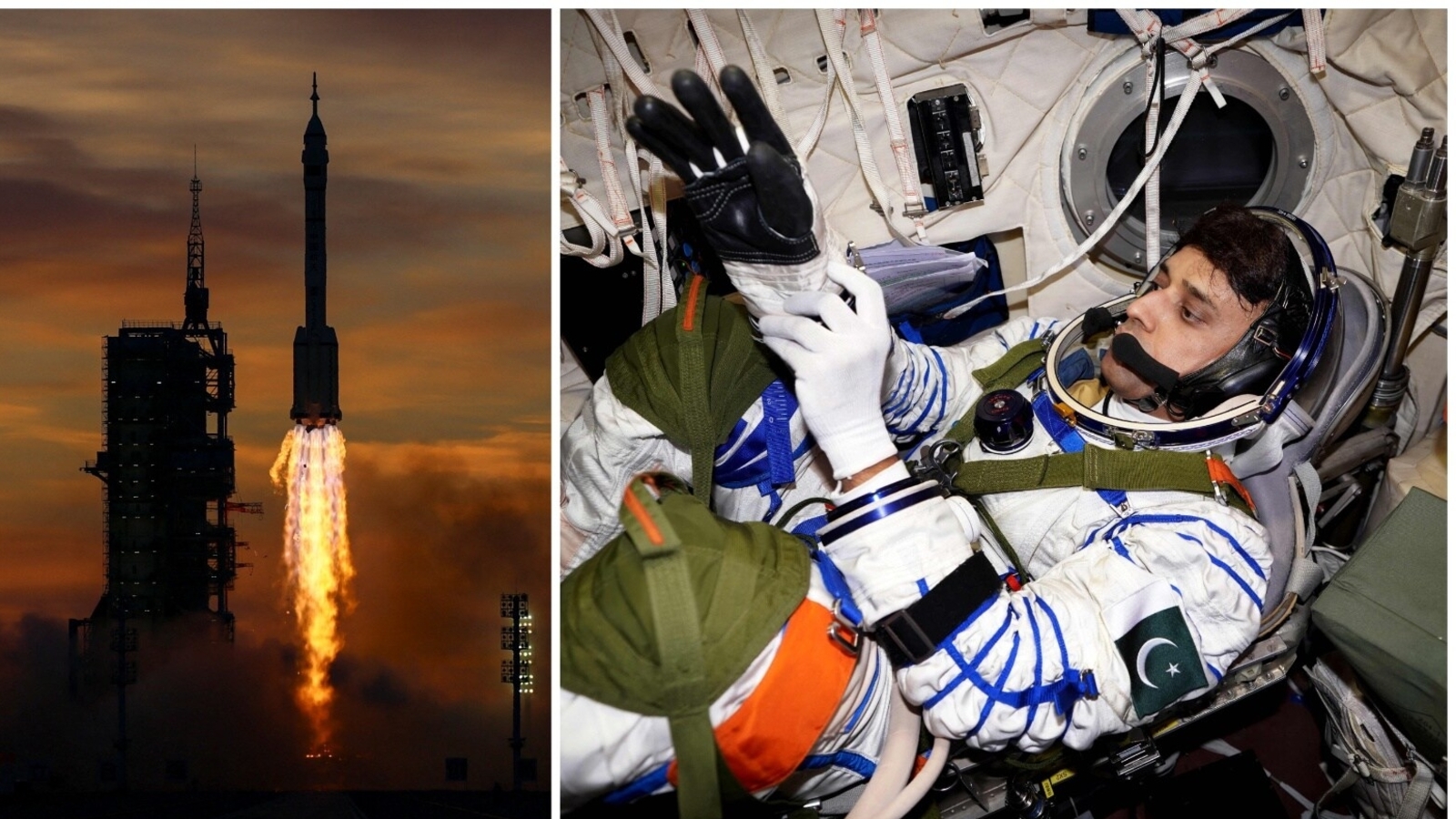
中国周三发射了三名宇航员进入太空,作为其神舟二十四号飞往“天宫”空间站任务的一部分。据中国媒体报道,三人机组成员包括航天员唐洪波、吴怡和巴基斯坦宇航员穆罕默德·齐尚·阿里。这是外国宇航员首次乘坐中国载人飞船飞行。
据法新社援引官方央视报道,搭载机组人员的长征二号F运载火箭于当地时间上午8时18分从中国西北部戈壁沙漠的酒泉卫星发射中心发射升空。
China launched three astronauts into space on Wednesday as part of its Shenzhou-24 mission to the Tiangong space station. The three-member crew comprises spacecraft pilot Tang Hongbo, flight engineer Wu Yi and Pakistani astronaut Muhammad Zeeshan Ali, as per Chinese media. It is the first time a foreign astronaut has travelled aboard a Chinese crewed spacecraft.A Long March 2F rocket carrying the crew lifted off from the Jiuquan Satellite Launch Centre in the country's northwestern Gobi Desert at 8:18am local time, AFP reported citing state broadcaster CCTV.
他们将前往“天宫”空间站,作为中国正在进行的载人航天计划的一部分,开展科学实验和其他活动。什么是神舟二十四号任务中国最新的载人航天任务神舟二十四号的主要目标是将宇航员送往“天宫”空间站,在那里他们将进行科学研究和其他活动。
They will travel to the Tiangong space station to conduct scientific experiments and other activities as part of China's ongoing human spaceflight programme. What is the Shenzhou-24 missionChina's latest crewed spaceflight mission, Shenzhou-24's main objective is to take astronauts to the Tiangong space station, where they carry out scientific research and other activities.
该任务是中国运营和维护其空间站持续努力的一部分。据中国载人航天工程办公室(CMSA)称,该任务包括约90项科学实验和技术试验。这些涵盖空间生物学、医学、材料科学和物理学等领域。关于长征二号F运载火箭长征二号F运载火箭,也称为长征二号F或CZ-2F,属于中国长征系列运载火箭,据美国联邦航空管理局称,该系列火箭已用于卫星发射、空间站任务和载人航天。它目前是中国唯一一款现役的设计用于载人的运载火箭。
The mission is part of China's ongoing efforts to operate and maintain its space station. According to the China Manned Space Agency (CMSA), the mission includes around 90 scientific experiments and technology tests. These cover areas such as space biology, medicine, materials science and physics. About the Long March 2F rocketThe Long March 2F, also known as Chang Zheng 2F or CZ-2F, belongs to China's Long March family of launch vehicles, which has been used for satellite launches, space station missions and human spaceflight, as per the Federal Aviation Administration. It is currently China's only active launch vehicle designed to carry humans.
该火箭由中国运载火箭技术研究院(CALT)研发,后者是中国航天科技集团(CASC)旗下的主要航天机构。
据中国载人航天工程办公室称,长征二号F运载火箭的研发始于1992年。
The rocket was developed by the China Academy of Launch Vehicle Technology (CALT), a major aerospace organisation under the China Aerospace Science and Technology Corporation (CASC).According to the China Manned Space Engineering Office, development of the Long March 2F began in 1992.
它于1999年11月20日完成了首次成功飞行。“长征”这个名字指的是中国共产党军队在1934年至1935年间进行的历史性长征,行程数千公里横跨中国,据媒体CGTN报道。中国用这个名字命名其系列空间发射运载火箭。长征二号F火箭规格长征二号F是一枚两级火箭,其主体连接四个液体燃料助推器。其设计使其能产生将载人飞船送入近地轨道所需的推力。
It completed its first successful flight on November 20, 1999. The name 'Long March' refers to the historic Long March undertaken by Chinese Communist forces between 1934 and 1935, covering thousands of kilometres across China, as per outlet CGTN. China uses the name for its family of space launch vehicles. Specifications of the Long March 2FThe Long March 2F is a two-stage rocket with four liquid-fuel boosters attached to its main body. Its design allows it to generate the thrust needed to lift a crewed spacecraft into low Earth orbit.
首次发射:1999年11月20日高度:58.34米(约191英尺)助推器数量:4个芯级直径:3.35米(约11英尺)起飞推力:约600吨力有效载荷能力:向近地轨道运送超过8100公斤(8.1吨)发射场:中国酒泉卫星发射中心主要用途:将宇航员和载人飞船送入轨道安全特性:发射逃逸系统空间飞行如何运作第一级和助推器:根据美国联邦航空管理局(FAA)的信息,火箭的第一级连接四个助推器。
First launch: November 20, 1999Height: 58.34 metres (around 191 feet)Number of boosters: 4Core diameter: 3.35 metres (around 11 feet)Liftoff thrust: Around 600 tonnes-forcePayload capacity: More than 8,100 kg (8.1 tonnes) to low Earth orbitLaunch site: Jiuquan Satellite Launch Centre, ChinaMain purpose: Launching astronauts and crewed spacecraft into orbitSafety feature: The launch escape systemHow the spaceflight worksFirst stage and boosters: The rocket has four boosters attached to its first stage, according to the FAA.
两者均使用YF-20B发动机,由两种液体燃料驱动:偏二甲肼(UDMH)和四氧化二氮。它们提供将火箭从地面托起所需的推力。
Both use YF-20B engines powered by two liquid fuels: unsymmetrical dimethylhydrazine (UDMH) and dinitrogen tetroxide. They provide the thrust needed to lift the rocket off the ground.
第二级:助推器和第一级分离后,第二级接管任务。它使用YF-24B发动机使火箭加速并将飞船送入轨道。
Second stage: After the boosters and first stage separate, the second stage takes over. It uses a YF-24B engine to accelerate the rocket and place the spacecraft into orbit.
飞船分离:火箭到达预定轨道后,神舟飞船与其分离,继续飞往中国的“天宫”空间站。长征二号F的安全特性发射逃逸系统:火箭在神舟飞船上方装配了应急逃逸塔。
Spacecraft separation: Once the rocket reaches the required orbit, the Shenzhou spacecraft separates from it and continues its journey towards China's Tiangong space station. Safety features in the Long March 2FLaunch escape system: The rocket has an emergency escape tower fitted above the Shenzhou spacecraft.
它利用强大的发动机在发射过程中发生问题时将乘员舱从火箭上拉离。紧急乘员防护:逃逸系统允许宇航员在发射紧急情况下远离火箭,并在乘员舱内安全返回地球。监测系统:火箭配备机载系统,可在飞行期间监测其性能并探测技术问题。逃逸塔分离:逃逸塔在发射后约两分钟抛弃,此时已不再需要。长征二号F火箭的历史长征二号F火箭于1999年11月20日首飞,搭载无人飞船神舟一号。该任务帮助中国测试飞船并为未来的载人航天任务做准备。
It uses powerful motors to pull the crew capsule away from the rocket if a problem occurs during launch. Emergency crew protection: The escape system allows astronauts to move away from the rocket and return safely to Earth inside the capsule in case of a launch emergency. Monitoring systems: The rocket has onboard systems to monitor its performance and detect technical problems during flight. Escape tower separation: The escape tower is jettisoned about two minutes after liftoff, once it is no longer needed. History of the Long March 2F rocketThe Long March 2F made its first flight on November 20, 1999, carrying the uncrewed Shenzhou-1 spacecraft. The mission helped China test its spacecraft and prepare for future human spaceflight missions.A major milestone came in October 2003, when the rocket launched Shenzhou-5 carrying astronaut Yang Liwei.
一个重大里程碑出现在2003年10月,当时该火箭发射神舟五号,搭载宇航员杨利伟。他成为首位进入太空的中国公民。通过这次任务,中国成为继俄罗斯和美国之后,第三个独立将人类送入太空的国家。
He became the first Chinese citizen to travel into space. With this mission, China became the third country, after the Russia and the US, to independently send a human into space.
该火箭持续支持中国的载人航天计划,包括前往其实验性空间实验室的任务。2021年,它发射神舟十二号,将首批乘组送往中国天宫空间站。同年晚些时候,它还发射了神舟十三号,其乘组在空间站驻留了六个月。
The rocket continued to support China's crewed space programme, including missions to its experimental space laboratories. In 2021, it launched Shenzhou-12, carrying the first crew to China's Tiangong space station. Later that year, it also launched Shenzhou-13, whose crew spent six months aboard the station.