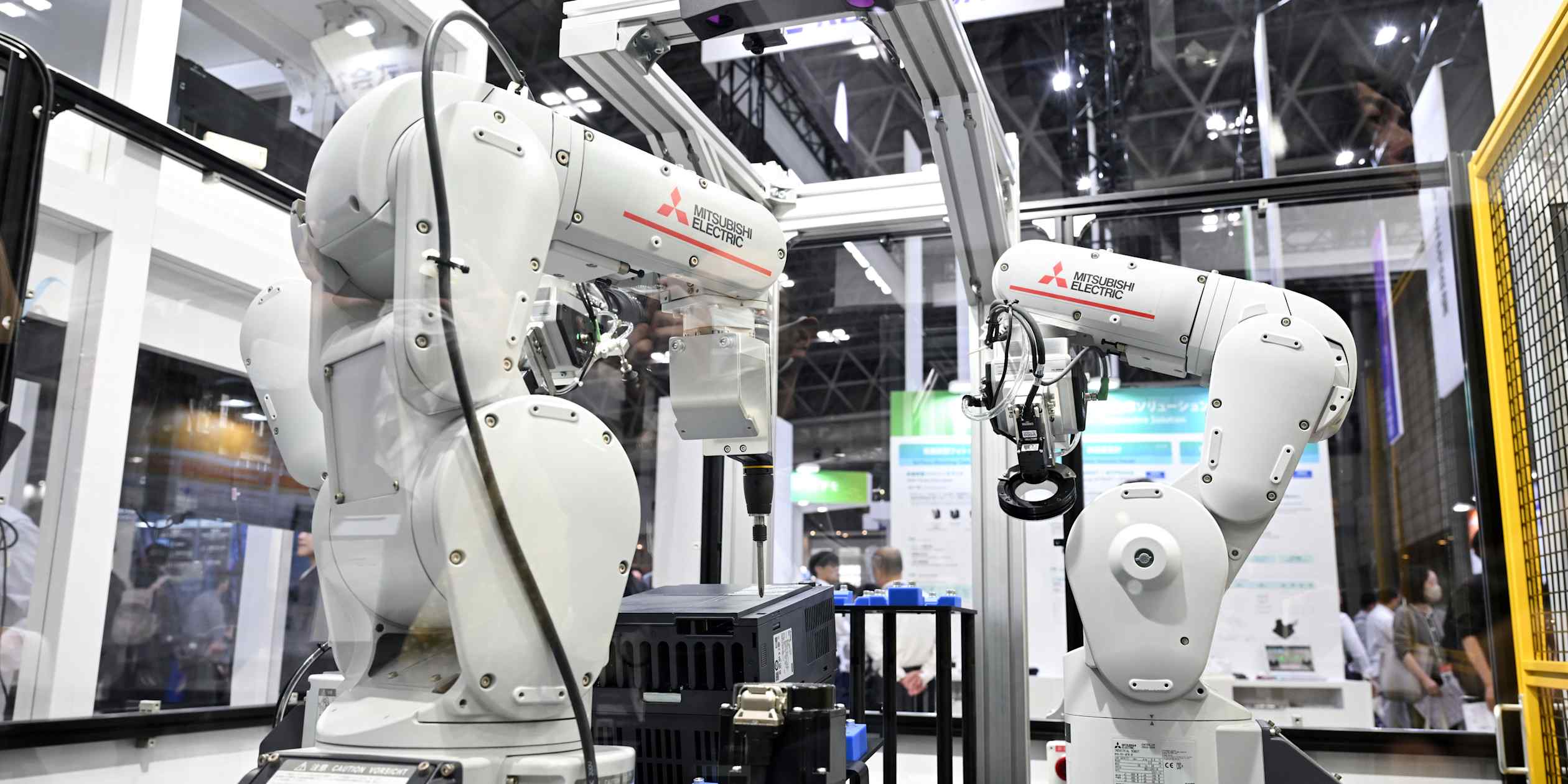
日本千叶 -- 随着特斯拉开始其第三代 Optimus 人形机器人的早期量产,以及中国在深圳举行的 APEC 领导人会议上展示机器人舞者和服务员,日本正在采取一种不那么花哨的方式来发展“物理 AI”。日本工程师表示,专注于工业领域,人形机器人预计将在未来几年内进入工厂车间,但不太可能成为制造业的主力军。工厂仍将主要依赖那些不那么光鲜的专用机器,它们负责封装芯片、将元件拧装到电路板上,以及成型智能手机外壳、汽车保险杠和仪表盘。
CHIBA, Japan -- As Tesla begins early-stage mass production of its third-generation Optimus humanoid robot and China treats attendees to robot dancers and waiters at the APEC gathering of world leaders in Shenzhen, Japan has been taking a less flashy approach to "physical AI." Focused on industry, Japanese engineers say humanoids are expected to reach factory floors within the next few years, but are unlikely to become the workhorses of manufacturing. Factories will still rely largely on less glamorous specialized machines that mold chip packages, screw components onto circuit boards and shape smartphone casings, automotive bumpers and dashboards.
三菱电机、日立、发那科、DMG 森精机和欧姆龙等日本产业技术公司,正专注于将人工智能融入现有设备,帮助制造商应对劳动力短缺、传承熟练工人的技能并提升产能。
Japanese industrial technology companies, such as Mitsubishi Electric, Hitachi, Fanuc, DMG Mori and Omron, are concentrating on incorporating artificial intelligence into existing equipment, helping manufacturers cope with labor shortages, pass on skills from experienced workers and boost production capacity.
人形机器人可能在仍由人工处理的非标准化任务中发挥作用,例如在金属工件被加工成涡轮叶片之前,对其进行装载和定位。但配备传感器和领域专用 AI 的专用机器,更适合那些需要微米级精度的制造工艺。
Humanoids could prove useful for irregular tasks still handled by people, such as loading and positioning a metal workpiece before it is machined into a turbine blade. But specialized machines with sensors and domain-specific AI are better suited to manufacturing processes that require micron-level precision.
“传统机器人擅长以高精度重复执行预定义任务,而人形机器人预计将更像人类一样移动和反应,并适应不断变化的环境,”投资银行 Houlihan Lokey 的董事总经理 Shin Murai 表示,他在 10 月担任了机器人制造商欧姆龙收购美国 OnLogic 的首席顾问。
"Conventional robots excel at repeatedly performing predefined tasks with high precision, while humanoids are expected to move and respond more like humans and adapt to changing circumstances," said Shin Murai, managing director at investment bank Houlihan Lokey, who was lead adviser for robot maker Omron's acquisition of OnLogic of the U.S. in October.
人工智能还被用于分析传感器数据以及设计和工程文档,使机器能够调整其运行方式和生产内容。对制造商而言,这意味着将海量工厂数据投入使用,涵盖车间和工人的图像、电压电流变化,以及设计规格、接线图和过往故障记录。
Artificial intelligence is also used to analyze sensor data and design and engineering documents, allowing machines to adjust how they operate and what they produce. For manufacturers, that means putting enormous volumes of factory data to use, from images of factory floors and workers as well as changes in electrical voltage and current to design specifications, wiring diagrams and records of past failures.
通过人工智能整合这些异构数据,可优化生产、预判设备故障并追溯缺陷成因。最终,企业设想实现工厂运行对人工干预的依赖大幅降低。
Bringing such disparate data together through AI could optimize production, anticipate equipment failures and trace the causes of defects. Ultimately, companies envision factories that operate with far less human intervention.
“数据至关重要。输入错误数据,得到的将是错误的人工智能,”工业软件商Aveva Japan的一名工程师表示。
"Data are critical. Feed wrong data, and you'll end up with wrong AI," said an engineer at Aveva Japan, an industrial software maker.
“不同功能需要不同类型的机器人,”日立数字系统与服务部门首席技术官森正胜补充道。他还指出,拥有数十年制造专长的不止日本,“西门子和施耐德也拥有丰富的工厂运营数据。我们都在争夺人工智能工厂的领导地位。”
"Different types of robots will be required for different types of functions," added Masakatsu Mori, chief technology officer at Hitachi's digital systems and services division. Japan was not alone in having decades of manufacturing expertise, he added. "Siemens and Schneider also have rich factory operation data. We are all jostling for leadership" on AI factories, he said.
半导体热潮有助于解释为何日本制造商专注于从专用设备中榨取更多产能,而非等待通用型机器人来满足激增的需求。
The semiconductor boom helps explain why Japanese manufacturers are focused on squeezing more productivity from specialized equipment rather than waiting for general-purpose robots to meet surging demand.
“以前客户要求的是能封装10颗芯片的模具,现在要求的是能封装50颗的,”三菱电机产业机电企划部副部长武田哲弘说。“随着芯片产量增加,对生产效率的需求也在增加。”武田回忆,工厂机器的订单曾遵循大约四年的繁荣-萧条周期,这在一定程度上是由智能手机和平板电脑等消费电子产品的需求驱动的。如今,需求已扩大到更广泛的设备,从智能手表、无线耳机到智能眼镜,而AI热潮则增加了对半导体制造设备的需求。
"Instead of a mold that packages 10 chips, we are being asked for one capable of packaging 50," said Tetsuhiro Takeda, deputy head of Mitsubishi Electric's industrial mechatronics planning department. "As chip production grows, so does the need for productivity." Orders for machines in factories once followed a roughly four-year boom-and-bust cycle, driven partly by demand for consumer electronics such as smartphones and tablets, Takeda recalled. Today, demand has broadened to a wider range of devices, from smartwatches and wireless earphones to smart glasses, while the AI boom is adding demand for semiconductor manufacturing equipment.
“很难预测当前周期何时结束,但看起来不会很快结束,”他说。6月,日本机床工业会将今年订单金额预测从1.7万亿日元上调至2万亿日元(约合126亿美元)。
"It is hard to predict when the current cycle will end, but it doesn't look like it will be anytime soon," he said. In June, the Japan Machine Tool Builders' Association revised up its forecast for this year's order value to 2 trillion yen ($12.6 billion) from 1.7 trillion yen.
中国在专用机器人领域也出现快速增长。根据加德纳世界机床调查,2025年中国以308亿美元销售额成为最大机床生产国,其次是德国的103亿美元和日本的87亿美元。在中国本土工厂自动化领军企业中,深圳的汇川技术生产伺服电机、变频器和机械臂。
China is also seeing rapid growth in specialized robots. According to Gardner World Machine Tool Survey, China was the biggest machine tool producer with $30.8 billion in sales in 2025, followed by Germany with $10.3 billion and Japan with $8.7 billion. Among China's homegrown champions in factory automation is Inovance, a Shenzhen-based maker of servo motors, inverters and robot arms.
“日本机器人制造商在中 国市场竞争变得困难,”Houlihan Lokey的村井说。
"It has become difficult for Japanese robot makers to compete in the Chinese market," said Houlihan Lokey's Murai.
在其他方面,公司们一直在通过收购来强化组建AI工厂所需的各种要素。
Elsewhere, companies have been on the acquisition trail to bulk up on the different elements needed to put together an AI factory.
欧姆龙10月以6.75亿美元收购OnLogic便是一例。作为传感器和机械控制器制造商,欧姆龙将把其产品与OnLogic的工业计算机结合,使工厂数据能在现场实时分析,以优化生产并检测潜在问题。
Omron's $675 million acquisition of OnLogic in October is a case in point. Omron, a maker of sensors and machinery controllers, will combine its products with OnLogic's industrial computers, allowing factory data to be analyzed on site in real time to optimize production and detect potential problems.
10月13日,在东京CEATEC电子展上,一台机器人在日立展台演示接线作业。
A robot demonstrates wiring work at Hitachi's booth at the CEATEC electronics show in Tokyo on Oct. 13.
法国工厂自动化制造商施耐德电气是另一家积极进军软件和数据层面的制造商,该公司于2023年将英国工程软件制造商 Aveva 转为全资子公司。施耐德电气还于2026年6月宣布收购挪威工业数据平台 Cognite。
Schneider Electric, a French factory automation maker, is another manufacturer moving aggressively into the software and data layers, having turned U.K. engineering software maker Aveva into a wholly-owned subsidiary in 2023. It also announced the acquisition of Cognite, a Norwegian industrial data platform, in June 2026.
Aveva 工程师表示,让整个工厂实现全自动化仍是一个遥远的愿景。工厂首先需要传感器、物联网芯片和连接功能,以持续监控和远程控制运营。随后,AI 可以分析多年的运营数据,识别模式并找到提高效率的方法。Aveva 的 PI 系统收集、存储和分析来自工业设备的数据,而其 Connect 平台则允许这些数据在工厂间共享并利用 AI 进行分析。
Making an entire plant fully automatic is still a distant vision, Aveva engineers say. Plants first need sensors and Internet of Things (IoT) chips and connectivity to continuously monitor and remotely control operations. AI can then analyze years of operating data to identify patterns and find ways to improve efficiency. Aveva's PI System collects, stores and analyzes data from industrial equipment, while its Connect platform allows that data to be shared across plants and analyzed using AI.
日立计划实现其整个供应链的自动化,将大型零售商与仓库和工厂连接起来,以便 AI 能根据需求变化(例如某家门店销量突然激增)调整生产和配送。
Hitachi plans to automate its entire supply chain, linking large retailers with warehouses and factories so AI can adjust production and distribution in response to demand changes, such as a sudden sales spike at a particular store.
与此同时,公司正在开发 AI,使机器人能够处理布线作业,这是一项仍难以自动化的任务。柔性电缆在被拾取时会改变形状,导致机器人难以识别和操作。例如在汽车装配中,人工工人仍负责安装线束。日立目前正在其位于东京东北方向的水户工厂,通过电梯生产测试这项技术。
At the same time, the company is developing AI to enable robots to handle wiring work, a task that remains difficult to automate. Flexible cables change shape as they are picked up, making them difficult for robots to recognize and handle. In automotive assembly, for example, human workers still install wire harnesses. Hitachi is now testing the technology in elevator production at its Mito Works, northeast of Tokyo.
9月,日立宣布与机器人制造商发那科建立合作伙伴关系,作为其打造自主工厂愿景的一部分。双方计划开发 AI 引导的机器人拾取机械臂,并计划于2027财年销售。
In September, Hitachi announced a partnership with robot maker Fanuc as part of its vision to create an autonomous factory. The companies plan to develop AI-guided robotic picking arms for sale in fiscal 2027.
与此同时,三菱电机已与德国设计软件公司 Navvis 合作开发了 GeoClover,这是一款能够创建工厂 3D 数字孪生的软件。它将工厂的 3D 地图与设备性能数据、操作诀窍以及过往故障记录相结合,帮助操作人员识别瓶颈、制定生产计划并提高效率。
Mitsubishi Electric, meanwhile, has partnered with German design software company Navvis to develop GeoClover, software that creates a 3D digital replica of a factory. It combines a 3D map of the plant with data on equipment performance, operational know-how, and records of past problems, helping operators identify bottlenecks, devise production plans and improve efficiency.
GeoClover 已在该公司位于名古屋附近尾张旭市的产业机器人工厂投入使用。武田指出,三菱电机在工厂自动化领域已深耕数十年。
GeoClover is already in use at the company's industrial robot factory in Owariasahi, near Nagoya. Takeda noted that Mitsubishi Electric has been in the factory automation business for decades.
“我们克服了许多挑战,”他说。“我们学会了如何调整生产、应对故障。这些知识已融入我们的 AI 之中。”
"We've overcome many challenges," he said. "We've learned how to adjust production and deal with glitches. That knowledge is incorporated into our AI."