分析人士表示,由于亚洲经济体与中国有着深厚的经济联系,这使得它们满足美国要求的努力变得复杂,而现有的贸易协定可能只能提供有限的保护,因此这些经济体在应对华盛顿最新关税措施时可能会面临困难。
Asian economies could face difficulties responding to Washington’s latest tariff measures as their deep economic ties with China complicate efforts to meet US demands, while existing trade agreements may offer limited protection, analysts said.
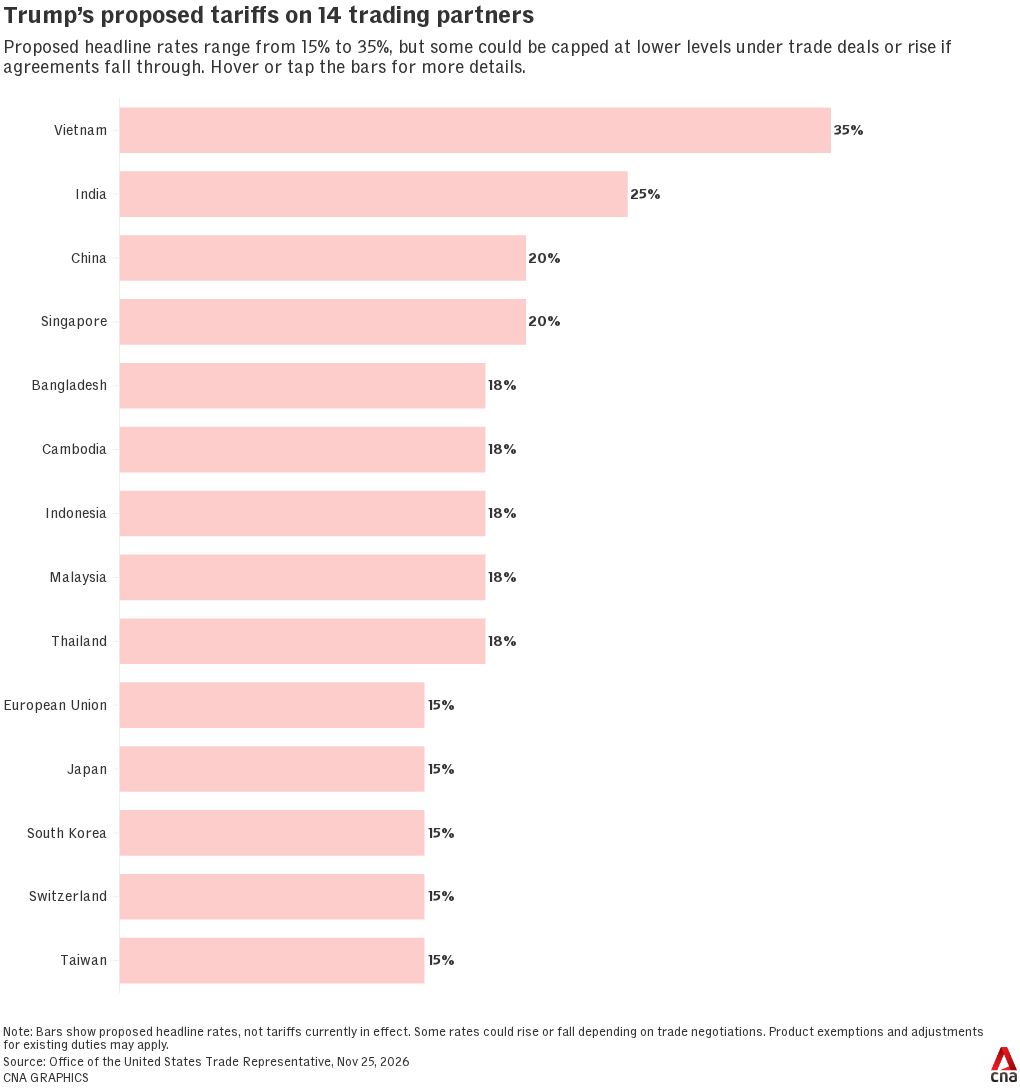
美国已提议对主要位于亚洲的14个经济体征收新关税,理由是它们涉嫌存在过剩的工业产能和不公平贸易做法。如果某些国家与华盛顿达成贸易协定,则可能面临较低的税率。
The United States has proposed new tariffs on 14 economies mostly in Asia, over alleged excess industrial capacity and unfair trade practices. Some countries could face lower rates if they conclude trade agreements with Washington.
例如,如果谈判失败,越南可能面临35%的关税,而如果达成协议,关税则为20%。
Vietnam, for instance, could face a tariff of 35 per cent if negotiations fail, compared with 20 per cent if a deal is reached.
阿德莱德大学国际贸易研究所高级研究员南森·格雷表示,华盛顿似乎旨在减少这些国家与中国的经济接触,而不是单纯鼓励它们提振国内消费。
Washington appears to be seeking to reduce these countries’ economic engagement with China, rather than simply encouraging them to boost domestic consumption, said Nathan Gray, senior research fellow at the University of Adelaide’s Institute for International Trade.
格雷周五(11月27日)对亚洲新闻台的《亚洲现在》栏目表示:“对美国而言,当你阅读这些报告时,他们推动的主要政策驱动力可能是与中国脱钩。”
“For the US, probably the main policy driver that they're pushing for when you read through these reports is disengaging with China,” Gray told CNA’s Asia Now on Friday (Nov 27).
“这对东南亚的大多数国家构成了一系列风险。风险在于,你惹恼了中国,而中国现在是世界上大多数国家的最大贸易伙伴。”这使得亚洲各国政府在满足华盛顿的要求与维持同北京的经济关系之间,面临着艰难的权衡。
“That poses a series of risks for most of the countries within Southeast Asia. The risks being that you upset China, which for most countries in the world is now their largest trading partner.”This leaves Asian governments facing difficult trade-offs between meeting Washington’s demands and maintaining their economic relationships with Beijing.
格雷补充说:“这就从政策角度提出了一个非常严重的问题:你实际上能做些什么。”
“It raises very serious questions on what you can actually do from a policy perspective,” Gray added.
他指出,华盛顿与一些东南亚国家联盟成员国达成的主动贸易协议,主要目的在于减少它们对中国零部件和机械的依赖,以及减少来自中国的投资。
He pointed out that reciprocal trade deals reached between Washington and some Association of Southeast Asian Nations (ASEAN) countries were largely aimed at reducing their reliance on Chinese components and machinery, as well as investment from China.
他说:“亚洲国家实际上没有机会切断这一联系。世界上大多数国家都没有这种能力。”来自贸易协定的保护有限与此同时,昆士兰科技大学法学院教授菲利西蒂·迪恩对亚洲新闻台的《亚洲现在》栏目表示,现有的自由贸易协定在应对华盛顿的关税措施时,可能只能提供有限的实际保护。
“Countries within Asia do not really have the opportunity to cut that off. Most countries in the world don't have the ability to do that,” he said. LIMITED PROTECTION FROM TRADE AGREEMENTS Meanwhile, existing free trade agreements may offer limited practical protection against Washington’s tariff measures, Felicity Deane, a professor at Queensland University of Technology’s School of Law, told CNA’s Asia Now.
在被问及新加坡与美国的自由贸易协定时,她表示:“答案是,在特朗普政府面前,似乎不存在任何类型的保护。”迪恩以澳大利亚的经历为例指出,澳大利亚与华盛顿之间的自由贸易协定并未能阻止针对澳大利亚产品的关税。
Asked about Singapore’s free trade agreement with the US, she said: “The answer is (there) doesn't appear to be any type of protection when it comes to the Trump administration.”Deane pointed to Australia’s experience, noting that its free trade agreement with Washington had not prevented tariffs on Australian products.
迪恩还指出,华盛顿的关切不仅限于中国,特朗普政府旨在应对来自多个经济体更廉价制成品竞争,作为其重建国内制造业更广泛努力的一部分。她说:“我认为它同样在针对所有这些经济体。”前方面临艰难抉择亚洲经济体在解决美国对国内储蓄和消费模式的关切时,也可能会遇到困难。
Deane also suggested that Washington's concerns extended beyond China, with the Trump administration seeking to address competition from cheaper manufactured goods across multiple economies as part of its broader push to rebuild domestic manufacturing. “I think it's equally targeting all of these economies,” she said. DIFFICULT DECISIONS AHEAD Asian economies may also struggle to address US’ concerns over domestic savings and consumption patterns.
在被问及新加坡的中央公积金和马来西亚雇员公积金是否通过鼓励储蓄而非消费而导致了结构性产能过剩时,格雷表示:“可能没有。”他指出,虽然美国经济主要由消费支出驱动,但许多东亚经济体具有更浓厚的储蓄文化。
Asked whether Singapore’s Central Provident Fund (CPF) and Malaysia’s Employees Provident Fund (EPF) contributed to structural excess capacity by encouraging savings over consumption, Gray said: “Probably not.”He noted that while the US economy is largely driven by consumer spending many East Asian economies have a stronger savings culture.
格雷说:“有一些文化因素推动了这种对储蓄而非支出的关注。”他补充说,政府改变这些模式的能力有限。
“There's some cultural factors that drive that savings focus rather than spending,” Gray said, adding that governments had limited ability to change these patterns.
格雷还质疑美国的相关调查是否在已确定的政策与结构性产能过剩之间建立起了清晰的因果关系。
Gray also questioned whether the US investigations had established a clear cause-and-effect relationship between the policies identified and structural excess capacity.
迪恩表示,除了改变国内政策之外,受影响的经济体还面临着是否对华盛顿提议的关税提出质疑的不确定性,鉴于美国贸易政策的频繁变化。她说:“问题在于,开始提出质疑是否符合所有人的时间成本。”
Beyond changing domestic policies, affected economies also face uncertainty over whether to challenge Washington’s proposed tariffs, given the frequent shifts in US trade policy, Deane said. “The question is whether it's worth everybody's time to start challenging things,” she said.
她补充说,这种不确定性使得企业,特别是小企业,越来越难以提前做好规划。
The uncertainty has made it increasingly difficult for businesses, particularly smaller companies, to plan ahead, she added.
她说:“我唯一的建议可能是拭目以待,因为在过去两年里,我们已经看到了许多退让,看到了许多政策的出台与废止。”“我们未来可能还会看到更多这样的变化。”
“My only advice would be to potentially wait and see, because we have seen a lot of pullbacks, we've seen a lot of changes that have come in and out in the last two years,” she said. “We’re potentially going to see more.”