过去三年来,自10月7日攻击发生以来和以色列对加沙发动种族灭绝战争以来,更广阔的地区一直处于冲突、经济动荡和权力平衡崩溃的状态。
In the past three years, following the October 7 attacks and the start of Israel’s genocidal war on Gaza, the wider region has been marked by conflict, economic turmoil, and a shattering of the balance of power.
伊朗长期以来维持的地区权力基础——联盟网络遭受了沉重打击并严重削弱。也门胡塞叛军是值得注意的例外。
The network of alliances maintained by Iran, long central to its regional power, has been hit hard and severely weakened. Yemen’s Houthi rebels remain one notable exception.
以色列取得了进展。许多黎巴南真主党和巴勒斯坦哈马斯的领导人被杀,而伊朗最高领袖阿亚图拉阿里·哈梅内伊也在2月份遇刺身亡。以色列占领了加沙大部分地区,在那里它也已杀害超过74000名巴勒斯坦人,并将该地区的大部分建筑物夷为平庭。
Israel has made gains. Many of the leaders of the Lebanese group Hezbollah and the Palestinian group Hamas have been killed, while Iranian Supreme Leader Ayatollah Ali Khamenei was also assassinated in February. Israel occupies most of Gaza, where it has also killed more than 74,000 Palestinians and reduced much of the enclave to rubble.
以色列的军事侵略行为付出了代价,使其与传统盟友疏远,并在全球范围内变得不受欢迎,包括在美国。与阿拉伯国家达成更多正常化协议似乎不太可能,至少在短期内是这样。
Its military aggression has come at a cost, isolating it from its traditional allies and making it globally unpopular, including in the United States. The potential for more normalisation deals with Arab countries seems unlikely, at least in the short term.
相反,以色列继续在该地区发动攻击,跨越了此前设定的红线——例如2025年对卡塔尔多哈的攻击——并使世界上许多政府将其视为中东动乱的主要源头。
Instead, Israel continues to launch attacks across the region, crossing previously held red lines – such as the 2025 attack on Doha, Qatar – and making many governments around the world view it as the primary source of unrest in the Middle East.
美国不是保护者“在10月7日之前,美国在中东的全部政策都建立在通过所谓的阿伯拉罕协议来正常化以色列在该地区的存在基础上,”皇家联合军事研究所的哈·厄里尔如是说,他指的是与包括阿联酋在内的几个阿拉伯国家达成的正常化协议。“以色列对10月7日攻击的回应结束了这一政策。”相反,美国没有实现以以色列为中心的稳定中东,而是今年与伊朗展开了一场战争,并自那以后目睹着德黑拉跨海湾地区攻击美国盟友,打破了人们对美国安全伞的安全感知。
US not a protector“Before October 7, the US’s entire policy in the Middle East rested on normalising Israel’s presence in the region through its so-called Abraham Accords,” HA Hellyer of the Royal United Services Institute said, referring to the normalisation deals with several Arab states, including the United Arab Emirates. “Israel’s response to the October 7 attack ended that.”Instead, rather than a stable Middle East with Israel at its centre, the US entered into a war with Iran this year, and has since looked on as Tehran targeted US allies across the Gulf, shattering the perceived security of the US security umbrella.
无人机与导弹袭击了卡塔尔的拉斯拉凡天然气枢纽,并在迪拜机场附近及阿联酋富查伊拉的石油产区引发火灾。同年9月,胡塞武装沿也门红海海岸迅速推进,占领了摩卡港及周边岛屿。这些战果进一步巩固了他们对曼德海峡的控制,而该海峡作为全球贸易与能源运输的关键通道,在霍尔木兹海峡出现动荡后其重要性愈发凸显。
Drones and missiles Qatar’s Ras Laffan gas hub and started fires near Dubai airport and at Fujairah’s oil zone. In September, the Houthis surged down Yemen’s Red Sea coast, taking the port of Mocha and nearby islands. Their gains tightened their grip on the Bab al-Mandeb strait, threatening a key route for global trade and energy supplies that had become even more important amid disruption in the Strait of Hormuz.
“各国对美国作为唯一可靠安全保障者的信任正在逐渐丧失,”赫利尔继续说道。
“There’s been a loss of faith in the US as a singularly sufficient security guarantor,” Hellyer continued.
“正因如此,该地区许多国家一方面继续维持甚至深化与美国的联系,另一方面也开始与其他外部势力展开对话。比如沙特阿拉伯、土耳其和巴基斯坦于8月份签署的麦加安全协议——该协议规定,任何对其中一国的攻击均被视为对全体成员的攻击。这些举措都反映出各国正寻求其他途径来保障自身安全,”他解释道。
“This is why you’re seeing many in the region talk to other external actors, in addition to continuing, and in some cases deepening their US ties, as well as initiatives such as the Mecca security pact as states in the region look elsewhere for ways to safeguard their security,” he said, referring to the defence agreement between Saudi Arabia, Turkiye and Pakistan, signed in August, agreeing that an attack on one was to be regarded as an attack on all.
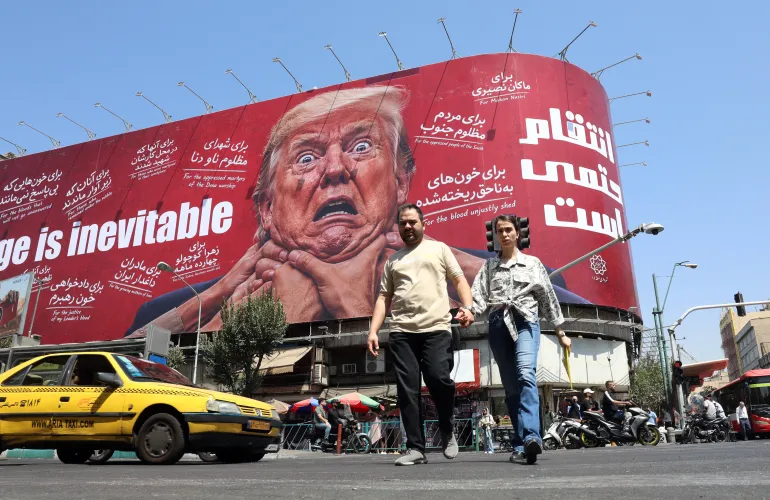
2026年8月19日,伊朗德黑兰,民众从一块反对特朗普的广告牌旁走过。[Abedin Taherkenareh/EPA] 随着各国对美国安全保障能力的信心下降,地区内的联盟关系与敌对态势也发生了剧烈变化。伊朗的诸多盟友——尤其是长期发挥威慑作用、令以色列不敢轻易发动攻击的真主党——似乎都在以色列的军事压力下逐渐瓦解。
Iranians walk near an anti-Trump billboard in Tehran, Iran, August 19, 2026 [Abedin Taherkenareh/EPA] Alliances Alongside the loss of confidence in the US as a security guarantor has come a dramatic reordering of alliances and rivalries. Much of Iran’s network – most notably Hezbollah, whose reputation had long served as a deterrent against Israeli attack – appeared to buckle under Israeli pressure.
这反过来又促使以色列加大军事行动力度:2024年10月及2026年3月,以军两次入侵黎巴嫩;2024年巴沙尔·阿萨德政权倒台后出现的权力真空期,以色列还趁机占领了部分叙利亚领土。“中东地区向来存在多方结盟现象,如今更是如此,”查塔姆研究所中东与北非项目主任萨纳姆·瓦基尔指出。随着土耳其得以在叙利亚发挥更大影响力,而中国也因自身能源供应面临威胁而积极参与促成伊朗停火的谈判,外部势力在该地区的作用正日益凸显。
That, in turn, emboldened an Israeli military push that saw troops invade Lebanon in October 2024 and again in March 2026 and seize Syrian territory during the brief power vacuum that followed Bashar al-Assad’s ouster in 2024“The Middle East has always been multi-aligned. However, now it’s even more so,” Sanam Vakil, the director of the Middle East and North Africa Programme at Chatham House, said of the increased leverage given to external actors, such as Turkiye in Syria and China’s involvement in negotiations over the end to war on Iran, as Beijing finds its own energy supplies under threat.
“颇具讽刺意味的是,自10月7日以来,以色列反倒成了试图改变现状的一方,而伊朗则几乎成了维护现状的代表,”她这样评价这两个敌对国家地位的明显逆转。目前德黑兰似乎更致力于收复过去三年中失去的阵地,而非进一步扩张势力范围。
“It’s ironic, since October 7, it’s Israel that has emerged as the revisionist power and Iran almost as the status quo power,” she said of the apparent reversal in status of the two belligerents, with Tehran seemingly more focused on regaining the ground it has lost in the last three years rather than advancing beyond them.
不过,瓦基尔提醒道,即便如此也绝不能夸大以色列的影响力,更不可将其视为地区超级大国。“以色列目前或许是中东地区军事实力最强的国家,但真正的实力应体现为能够维护地区稳定,而这一点以色列至今尚未展现出来,也没有表现出这样做的意愿。”
However, none of this was to overstate Israeli influence, or liken it to a regional superpower, Vakil cautioned. “Israel may currently be the preponderant military power in the Middle East, but real power is typically classed as being able to project stability, which Israel hasn’t shown itself able or willing to do,” she said.
原本以色列与美国都指望2月份的打击行动能迅速推翻伊朗政府,结果却催生了新的对抗局面。如今,德黑兰借助霍尔木兹海峡对以色列、美国及其盟友施加经济压力。该海峡紧邻伊朗,通常承担着全球约五分之一的石油与天然气运输任务;此外,伊朗还通过其盟友胡塞武装对曼德海峡施加威胁。
Clogged arteries While Israel and the US hoped February’s attacks would swiftly topple Iran’s government, they have instead opened a new front. Tehran now wields economic leverage over Israel, the US and their partners through the Strait of Hormuz, which borders Iran and typically carries about a fifth of the world’s oil and gas, and through Bab al-Mandeb, which is now threatened by its Houthi allies.
无论德黑兰的真实意图为何,此次经济冲击的影响程度却并不均衡。得益于应急储备、美国创纪录的石油产量以及挪威等国的石油供应,西方国家暂时避免了重蹈1970年代石油危机的覆辙——当时美国司机们曾排长队抢购汽油。尽管当前的供应中断规模更大,但西方所受影响仍相对有限。4月份,国际货币基金组织仅将2026年全球经济增长预期从3.3%小幅下调至3.1%。
Whatever Tehran’s intentions, the economic pain has been uneven. The West, cushioned by emergency reserves, record US oil production and supplies from countries such as Norway, has so far avoided the turmoil of the 1970s oil shocks, when US drivers queued for petrol, even though the current disruption is on a greater scale. In April, the International Monetary Fund trimmed its 2026 global growth forecast only slightly, to 3.1 percent from 3.3 percent.
相比之下,海湾地区的石油出口国则遭受重创。国际货币基金组织将沙特阿拉伯的增长预期从4.5%下调至3.1%,同时预测卡塔尔经济将由原本的增长6.1%转为萎缩8.6%。
Gulf exporters, in contrast, have fared far worse. The same assessment cut its forecast for Saudi Arabia from 4.5 to 3.1 percent, and turned Qatar’s from growth of 6.1 percent into a contraction of 8.6 percent.
“有趣的是,从诸多方面来看,西方对海湾地区石油需求的减少反而使得以色列愈发成为美国的负担,”以色列政治经济学家希尔·赫弗在接受半岛电视台采访时说道。他提到的两国外交同盟关系,一直以来都建立在以色列身处一个对美国利益至关重要的产油区的战略位置之上。
“It’s curious, in many ways the West’s reduced need for Gulf oil has increased the degree to which Israel has become a liability for the US,” Israeli political economist Shir Hever told Al Jazeera, referring to a diplomatic alliance between the two states long underpinned by Israel’s strategic position in an oil-rich region central to US interests.
“在以色列国内有一种观点认为,当前的危机或许会促使海湾国家与以色列结盟,”他补充道,同时也指出一个颇具讽刺意味的事实:在10月7日之后爆发的多场冲突中,以色列才是主要的挑衅方。“不过这种可能性似乎微乎其微。”
“There’s a train of thought in Israel that the current crises may push the Gulf states into allying with it,” he said, while noting the irony that Israel had been the main aggressor in the conflicts that followed October 7. “Though that seems fairly unlikely.”