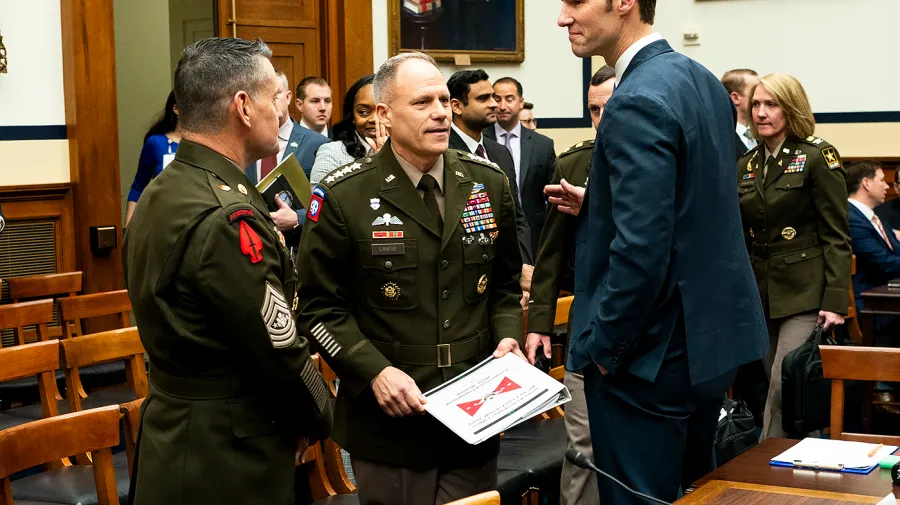
陆军代理参谋长克里斯托弗·拉内夫上将周二向国防工业保证,尽管今年早些时候失去了最高将领,但军队最大的分支并未放弃现代化建设,事实上正在“冲刺向前”。“对我们在此的行业合作伙伴,我们需要你们听到这一点:国防部长和我并未放弃现代化建设。这一点在《陆军方位》中得到了明确体现,我在此阐述了超越对手的需求,我希望在看到陆军代理部长[亚当]·泰勒昨天的讲话后,你们能看到我们的陆军重视美国的创新精神,以此帮助我们实现这一目标。”
The Army’s acting chief of staff, Gen. Christopher LaNeve, assured the defense industry on Tuesday that the military’s largest branch is not walking away from modernization after losing top brass earlier this year, but is in fact “sprinting towards it.”“And to our industry partners in this room, we need you to hear this: the secretary and I are not walking away from modernization. This is clearly captured in the Army Azimuth, where I lay forth the requirements to outpace our adversaries, and I hope that after yesterday's remarks from Acting Army Secretary [Adam] Telle, you can see that our Army values American ingenuity to help us with this,” LaNeve said during the Dwight D. Eisenhower luncheon at a military conference in Washington, D.C.
拉内夫在华盛顿特区一场军事会议上的德怀特·D·艾森豪威尔午餐会上如是说。“不,陆军并未背离现代化建设。事实上,情况恰好相反。我们正在冲刺向前。”拉内夫在被国防部长皮特·赫格塞思解除陆军参谋长兰迪·乔治职务后被任命为该职务时,在美国陆军协会(AUSA)上如此表示。拉内夫同时也是陆军副参谋长,他在新陆军领导层寻求完善乔治和前陆军部长丹·迪斯科尔倡导的现代化工作重点时发表了上述言论。
“No, the Army's not turning its back on modernization. In fact, quite the opposite. We are sprinting towards it,” LaNeve, who was picked for the role after Defense Secretary Pete Hegseth fired Army Chief of Staff Gen. Randy George, said at the Association of the United States Army (AUSA). LaNeve, also the Army’s vice chief of staff, made the remarks as the new Army leadership looks to refine priorities for modernization efforts advocated by George and former Army Secretary Dan Driscoll, who resigned in late August after months of clashes with Hegseth.
迪斯科尔因与赫格塞思数月的冲突,于八月下旬辞职。“我们的投资必须增强陆军作为一个集体作战系统的能力,而非试图让每个平台在技术上占优或为每个编制配备所有能力。我们将把资源集中在对汇聚、打击、近战和持久作战至关重要的能力上。”陆军在题为《陆军如何作战》的46页框架文件中如是说,该文件由拉内夫签署,上周发布。
“Our investments must strengthen the Army as a collective warfighting system rather than attempt to make every platform technologically superior or equip every formation with every capability. We will concentrate resources on the capabilities essential to Convergence, Strike, Close Battle and Endurance,” the branch said in the "How the Army Fights," a 46-page framework, signed by LaNeve, which was published last week.
去年四月推出的陆军转型倡议鼓励全军进行技术实验,削减官僚主义,并将资源重新导向首要的作战能力。
The Army Transformation Initiative, which was rolled out last April, encouraged technological experimentation across the force, cut bureaucracy and redirected resources to top-priority operational capabilities.
“陆军不能也不能一次性现代化所有事物,”该军种在框架中表示。“答案在于聚焦现代化。”陆军代理秘书亚当·泰勒周一表示,陆军必须以“商业速度”而非政府速度行事,因为特朗普政府继续重组该军种的运作和创新方式。“我们花费太长时间来寻找和资助好点子。这是因为我们选择合作伙伴不是基于他们能否为我们的士兵提供良好的装备或创新,而是基于他们的官僚体系是否足够庞大以与我们庞大的官僚体系对接。”
“The Army cannot and should not modernize everything at once,” the branch said in the framework. “The answer is focused modernization.”Adam Telle, the Army’s acting secretary, said on Monday that the Army has to move at the “speed of business” and not the speed of government as the Trump administration continues to rearrange how the branch operates and innovates. “We were taking too long to find and fund good ideas. That’s because we based who we did business with not on how well they could deliver equipment or innovation to our soldiers, but based on whether their bureaucracy was big enough to interface with our big bureaucracy,” Telle said during his Monday appearance at AUSA.
泰勒在周一参加AUSA活动时表示。“敏捷、充满活力且拥有卓越创意的公司被迫等待,而我们却让他们挨饿。”陆军领导人表示,最近推动投资和创新的举措是打破现状所必需的,但现在由领导层来制定“威胁导向的投资”,拉内夫周二表示。陆军将决定哪些技术需要资助以及在何处实施,因为该军种的资源并非“无穷无尽”,拉内夫表示。
“Agile, hungry companies with brilliant ideas were starved while we forced them to wait.”Army leaders have said the recent push to spur investment and innovation is necessary to shake up the status quo, but it is now up to leadership to make “threat-informed investments,” LaNeve said on Tuesday. The Army will decide which technologies need funding and where they will be implemented as the service branch's resources are not “endless,” LaNeve said.
“这意味着要对投资的去向做出深思熟虑的决定。当我想到陆军能力时,我会将其划分为三类,我已经多次在地板上向你们讲述过:遗留的、持久的和现代的,”陆军代理参谋长表示。“我们将剥离遗留装备,以尽快减轻部队因老旧、失效装备而分心的负担,这些装备阻碍了我们进行有意义的训练。”“我们将有目的地投资于持久能力,以缩短我们引进现代装备到部队所需的桥梁时间,”他在周二表示。
“This means making thoughtful decisions over where investments are made. And when I think of Army capabilities, I bend them into three categories, and I've talked to you a lot about this on the floor: legacy, enduring, and modern,” the acting Army chief of staff said. “We're going to divest legacy equipment with the intention to unburden our units as fast as we can from the old and failing equipment that distracts us from meaningful training.”“We will purposely invest in our enduring capabilities that halve the bridge time for us to get the modern equipment into the force,” he said on Tuesday.
“但我们也将为可规模化并能直接贡献于陆军在联合部队中作战方式的现代能力进行有意识的投资。”
“But we will also make intentional investments for modern capabilities that can be scaled and directly contribute to how the Army fights within the joint force.”