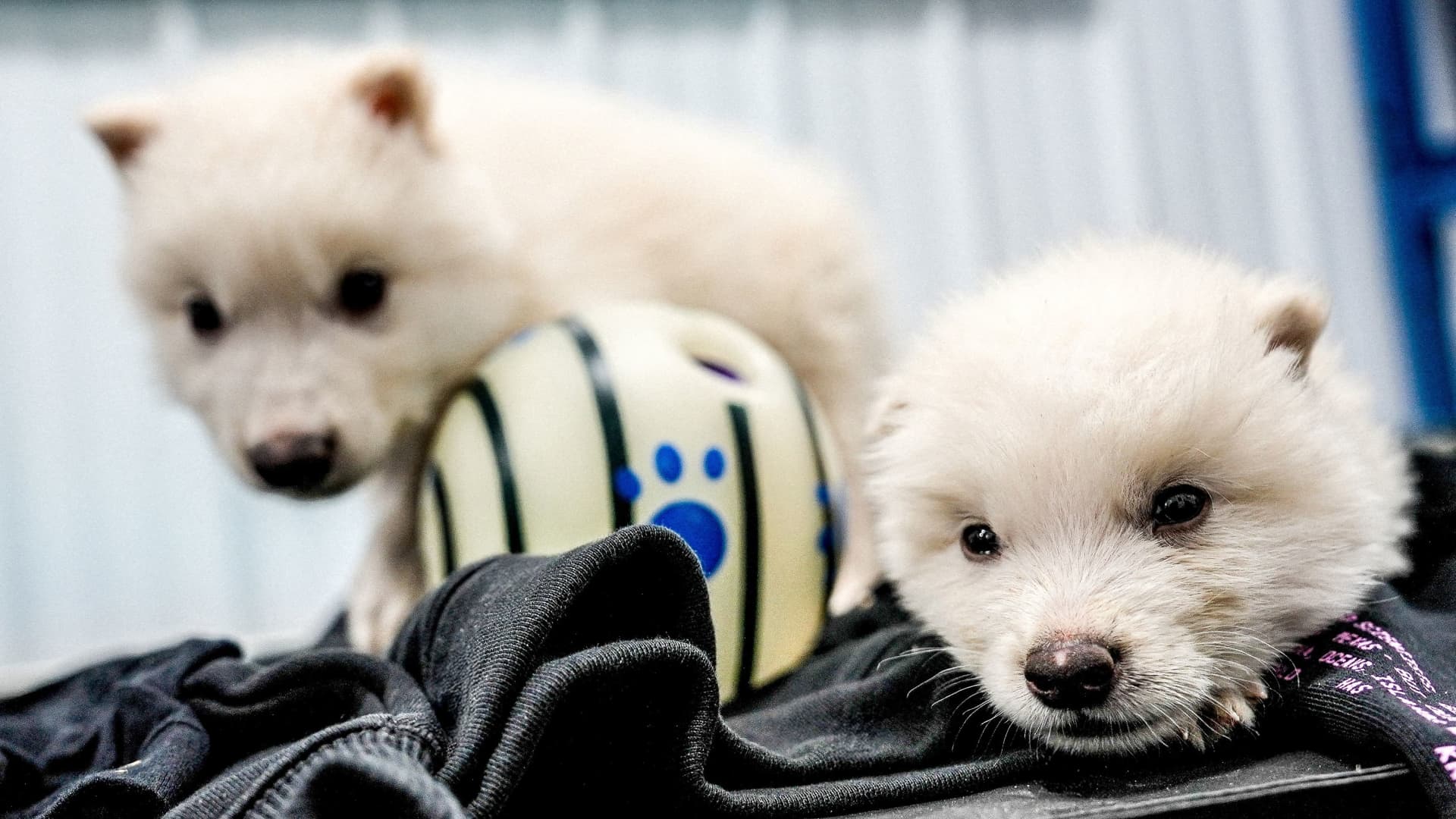
巨型生物科学公司(Colossal Biosciences)致力于复活诸如猛犸象和恐狼等灭绝动物的努力,引发了与《侏罗纪公园》的比较。
Colossal Biosciences' efforts to bring back extinct animals like the woolly mammoth and dire wolves have drawn comparisons to Jurassic Park.
首席执行官兼联合创始人本·拉姆(Ben Lamm)上周在CNBC人工智能论坛上对CNBC记者朱莉娅·博斯廷(Julia Boorstin)表示,他理解这种比较。"我认为90年代看过《侏罗纪公园》却没说它很酷的人,就像我不认为他们在派对上会很有趣一样,"拉姆开玩笑说。"但没错,我看过这些电影。我喜欢它们。它们娱乐了我们。它们吓到了我们。"
CEO and co-founder Ben Lamm told CNBC's Julia Boorstin at the CNBC AI Forum last week that he understands those comparisons. "I think anyone that saw Jurassic Park in the 90s and didn't say it was cool, like I don't think they're probably very fun at parties," Lamm joked. "But yes, I saw the movies. I love them. They entertained us. They scared us."
然而,拉姆表示:"我一直得在X平台提醒人们,你知道,那些只是电影,"他说。"我不认为《侏罗纪公园》有任何保护或人类整体受益的模型,所以我们试图从略微不同的角度出发。"由于恐龙的可行DNA已不复存在,复活恐龙实际上是不可能的。但除了恐狼和猛犸象项目之外,Colossal目前正在进行的工作还包括对渡渡鸟、塔斯马尼亚虎以及一种名为莫亚的巨型鸟类进行基因工程改造,等等。"
However, Lamm said, "I constantly have to remind people on X that, you know, they were movies," he said. "I don't think Jurassic Park had any conservation or general human benefit models to it, so we've tried to take a slightly different perspective." Since viable dinosaur DNA is no longer available, bringing back dinosaurs is, in fact, impossible. But what is underway at Colossal, besides the dire wolf and woolly mammoth projects, is work to genetically engineer the dodo bird, the Tasmanian tiger, and a giant bird called a moa, among others.

在接下来的一两年内,人们很可能会继续看到我们将灭绝物种带回地球,甚至可能会有更多的恐狼,"拉姆对博斯廷说。
"It's highly likely in the next coming year or two, people will continue to see us deliver extinct species back to Earth, and we could even have more dire wolves, too," Lamm told Boorstin.
创造这些狼崽的过程涉及从一块头骨和一颗牙齿中提取遗传物质,它们已有数百年的历史。利用AI模型,Colossal利用古DNA重建了恐狼基因组,并将其映射到其最近的现存亲属——灰狼身上。团队随后通过编辑现代灰狼的细胞来创建胚胎。
The process of creating the wolf pups involved taking genetic material from a skull and a tooth that were tens of hundreds of years old. Using AI models, Colossal used the ancient DNA to reconstruct the dire wolf genome and map it to its closest living relative, the gray wolf. The team then created embryos by editing the cells of modern gray wolves.
三只名为罗穆卢斯、雷穆斯和卡莉希的狼崽,是由被用作代孕母亲的家犬所生。
Three pups, named Romulus, Remus, and Khaleesi, have been born to domestic dogs used as surrogate mothers.
博斯廷指出,持怀疑态度的人表示,他们并没有真正实现恐狼的"复活",而是创造了一只基因改造的灰狼。
Skeptics, Boorstin pointed out, say that they didn't really de-extinct a dire wolf, rather, they created a genetically modified gray wolf.
Lamm称这是一个"语义争论","本末倒置"。"灰狼只是经过基因改造的恐狼。它们只是由自然、上帝或你愿意如何分类的方式完成的,"他说。
Lamm called this a "semantic argument" that "misses the forest for the trees." "Gray wolves are just genetically modified dire wolves. They were just done by nature or God or however you want to classify it," he said.
Colossal正在其毛象项目中进行类似的过程——这涉及对亚洲象进行基因改造。Lamm在八月告诉《时代》杂志,公司计划在2030年代实现毛象的出生。"我们称它为毛象,"他说。"因为如果它看起来像鸭子,叫声像鸭子,履行鸭子的生态功能,那就是鸭子,从我们的角度来看。"
Colossal is undertaking a similar process in their woolly mammoth project – that involves genetically modifying an Asian elephant. Lamm told Time in August that the company is aiming to have a woolly mammoth birth in the 2030s. "We call it a woolly mammoth," he said. "Because if it looks like a duck, it quacks like a duck, it serves ecological functions of a duck, it's a duck, in our perspective."
Lamm在2019年与著名哈佛遗传学家乔治·丘奇会面后对这项工作产生了兴趣,他称丘奇为"合成生物学之父"。丘奇发起了个人基因组项目,他告诉CNBC在2021年,自己已经梦想了数十年让毛象复活。
Lamm became interested in this work after a 2019 meeting with renowned Harvard geneticist George Church, who Lamm called "arguably the father of synthetic biology." Church, who initiated the Personal Genome Project, had been dreaming about bringing back the woolly mammoth for decades, he told CNBC in 2021.
然而,复活像毛象这样的动物的愿景远不止于创造一个真实生活中的侏罗纪公园,让以前灭绝的物种重现。"[丘奇]设想我们可以利用CRISPR及所有这些工具和技术来让灭绝物种复活,利用其中一些技术用于人类医疗,然后构建一个可编程的生命模型,我们可以将其应用于地球上的众多不同用途,"Lamm说。
However, the vision to revive animals like the woolly mammoth goes far beyond creating a real-life Jurassic Park with previously extinct creatures. "[Church] had this vision that we could leverage CRISPR and all these tools and technologies to bring back extinct species, use some of those technologies for human healthcare, and then build this programmable life model that we could apply to so many different use cases on Earth," Lamm said.
这些用途包括前述的以保护为重点的益处,这是去灭绝所承诺的。例如,工程化的毛象可以通过踩踏高海拔北极地区的雪覆盖来帮助对抗气候变化,这能保持土壤冻结,并通过倒伏树木,从而将吸热的森林转变为草原。
Those use cases include those aforementioned conservation-focused benefits that de-extinction promises. For example, the engineered woolly mammoths could help fight climate change by stomping down snow cover in high-altitude arctic regions, which keeps soil frozen, and knocking down trees, thereby converting heat-absorbing forests into grasslands.
但围绕去灭绝的过程也正在基因工程和发育生物学领域打开新的大门,Lamm说。
But the processes around de-extinction are also opening new doors in genome engineering and developmental biology, Lamm said.
这可能对“从微生物到海洋中的塑料,再到人类的基因疗法和靶向递送,以及根除遗传性疾病”产生影响,他说。Lamm 理论认为,围绕DNA合成的这些努力甚至可能导致开发生长更快的作物或树木。
That could have implications on "everything from microbes to plastic in the oceans to gene therapies and targeted delivery for humans to eradicating genetic diseases," he said. Lamm theorized that these efforts around DNA synthesis could even lead to developing crops or trees that grow faster.
“我们正在推动DNA合成的边界,以合成最大载荷的DNA,”他说。“这将彻底改变我们对可编程生命的思考方式。”一家从Colossal分拆出来的公司,名为Astromech,正在推进Lamm所说的“趋同进化”研究,探讨为何在几乎所有方面都相似的物种会有不同的免疫力或其他健康问题,例如为什么大象患癌的比率仅为人类的很小一部分。Lamm表示,这项研究可能被用于解决人类医疗挑战或疫情应对。根据《D杂志》的报道,Astromech在3月份的估值达到20亿美元。
"We're pushing the bounds of DNA synthesis to synthesize the largest cargos of DNA," he said. "That will be massively transformative for how we think about programmable life." A company spun off from Colossal, called Astromech, is pushing into what Lamm called "convergent evolution," studying what causes species that are similar in nearly every way to have different immunities or other health issues, such as why elephants get cancer at a fraction of the rate humans do. That research could be leveraged to solve human healthcare challengers or pandemic responses, Lamm said. Astromech was valued at $2 billion in March, according to D Magazine.
“我们正面临生物多样性危机,因此我们需要这些工具,因为我们将在未来25年内失去大约一半的生物多样性。因此,我们需要冷冻保存,我们需要生物银行,我们需要基因拯救以及这些类型的工具,”Lamm说。“这为我们打开了大门,让我们可以说,如果我们采用这些模型和这些进化趋势,我们能从中学到什么,以及如何将其应用于其他用例,以及如何在从作物到人类医疗及更广泛领域的一切事物上应用定向进化。”
"We are in a biodiversity crisis, so we need these tools because we're going to lose about half of biodiversity in the next 25 years. So, we do need cryopreservation, we need biobanks, we need genetic rescue and these types of tools," Lamm said. "It opens the gate for us to say, if we take these models and we take these evolutionary trends, what can we learn from it, and how can that apply to other uses cases, and how can we use directed evolution on everything from crops to human healthcare and beyond?"
这些应对世界上一些最大问题的努力使得Colossal Biosciences对投资者具有吸引力。7月,该公司宣布由TWG Global领投的2亿美元C轮融资,使其估值达到102亿美元。自成立以来,该公司累计融资超过4.35亿美元。
These efforts to tackle some of the world's biggest problems have made Colossal Biosciences attractive to investors. In July, the company announced a $200 million Series C round led by TWG Global, bringing its valuation to $10.2 billion. In total, the company has raised more than $435 million since its founding.
但拉姆也意识到,许多人——尤其是年轻人——受到让动物从灭绝中复活这一想法的启发。拉姆表示,公司30%的投资者“都是从他们孩子那里来的。”
But it's not lost on Lamm that many people are inspired by the idea of bringing animals back from extinction, especially young people. Lamm said that 30% of the company's investors "come to us from their kids."
“如果我们能激励下一代,让他们对科学、教育和保护产生兴趣,然后构建一个可用于众多不同用途的合成生物学平台,那就是我们真正的使命,”他说。“我们的孩子们将继承我们的问题,而如何解决这些问题的决策也将由他们来做。”
"If we can inspire the next generation and get them excited about science and education and conservation, and then build out a synthetic biology platform that can be leveraged for so many different use cases, that's the real mission here," he said. "Our kids, they're going to inherit our problems, and the decisions on how we solve those."