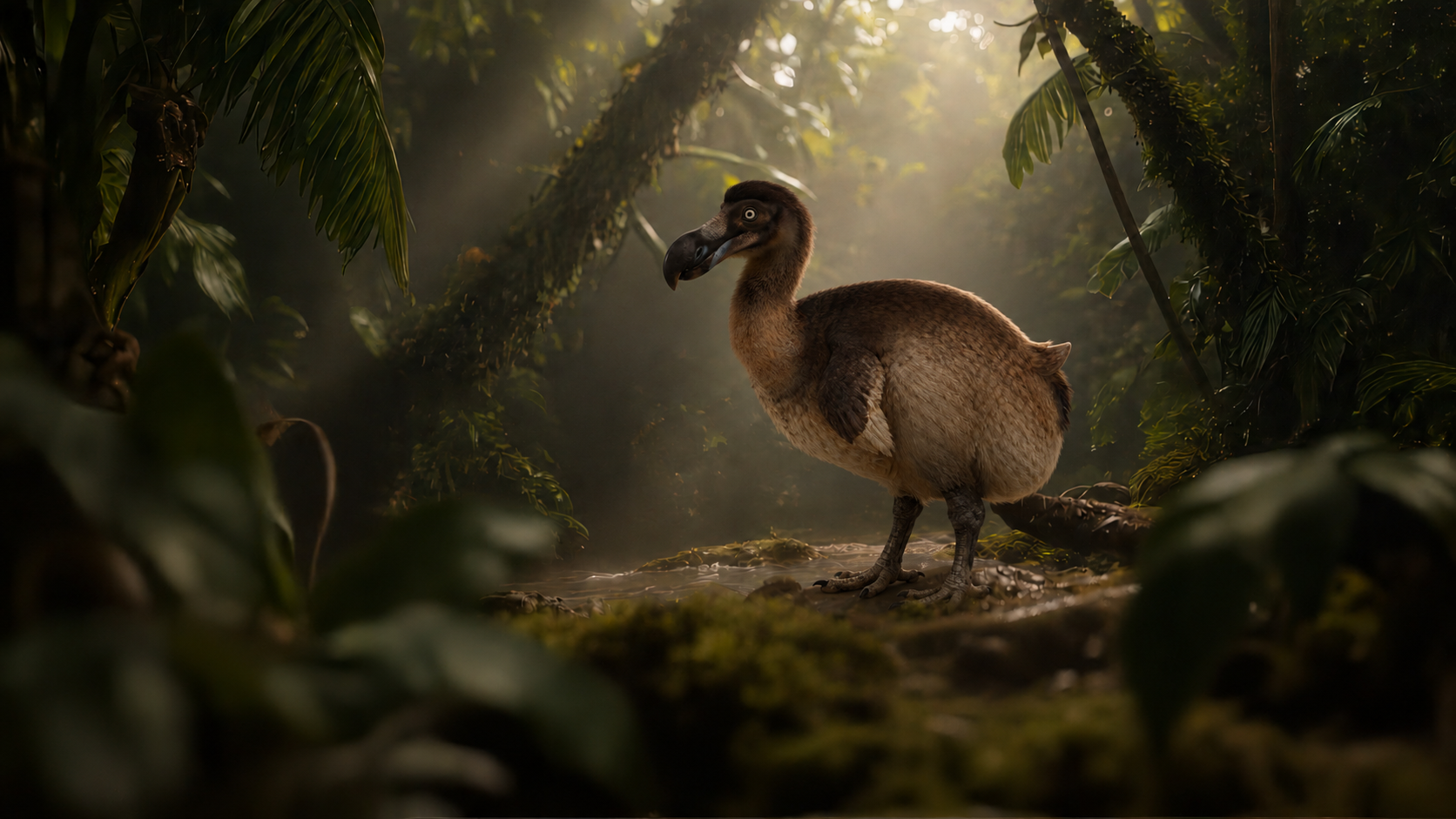
有很多理由让人对人工智能可能带来的危害感到担忧,这也解释了为什么这项技术会遭到许多批评者的反对。不过,即便是最严厉的批评者,也可能会对来自总部位于达拉斯的 Colossal Biosciences 公司的这一消息感到惊讶:该公司的研究人员宣布,人工智能或许能够帮助让已经灭绝的渡渡鸟重新“复活”。这种早在 350 多年前就从地球上消失的鸟类,有可能在 2030 年代初期再次出现在我们的生活中。
There are a whole lot of reasons to have a whole lot of concerns about the harm artificial intelligence can cause, which explains why the technology has so many detractors. But even the harshest critics might smile at the news coming out of Dallas-based Colossal Biosciences. There, researchers have just announced that AI may help hasten the return of the extinct dodo, with the flightless bird, which vanished from the world more than 350 years ago, likely walking among us again sometime in the early 2030s.
由于现存的渡渡鸟 DNA 样本非常稀少,且这些样本在几个世纪以来已经发生了退化,因此人工智能的分析能力和数据处理能力正是填补这些基因空白所必需的工具。
With so few ancient samples of dodo DNA surviving—and that which does exist having degraded over the centuries—the analytic and number-crunching power of AI is just what’s needed to fill in the genetic blanks.
“‘复活’已灭绝的物种既是一个生物学问题,也是一个数据问题,”Colossal Biosciences 的首席执行官兼联合创始人本·拉姆(Ben Lamm)在一份声明中表示。“人工智能能够分析调控鸟类基因的机制,从而识别出可能导致渡渡鸟独特体型特征的基因因素。”Colossal Biosciences 在 2025 年首次证明了其“复活”已灭绝物种的技术实力:该公司成功测序了早已灭绝的恐狼的古代 DNA,利用这些数据重新编写了现代灰狼的基因组,使这种生活在冰河时代的动物得以‘复活’(即让它的基因在现代环境中得以表达)。
“De-extinction is as much a data problem as a biology problem,” said Colossal CEO and co-founder Ben Lamm in a statement. “[AI] learns how regulatory DNA shapes living birds, then identifies the genetic switches that may have contributed to the dodo’s distinctive anatomy.”Colossal established its de-extinction bona fides in 2025, when it announced that it had sequenced ancient DNA from the long-extinct dire wolf, used that to rewrite the genome of the extant gray wolf, and brought the Ice Age dire wolf back to life, more than 10,000 years after it vanished.
该公司计划“复活”的其他物种还包括长毛猛犸象、塔斯马尼亚虎、类似鸵鸟的恐鸟以及类似羚羊的夸加兽。渡渡鸟虽然行动笨拙、翅膀短小、眼睛突出、喙部奇特,但它缺乏那些动物所拥有的力量、优雅或魅力——而这恰恰也是它的独特之处。
Animals that are also on the company’s de-extinction to-do list include the woolly mammoth, the Tasmanian tiger, the ostrich-like moa, and the antelope-like quagga. The dodo, with its waddling gait, its stubby wings, its goggly eyes, and its preposterous beak, has none of the power, grace, or charisma of those other animals—but that’s part of its charm.
“渡渡鸟根本没有机会,”《纽约先驱论坛报》作家威尔·卡佩在其1941年出版的《如何灭绝》一书中写道。“他似乎就是为了灭绝而被发明出来的,除此之外一无是处。我不是在指责渡渡鸟,但它确实是个乱七八糟的东西。葡萄牙人称这些鸟为doudos,即傻瓜,因为它们会友好地与葡萄牙人相处,任凭自己被棒子击打头部。”
“The dodo never had a chance,” wrote New York Herald Tribune writer Will Cuppy, in his 1941 book How to Become Extinct. “He seems to have been invented for the sole purpose of becoming extinct and that was all he was good for. I’m not blaming the dodo, but he was just a mess. The Portuguese called the birds doudos, or fools, because they would associate with the Portuguese on friendly terms and allow themselves to be hit on the head with clubs.”
但激发嘲笑的事物也会激发爱意——而要让渡渡鸟复活,就需要大量这样的爱。复活像恐狼这样的有胎盘哺乳动物相对来说是一个较为直接的过程。巨型公司的研究人员首先从一只活着的灰狼身上采集细胞,并对14个基因进行了20处编辑,这些基因编码了恐狼的白色皮毛、体型更大、颚部更强大、寒冷天气下的代谢等特征。
But what inspires mockery inspires love too—and it will take plenty of that to bring the dodo back. De-extincting a placental mammal like a dire wolf is a comparatively straightforward process. Colossal researchers first harvested cells from a living gray wolf and made 20 edits to 14 genes, coding for the dire wolf’s white coat, larger size, more powerful jaws, cold weather metabolism, and more.
随后,他们提取了这个被改写细胞的细胞核,并将其植入一个自身细胞核已被移除的灰狼卵子中。接着,受精卵被允许发育成胚胎,并被植入一只大型家犬的子宫中。仅仅60多天后,这只母狗生下了一只幼狼。
They then extracted the nucleus of that rewritten cell and inserted it into a gray wolf ovum whose own nucleus had been removed. Next, the fertilized egg was allowed to develop into an embryo and was implanted in the womb of a large domestic hound. Just over 60 days later, that mama dog gave birth to a puppy wolf.
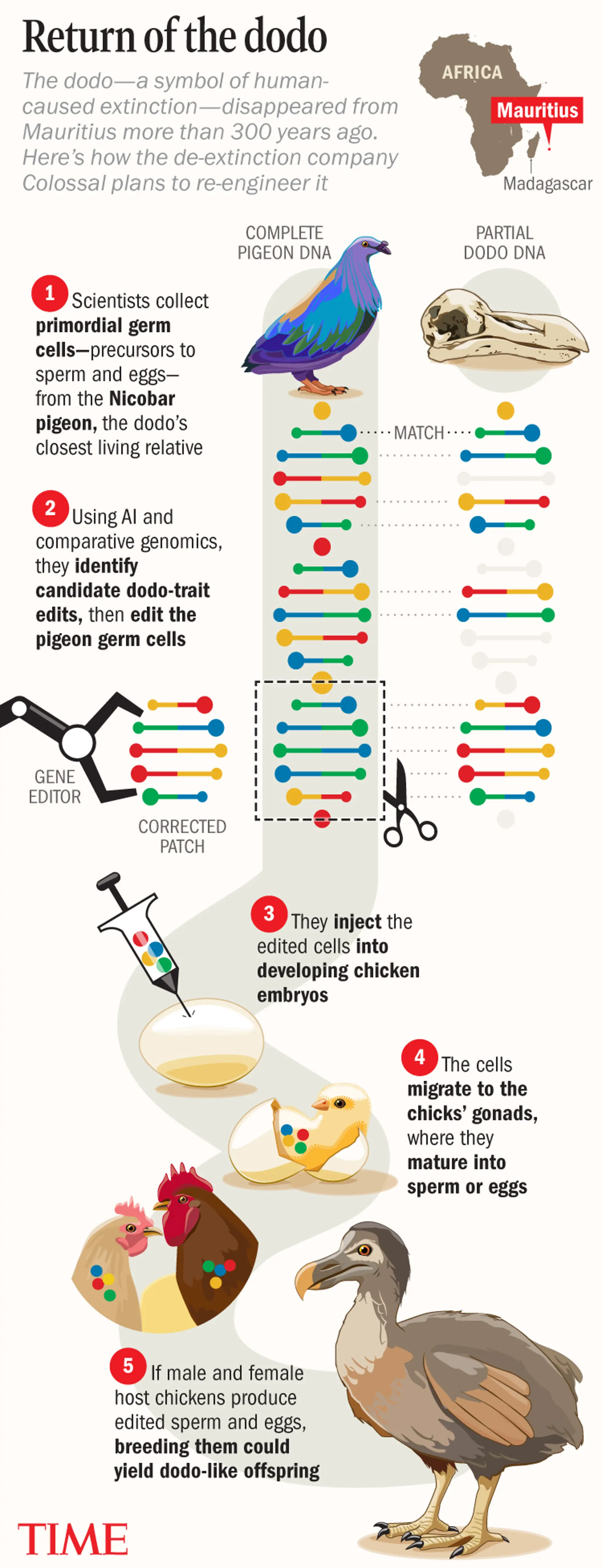
复活一种在子宫外孵化的鸟类则会更困难。对于渡渡鸟,研究人员将首先从它最近的现存亲戚——尼科巴鸽身上采集原始生殖细胞(PGCs)——即能够发育成卵子和精子的早期细胞。这些PGCs将以与编辑灰狼相同的方式被改写,以加入渡渡鸟的特征。随后,这些细胞将通过家鸡蛋的蛋壳被注入一个微小的鸡胚胎中。PGCs会迁移到即将发育成鸡的胚胎性腺中,并在那里定居。当被编辑的雌性小鸡孵化、成长并与被编辑的雄性交配时,它将产下的蛋不仅会孵化出像它一样的鸡,而是会孵化出渡渡鸟。
De-extincting a bird, which does its gestating outside of any womb, will be harder. For the dodo, the researchers will first harvest primordial germ cells (PGCs)—nascent cells that give rise to eggs and sperm—from the nicobar pigeon, the dodo’s closest living relative. The PGCs will then be rewritten to add dodo traits, in the same way the gray wolf was edited. Those cells will then be injected through the shell of a domestic chicken egg into a microscopic chick embryo. The PGC’s will migrate to the embryonic gonads of the chick-to-be, taking up residence there. When the edited female chick hatches and grows and mates with an edited male, she will lay eggs that will produce not a chicken like her, but a dodo.
“在理想情况下,如果我们拥有数百枚尼科巴鸽的蛋,我们会把鸽子作为代孕母鸟,”Colossal 的鸟类物种总监 Anna Keyte 说。“但尼科巴鸽是季节性繁殖者。它们一年中只有几个月会产卵,而且通常每窝只下两枚蛋。鸡蛋非常容易获取。有的鸡一天就能下一个蛋。你可以从鸡那里获得的代孕蛋数量远远多于尼科巴鸽。”
“In an ideal world, if we had hundreds of nicobar pigeon [eggs] we would use the pigeon as the surrogate,” says Anna Keyte, Colossal’s avian species director. “But nicobars are seasonal breeders. They only lay for a couple of months out of the year and they usually lay just two eggs in a clutch. Chicken eggs are super easy to get. Some chickens will lay an egg a day. You can just get vastly more surrogate eggs from a chicken than you can from a nicobar.”
但首先编辑原始配子细胞(PGC)并非易事,因为渡渡鸟基因组中有大量编码该物种特征的位点——尤其是其冰淇淋勺形的喙。研究人员并非在读取具体基因,而是读取调控元件——即决定哪些基因被开启或关闭的基因组部分。仅喙部的调控就已是巨大工程。与喙大小相关的调控元件超过 650 个,涉及喙厚度和宽度的则接近 1,700 个。更糟的是,古代样本中 DNA 的碎片化导致对这些调控开关的方向记录不完整。公司称为 GenoMorph 的新人工智能平台可以填补这些空白。
But editing the PGCs in the first place will be no small thing, simply because there are so many sites on the dodo genome that code for the species’s traits—especially its ice-cream-scoop-shaped beak. It’s not precisely the genes that the researchers are reading in their work, but the regulatory elements—or the parts of the genome that determine which genes get switched on and off. And for the beak alone, that’s a heavy lift. There are more than 650 regulatory elements associated with beak size and nearly 1,700 with beak thickness and breadth. Worse, the fragmentation of DNA in the ancient samples gives an imperfect record of which of those regulatory switches are to be flipped which way. A new AI platform the company calls GenoMorph can fill in those gaps.
为开发 GenoMorph,Colossal 的科学家构建了一个图谱,展示控制面部发育的基因开关在鸡、鹌鹑、鸭和鸽子胚胎发育过程中的开启与关闭方式。随后,他们比较了 70 多种鸟类的基因组和颅骨形态,包括渡渡鸟最近的活体亲缘——尼科巴鸽。结果得到约 2,350 个可能解释渡渡鸟异常喙形的基因开关列表,团队正逐一进行测试。这项工作建立在另一项成果之上:一份相当完整的渡渡鸟基因组,该基因组是利用 Colossal 最初为其恐狼项目开发的软件,从一只保存完好的标本中组装而成。
To develop GenoMorph, Colossal scientists built an atlas showing how the genetic switches that control facial development turn on and off as embryos grow in chickens, quail, ducks, and pigeons. They then compared genomes and skull shapes from more than 70 bird species, including the dodo’s closest living relative, the Nicobar pigeon. The result is the list of about 2,350 genetic switches that may help explain the dodo’s unusual beak, which the team is now testing one by one. That work builds on a separate achievement: a remarkably complete dodo genome, assembled from a single well-preserved specimen using software Colossal originally developed for its dire wolf project.
“就古代基因组而言,这个样本堪称非凡,”Colossal公司的首席科学官贝丝·夏皮罗说道,“虽然存在一些小缺口,但数量远少于我们通常在古代DNA样本中看到的。我们几乎完整地获取了渡渡鸟的基因组信息。” 渡渡鸟最显著的特征或许就是它的喙,但实际上还有诸多其他特征都记录在这由20亿个碱基对构成的基因组中。正因如此,Colossal的科学家们呼吁大家耐心等待——预计大约需要五年时间才能让渡渡鸟重新出现在世上。
“For an ancient genome, this one is extraordinary,” says Beth Shapiro, Colossal’s chief science officer. “There are a few small holes, but far fewer than we usually see with ancient DNA. We’re really not missing much of the dodo genome.”The beak might be the most dramatic dodo feature, but there are plenty of others, written in the two billion letters that make up the dodo genome—which is why Colossal scientists urge patience for the five or so years it will take to bring a dodo back into the world.
此前,Colossal为解读和分析恐狼基因组所做的工作为后来开发用于解析渡渡鸟基因组的GenoMorph技术奠定了基础;同理,此次对渡渡鸟基因组的研究成果也能为其他拟复活物种的基因解读与编辑工作提供借鉴。
In the same way that some of the work Colossal did to read and analyze the dire wolf genome helped in the later work developing GenoMorph to read the dodo genome, the dodo work can similarly pay itself forward to reading and editing the genomes of other species to be de-extincted.
夏皮罗在一份声明中表示:“看到最初为恐狼项目研发的技术如今能在其他物种研究项目中发挥价值,我们深感欣慰。每一次科学突破都会成为可扩展的技术平台的一部分,进而推动后续各项研究项目的进展。” 目前,渡渡鸟仍只是存在于理论层面的“虚拟物种”,但用不了多久,它便有可能在21世纪真正重现人间。
“It’s been rewarding to see that an approach developed for the dire wolf is now producing value across another species program,” said Shapiro in a statement. “Every scientific breakthrough becomes part of a scalable technology platform that can accelerate the programs that follow.”For now, the dodo remains biological vaporware—but it’s vaporware that could, before too long, take shape in the 21st century.