
Moët Hennessy Louis Vuitton SE 本周进一步披露了中国奢侈品市场深度低迷的情况,透露其在大陆的销售额在第三季度出现两位数下降,而传统上消费能力较强的客群也在海外削减了开支。
Moët Hennessy Louis Vuitton SE offered a closer look at the deepening Chinese luxury slump this week, revealing that sales on the mainland dropped by double digits in the third quarter while the traditionally high-spending consumer group also pulled back overseas.
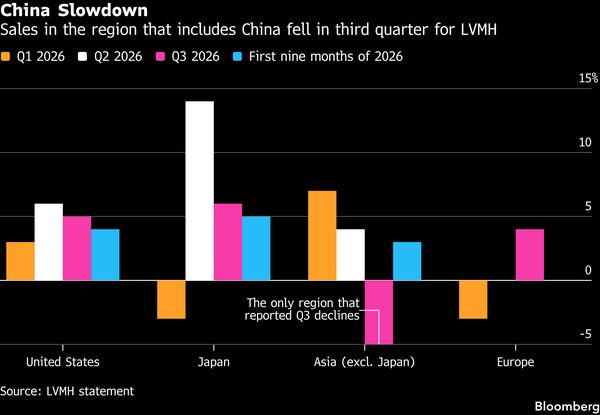
疲软的消费导致亚洲(不含日本)地区的有机收入下降了 5%,这是奢侈品巨头唯一出现年同比下降的地区。中国游客在海外的购买额下降了个位数中段的百分比,而总体需求在截至 9 月 30 日的季度末有所改善,首席财务官塞西尔·卡巴尼斯在与分析师的电话会议上如此表示。
The weak spending contributed to a 5% drop in organic revenue in the Asia excluding Japan segment, the only region where the luxury giant saw a year-on-year decline. Chinese shoppers’ purchases overseas declined by a mid-single-digit percentage, while overall demand improved later in the quarter ending Sept. 30, Chief Financial Officer Cecile Cabanis told analysts on a call.
作为长期被视为行业风向标的 LVMH,其在中国的放缓加剧了人们对更广泛奢侈品复苏持续性的怀疑,也可能为包括 Yves Saint Laurent 母公司 Kering SA 和 Hermès International SCA 在内的竞争对手传递出令人担忧的信号,这些公司将在本月晚些时候发布财报。中国曾在不到一年前帮助推动了行业复苏,但经济情绪的恶化再次抑制了高端消费。
The China slowdown at LVMH, long seen as an industry bellwether, adds to doubts about the durability of a broader luxury recovery and could offer a worrying signal for rivals including Yves Saint Laurent owner Kering SA and Hermès International SCA, which are due to report earnings later this month. China had helped fuel an industry rebound less than a year ago, but worsening economic sentiment is again weighing on high-end spending.
“今年夏天,中国的新闻面并不乐观,”卡巴尼斯说。“因此,这确实削弱了消费者的愉悦感,并营造出短期内较为低迷的中国市场环境。”中国的奢侈品需求正受到多方面的挤压。在更广泛的经济放缓背景下,消费者的谨慎情绪正在抑制国内消费,并推动部分购物者转向更便宜的本地品牌。与此同时,近期股市疲软以及对海外财富征税力度的加强,也在压制该国部分最富有的消费者。
“The news flow has not been particularly good in China in the summer,” Cabanis said. “So this has really weighed on the feel-good factor and created a short-term subdued Chinese backdrop.”Luxury demand in China is being squeezed on numerous fronts. Consumer wariness amid a broader economic slowdown is restraining spending at home and pushing some shoppers toward cheaper local brands. At the same time, recent stock-market weakness and tougher taxation of overseas wealth are weighing on some of the country’s richest consumers.
“每个人都在经历困难时期,”总部位于上海的咨询公司 Foresight Performance Partners 的联合创始人雅克·罗伊岑(Jacques Roizen)说道。“作为大型企业集团的 LVMH 实际上代表了整个奢侈品行业的趋势;其他上市的奢侈品公司也无法显著超越 LVMH 的表现。”中国市场的需求放缓与美国消费者的支出增长形成了鲜明对比——美国消费者的支出增长了约 5%(即增长幅度为 5% 左右)。
“Everybody’s having a tough time,” said Jacques Roizen, co-founder of Shanghai-based consultancy Foresight Performance Partners. “LVMH as a portfolio of scale is such an industry index, and the other luxury listed companies are not going to significantly outperform that.”The slowdown in Chinese demand contrasted with spending by US customers, which rose by a mid-single-digit percentage.
在本季度,路易威登(Louis Vuitton)因与当地茶饮连锁品牌 Molly Tea 的商标纠纷而引发公众批评,这进一步加剧了该公司所面临的压力。卡巴尼斯(Cabanis)表示,虽然这种影响难以量化,但消费者情绪的负面变化至少在初期对路易威登造成了负面影响。
Louis Vuitton also faced public backlash after a trademark dispute with local tea chain Molly Tea stirred criticism in China during the quarter, adding to pressure on LVMH’s biggest label. Cabanis said that while it was difficult to quantify the impact, the consumer pushback hurt Louis Vuitton at least at the beginning of the period.
中国市场的疲软态势,加上中东地区的冲突以及全球范围内的生活成本上升问题,都在给整个奢侈品行业带来压力。据彭博社(Bloomberg)报道,7 月份中国市场上 25 家主要奢侈品品牌的销售额下降了超过 10%;这一趋势威胁到了奢侈品行业刚刚开始的复苏进程——此前,得益于人工智能技术推动的股市繁荣,奢侈品消费曾一度有所回升。
The setback in China comes as the broader luxury recovery faces pressure from conflict in the Middle East and cost-of-living concerns that are curbing discretionary spending globally. That pressure is already showing across the luxury sector. Sales at the 25 biggest luxury labels in China dropped more than 10% in July, Bloomberg reported earlier. That threatens to derail a recovery that began less than a year ago, when a stock market boom fueled by artificial intelligence helped revive luxury spending.
彭博社智库(Bloomberg Intelligence)的分析师黛博拉·艾特肯(Deborah Aitken)和卡琳·皮顿(Karine Pitton)指出:“随着中国经济增长放缓的加剧,LVMH 今年在收入和每股收益方面的增长势头变得愈发不稳定。”
LVMH’s renewed gains in revenue and earnings per share this year “grew precarious” as China’s slowdown deepened in the third quarter, Bloomberg Intelligence analysts Deborah Aitken and Karine Pitton wrote.
“中国消费者的消费观念发生了变化,这迫使我们必须加强自身的竞争力,”首席财务官卡巴尼斯(Cabanis)表示,“我们需要采取更多措施来应对挑战,但我们并未停止在中国市场的投资。”
“There was a shift in the Chinese consumer backdrop, and this forces us to sharpen our self-help effort,” CFO Cabanis said. “We need to do more, but we have not stopped investing in China.”