
新一轮工业革命已然到来。与之前的电力和互联网一样,人工智能也有潜力通过开辟新的增长路径来推动经济转型。印度也不例外。
The next industrial revolution is here. Like electricity or the internet before it, artificial intelligence has the potential to transform economies by opening new avenues for growth. India is no exception.
人工智能使得科技巨头企业的市场估值大幅攀升,促成了全球数千亿美元规模的投资,并正在重塑我们的工作方式。目前仍有诸多问题亟待解答:人工智能能否带来投资者所期待的生产力提升?又会对就业市场造成何种影响?
AI has sent market valuations for tech champions soaring, unleashed hundreds of billions of dollars in investment globally and begun reshaping how we work. The unanswered questions: Can it deliver the productivity lift investors are betting on? And at what cost to jobs?
对印度而言,这一变革意义重大。总理纳伦德拉·莫迪希望印度能在2047年跻身发达国家行列。我们的预测显示这一目标实现难度较大,而人工智能带来的红利或许有助于缩小这一差距。
For India, the stakes are high. Prime Minister Narendra Modi wants the country to achieve developed-economy status by 2047. Our forecasts suggest that is a stretch target. An AI dividend could help close the gap.
人工智能产生经济影响的一个重要途径就是提升任务执行效率。为评估其对生产力的促进作用,一个合理的切入点便是测算那些可通过人工智能显著提升效率的工作岗位所占比例。
An important channel for AI’s economic impact: allowing tasks to be performed more efficiently. To assess the productivity boost, a good starting point is to determine the share of jobs substantially composed of tasks where AI could deliver big efficiency gains.
基于我们制定的全球通用评估标准,我们估算出印度约有6%的就业岗位能够切实受益于生成式人工智能带来的效率提升——也就是说,借助聊天机器人等工具,这些工作能够更高效地完成。若所有劳动者都能全面使用各类人工智能软件工具,这一比例还将翻倍至12%。
Using our globally comparable measure of AI job exposure, we estimate 6% of India’s jobs are meaningfully exposed to the first-order effects of generative AI—meaning access to chatbots should allow them to be performed more efficiently. With full access to AI-powered software tools, the share doubles to 12%.
这一数值在全球范围内仍处于较低水平。在发达经济体中,该比例分别达到27%和51%。这种差距反映出印度有大量就业岗位集中在农业、建筑业及服务业领域,这些岗位对技能的要求较低或处于中等水平,人工智能难以对其产生显著影响。
That’s low by global standards. For advanced economies, the exposures are 27% and 51%, respectively—a gap that reflects India’s high concentration of jobs in agriculture, construction and services with low- to medium-skill requirements, where AI likely won’t have a substantial impact.
考虑到印度GDP的构成结构,实际受人工智能影响较大的就业岗位比例可能高于我们的测算值。原因在于信息技术、商务服务及金融等知识密集型产业所创造的附加值,大约是其就业人数占比所对应的水平的四倍。
India’s GDP-weighted exposure is likely higher than our measure implies. That’s because knowledge-intensive industries such as IT, business services and finance generate roughly four times as much value added as their employment weight.
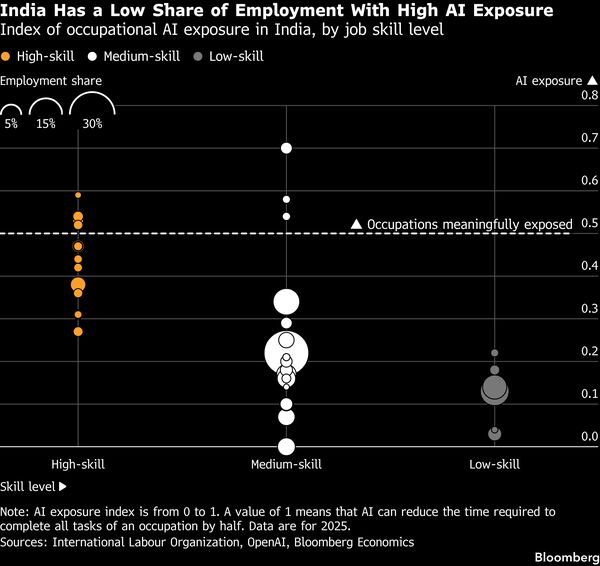
曝光度越高,潜在的收益也就越大。实证研究表明,人工智能(AI)平均能将劳动生产率提高约30%。将这一效应应用于印度按GDP权重计算的实际情况,并考虑到AI在印度劳动力收入中所占的60%的比重,可以推断出:在AI全面普及后,印度的总要素生产率将提升4%至9%。如果这一变革需要十年时间来完成,那么每年的生产率增长率将额外增加0.4%至0.9个百分点——这是一个相当显著的提升。
The greater the exposure, the greater the potential payoff. Empirical studies find AI increases labor productivity by about 30% on average. Applying that to India’s GDP-weighted exposure and scaling it by its 60% labor income share implies a 4%-9% lift in total factor productivity after full adoption. Assuming diffusion takes a decade, that’s an extra 0.4-0.9 ppt on annual productivity growth—a significant boost.
我们的计算基于诺贝尔经济学奖得主达龙·阿西莫格鲁(Daron Acemoglu)提出的理论框架,假设AI的潜力能够得到充分发挥,并且不会导致长期性的就业流失。
Our calculations draw on a framework from Nobel laureate economist Daron Acemoglu and assume AI’s potential is fully realized and there are no lasting job losses.
一个尚未解决的问题是:这项技术将如何与劳动者互动?它有可能提高劳动者的工作效率;如果自动化成为主流,也可能在经济的其他领域创造新的就业机会。最糟糕的情况是失业率会急剧上升。
An unsettled question is how the technology will interact with workers. It could make them more productive. If automation prevails, it could create opportunities elsewhere in the economy. The worst case is a sharp increase in unemployment.
对于印度价值3000亿美元的IT服务产业来说,这一问题的影响尤为重大。该产业的成功建立在大量具备技能、能说英语且成本竞争力强的劳动者基础之上,这些劳动者为全球企业提供软件开发、客户支持及后台运营等服务。然而,AI可能会颠覆这种商业模式:如果常规的认知性工作被自动化,企业可能会将业务转移到成本更低的国家,从而减少对印度服务的需求。
Nowhere is that debate more consequential than for India’s $300 billion IT services industry. Its success was built on a vast pool of skilled, English-speaking, cost-competitive workers serving global firms looking to offshore software development, customer support and back-office operations. AI could upend that model. If routine cognitive work is automated, firms may look to nearshore activities, eroding demand for India’s services.
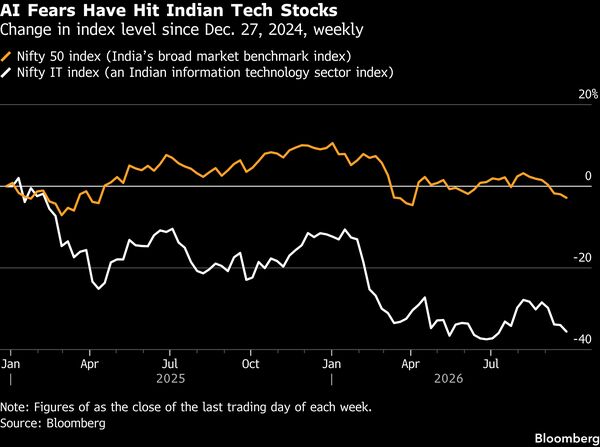
目前,印度IT企业的股价表现不佳,这表明投资者已经将这种风险纳入了考量之中;如果这种趋势真的成为现实,印度的产出和就业都将受到冲击。
Stock market moves—with India’s IT firms underperforming on AI disruption fears—suggest investors are pricing in that risk. If it crystallizes, output and employment will both take a hit.
从历史经验来看,我们有理由保持乐观:印度的IT企业曾多次根据技术变革调整自己的商业模式。AI或许会成为印度企业向上游价值链迈进的又一次机会——通过开发基于AI的产品和服务来实现这一目标。印孚瑟斯(Infosys)和塔塔咨询服务公司(TCS)已经在积极进行这样的转型。此外,印度庞大的工程师人才储备仍将是其重要的竞争优势。
History offers reason for optimism. India’s IT firms have repeatedly adapted their business models to technological changes. AI could be the next opportunity to move up the value chain by developing AI-enabled products and services. Infosys and TCS are making the shift. And India’s vast pool of engineers will remain a competitive advantage.
实现人工智能(AI)的潜力将面临诸多挑战。AI的普及程度会受到多种因素的影响,包括AI系统的可靠性、自动化任务的盈利能力、相关法规以及硬件资源的可用性。这些因素难以被量化或准确评估。
Realizing AI’s promise will be challenging. Diffusion will be shaped by a range of factors, including the reliability of AI systems, the profitability of automating tasks, regulation and access to hardware. Quantifying those constraints is tough to do.
一项美国的研究表明,目前仅有约25%的技术上可以通过AI实现自动化的任务具有实际的经济价值(即这些任务能够带来盈利)。如果部署成本持续下降,这一比例可能会上升到55%。
One US study suggests only about 25% of what’s technically feasible to automate with AI is currently profitable. If deployment costs steadily decline, that could rise to 55%.
AI基础设施对于AI的普及至关重要。随着AI的应用从聊天机器人扩展到更复杂的智能系统及实时处理系统,对计算能力的需求将大幅增加。因此,能否获得可靠的计算资源将直接决定这项技术能够以多快的速度、多低的成本得到广泛应用。
AI infrastructure will be critical for diffusion. As adoption shifts from chatbots toward AI agents and real-time systems, inference demand will soar. That means reliable access to computing power will determine how broadly and cheaply the technology can be deployed.
虽然印度的数据中心容量正在迅速扩张,但仍远低于美国和中国的水平。这使得印度企业不得不依赖外国控制的基础设施,从而面临价格波动、服务可用性以及系统连续性等方面的风险。
dia, data center capacity is expanding rapidly but remains well below levels in the US and China. That leaves firms dependent on foreign-controlled infrastructure and exposed to price, availability and continuity risks.
为了解释这些障碍,有一种方法是根据各国的盈利能力以及国际货币基金组织(IMF)制定的“AI准备指数”来调整潜在的生产率提升幅度。该指数衡量了各国在数字化和制度层面利用AI技术的能力。印度的AI准备程度仅为美国的60%,这意味着AI对印度经济增长的促进作用可能仅限于0.1%至0.3%。
One way to account for these and other hurdles is to scale down the potential productivity gains by the profitability share and the International Monetary Fund’s AI preparedness index, which gauges countries’ digital and institutional capacity to harness the technology. India’s readiness is 60% of that of the US. This reduces the boost to 0.1-0.3 ppt.
AI确实可以加速印度政府所追求的生产率提升。但要充分发挥其潜力,还需要确保企业能够获得可靠的计算资源,加快AI技术的应用,并推动产业向更高附加值的领域转型。印度已经在为此做准备:国内的企业集团(如Reliance Industries和Adani Group)以及全球科技巨头(如Google和Microsoft)都在数据基础设施和云计算领域进行了大量投资。此外,政府提出的针对使用印度数据中心的外国云计算服务提供商的20年税收优惠政策也有望吸引更多投资。
AI can accelerate the productivity gains Modi is seeking. But capitalizing on its potential will require ensuring reliable access to computing power, accelerating adoption and shifting to higher-value operations. India is laying some of the foundations. Domestic conglomerates like Reliance Industries and Adani Group and global tech giants such as Google and Microsoft are investing heavily in data infrastructure and cloud capacity. The government’s proposed 20-year tax holiday for eligible foreign cloud providers using India-based data centers could attract further investment.
“IndiaAI计划”为超过45,000个图形处理器(GPU)提供了补贴,从而让更多企业能够使用计算资源,而不仅仅是那些大型企业。不过,印度仍需依赖进口的先进计算设备,这使得其计算能力的使用受到全球供应链限制以及美国出口政策变化的影响。印度与美国签署的关于扩大GPU和数据中心设备贸易的协议,或许有助于降低这种风险。
The IndiaAI Mission gives subsidized access to more than 45,000 GPUs, widening access to computing power beyond the largest firms. India will still depend on imported frontier accelerators, leaving access exposed to global supply constraints and changes in US export rules. The India-US agreement to expand trade in GPUs and data center equipment could help mitigate that risk.
仅仅建设基础设施并不能确保生产力的大幅提升。企业还需要将人工智能技术整合到现有系统中,重新组织工作流程,并培养大规模应用这些技术所需的技能。对于印度的IT行业来说,真正的考验在于:是否会有足够多高价值的工作机会出现,以抵消常规服务所面临的日益增加的压力。
Building infrastructure alone won’t guarantee a productivity windfall. Companies still need to integrate AI into existing systems, reorganize workflows and nurture the skills needed to use it at scale. For India’s IT sector, the remaining test will be whether enough higher-value work emerges to offset mounting pressure on routine services.