以色列总理本杰明·内塔尼亚胡周日公布了更新的国家安全 doctrine,并展示了竞争性地区联盟的地图,表明其安全方针侧重于先发制人的军事行动、扩大缓冲区以及寻求新的地区伙伴关系。
Israeli Prime Minister Benjamin Netanyahu has unveiled an updated national security doctrine and displayed a map of rival regional alignments, signalling a security approach that prioritises preemptive military action, the expansion of buffer zones, and the pursuit of new regional partnerships.
该文件由以色列国家安全委员会协助制定,由总理办公室于周日发布,距离以色列议会选举仅剩九天,此次选举可能宣告内塔尼亚胡执政时代的终结。文件概述了一项正式政策:通过军事行动而非遏制来防范被感知的威胁——这一政策在过去几年中已多次付诸实践,当时以色列正对邻国发动多场战争和袭击。
The document was developed with the assistance of Israel’s National Security Council and published by the Prime Minister’s Office on Sunday, just nine days before Israel’s parliamentary elections that could spell the end of Netanyahu’s time in office. It outlines a formal policy of preventing perceived threats through military action rather than containment – a policy that has already been seen in action over the past few years, as Israel pursues multiple wars and attacks on its neighbours.
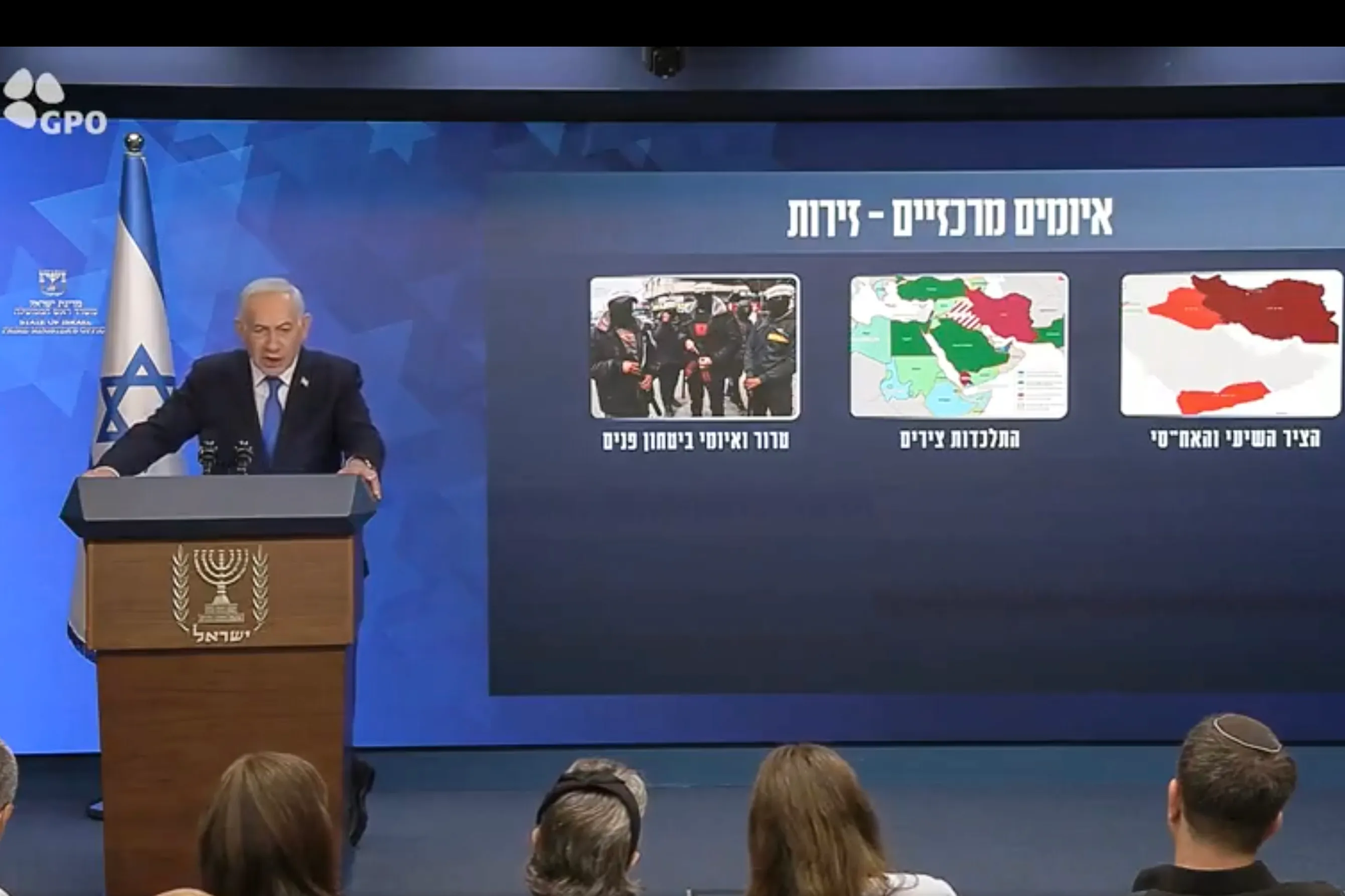
内塔尼亚胡在今日早些时候关于以色列安全的演讲中展示了这张划分为不同派系的中东地图。
Netanyahu displayed this map of the Middle East, divided into different factions, during his speech on Israel's security earlier today.
2026年10月18日 地图发布的时间具有特殊的政治意义,内塔尼亚胡正面临对其执政行为的批评、正在进行的腐败审判、他对2023年10月7日袭击事件的处理以及随后爆发的战争的质疑,而他正努力留任。
October 18, 2026 The timing of the map’s release carries particular political significance, with Netanyahu fighting to retain power amid criticism of his conduct in power, the ongoing corruption trial he faces and his handling of the October 7, 2023, attacks, as well as the wars that followed.
随着10月27日选举日的临近,内塔尼亚胡正试图强化自己作为以色列“安全先生”的形象,希望赢得那些可能不认同他其他政策或行为,但仍认为他是最有可能捍卫国家的领导人的以色列选民的支持。
As the October 27 election day draws closer, Netanyahu is attempting to bolster his credentials as Israel’s ‘Mr Security’, hoping to get the votes of Israelis who may not like some of his other policies or behaviour, but still view him as the most likely leader to defend the country.
内塔尼亚胡周日获得了美国总统唐纳德·特朗普的背书,他在简报会上表示,以色列可能面临两年后华盛顿出现一个远不那么支持以色列的政府的可能性,届时特朗普总统任期将结束。
Netanyahu, who did get the endorsement of US President Donald Trump on Sunday, said during the briefing that Israel could face the possibility of a far less supportive administration in Washington in two years, after the end of the Trump presidency.
“两年后……一位对以色列极为敌视的总统可能在美国上台,”内塔尼亚胡警告道。
“In two years, a president… who is extremely hostile to Israel could come to power [in the United States],” Netanyahu warned.
因此,他主张以色列必须“扩大我们的联盟网络,发展使我们成为其他国家宝贵资产的能力”,以此作为美国对以色列政策发生变化时保护自己的方式。
He therefore argued that Israel must “expand our network of alliances and develop capabilities that make us a valuable asset” to other countries as a way of protecting itself if US policy towards it changed.
分析人士指出,这些言论表明,内塔尼亚胡正试图将自己的领导力描绘为应对以色列地区军事挑战和外交孤立的关键,同时也在安抚恐惧中的选民。
The comments, according to analysts, suggest that Netanyahu is seeking to portray his leadership as essential to navigating both Israel’s regional military challenges and its diplomatic isolation, all while keeping a fearful electorate reassured.
马尔科姆·H·克尔卡内基中东中心研究副主任莫哈纳德·哈杰·阿里解释说,该战略呈现的核心是围绕竞争性的地区集团和缓冲区展开。
Mohanad Hage Ali, deputy director for research at the Malcolm H Kerr Carnegie Middle East Center, explained that the strategic presentation centred on competing regional blocs and buffer zones.
哈杰·阿里指出,这一框架“孕育并滋生存在性恐惧,这将导致以色列选民感到需要一位果断的领导人”。
That framework “incubates and nurtures existential fears, which would lead Israeli voters to feel the need for a decisive leader”, Hage Ali noted.
在他的评估中,内塔尼亚胡有望从以色列公众对地区威胁的恐惧中获益,通过将自己塑造成能够应对这些威胁的熟悉领导人,从而在选民眼中成为“熟悉的恶魔”,正如分析师所说,即那些在敏感时期不愿接受政治变革的选民。内塔尼亚胡的政治对手迅速对此叙事进行反驳。
In his assessment, Netanyahu stands to benefit from the Israeli public’s fear of regional threats by presenting himself as a familiar leader capable of managing them, making him “the devil you know”, as the analyst put it, to voters reluctant to embrace political change at a sensitive time. Netanyahu’s political opponents have been quick to push back against that narrative.
即将到来的选举中,总理的主要挑战者之一加迪·艾森科特表示,所发表的主义是“两页空洞的内容,充斥着与安全概念毫无关联的口号”。另一位前总理雅伊尔·拉皮德则将该文件描述为“表面的”。
Gadi Eisenkot, one of the prime minister’s main challengers in the upcoming election, said that the published doctrine was “two hollow pages, full of slogans that have nothing to do with a security concept”. Another, former Prime Minister Yair Lapid, described the document as “superficial”.
内塔尼亚胡在简报会上展示的地图最初于五月由德国政治基金会弗里德里希·艾伯特基金会(Friedrich-Ebert-Stiftung)发布。该地图将中东和非洲部分地区划分为竞争性集团,突显了该地区复杂的联盟与竞争网络。这些网络包括国家、未被承认的实体以及非国家行为体。
The map displayed during Netanyahu’s briefing was originally published in May by Friedrich-Ebert-Stiftung, a German political foundation. It divides the Middle East and parts of Africa into competing blocs, highlighting the region’s complex network of alliances and rivalries. Those networks include states, unrecognised entities and non-state actors.
该地图标注了以色列与阿拉伯联合酋长国的结盟关系,被描述为“六边形联盟”,同时还标注了埃及、土耳其、巴基斯坦和沙特阿拉伯的另一组群体——后三国于8月签署了麦加共同防御条约——被标注为“逊尼钻石联盟”。它还将伊朗及其地区盟友描绘为一个独立的轴线。
The map identifies an Israel-United Arab Emirates alignment, described as the “Hexagon Alliance”, alongside a separate grouping of Egypt, Turkiye, Pakistan and Saudi Arabia – the latter three of which signed the Mecca mutual defence pact in August – labelled the “Sunni Diamond Alliance”. It also depicts Iran and its regional allies as a separate axis.
该地图旨在说明已发表安全 doctrine 中概述的问题,呈现一个以色列面临多重威胁的地区,以色列正试图在更广泛的地区培育的联盟,以及对“缓冲区”——即占领其他国家领土——的感知需求。
The map serves to illustrate the issues outlined in the published security doctrine, presenting a region where Israel faces multiple threats, the alliance that Israel is seeking to cultivate across the wider region, and the perceived need for “buffer zones” – the occupation of territory in other countries.
以色列目前在加沙和黎巴嫩南部对领土的非法占领说明了扩大缓冲区方式可能带来的后果。
Israel’s existing illegal occupation of territory in Gaza and southern Lebanon illustrates the potential consequences of expanding the buffer zone approach.
哈吉·阿里警告称,继续推行以扩大军事控制为核心的做法可能在安全缓冲区的名义下导致“更多冲突和更多民族清洗”。
Hage Ali warned that continuing to pursue an approach built around expanding military control could lead to “more conflict and more ethnic cleansing” under the guise of security buffers.
内塔尼亚胡所展示的地图中一个显著的元素是其明确将非国家行为体指定为友好实体。
A striking element of the map displayed by Netanyahu is its explicit designation of non-state actors as friendly entities.
该地图突出了苏丹准军事化的快速支援部队控制的领土以及哈夫塔尔自称为利比亚国家军队的领土,这些地区被视为与以色列和阿拉伯联合酋长国合作的轴线内的区域。
The map highlights territories controlled by the paramilitary Rapid Support Forces in Sudan and Khalifa Haftar’s self-styled Libyan National Army within an alignment deemed cooperative to Israel and the United Arab Emirates.
哈吉·阿里解释称,以色列将这些行为体视为务实的伙伴,或至少是在更广泛的战略格局中的合作实体。然而,将这些群体与以色列公开关联可能损害它们在阿拉伯世界的国内声誉。
Israel views these actors as pragmatic partners or at least cooperative entities in a broader strategic grid, Hage Ali explained. However, the public association of these groups with Israel threatens to damage their domestic standing across the Arab world.
这反映了内塔尼亚胡的当前优先事项,即“以色列人的想法比盟友的声誉和这些联盟的可行性更重要”,哈吉·阿里补充道。
That reflects Netanyahu’s immediate priorities, where “what Israelis think matters more than the reputation of your allies and the viability of these alliances”, Hage Ali added.
将中东描绘为被竞争性联盟划分的地区也可能对内塔尼亚胡更广泛的外交野心构成风险。
The portrayal of the Middle East as a region divided into competing alliances also carries risks for Netanyahu’s broader diplomatic ambitions.
今年早些时候,内塔尼亚胡提出了“六边形联盟”构想,设想以色列、印度、希腊、塞浦路斯以及未命名的阿拉伯、非洲和亚洲伙伴之间的合作,以对抗他所描述的“激进”地区联盟。
Earlier this year, Netanyahu proposed a “hexagon of alliances”, envisaging cooperation between Israel, India, Greece, Cyprus and unnamed Arab, African and Asian partners, against what he described as “radical” regional alliances.
该提议的联盟尚未正式成立,以色列和国际媒体的评论人士将其描述为一种品牌塑造行为,而非具有约束力的军事协定,指出像印度这样的国家更倾向于不结盟和务实贸易,而非意识形态僵化的集团。对德黑兰及其地区伙伴而言,这一地图也提供了强大的政治杠杆。
The proposed grouping has not been established as a formal alliance, and commentators in Israel and the international press have described the project as a branding exercise rather than a binding military pact, noting that countries like India prioritise non-alignment and pragmatic trade over ideologically rigid blocs. For Tehran and its regional partners, the map also offers potent political leverage.
哈吉·阿里强调,这一视觉布局“肯定会帮助他们的宣传机器”,为真主党和其他伊朗盟友提供证据,以强化以色列试图扩张和主导该地区的叙事。
Hage Ali emphasised that the visual layout “will certainly help their propaganda machine”, providing Hezbollah and other Iranian allies with evidence to reinforce the narrative that Israel seeks to expand and dominate the region.