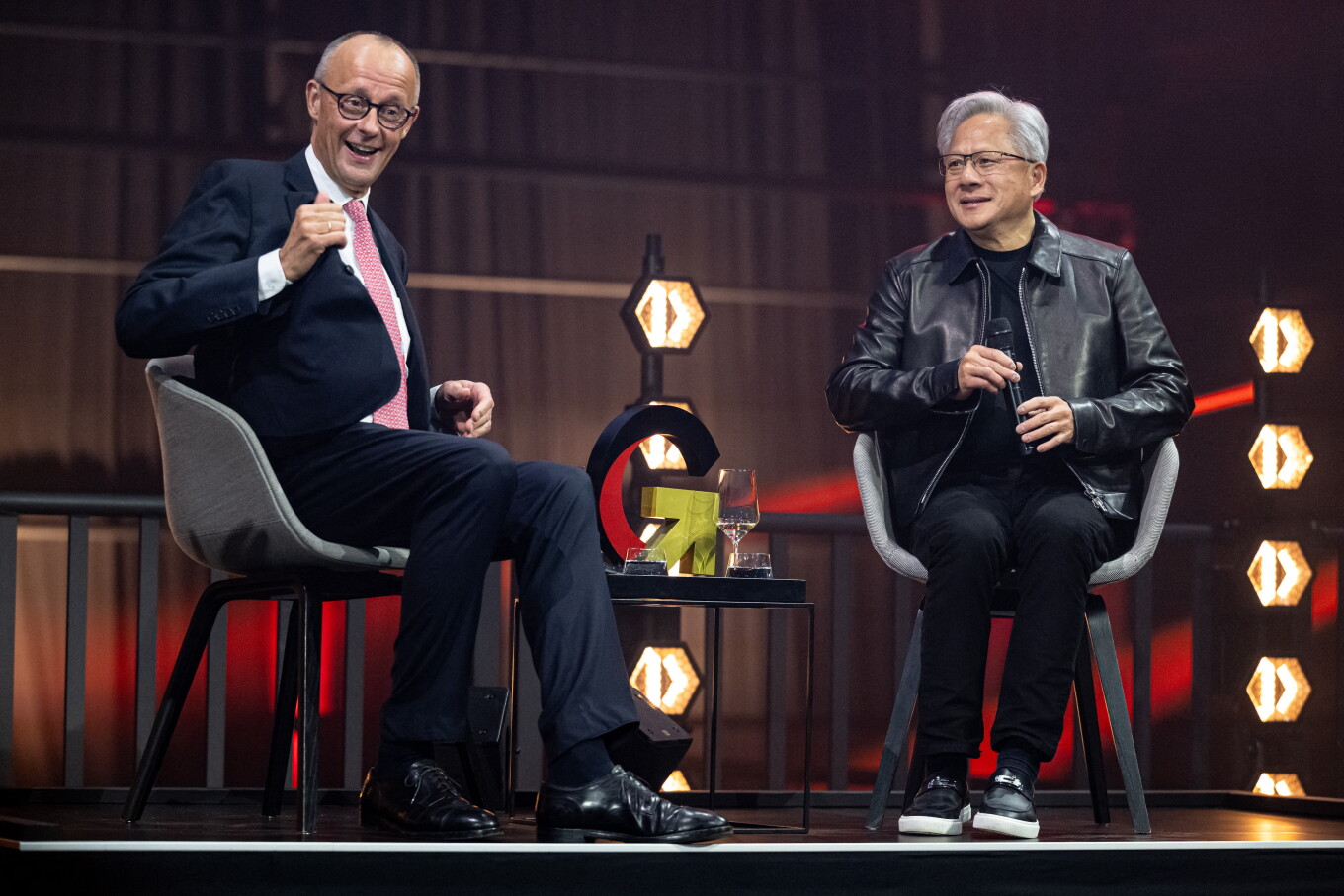
大卫·麦克休 法兰克福,德国 — — 英伟达首席执行官黄仁勋呼吁德国的汽车和工业机械制造商迅速采用人工智能,通过利用其制造数据和专业知识的丰富资源,来“重塑”该国困难的商业模式。
DAVID MCHUGH FRANKFURT, Germany — Nvidia CEO Jensen Huang urged Germany’s makers of cars and industrial machines to quickly adopt artificial intelligence to “re-engineer” the country’s struggling business model by tapping its wealth of manufacturing data and expertise.
黄仁勋的公司设计了像Anthropic和OpenAI这样的公司用于开发人工智能应用的强大计算机芯片和软件。他表示,数字技术永远不会取代制造业以及德国在这一领域拥有丰富经验的汽车和机器人工程世界。
Huang, whose company designs the powerful computer chips and software used by companies like Anthropic and OpenAI to develop AI applications, said that digital technology would never replace manufacturing and the engineering world of cars and robots where Germany has vast experience.
或者说,正如他所说,“电子永远不会取代原子。”但他表示,通过拥抱技术,工业将受益匪浅。
Or, as he put it, “electrons will never replace atoms.”But he said industry would benefit by leaning into technology.
“下一波人工智能是物理层面的。这是人工智能与物理世界互动的领域:机器人、制造业、汽车、重工业,”黄仁勋周一在柏林举行的投资会议上,与德国总理弗里德里希·默茨的讨论中说道。
“The next wave of AI is physical. This is where AI interacts with the physical world: robotics, manufacturing, cars, heavy industry,” Huang said Monday during a discussion with German Chancellor Friedrich Merz at an investment conference in Berlin.
“因此,人工智能只能增强你们的能力。它不会取代你们的能力。所以要善用这项技术。”黄仁勋表示,德国在制造业方面的数据和专业知识“是你们的自然资源,属于国家”,但需要更好地利用人工智能。“这场工业革命如此强大,如此有力。你们没有第二次机会,”他说。
“And so AI can only augment your capability. It will not replace your capability. So take advantage of the technology.”Huang said Germany’s data and expertise on manufacturing “is your natural resource, it belongs to the nation” but it needs to take better advantage of AI. “This industrial revolution is so mighty, so powerful. You don’t have another chance,” he said.
像默茨这样的欧洲领导人正将人工智能视为潜在的增长来源,但也对欧洲在美国科技公司领域的依赖程度表示担忧。欧洲拥有丰富的高质量公共部门和机器可读的制造数据,这些数据可作为人工智能的“原料”,前欧洲央行行长马里奥·德拉吉曾指出,这是欧洲在人工智能领域与美国和中国竞争的一个机遇。
European leaders like Merz are looking to AI as a potential source of growth but are also concerned about the extent of European dependence on U.S. tech companies in the field. Europe’s wealth of high quality public-sector and machine-readable manufacturing data could serve as grist for AI, an opportunity cited by former European Central Bank head Mario Draghi as an area where Europe could compete with the U.S. and China in the AI field.
黄仁勋和默茨表示,人工智能是德国所谓“中小企业”(即高度专业化工业部门中的数百家中小企业)的一个机遇。
Huang and Merz said AI was an opportunity for Germany’s so-called “mittelstand,” the hundreds of small- and medium-sized companies in highly specialized industrial sectors.
默茨正努力在疫情后多年近乎停滞之后复兴德国的经济增长。经济面临的逆风包括:由于乌克兰入侵导致失去廉价俄罗斯天然气后能源价格高企;中国在德国曾经占优势的汽车等行业中的竞争;以及拖延项目多年的过度官僚程序和审批。所有这些因素都给一个高度依赖出口复杂机器制造的经济蒙上了阴影,包括汽车、火车、飞机和工厂设备。
Merz is struggling to revive growth in Germany after years of near-stagnation after the pandemic. Among the economy’s headwinds are high energy prices after losing cheap Russian natural gas due to the invasion of Ukraine , competition from China in sectors like autos where Germany once dominated, and excessive red tape and permissions that hold up projects for years. All that has put a damper on an economy heavily oriented toward building complicated machines for export, including cars, trains, aircraft and factory equipment.
欧洲在建设提供人工智能应用训练所需巨大算力的数据中心方面落后于美国,并且担心欧洲公司的敏感数据在美国公司拥有的服务器上,即便这些服务器位于欧洲,也可能因美国的传票和刑事令状而暴露于美国法律体系之中。
Europe lags the U.S. in building out the data centers that offer the massive computing capacity to train artificial intelligence applications, and faces concerns over the security of European companies’ sensitive data against subpoenas and criminal warrants on servers owned by U.S. companies and thus exposed to the U.S. legal system even if they’re in Europe.
黄似乎通过敦促德国进口人工智能技术来应对这些担忧,但同时补充说:“你们不应输出文化,不应输出价值观,不应输出知识。”黄表示,德国应该“利用人工智能。让他们编码,让他们编程,让他们教授这种人工智能并将其留在德国,让我们重新塑造——正如总理所说的——德国。这是你们实现这一点的机会。”
Huang appeared to address such concerns by urging Germany to import AI technology but adding that “you should not export your culture, export your values, export your knowledge.”Huang said Germany should “take advantage of artificial intelligence. Let them codify, let them program, let them teach this artificial intelligence and keep it here in Germany, and let’s re-engineer, the chancellor’s words, Germany. This is your chance to do it.”