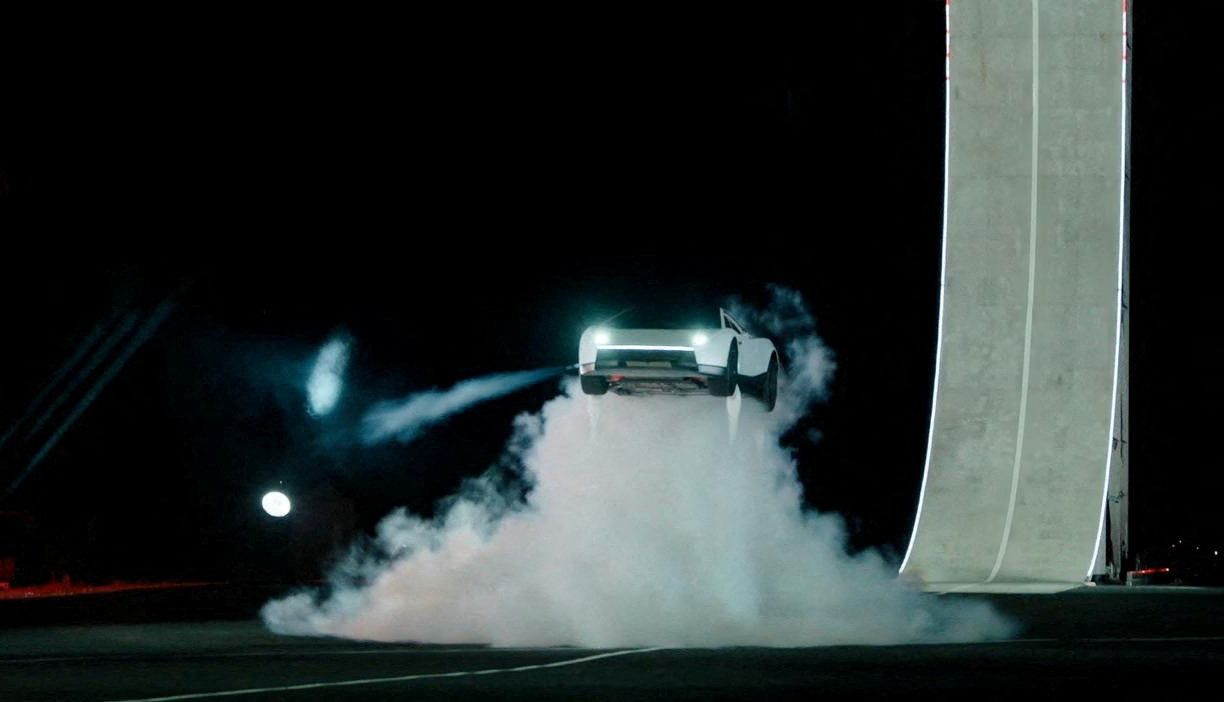
新款特斯拉 Roadster 简直是科幻产物:它能冲向空中、完成桶滚动作,然后借助冷气火箭推进器轻柔落地。
The new Tesla Roadster is science fiction: It can zoom into the air, perform barrel rolls, and then plop down softly using cold-gas rocket thrusters.
上周,这款 Roadster 在得克萨斯州的一处火箭设施发布,是工程学的胜利 —— 一件供超级富豪玩赏的精致玩具,前提是它真能投产(预订条款上的免责声明暗示 CEO 埃隆·马斯克本人也存疑)。
Unveiled last week at a rocket facility in Texas, the Roadster is a triumph of engineering — an exquisite toy for the super-rich, if it ever reaches production (the disclaimers on the advance orders suggest CEO Elon Musk himself has doubts).
然而,具有讽刺意味的是,它同时也标志着一种失败:Roadster 并非能在消费市场扭转局势、击败比亚迪等对手的车型。相反,它以另一种方式预示着未来,一个中国不仅在汽车领域,而且在机床、医药、造船等所有领域都掌握全球大规模制造权的未来。
Yet, paradoxically, it also represents a defeat: The Roadster isn’t a vehicle that will turn the tables on China, outcompeting the likes of BYD in the consumer market. Instead, it represents the future in another way, one in which China owns global mass manufacturing not just in cars but everything else — machine tools, pharmaceuticals, ships.
随着低价中国出口商品淹没全球市场,从华盛顿到布鲁塞尔再到柏林的政界人士,多将问题归结为中国产能过剩,并竖起贸易壁垒以保护本国产业。例如,欧盟与中国最近就中国混合动力汽车设定配额并加征关税达成一致,并正考虑对其他工业品类实施类似限制。
As low-priced Chinese exports swamp global markets, politicians from Washington to Brussels to Berlin diagnose the problem largely as one of Chinese overproduction, and are putting up trade barriers to protect their domestic industries. The EU and China, for example, recently agreed to set quotas with tariffs for Chinese hybrid cars, and are considering similar restrictions on other industrial categories.
但这忽视了更广泛的挑战。中国激增的出货量远不止是剩余产能 —— 即中国工厂产出与国内疲软经济所能消化量之间的差额。这是一项蓄意战略,在该国的五年工业规划中有明确表述,归根结底代表了中国对国家权力的追求。
But this misses the broader challenge. China’s surging shipments are much more than just surplus production, the difference between what comes out of Chinese factories and what can be sold domestically in a sagging economy. They are a deliberate strategy, clearly stated in the country’s five-year industrial plans and, ultimately, represent China’s quest for national power.
对西方产业领袖而言,其含义关乎生存:他们要么像特斯拉推出 Roadster 那样,沿着技术阶梯向日益稀缺的利基市场攀登;要么面临被中国竞争对手摧毁的风险,大众汽车在中国 —— 仍是其最大单一市场 —— 的现状便是明证。
The implication for Western industry leaders is existential: They can either climb the technological ladder into increasingly rarefied niches — like Tesla, with its Roadster — or risk being destroyed by Chinese rivals, as is currently happening to Volkswagen in China, still its largest single market.
事实上,有影响力的中国战略家根本不承认“产能过剩”这一概念。北京大学国家发展研究院教授陆峰认为,中国的“产业社会主义”与美国的“金融资本主义”正走向一场对决——他警告说,屈从于外部压力遏制“产能过剩”将是“自己捆绑自己的手脚”。在这种思维逻辑下,既然中国对权力的渴望是无限的,就不存在生产过多的问题。布鲁金斯学会专门研究中国产业政策的研究员陈凯尔(Kyle Chan,音译)将陆峰这一派经济民族主义称为“产业极大主义”。
In fact, influential Chinese strategists don’t recognize the concept of overproduction at all. Lu Feng, a professor at Peking University’s School of Government, sees a showdown on the way between China’s “industrial socialism” and the US’ “financial capitalism” — and he warns that caving to foreign pressure to curb “overproduction” would be “tying our own hands.”In this way of thinking, since China’s desire for power is limitless, there can be no question of producing too much. Kyle Chan, a researcher specializing in China’s industrial policies at the Brookings Institution, labels Lu’s brand of economic nationalism, “industrial maximalism.”
那么,或许我们该把Roadster(Roadster,特斯拉首款量产车型)称为其对立面——“产业极小主义”的典型例子。
Perhaps, then, we should call the Roadster a prime example of its opposite: “industrial minimalism.”
在全球主要车企中,特斯拉曾拥有最好的机会掌揣未来出行的主导权。确实,其于2019年建成的上海超级工厂,以及由此带动的本土供应链,成为中国新能源汽车产业的催化剂。但马斯克如今已清醒地认识到他亲手催生的竞争对手。他在2024年警告称,如果没有贸易壁垒,中国将“几乎摧毁世界上大多数其他车企”。马斯克现在押注特斯拉的未来在于成为机器人制造商。
Among leading global automakers, Tesla had the best chance of owning the future of mobility. Indeed, its Shanghai gigafactory, built in 2019, and the local supply chains it developed were a catalyst for the entire Chinese EV industry. But Musk is now clear-eyed about the competition he helped spawn. Without trade barriers, he warned in 2024, China would “pretty much demolish most other car companies in the world.”Musk is now betting Tesla’s future on becoming a robot maker.
但他在那个领域也将面临同样的问题。来自中国的挑战是系统性的,而非针对特定行业。中国的产业机器旨在通过压倒性的规模经济将产品商品化、压低价格、征服全球市场——不计财务回报。这不是关于利润最大化,而是关于权力最大化。
But he’ll run into the same issues in that sector, too. The challenge from China is systemic, not industry specific. The country’s industrial machine is set up to commoditize products through overwhelming economies of scale, to bring down prices, and conquer global markets — regardless of financial return. This is not about profit maximization. It’s about power maximization.
在《卫报》撰文的科技记者常策近期走访了五座城市的11家中国机器人制造商,他看到的未来是:美国利用其先进的研究能力,试图打造终极机器人——一种能“修剪草坪、遛狗、照看孩子”的机器;而中国则以极低的成本,为这些任务中的每一个量产出实用的机器人。目前,中国已占全球新增工厂机器人的60%。
Writing in The Guardian, the tech reporter Chang Che, who recently visited 11 Chinese robot makers across five cities, sees a future where the US leverages its advanced research capabilities to try to build the ultimate robotic machine — one that can “mow your lawn, walk your dog, and babysit your children” — while China cranks out functioning robots for each of those tasks at a fraction of the price. Already, China accounts for 60% of all the world’s new factory robots.
中国也具备满足全球电动汽车100%需求的产能。即将出版新书《美国轮子,中国路:全球电动汽车竞赛如何重塑世界》的作者邓迈克对《华尔街日报》表示,留给西方车企的选择只剩下“向高端迈进,否则就被挤出局”。特斯拉Roadster(Roadster)简直是要冲上云霄。其他车企将不得不实现类似的垂直跃升,否则就会被淘汰出局。
It also has the capacity to supply 100% of global demand for EVs. Michael Dunne, the author of the forthcoming , told The Wall Street Journal that what remains for Western carmakers “is to move up or get pushed out.”The Tesla Roadster is, quite literally, aiming for the skies. Other carmakers will have to make a similar vertical ascent, or bite the dust.