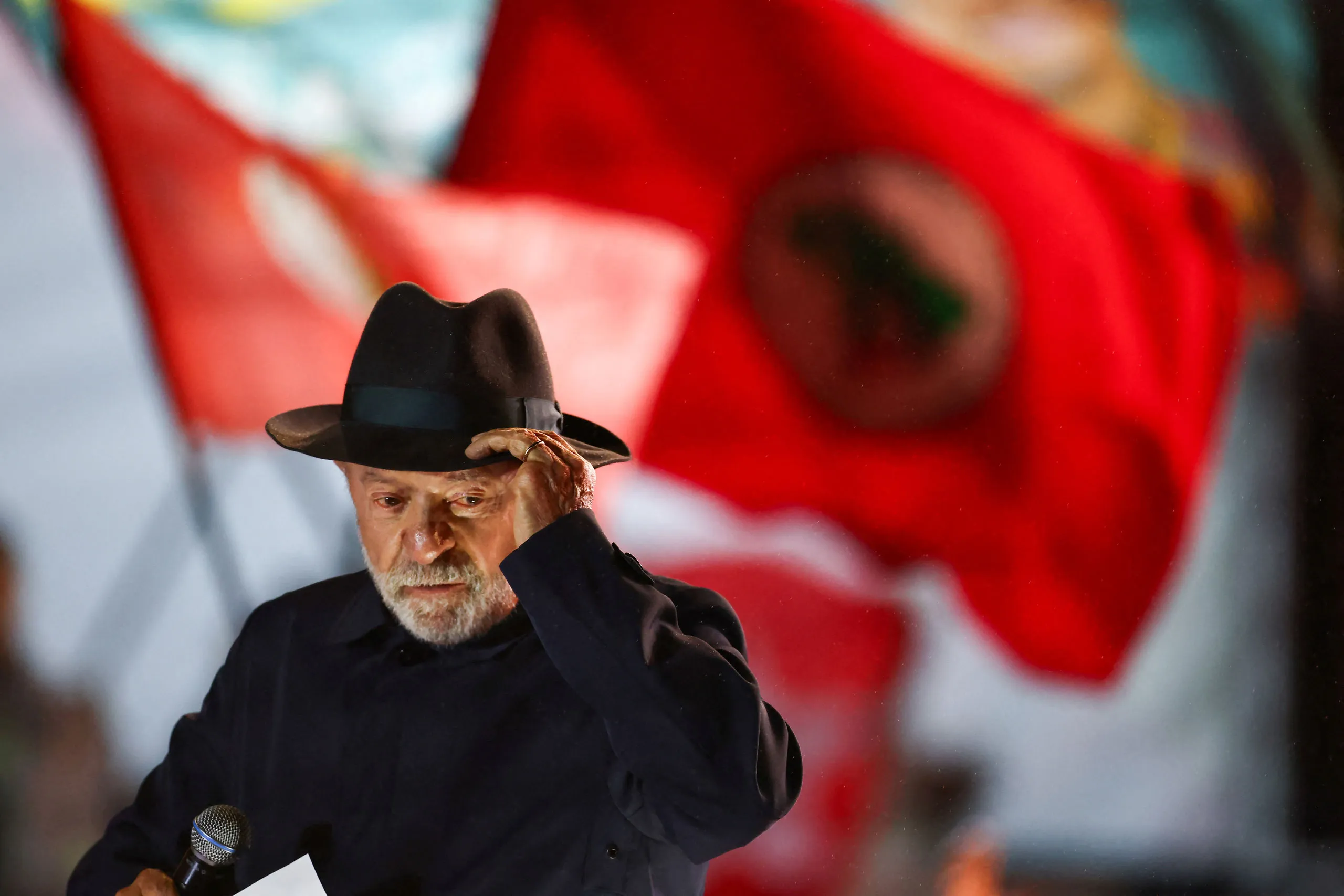
在巴西总统卢伊兹·伊纳西奥·卢拉·达席尔瓦最后一次竞选活动的最后几天,他的支持者们选择了一首英国经典歌曲作为竞选主题曲。这首歌是大卫·鲍伊(David Bowie)和皇后乐队(Queen)于1981年发行的热门单曲《Under Pressure》。这首歌曲被用来制作了一段病毒式传播的视频,视频中展示了这位80岁政治家的半世纪奋斗历程:从一个出身极度贫困的普通工会成员,成长为工人阶级的坚定捍卫者。
In the final days of his final campaign, supporters of the Brazilian President Luiz Inácio Lula da Silva turned to a British classic. David Bowie and Queen’s 1981 hit, “Under Pressure,” became the soundtrack of a viral video showing scenes from the eighty-year-old Lula’s half century in politics. Here was the humble trade unionist, born into extreme poverty, standing up as a fiery-eyed tribune of the workers. “Can’t we give ourselves one more chance?” the song implores, over clips of a younger, scraggly-bearded Lula rallying the people, casting his vote in the ballot box, and winning elections.
歌曲中充满恳求:“我们难道就不能再给自己一次机会吗?”视频中出现了年轻时的卢拉——他留着蓬乱的胡须,正在动员民众投票、赢得选举的场景;随着歌曲的高潮部分,我们还能听到这样的歌词:“我们为什么就不能再给爱一次机会呢?”视频中还展示了卢拉被热情的群众包围、亲吻巴西国旗,以及他与来自全国各地的同胞们拥抱的感人画面——从圣保罗的红色衬衫支持者,到亚马逊地区的原住民领袖。
“Why can’t we give love that one more chance?” we hear as the song crescendoes, amid footage of Lula mobbed by ecstatic crowds, kissing the Brazilian flag, and embracing a kaleidoscope of his countrymen, from red-shirted throngs in São Paulo to Indigenous leaders from the Amazon. Then there’s an older Lula, back on the streets after being freed from prison for what his allies always believed were unjust corruption charges, and mobilizing opposition to Brazil’s far right in defense of the country’s democracy.
视频中还有卢拉出狱后的情景:他再次走上街头,坚决反对巴西极右翼势力,捍卫国家的民主。歌曲的最后一句是:“这是我们的最后一舞……”随着巴西人本周日进行总统选举的第二轮投票,这首歌曲的旋律可能会就此画上句号。卢拉面临着可能终结其政治生涯的失败;目前看来,他的对手弗拉维奥·博索纳罗(Flavio Bolsonaro)更有可能获胜。
The song subsides: “This is our last dance.”The music could stop this weekend, as Brazilians vote in the second round of their Presidential election. Lula faces a career-ending defeat, with the odds favoring Flavio Bolsonaro, a hard-right challenger who, like his jailed father, the former President Jair Bolsonaro, is bent on unravelling Lula’s legacy. The first round, which took place on October 4th, was grim for Lula. In a surprise result, the incumbent placed two points behind Bolsonaro, who is currently a senator, while right-wing parties and candidates surged in congressional and state elections across the country.
这位极右翼候选人与其被监禁的父亲(前总统贾伊尔·博索纳罗,Jair Bolsonaro)一样,一心想要破坏卢拉的政治遗产。10月4日举行的第一轮选举对卢拉来说非常不利:出人意料的是,现任总统卢拉的得票率落后于博索纳罗两个百分点;与此同时,全国各地的右翼政党及候选人都在议会和州级选举中取得了显著胜利。
巴西正逐渐成为过去两年中众多转向右翼的拉丁美洲国家中的一个典型例子——这一变化与特朗普政府对该地区的意识形态影响密切相关。
Brazil is now poised to become the most important entry on a long list of Latin American states that have swung to the right in the past two years, a shift that runs in concert with the Trump Administration’s ideological vision for the hemisphere. (If Lula loses, only Mexico, Guatemala, and Uruguay will remain as countries with elected left-leaning governments.)
- 人名和地名一律使用中文汉字进行转写;品牌名称和产品名称可保持原样(即使用拉丁字母)。
Even if Lula pulls out a narrow victory, he could spend his next term significantly constrained by a federal structure dominated by the right.
翻译内容:
如果卢拉落败,那么只有墨西哥、危地马拉和乌拉圭仍会由左翼政府执政。
即使卢拉以微弱优势获胜,他在下一任任期内的行动也会受到由右翼势力主导的联邦体制的严重限制。
He’s also going up against history: the first-round winner in Brazil’s Presidential race has won the second-round vote in every election stretching back to 1989, the first direct Presidential election held in the country after it was redemocratized following years of military dictatorship.
此外,他的竞选还面临着历史惯例的挑战:自1989年以来,巴西每次总统选举中,第一轮的获胜者都赢得了第二轮的投票——那次选举是该国在经历多年军事独裁后首次举行的直接总统选举。卢拉也参加了1989年的选举,但在决选中落败。然而,他后来成为了巴西现代民主时代最具影响力的人物,其领导的工人党也成为南美洲的主要政治力量之一。
Lula ran in that 1989 election, too, and lost in the runoff. But he went on to become the most consequential figure in Brazil’s modern democratic era, and his Workers’ Party one of the leading political forces in South America. He was finally elected to the Presidency in 2002 and served two terms, until the end of 2010, harnessing a commodity boom to invest in major social spending, including welfare programs, that lifted tens of millions out of poverty.
2002年,他最终当选总统并连任两届,直至2010年底。在商品价格飙升的背景下,他大力投资于社会福利项目,帮助数千万人摆脱了贫困。他还推动巴西成为全球气候行动的领导者,有效减缓了亚马逊雨林的砍伐速度。此外,他带领巴西站在了“全球南方国家”的前列,在外交政策上坚持独立立场,使巴西成为重塑全球秩序的重要力量之一。
He positioned Brazil as a world leader in climate action, helping slow the deforestation of the Amazon. And he led Brazil into the vanguard of the Global South, charting an independent line in foreign policy that placed his country as one of the new pillars of an aspirational reconfigured global order. Constitutional rules prohibiting more than two consecutive terms in office led to his being succeeded in 2011 by his close political ally Dilma Rousseff, whose tenure suffered tougher economic headwinds and was brought to an end by a sprawling corruption scandal that implicated a swath of Brazil’s political and business establishments.
由于宪法规定总统连任不得超过两届,2011年卢拉的职位由他的政治盟友迪尔玛·罗塞夫接任。然而迪尔玛的执政期间遭遇了严重的经济困境,并因一场涉及巴西政界和商界广泛人士的腐败丑闻而被迫下台。2018年,卢拉本人也被判犯有腐败和洗钱罪,被判处12年监禁;580天后,法院裁定他的审判程序存在严重缺陷,因此他获得了释放。
The investigations led to Lula himself being convicted of corruption and money laundering in 2018, and being given a twelve-year sentence; five hundred and eighty days later, he was released, after a court ruled that he had been denied adequate due process, an outcome that confirmed for many of his supporters the belief that his incarceration had been engineered to keep him out of an election cycle that he would have won. (The charges were completely annulled in 2021.)
这一结果让许多支持者坚信,他的监禁其实是为了阻止他参加本可以获胜的选举。2021年,那些支持军政府统治的人选——极右翼的前陆军军官雅伊尔·博索纳罗——成功当选总统。博索纳罗上任后大幅削减了对环境的保护措施,削减了对大学和城市住房项目的资金支持,并在应对新冠疫情时表现极其糟糕。2022年,卢拉重新展现了他的民粹主义魅力,组建了足以击败博索纳罗的联盟,成功赢得了第三个总统任期。
Instead, Jair Bolsonaro, a hard-right former Army man who looked approvingly on the days of military rule, was elected. As President, he slashed Lula’s protections for the environment, cut funding to universities and to urban-housing programs, and badly mismanaged the pandemic. In 2022, Lula summoned his old populist magnetism, built a coalition large enough to defeat Bolsonaro, and won a third term.
但博索纳罗——在国际媒体中被称作“热带地区的特朗普”——拒绝承认失败。2023年1月8日,数千名他的支持者冲进了巴西首都巴西利亚的核心地区,破坏了最高法院、国会和总统府的建筑物。
But Bolsonaro, styled in international media as the Trump of the Tropics, did not accept losing. On January 8, 2023, thousands of his supporters stormed the heart of Brasilia, the federal capital, vandalizing the buildings of the Supreme Court, Congress, and the Presidential Palace.
巴西当局后来认定博索纳罗参与了推翻卢拉的政变阴谋;他目前正被判处27年的软禁。这场叛乱立即引发了与美国的相似之处:在过去十年中,美国和巴西都经历了许多相似的动荡与混乱。从某些角度来看,这两个西半球的最大民主国家正在不同的时间线上经历着相同的现实:贾伊尔·博索纳罗和特朗普都以反对现有体制的煽动者身份参选,他们宣扬分裂性的民族主义言论,利用选民的冷漠与失望情绪来赢得支持,并在虔诚的福音派基督徒中获得了支持者。
Brazilian authorities later determined that Bolsonaro was part of a coup plot to oust Lula; he’s currently serving a twenty-seven-year sentence under house arrest. The insurrection drew immediate and obvious parallels to the United States, which, during much of the past decade, has lurched alongside Brazil through a strange hall of mirrors. In some ways, the two largest democracies of the Western Hemisphere are experiencing a shared reality on different time lines: Jair Bolsonaro and Trump both ran as anti-establishment demagogues, peddling a divisive nationalism that tapped into widespread voter apathy and disillusionment, and won a base among devoted evangelical Christians. (They also both came with a soap-opera-worthy cast of scions and hangers-on, a number of whom appear enmeshed in a range of suspect, self-dealing enterprises.)
(他们的身边也都围绕着一批类似肥皂剧中的“权贵家族成员”和追随者,其中许多人似乎卷入了各种可疑的、自私自利的商业活动中。)卢拉和乔·拜登都是经验丰富的政治家,他们分别代表着更为自由、传统的政治理念;本应能够阻止博索纳罗和特朗普的再次当选,但他们却未能彻底击败这些极端主义势力。与拜登的情况类似,卢拉也发现:有相当多巴西同胞对他的呼吁无动于衷——或者从一开始就对他的言论持怀疑态度。
Lula and Joe Biden, well-known veterans of an older, more liberal status quo, seemed the right sorts of politicians to thwart the reëlection of Bolsonaro and Trump, respectively, but they failed to defeat Trumpism or Bolsonarismo as movements. Like Biden, in this cycle Lula found that a disconcerting number of his compatriots were unmoved by his calls to save democracy from those who would seek to undermine it—or didn’t buy into his rhetoric in the first place.
尽管没有人能像指责拜登那样,指责卢拉缺乏胜任这份工作的脑力和体力——他的社交媒体上有多段他健身的视频——但他的政治根基源于上世纪七八十年代的工会和劳工运动,在如今已被21世纪更加原子化的零工经济重塑的巴西,这种根基已不那么适用。卢拉可以宣扬一些强劲的宏观经济指标——失业率处于2012年以来的最低水平——但大多数巴西人感受到的是生活成本危机的压力、对治安问题的持续担忧,以及对国家走向日益加深的悲观情绪。
Though no one can accuse Lula, as they did Biden, of lacking the mental and physical acuity for the job—his social media includes various videos of him working out—his politics, rooted in unions and labor movements from the nineteen-seventies and eighties, don’t as much in a Brazil now reshaped by the more atomized gig economies of the twenty-first century. Lula can tout some strong macroeconomic indicators—unemployment is at its lowest rate since 2012—but most Brazilians feel the crunch of a cost-of-living crisis, persistent concerns about law and order, and a growing pessimism about the direction of their country.
这些因素在2024年拖累了民主党;与此同时,美国民众对通胀的愤怒在特朗普执政的过去两年里只增不减。
Those dynamics hobbled the Democrats in 2024; meanwhile, anger over inflation in the U.S. has only intensified in the past two years under Trump.
美国与巴西之间回荡的远不止是回声。特朗普对巴西经济加征关税,并对亚历山大·德·莫赖斯实施惩罚性制裁——后者是参与起诉雅伊尔·博索纳罗最深的最高法院大法官。(制裁已被取消,尽管白宫最近曾考虑重新实施。)卢拉抓住这些举动,将其视为对竞选的干预,以及博索纳罗家族所怂恿的对巴西主权的攻击。但巴西的极化程度如此之深,以至于许多巴西人对卢拉的呼吁无动于衷,只想让左翼败北。
There are more than echoes ricocheting between the United States and Brazil. Trump has slapped tariffs on the Brazilian economy and punitive sanctions on Alexandre de Moraes, the chief justice most heavily involved in the prosecution of Jair Bolsonaro. (The sanctions were dropped, though the White House has recently weighed reimposing them.) Lula seized on these acts as meddling in the campaign, and as an assault on Brazilian sovereignty encouraged by the Bolsonaro family. But such is the scale of Brazil’s polarization that many Brazilians are insensible to Lula’s entreaties and want the left defeated.
若当选,这位把自己表现为父亲较温和版本的小博索纳罗已明确表示,他的计划不仅是让父亲获释,还要惩罚那些推动起诉其父的司法界高层人物。他的兄弟爱德华多在整个卢拉任期内自我流亡美国,想要清洗该国外交部。一年前,巴西决定调查并惩罚老博索纳罗,曾被许多观察人士称赞为一个勇敢的范例,展示了如何应对对和平权力交接的攻击。
If elected, the younger Bolsonaro, who comports himself as a more moderate version of his father, has been clear on his plans not only to secure his father’s freedom but to punish the top figures in the judiciary who pushed for his prosecution. His brother, Eduardo, who has spent Lula’s term in self-imposed exile in the United States, wants to purge the country’s foreign ministry. A year ago, Brazil’s decision to investigate and punish Bolsonaro, Sr., was hailed by many observers as a courageous example of how to deal with assaults on the peaceful transfer of power.
但政治学家兼作家奥利弗·施滕克尔对我说,博索纳罗家族的回归“将迫使我们重新评估全世界民主学者中的那一信念,即巴西在展示如何保护民主免受威权主义侵害方面走在了前列。”
But a return of the Bolsonaros, Oliver Stuenkel, a German Brazilian political scientist and writer, told me, “would force us to reassess that conviction among democracy scholars around the world that Brazil led the way in showing how to protect democracy against authoritarianism.”
周日,两位候选人参加了一场火药味十足、大体上毫无教益的电视辩论,他们在台上绕着对方踱步并互相辱骂。博索纳罗把卢拉说成小偷,暗示最好与他保持身体距离,“因为我的钱包可能会被偷。”卢拉则称博索纳罗是“暴徒”,这显然影射后者据称与里约热内卢众多准军事组织有关联。
On Sunday, the two candidates took part in an acrimonious, largely unedifying televised debate, where they paced around each other onstage and hurled insults. Bolsonaro cast Lula as a thief, suggesting that it was best to keep his physical distance, “because my wallet could be stolen.”Lula called Bolsonaro a “thug,” an apparent allusion to alleged ties to a host of paramilitary organizations in Rio de Janeiro. (Bolsonaro has previously denied any such connections and dismissed the allegations as “smears.”)
(博索纳罗此前一直否认与这些势力的任何关联,并将这些指控称为“诽谤”。)与萨尔瓦多总统纳伊布·布克勒类似,博索纳罗承诺将严厉打击犯罪活动,计划扩建最高安全级别的监狱以关押更多贩毒集团成员,并对被判强奸罪的罪犯实施化学阉割等惩罚措施。博索纳罗的一些支持者希望他效仿阿根廷总统哈维尔·米莱的作风——米莱是一位激进的自由主义者,大幅削减了政府开支并关闭了多个政府部门。
In the vein of El Salvador’s President, Nayib Bukele, Bolsonaro has promised a ruthless crackdown on crime, with expanded maximum-security prisons to detain more suspected cartel members and chemical castration for convicted rapists. Some in Bolsonaro’s camp want him to follow the lead of the Argentinian President, Javier Milei, a radical libertarian who has hacked away at public spending and shut down whole government ministries.
然而,大多数巴西人对这种极端措施并不感兴趣。路易斯安那州立大学的巴西历史学家安德烈·帕利亚里尼告诉我:“如果我是弗拉维奥的支持者或顾问,我会担心他可能会过度解读自己的权力范围,从而做出过激的行为。”安德烈补充道:“这次选举虽然是对卢拉的否定,但并不意味着巴西民众真正支持弗拉维奥所承诺的那种极端保守的政策。”
But most Brazilians don’t have much of an appetite for such shock therapy. “If I were a Flavio supporter or an adviser, I would be worried about overinterpreting my mandate and going too far,” Andre Pagliarini, a historian of Brazil at Louisiana State University, told me. “The election may be a repudiation of Lula, but it’s not a sign of deep support for the kind of reactionary overreach that Flavio is promising.”
如果卢拉落败,巴西在国际舞台上的立场可能会发生巨大变化。卢拉一直是巴勒斯坦事业的坚定支持者;而博索纳罗则像他的父亲一样,积极与以色列右翼势力建立友好关系。他或许还会试图削弱巴西对联合国气候协议的承诺,以及与那些非西方国家的合作关系。一位不愿公开姓名的巴西高级外交官表示,如果弗拉维罗获胜,巴西可能会从“全球南方国家的领导者”转变为“特朗普棋盘上的棋子”。
In the event of Lula’s defeat, Brazil may cut a very different pose on the world stage. Lula is a champion of the Palestinian cause; Bolsonaro, like his father, has made a point of befriending the Israeli right. He may also seek to weaken Brazil’s commitments to the U.N.’s climate treaty and to non-Western blocs such as the . A senior Brazilian diplomat, speaking to me on condition of anonymity, suggested that a Flavio victory would see “Brazil having to resign from being one of the protagonists of the Global South to becoming a pawn on Trump’s chessboard.”
不过这种说法可能有些夸张——毕竟巴西拥有重要的国际影响力,且与中国(其最大的贸易伙伴)保持着密切的关系。巴西的农业企业大多支持博索纳罗的政策,而这些企业非常依赖中国市场,同时也与美国出口商存在竞争关系。在拉丁美洲,类似的例子屡见不鲜:许多新右翼领导人一旦掌权,就会迅速调整自己的立场,采取更加中立或不结盟的态度,以避免卷入中美之间的冲突。
That may be an exaggeration, given Brazil’s clout and heft, and also its extensive ties with China, its biggest trade partner. Brazil’s lucrative agrobusinesses, whose owners mostly back Bolsonaro, need the Chinese market and often compete with U.S. exporters. “You’ve seen versions of this all over Latin America, with leaders on the new right who have very quickly pivoted to a more neutral or nonaligned posture when it comes to the China-versus-U.S. competition,” Brian Winter, editor-in-chief of Americas Quarterly, told me.
“竞争确实非常激烈,”《Americas Quarterly》的主编布莱恩·温特告诉我,“尤其是在巴西。”下个月的中期选举之后,特朗普的支持率可能会降至历史最低点;他提出的针对该地区的核心政策——即今年3月在佛罗里达州宣布的名为“美洲保护盾”(Shield of the Americas)的反垄断安全协议——也可能很快被废除。“目前我们看到的是一股普遍反对现任政府的浪潮,”查塔姆研究所(Chatham House)的拉丁美洲问题专家克里斯·萨巴蒂尼(Chris Sabatini)说道,“因此,特朗普推行的许多政策(比如‘美洲保护盾’)很可能在特朗普政府任期结束后就不再继续实施。”
“But it’s especially true of Brazil.”After next month’s midterms, Trump’s brand could be weaker than it has ever been, and his signature policy for the region—an anti-cartel security pact called the Shield of the Americas which he unveiled this March, in Florida—could be short-lived. “It’s mostly an anti-incumbent wave that we’re seeing,” Chris Sabatini, the director for Latin America at Chatham House, told me. “And so, what this will mean is a lot of these initiatives that Trump has started, like the Shield of the Americas, will not live past the Trump government.”
卢拉希望那些在首轮选举中未投票的、对现状感到不满的巴西民众能够最终投票支持他。他已经有时间审视全球局势,并思考自己在其中的位置。在去年接受《Jon Lee Anderson》采访时,他表达了对特朗普的担忧:特朗普正在主导整个美洲的右翼势力。卢拉说:“我最近看了他在美国国会发表的演讲,简直荒谬至极——那些共和党人对他的每一句话都报以掌声。他的言论几乎和20世纪初意大利和巴西的无政府主义者如出一辙,他们呼吁建立一个没有制度、由资本统治的社会。”
他痛惜国际秩序的衰落,而这个秩序本是美国在二战后帮助建立的。“我们原本以为自己正在创造一个更加文明、更加团结、更加人道的社会,”他说。
Lula is hoping that millions of disaffected Brazilians who didn’t vote in the first round may yet come out to cast a ballot for him. He has had time to take stock of the global scene and has contemplated his place within it. In an interview with ’s Jon Lee Anderson last year, he described his uneasiness watching Trump, who looms over the hemispheric right. As Lula put it, “I saw a speech of his in the U.S. Congress recently, and it was absurd—those Republicans clapping at whatever nonsense he said. “It was almost the same kind of speech that anarchists used to make in Italy and Brazil at the beginning of the century, calling for a society without institutions, a society where the empire of capital rules.” He lamented the waning of the international order, which the United States helped author after the Second World War. “We thought we were creating a more civilized, more solidarity-based, more humane society,” he said.