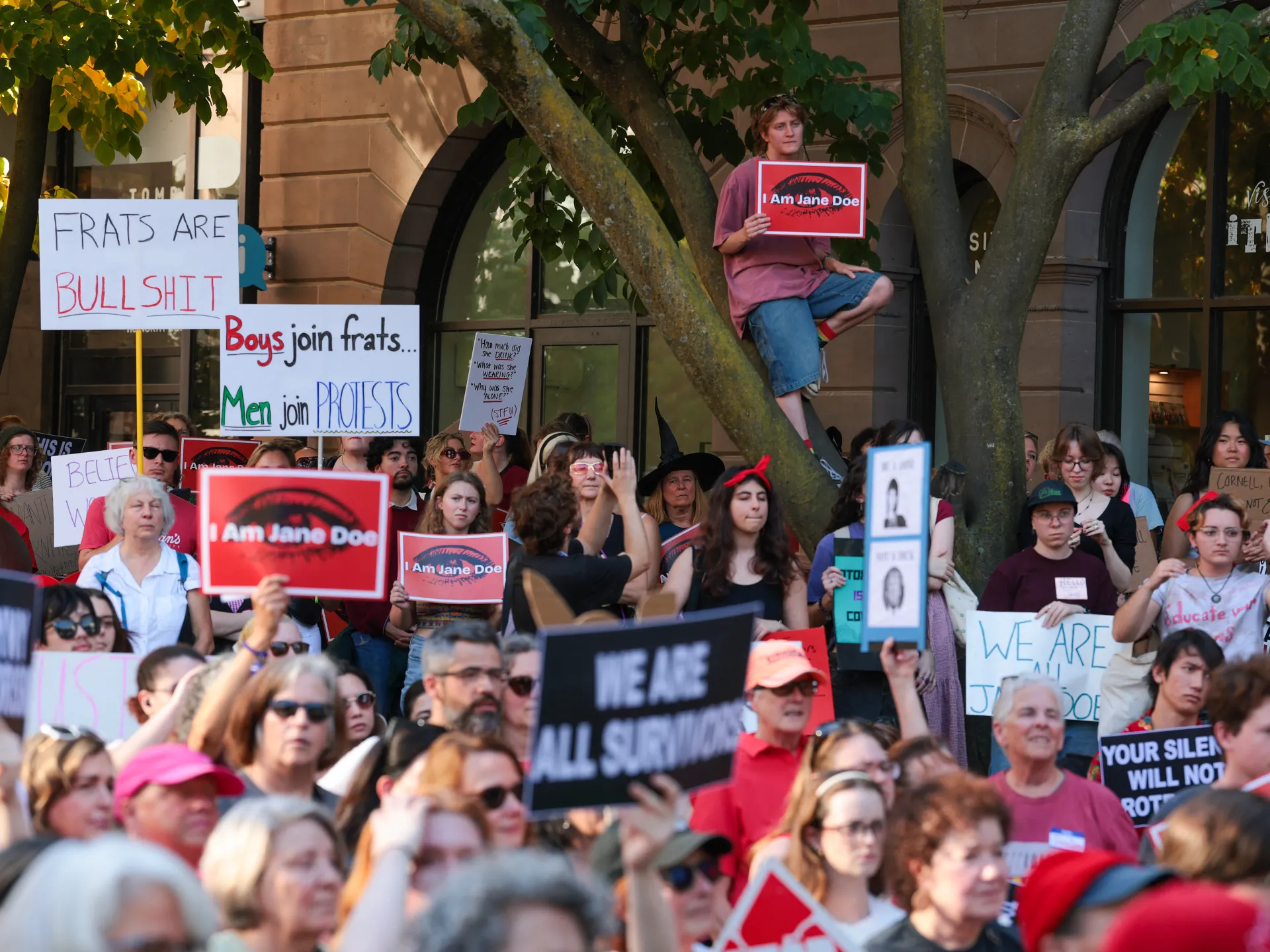
康奈尔大学处理性侵举报的内部流程辜负了“简·多伊”(Jane Doe)。2024年,这名大三学生举报称,她在无行为能力的情况下在一个兄弟会住宅内遭到七名男子性侵。康奈尔大学展开了一项历时数月的调查,但这一过程未能实现简·多伊所寻求的问责。她感到自己的诉求无人倾听,且缺乏安全感,最终在未完成学位的情况下退学。她指控的这些男子未受到任何刑事指控。她目前正因校方处理其案件的方式起诉康奈尔大学。参与这些流程的行政人员均未被点名。他们尚未面临问责。
Cornell University’s internal processes for responding to sexual assault reports failed “Jane Doe”. In 2024, the third-year student reported being sexually assaulted by seven men while incapacitated at a fraternity house Cornell launched an investigation that would last months, but the process failed to deliver the accountability Jane Doe sought. She was left feeling unheard and unsafe, dropping out without completing her degree. No criminal charges were brought against the men she accused. She is now suing Cornell over its handling of her case. None of the administrators involved in those processes have been named. They have yet to face accountability.
她的经历暴露了大学内部的保密程序旨在让“问题”消失,而不是为受害者争取任何形式的正义。这也暴露出那些身居要职的人——院长、教务长和校长,连同《教育修正案第九条》和勤工俭学及平权行动官员以及大学律师——主要致力于保护他们的机构。这才是真正的目标。他们并非为了替弱势学生、教职员工或教员发声。
Her experience reveals the ways in which confidential procedures at universities are intended to make “problems” go away, rather than work towards any form of justice for victims. It also reveals how those in positions of authority – deans, provosts and presidents, alongside Title IX and Affirmative Action officers, and university lawyers – are primarily invested in protecting their institutions. That is the real goal. They are not here to advocate for vulnerable students, staff, or faculty.
每周,美国各地校园里的学生——绝大多数是女性——都会遭到性侵。康奈尔大学2025年的一项调查发现,35%参与调查的本科女学生表示,自入学以来曾经历过涉及武力或丧失行为能力的非自愿性接触。这个问题不仅限于康奈尔大学:密歇根州立大学2025年的一项调查发现,大约五分之一的本科女学生自入学以来曾遭受性侵。
Every week, students on campuses throughout the United States – overwhelmingly women – are sexually assaulted. A 2025 Cornell University survey found that 35 percent of undergraduate women respondents had experienced nonconsensual sexual contact involving force or incapacitation since enrolling. The problem extends well beyond Cornell: a 2025 Michigan State University survey found that approximately one in five undergraduate women had experienced sexual assault since enrolling.
然而,大多数事件并未被举报。美国司法部的一项研究发现,向警方报案的既遂和未遂强奸案不到5%。
Yet most incidents go unreported. A US Department of Justice study found that fewer than 5 percent of completed and attempted rapes were reported to police.
学生——以及他们的父母——必须明白,举报违规行为的途径在战略上被设计得难以应对,甚至彻底失效。尽管你会听到管理人员说尽漂亮话,但他们确保那些公开吹捧的系统依然错综复杂、无法触达。这支薪酬优厚的管理人员大军——那些在家长日和校友活动上迎接你、看起来可亲可信的资深教职员工——对学校负责,这使他们成为受害者不可靠的盟友。
Students – and their parents – must understand that the pathways for reporting violations are strategically designed to be difficult to navigate, or outright broken. Although you will hear administrators make all the right noises, they ensure that their publicly-touted systems remain labyrinthine and impossible to access. This army of well-paid administrators – lovely, trustworthy-looking senior faculty and members of staff that welcome you on Parents’ Day and at Alumni functions – answer to the institution, making them unreliable allies of the victim.
受害者被期望承担责任方的角色,在创伤体验仍在持续之际,详细记录发生在他们身上的事情。他们被迫向校园警察和各类所谓保护学生的管理人员,反复讲述袭击的细节。研究表明,被迫为各类管理人员反复“表演”,会让人重历侵害,加重创伤。
Those who are victimised are expected to be the responsible party, documenting what happened to them in detail even as the trauma of the experience is ongoing. They are forced to repeat the particularities of the assault multiple times – to campus policemen and various administrators supposedly there to protect the student. As research shows, being forced to repetitively “perform” for various administrators makes one relive the violation and compounds trauma.
教育机构往往将无能武器化,归咎于那些刻意设计失效的系统,以此逃避处理合理的、甚至是灾难性的担忧。除此之外,管理人员策略性地表演关怀,却让举报伤害的人在一个个办公室之间来回踢皮球。正如女权主义学者萨拉·艾哈迈德在2021年著作《投诉!》中所言,这一过程将投诉者构建为问题所在,化解了他们构成的威胁。它确保那些敢于发出异议、要求问责的人刻骨铭心地吸取教训。
Educational institutions often weaponise incompetence, blaming it on systems that are purposefully nonfunctional in order to avoid dealing with legitimate, even catastrophic, concerns. On top of this, administrators strategically perform care while caroming anyone who reports harm from one office to another. This seemingly absurd game of musical chairs is aimed at exhausting the victims. As feminist scholar Sara Ahmed argues in her 2021 book Complaint!, this process frames the complainant as the problem and dissipates the threat they pose. It ensures that lessons are imprinted on those who dare to voice dissent and demand accountability.
战略功能失调是有目的的:它维护了体制并让受害者噤声。“破损”的系统鼓励受害者将事情内部化,向他们保证,体制内的程序比起向警方举报违规行为所受到的伤害要小。纪律处分程序被列为机密,表面上是为了保护受害者。(的确,那些遭受性暴力创伤的人理应获得隐私。但这些并不是机构想要保持沉默的原因。)
Strategic dysfunction has a purpose: It safeguards the institution and silences victims. The “broken” system encourages victims to keep things in-house, assuring them that institutional processes will be less injurious than reporting a violation to the police. Disciplinary proceedings are kept secret, ostensibly to protect the victims. (Indeed, those traumatised by sexual violence deserve privacy. But these are not the reasons that institutions want to keep things quiet).
想知道为什么经历过违规行为的学生、教职员工或教员没有立即“请律师”吗?正如公共卫生倡导者索尼娅·切鲁维利尔(Sonia Cheruvillil)博士所指出的那样,“在任何地方的性暴力案件中,请律师的情况都极为罕见。绝大多数性犯罪根本没有向任何权威部门举报,因为它们是由朋友和家人实施的。权威部门并不安全。大学校园是伤害的更大生态系统的一个缩影,它将幸存者和受害者禁锢在原地,将他们的经历个体化,并剥夺了他们的正义。”
Wondering why students, staff, or faculty members who have experienced a violation do not immediately get “lawyered up”? As Dr Sonia Cheruvillil, a public health advocate, noted, “Getting a lawyer is rarely what happens in sexual violence cases anywhere. The vast, overwhelming number of sex crimes are not reported to any authority because they are committed by friends, family. Authorities are not safe. University campuses are a microcosm of a larger eco-system of harm that keeps survivors and victims in place, individualizes their experience, and denies them justice.”
学生可能无法向家人寻求支持,因为并非所有的家庭都是安全的。一些人甚至受到家人的强烈阻挠,被劝阻不要进行正式投诉。
Students may not be able to go to family for support, because not all families are safe. Some are actively discouraged by their families from making formal complaints.
美国各地的大学经常炫耀其旨在向学生宣传性侵犯教育的项目。他们喋喋不休地敦促教职员工完成(无用的)在线“合规练习”,名义上是教他们如何识别和举报基于性别的暴力。但如果你试图真正举报自己遭遇的基于性别的暴力,你得到的很可能只有一片沉默。
Universities across the US often flaunt their programmes aimed at educating students about sexual assault. They harangue faculty and staff to complete (useless) online “compliance exercises”, supposedly to teach them how to recognise and report gender-based violence. But try to actually report one’s experience of gender-based violence and you’ll likely hear crickets.
正如我的一个学生所说,不要被那些宣称校园是“安全区”、标榜大学对歧视或攻击采取零容忍政策的可爱传单所愚弄。它们是机构的公众形象,更重要的是,它们是其策略的一部分。
As one of my students said, don’t be fooled by those cute flyers declaring campuses as “safe zones”, touting the university’s zero-tolerance policy towards discrimination or assault. They are the public face of the institution and, importantly, part of its strategy.
这些都是表演,是不作为所必需的,也是行政人员所采用的障眼法。
These are performances, necessary for inaction, for the sleight of hand administrators employ.
教育机构正是依靠这些表现来掩盖其根深蒂固的暴力行径,而女性和少数族裔群体则是这些表现的核心所在——机构将他们任命至显要职位,本意是保护那些易受基于性别的暴力及其他形式歧视伤害的人:平权行动官、第九条协调员。
And essential to these performances on which educational institutions rely for covering up embedded practices of violence are the women and minoritised people that institutions appoint to prominent positions, meant to safeguard those who are vulnerable to gender-based violence and other forms of discrimination: The Affirmative Action Officer, the Title IX Officer.
正如我的同事、布法罗大学非洲与美国研究前教授里纳尔多·沃尔科特所说:“《教育修正案第九条》的管理者——其中许多是女性、黑人、少数族裔——经常被派去执行政策工作,同时也从事与身份相关的情感工作。他们的身份是必要的、不可或缺的。他们从事这些工作是为了平息我们的情绪,让我们相信机构认同我们并且会关心我们。身份认同的情感劳动随后却遭到不作为或其他政策主张的背叛,这赤裸裸地表明,无济于事。”
As my colleague Rinaldo Walcott, former professor of Africana and American Studies at the University at Buffalo, said, “Title IX administrators – many of whom are women, Black, minoritised people – are often deployed to do policy [work] as well as to do identity-related emotional work. Their identities are necessary, essential. They are in those jobs to calm us down. To make us believe the institution identifies with us and will care. The affective labour of identity recognition that is then betrayed by non-action or other policy claims plainly reveals that not much can be done.”
他们是维系高等教育机构的妥协零件,保护这些机构免于被追究责任,并且深深卷入了有罪不 impunity(原文如此:impunity)文化的创建和延续之中。将这些甘愿充当的“代表机构”工具化,使其成为机构面向公众政策的门面,对于制造合理的推脱借口至关重要。他们的实际工作是阻挠任何提出正式指控、寻求追责或救济的努力。
They are the compromised wingnuts that hold tertiary educational institutions together, protecting them from being held accountable, and deeply imbricated in the creation and continuation of a culture of impunity. Instrumentalising these willing “representative bodies” to be the face of institutions’ public-facing policies is crucial for plausible deniability. Their actual job is to block any efforts to file formal charges or seek accountability or redress.
在康奈尔大学,同事们——通常是那些保护最少、权力最小的人——正在组织学术讲座、静坐抗议,并与学生们协同努力。许多学生仍然愿意相信,通过专注于减少伤害的知名研究,机构是可以被改良的:“创伤知情”的方法。我的同事们对体制暴力有着切身体会,他们心知肚明。
At Cornell University, colleagues – often those with the least protection and power – are organising teach-ins, sit-in protests, and coordinating efforts alongside their students. Many students still want to believe that institutions can be improved with well-known research focused on reducing harm: “Trauma-informed” approaches. My colleagues, who have firsthand knowledge of institutional violence, know better.
通过他们的努力,他们希望传达这样一个信息:更好的沟通、更多关于知情同意的教育,或者禁止兄弟会举办派对可能还远远不够。
Through their efforts, they are hoping to convey that better communication, even more education about consent, or banning parties at fraternities may not be enough.
康奈尔大学系统的“失败”,事实上是它的成功故事。大学有着强烈的动机来保护自己的声誉并保持捐赠资金的流动。鉴于大学的系统在战略上陷入瘫痪,能做些什么呢?
Cornell University’s systematic “failure” was, in fact, its success story. Universities have powerful incentives to protect their reputations and keep donor money flowing. What can be done, given universities’ strategically broken systems?
正如我在康奈尔大学的同事们所说,体制流程是“旨在造成创伤,而不是提供救济、正义或赔偿”。相反,让我们把重点放在在体制之外建立行之有效的反制系统上。如果——且仅如果我们拥有强大的、独立的支援系统,并且舆论哗然的程度足以影响公众认知和至关重要的捐赠资金,那么这些机构或许才会采取尽可能少的操作。
As my colleagues at Cornell said, institutional processes are “designed to cause trauma, not to offer relief, justice, or reparations”. Let’s focus, instead, on building working counter-systems outside the institutions. If – and only if – we have powerful, independent support systems, and the outcry is significant enough to affect public perception and all-important donor funds, then institutions may do the least possible.
我们最好明白,大学——以及那些负责保护学生、教职员工的高薪行政人员——同样受到羞耻感以及对失去职位和权力的恐惧所驱使。与那些他们知道会让你保持沉默的事物——羞耻感、恐惧以及缺乏资源和支援系统——作斗争,是将“在战略上陷入瘫痪”的系统拖入采取行动的唯一途径。
We would do well to understand that universities – and those highly-paid administrators charged with protecting students, faculty, and staff – are also guided by shame and the fear of losing positions and power. Working against what they know will keep you silent – shame, fear, and lack of resources and support systems – is the only way to drag “strategically broken” systems into taking action.