
中国花了近两年的时间让全球对其廉价、开放的人工智能模型产生依赖。如今,一项意外提出的新出口管制方案正引发焦虑,人们担心北京可能会切断这些已被众多用户依赖的工具。
China spent the better part of two years getting the world hooked on its cheap, open artificial intelligence models. Now, a surprise proposal for new export controls is stirring anxiety that Beijing may pull the plug on these tools that so many have come to depend on.
如果实施,这对中国人工智能产业的影响可能极为巨大,对那些将其产品视为硅谷替代方案的全球初创企业和研究机构而言,后果更为致命。中国的开放权重模型公开了技术内部工作原理,允许开发者下载并进行定制。
The stakes could be enormous for the Chinese AI industry, and even more devastating for the global startups and research institutions that have turned to its offerings as an alternative to Silicon Valley. China’s open-weight models make the inner workings of the technology public, allowing developers to download and customize them.
但目前尚无充分理由惊慌。国内科技行业中仍有近乎宗教般的开放AI开发热情。且现行草案中包含大量例外。已进入公共领域的技术不受影响,未来的开放权重发布将可获得自动批准,政府已表示。摩根士丹利分析师称,短期内对中国大语言模型、开源开发以及海外商业化的影响预计有限。
But there’s little reason to panic — yet. There remains a near-religious devotion to open AI development from loud voices inside the country’s tech industry. And the current draft rules have plenty of carve outs. Technology already in the public domain isn’t affected, and future open-weight releases would be eligible for automatic approvals, the government has said. The near-term impact on Chinese large language models, open-source development, and overseas commercialization is expected to be limited, according to Morgan Stanley analysts.
尽管如此,该提案应被视为警示:北京目前并未切断AI的外流,但已明确表明其有能力这样做。
Still, the proposal should serve as warning: Beijing isn’t shutting off the outflow of its AI right now, but is making clear that it can.
许多人将此政策解读为在安全与开放之间寻找平衡的尝试,随着技术威力日增,这一关切是合理的。商务部发言人表示,此举旨在防止滥用、误用,并“确保人工智能仍受人类控制”。中国最不希望看到的是一场被追溯至本国的AI灾难,这些限制可能正是为避免此类事件。此外,北京很可能也在寻求更大权力,以防止类似“Manus”事件的发生——当时它迫使Meta Platforms公司撤销对一家华裔创办的初创公司的收购。
Many interpret the policy as an attempt to thread the needle between safety and openness, a valid concern as the technology becomes more powerful. A Commerce Ministry spokesperson said that the measures aimed to prevent misuse, abuse and to “ensure that AI remains under human control.”The last thing China wants is an AI catastrophe traced back to it, and these restrictions may be trying to avoid that. It’s also likely Beijing is seeking greater powers to head off a Manus-style incident, when it forced Meta Platforms Inc. to undo the acquisition of the Chinese-born startup.

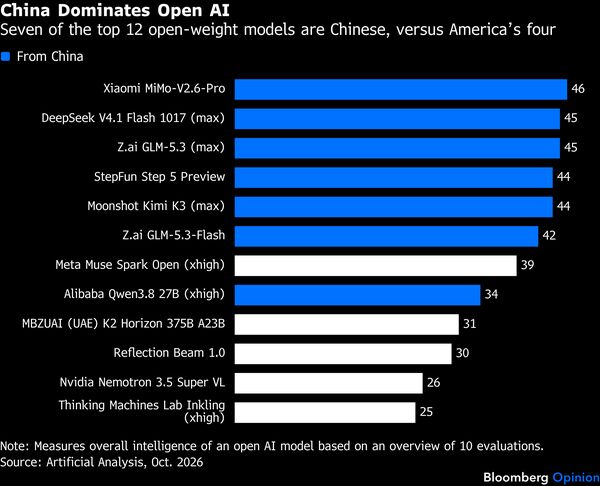
尽管如此,这种情况一直是一个迫在眉睫的威胁。而撤回开源策略将造成沉重打击:根据 Hugging Face 的数据,阿里巴巴集团控股有限公司的 Qwen 模型已成为全球开发者的默认基础模型。基于 Qwen 构建的衍生模型超过 15 万个,几乎是 Meta Llama 模型的五倍。在中国人工智能分析机构 Artificial Analysis 对开放系统智能水平的排名中,中国拥有前 12 名中的 7 个模型。
Still, something like this was always a looming threat. And a pullback would hit hard: Alibaba Group Holding Ltd.’s Qwen models have become the default foundation for global developers, according to Hugging Face. More than 150,000 derivatives have been built from Qwen, nearly five times as many as Meta’s Llama. China boasts seven of the top 12 models on Artificial Analysis’ measure of intelligence for open systems.
在中国科技界,对开放 AI 的支持往往披着哲学的外衣。这被视为防止这个时代最具影响力的技术被少数精英公司垄断的一种方式,这与美国科技巨头保持其系统闭源形成鲜明对比。DeepSeek 研究员陈德力在 X 平台上宣布一款提升企业使用其模型效率的开源工具时表示,这是一场光明与黑暗的较量。他将开源与闭源称为“关乎人类两种未来、两种命运的决定性战役”,并誓言战斗“直到彻底胜利”。将赌注描绘得如此戏剧化的,他绝非孤例。
Inside the country’s tech sector, support for open AI is often cloaked in philosophical language. It’s seen as a way to keep the most consequential technology of our time from being controlled by just a few elite firms, unlike US tech giants that keep their systems closed. It’s a competition between light and darkness, DeepSeek researcher Deli Chen said on X while announcing a new open-source tool that boosts efficiency for businesses using its models. He called open versus closed a “decisive battle between two futures, two destinies for humanity,” while pledging to fight “until total victory.”He’s hardly alone in painting the stakes so dramatically.
甚至连国家主席习近平也曾利用出席全球 AI 活动的机会为开放发展摇旗呐呼,最著名的是在 7 月上海举办的世界人工智能大会上,以及最近在新德里举行的金砖国家峰会上。
Even President Xi Jinping has used appearances at global AI events to champion open development, most notably at Shanghai’s World AI Conference in July and more recently at the BRICS Summit in New Delhi.
然而,对于寻求一条始终难以捉摸的盈利之路的中国公司来说,这始终是一条充满风险的路径。AI 是否能收回开发所需的天价投入是一个全球性的难题,但同行施加的开源技术压力让这笔账更难算。彭博情报分析师表示,中国大模型厂商在短期内预计将继续深度亏损。如果想要盈利,企业最终可能会放弃开源发布,或采取混合模式。
Yet for Chinese companies seeking an ever-elusive path to profitability, this was always a risky route. Whether AI will ever recoup the sky-high spending needed for development is a global conundrum, but peer pressure to give your tech away makes the calculus trickier. Chinese LLM makers are expected to remain deeply unprofitable in the near term, Bloomberg Intelligence analysts have said. Firms may eventually abandon open releases, or pursue a hybrid approach, if they want to make money.
权衡在于,这能吸引大量用户,并有助于推动整个行业向前发展。正如我长期以来所主张的,美国必须投资建设自己的开放权重生态系统。看到初创公司 Reflection AI 和英伟达等科技巨头在这方面取得一些进展,令人欣慰。开放模型能让 AI 在整个经济领域的集成成本更低,甚至可能扩大美国的科技人才库。正如代码托管平台 GitHub 一名前员工今年早些时候指出的,中国拥抱开源技术强化了该国的人才输送管道,让许多人获得了钻研和创造产品的能力。
The trade-off is that it attracts a lot of users and can help propel the entire industry forward. As I’ve long argued, the US must invest in its own open-weight ecosystem. It’s been heartening to see some progress on that front from startups like Reflection AI and tech giants like Nvidia Corp. Open models can make AI cheaper to integrate across the economy, and could even expand America’s tech talent pool. As one former employee at coding platform Github noted earlier this year, China’s embrace of open-source technology the country’s talent pipeline, giving many people the ability to tinker and create products.
甚至硅谷的主要初创公司也从中受益,因此当开放模型面临禁令威胁时才会引发轩然大波。
Even major Silicon Valley startups have benefitted, hence the uproar when open models came under threat of a ban.
对华盛顿而言,或许最大的教训是:以与中国竞争为借口,为鲁莽加速和宽松监管辩护,其说服力比以往任何时候都更加苍白无力。甚至北京现在也表明,它认真对待让 AI 保持在可控范围内的必要性 —— 保持在可控范围内。
Perhaps the biggest lesson for Washington is that pointing at a race with China as an excuse for risky acceleration and light-touch regulation rings hollower than ever. Even Beijing is now showing it takes seriously the need to keep AI under control — under control.
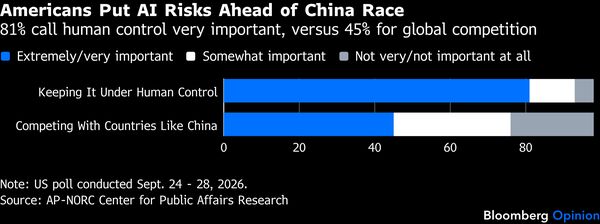
许多美国人也感觉 AI 的发展速度超过了护栏。根据最近的一项全国民调,绝大多数人希望华盛顿优先确保 AI 处于人类控制之下 —— 这一比例远高于认为与中国竞争同等重要的人群比例。
Many Americans also feel AI’s development is outpacing guardrails. A large majority want Washington to prioritize keeping AI under human control — far more than the share who say competing with China is as important, per a recent nationwide poll.
北京仍希望让世界依赖其 AI,并希望制定规则。全球依赖程度越深,北京就越能同时实现这两项目标。
Beijing still wants the world hooked on its AI, and wants to set the rules. The deeper that global dependence grows, the more it gets to do both.