
据穆迪公司的一份报告,美国寿险公司在人工智能领域的投资敞口在上半年大幅跃升,并预计将继续增长。
US life insurers’ investment exposure to the artificial intelligence sector spiked in the first half of the year and is expected to keep growing, according to a report by Moody’s Corp.
报告显示,截至6月底,美国寿险公司持有的与AI相关的投资约为852亿美元,较2025年底增长24%。这些持仓包括超大规模云服务商、数据中心和芯片制造商。
US life insurers held about $85.2 billion in investments related to AI at the end of June, up 24% from the end of 2025, according to the report. These holdings include hyperscalers, data centers and chip manufacturers.
穆迪分析师将超大规模云服务商定义为引领AI建设的五家美国公司:Alphabet Inc.、Amazon.com Inc.、Meta Platforms Inc.、Microsoft Corp.和Oracle Corp.。截至6月底,寿险公司持有这些公司约322亿美元的债务,较年初增加21%。这约占超大规模云服务商未偿债务的6.6%。
Moody’s analysts define hyperscalers as the five US companies leading the AI buildout: Alphabet Inc., Amazon.com Inc., Meta Platforms Inc., Microsoft Corp. and Oracle Corp. Life insurers held roughly $32.2 billion of their debt at the end of June, an increase of 21% from year-end. That represents about 6.6% of the hyperscalers’ outstanding debt.
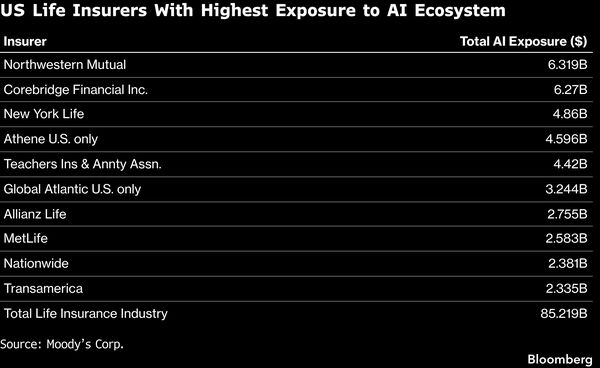
报告指出,尽管保险业对AI投资的总敞口仍然较低,仅占其现金和投资资产的1.4%,但这一数字可能低估了其总的间接敞口。例如,由超大规模云服务商通过担保和租赁支持的投资增加了未反映在直接持仓中的敞口。
While the insurance sector’s total exposure to AI investments remains low, at 1.4% of its cash and invested assets, the figure may understate its total indirect exposure, according to the report. Investments backed by hyperscalers through guarantees and leases add exposure that isn’t reflected in direct holdings, for example.
该分析也不包括对某些公司的投资,这些公司的业绩“与AI生态系统高度相关”,如果AI支出放缓,其信用质量可能会恶化。
The analysis also didn’t include investments in some companies whose performance is “highly correlated to the AI ecosystem” and whose credit quality could weaken if spending on AI slows down.
寿险公司对支持AI的数字基础设施债务的敞口激增34%,截至6月底达到395亿美元。这些包括数据中心、图形处理单元和张量处理单元设备的项目融资交易。
Insurers’ exposure to debt backing the digital infrastructure that supports AI jumped 34%, reaching $39.5 billion at the end of June. These include project financing deals for data centers, graphics processing units and tensor processing unit equipment.
虽然这些持仓大多为投资级,但穆迪分析师指出,落入垃圾级类别的债券占比从4.7%小幅上升至6.1%。
While most of those holdings are investment grade, Moody’s analysts note that the share of bonds falling into the junk category ticked up from 4.7% to 6.1%.