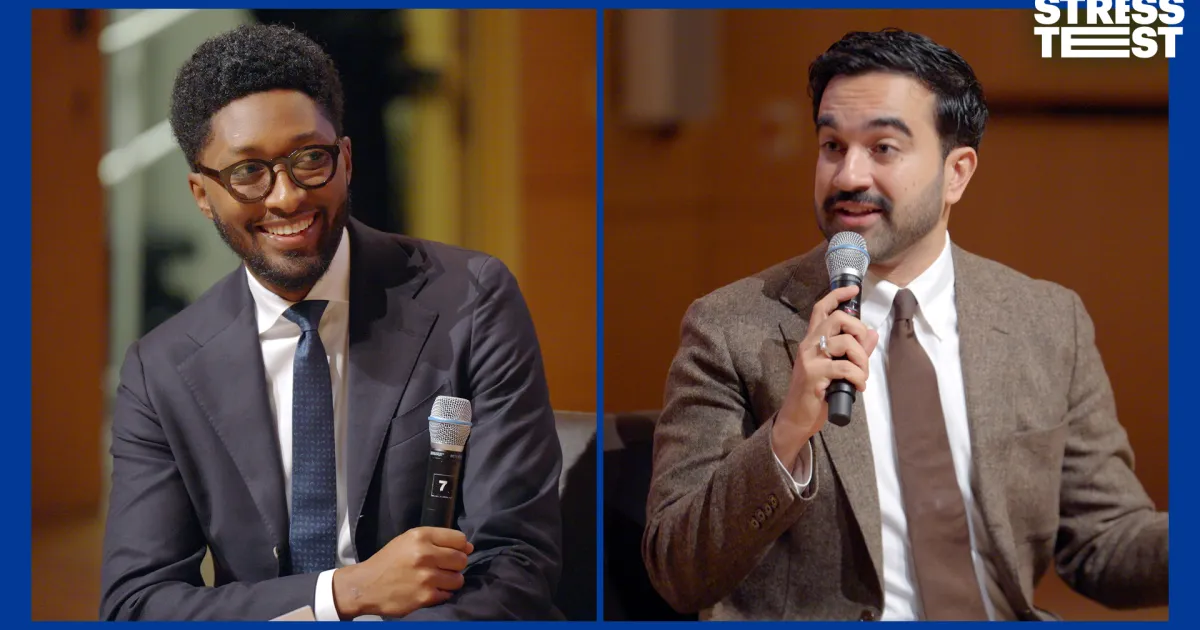
他的名字或许不会出现在今年11月的选票上,但纽约市长佐赫兰·马姆达尼无疑是当前美国政坛最具影响力的人物之一。去年底取得突破性胜利后,马姆达尼已成为不妥协进步运动的代表人物,并一直在利用其日益增长的政治资本,通过一连串背书来塑造各场竞选。
His name might not be on the ballot this November, but New York City Mayor Zohran Mamdani is undoubtedly one of the most influential figures in American politics right now. After his barrier-breaking victory late last year, Mamdani has emerged as the face of the no-holds-barred progressive movement and has spent the season leveraging his rising capital to shape races with a string of endorsements.
在《 》这一期节目中,联合主持人加里森·海耶斯在气候周纽约期间,于新学院蒂施曼礼堂现场观众面前,与马姆达尼市长进行了一对一对话——该活动由 、 以及B联合呈现。
In this episode of , co-host Garrison Hayes sits down one-on-one with Mayor Mamdani in front of a live audience at The New School’s Tishman Auditorium during Climate Week NYC—for an event co-presented by , , and the B.
随着中期选举临近,马姆达尼深入探讨了一个正在迅速重塑政治版图的议题:全美范围内的人工智能数据中心建设热潮。他剖析了由此产生的能源和资源需求激增,为何不仅是一个科技故事,更是一个紧迫的、关乎民生的气候议题,并激励着跨党派选民。当然,与马姆达尼的任何交谈似乎总免不了聊到纽约的篮球英雄——尼克斯队。
With the midterms looming, Mamdani dives into an issue rapidly redefining the political landscape: the nationwide AI data center building boom. He breaks down why the surging demand for energy and resources it creates isn’t just a tech story but an urgent, kitchen-table climate issue motivating voters across party lines. And, naturally, any chat with Mamdani manages to find its way to New York’s basketball heroes, the Knicks.
但就在活动前几天,一位意外的、抢尽风头的客人造访格雷西官邸,因此加里森只能从这一点切入:“我们之间的对话不仅仅是市长与总统的对话,”马姆达尼在平息观众的笑声后说道,“也是两个纽约人的对话——两个有许多分歧,但也同样热爱这座城市的纽约人。”“只要有人能帮助这座城市,我就会跟他谈,”他补充道。
But with an unexpected, headline-grabbing guest visiting Gracie Mansion just days before the event, there was only one place Garrison could start: “The conversations that we have are not just those of a mayor and a president,” the mayor said after quelling laughter from the audience, “but also of two New Yorkers—two New Yorkers who have many differences of opinion, but two New Yorkers who also do love this city.”“As long as someone can help the city, I’ll talk to him,” he added.
市长对听众说,气候变化几乎成了每天都要面对的压力源。“我们上任将近十个月。在这段时间里,每三天就有一天,我们处于山洪紧急状态。每三天就有一天。这让我感到震惊,因为这恰恰浓缩了一个事实:气候危机正在从根本上改变我们的日常现实。”
Climate change has been an almost daily stressor, the mayor told the audience. “We’ve been in office for close to ten months. And in that time, one out of three days, we have been in a flash flood emergency. One out of three days. And that is staggering to me, because it is a distillation of the fact that the climate crisis is fundamentally changing our day-to-day realities.”
马姆达尼认为,气候信息的传达正在发生巨变,而这种变化能够与选民产生共鸣。他告诉加里森,现实世界的影响如保险费上涨和洪水基础设施老化。“长期以来,公共话语中对气候问题的处理方式,几乎让人觉得这是一种只有部分人负担得起的关切,而其他人则不得不应对更紧迫的危机。这不是一种奢侈的关切。”
Mamdani sees a sea change in climate messaging that can connect with the voting public. “For too long it has felt like the way that climate is treated in public discourse is almost as if it’s a concern that some can afford to have, while others have to deal with more immediate crises,” he told Garrison, pointing to real-world impacts like rising insurance rates and aging flood infrastructure. “This is not a luxury concern.”
马姆达尼尤其从数据中心在全国各地激起地方抵制的方式中看到了希望。“我认为有很多关心数据中心的人,可能甚至没有意识到这种关心本身就是一种气候关切,”他解释道。“当你审视数据中心以及针对它的反对声音时,会发现它超越了一个党派。这是目前这个国家最具两党共识的问题之一。这也表明,那同样可以成为对抗气候危机的联盟。”我们下周将带来中期选举快闪播客的又一期节目。这样你就不会错过任何一期节目。com/motherjones。
In particular, Mamdani sees hope in the way data centers have galvanized local resistance across the country. “I think there are a lot of people who care about data centers who might not even understand that care is a climate concern,” he explained. “When you look at data centers and you look at the opposition to it, it goes beyond one party. It is one of the most bipartisan issues in this country right now. And that also shows that that, too, could be the coalition against the climate crisis.”We’ll be back with another episode of our midterm pop-up podcast next week. so you don’t miss a showcom/motherjones. Garrison Hayes: Hey, it’s Garrison Hayes, co-host of here at , and today on the show, a giant name in American politics right now.
加里森·海耶斯:嘿,我是加里森·海耶斯,本节目的联合主持人,今天节目请到的是一位当下美国政坛的重量级人物。他可能不会出现在11月3日的选票上,但他已经对那些出现在选票上的名字产生了巨大影响,他动用自己的政治资本进行了一系列背书,助推那些无疑将成为他所参与的新进步运动核心的人物。
He might not be on the ballot on November 3, but he’s already had an outsized impact on the names that do appear, cashing in his own political capital to make a string of endorsements, boosting folks who will no doubt become central to the new progressive movement that he is a part of.
当然,我说的正是市长佐赫兰·马姆达尼。上个月,在纽约市气候周期间,我当着现场观众的面,与纽约市市长进行了一对一对话,中期选举显然挂在他心上,但本轮选举周期最大的议题之一同样如此,那就是我们在节目中谈过的话题:数据中心。
I am, of course, talking about Mayor Zohran Mamdani. Last month, I sat down with the mayor of New York City one-on-one during New York City’s Climate Week in front of a live audience, and the midterms were definitely on his mind, but so too was one of the biggest issues of this election cycle, something we’ve talked about right here on : data centers.
在你们即将听到的这场对话中,市长主张,人工智能建设热潮实际上是一个重大的气候议题,也是各党派、各种政治立场的人们下个月要投票决定的问题。那么话不多说,以下就是我在纽约市新学院蒂什曼礼堂进行的完整采访,本次活动由、和联合主办。就在我们交谈前几天,马姆达尼在他的官邸格雷西官邸接待了一位非常特别的访客。所以我觉得那是个不错的开场话题。请欣赏。
During the chat that you’re about to hear, the mayor argues that the AI building boom is in fact a big climate issue, one that people of all parties and politics are voting on next month. So without further ado, here’s my entire interview at the New School’s Tishman Auditorium in New York City, co-presented by , , and the . Just a few days before we spoke, Mamdani had a very special visitor at Gracie Mansion, his official residence. So I thought that was a good place to start. Enjoy.
GH:好的。你知道,我们正处在一个关键时刻。极端天气、即将到来的中期选举——这是所有人都在想的事——还有对人工智能、数据中心及其对气候影响的担忧。还有谁比美国最大城市的市长更适合来谈这些呢?也许是最伟大的城市,我不知道。我不知道。市长先生,感谢您来到这里,感谢您参与这场对话。我们会谈所有这些事情,气候,但我必须问您,老兄,特朗普为什么这么喜欢您?
GH: Okay. You know, we are living in a pivotal moment. Extreme weather, midterms are upcoming—that’s on everyone’s mind—concerns about AI, data centers, impacts on the climate. And who better to have this conversation with than the mayor of America’s biggest city? Maybe greatest city, I don’t know. I don’t know. Mr. Mayor, thank you for being here and for having this conversation. We’ll talk about all that stuff, climate, but I have to ask you, man, why does Trump like you so much?
佐赫兰·马姆达尼:首先,我要说很高兴来到这里。很高兴和大家在一起。你知道,这个问题很大程度上我会让别人来回答。不过我要说的是,我们有一件其他任何城市都没有的东西,那就是这里是总统的家乡。所以我们之间的对话不仅仅是市长和总统之间的对话,也是两个纽约人之间的对话——两个在许多问题上意见相左的纽约人,但也是两个同样深爱这座城市的纽约人。
Zohran Mamdani: Well, first, I will say it’s a pleasure to be here. It’s a pleasure to be here with all of you. You know, I think there’s a lot of that question I’ll let other people answer. What I will say, though, is that one thing we have that no other city has is that this is the city where the president comes from. And so the conversations that we have are not just those of a mayor and a president, but also of two New Yorkers—two New Yorkers who have many differences of opinion, but two New Yorkers who also do love this city.
因此,举例来说,在我们本周一最近的那次交谈中,很多内容都回到我提出的这一点上:这些是纽约人此刻正面临的一些问题,其中之一是住房危机,缺乏可负担住房是我们成为美利坚合众国最昂贵城市的主要驱动因素,并向总统推销建设我们城市自1970年代初以来将见到的最大住房开发项目—— Sunnyside Yard——1.2万套住房,3万个就业岗位。
And so, for example, in the recent conversation that we had this Monday, a lot of it came back to my putting forward: These are some of the issues that New Yorkers are facing in this moment, one of them being the housing crisis, the lack of affordable housing being the primary driver of us being the most expensive city in the United States of America, and pitching the president on constructing what would be the largest housing development our city has seen since the early 1970s, Sunnyside Yard—12,000 homes, 30,000 jobs.
另一点,正如总统所说,我提出的是关于对海地裔纽约人稳定性的重要性,他们最近被终止了TPS(临时保护身份),以及理解他们和我们一样同样是这座城市肌理的一部分意味着什么。对我而言,这始终是一个陈述理由的机会。只要有人能帮助这座城市,我就会和他们谈。
And the other point, as the president said, that I brought up was about the importance of stability for Haitian New Yorkers who have recently had TPS ended, and what it looks like to understand that they are just as much a part of a fabric of this city as we are. And to me, it’s always an opportunity to make the case. And as long as someone can help the city, I’ll talk to them.
GH:这实际上很相关,谈到优先事项。正如我提到的,今年夏天,你知道,极端天气占据了头条新闻,而且,你知道,这个周末甚至可能会有风暴来袭。我很好奇,你是如何决定优先排序的,就你的气候优先事项而言如何排序,不仅是未来几天,而是纽约人在未来几年将面临的情况?
GH: This is actually relevant, talking about priorities. As I’ve mentioned, this summer, you know, extreme weather dominated the headlines, and, you know, this weekend maybe even there will be a storm coming. I’m curious, how are you deciding what to prioritize, kind of to rank by way of your climate priorities, not just for the coming days, but for what New Yorkers will face over the coming years?
ZM:嗯,我想针对你所说的,我最近和团队有过一次交谈。我们上任到现在,你知道,将近10个月了,在那段时间里,每三天就有一天,我们处于山洪紧急状态。每三天就有一天。这对我来说是惊人的,因为它提炼出了一个事实:气候危机正在从根本上改变我们日常的现实,甚至仅仅就天气而言。我从未像现在这样了解天气。因为每天早上我们醒来,我们看预报是什么,而事实是,你知道,你有了预报,然后事情可以就这样变化。
ZM: Well, I think to your point, I was recently having a conversation with the team. We’ve been in office for now, you know, close to 10 months, and in that time, one out of three days, we have been in a flash flood emergency. One out of three days. And that is staggering to me, because it is a distillation of the fact that the climate crisis is fundamentally changing our day-to-day realities, even in terms of just the weather. I have never known more about the weather than I do now. Because every morning we wake up, we look at what’s the forecast, and the fact is, you know, you have a forecast and then things can change like this.
我们也知道,这不是纽约市独有的问题。我们最近举办了U20市长会议,世界各地的市长来到我们这座城市,我有幸见到了罗马市长瓜尔蒂耶里。他告诉我,在罗马,他们30分钟内收到的降雨量超过了他们原本预计一个月才会有的降雨量。同样,在我们这座城市,我们的下水道系统建于大约100年前,最近做过一些更新,但它的承载能力只能应对1.25到1.75英寸的降雨量,而我们有时在30分钟内就会迎来5英寸的降雨。
And we also know that this is not a New York City–specific problem. We recently had the U20 with mayors from around the world coming to our city, and I had the pleasure of meeting the mayor of Rome, Sindaco Gualtieri. And he told me that in Rome, they received more rainfall in 30 minutes than they would have expected to receive in a month. And similarly, here in our city, we have a sewage system built about 100 years ago, updated a little more recently, but it ranges from being able to take 1.25 to 1.75 inches of rainfall, and we’ve seen at times getting five inches of rainfall in 30 minutes.
对我们来说,优先事项必须是:我们能做的最紧迫的事情是什么,以及我们如何同时认识到这是一个短期、中期和长期的问题?这方面的例子包括:好,我们需要对下水道进行数十亿美元的投资,尤其是在受灾最严重的社区,也就是皇后区东南部。
And to us, the priority has to be: What are the most immediate things we can do, and how do we also understand that this is a short-, medium-, and long-term issue? And so some of the examples of that has been: Okay, we need to have a multibillion-dollar investment in sewage, and that especially in the neighborhoods that are hardest hit, so Southeast Queens.
另一点是,我们必须拥有云暴技术这样的尖端技术。所以我们决定在霍姆克雷斯特投资近1亿美元,真正配备那种能够容纳过量降雨的技术,让下水道系统有时间恢复后再排放,同时在做所有这些事情的过程中,种下我们这座城市十年来最多的树木。
The other is we have to have cutting-edge technology like cloudburst technology. So we made a decision to invest close to $100 million in Homecrest to actually have that kind of technology that can hold excess rainfall so that the sewage system can recover before releasing it, and doing all of these things while also planting the most trees we’ve seen in our city in a decade.
在那次U20聚会上——我还没遇到过反对种树的人,但我会找到他们的——在那次市长聚会上,巴黎市长也在场,他们在增加树木数量、减少污染量以及从根本上改变那座城市空气质量方面也取得了令人难以置信的成就。我们也把它视为一个榜样。
And at that U20 gathering— I’ve yet to meet anti-tree people, but I will find them— at that gathering of mayors, the mayor of Paris was there, and they’ve also had incredible achievements at increasing the number of trees, decreasing the amount of pollution, and fundamentally transforming the air quality in that city. We look to it also as a model.
GH:我们知道黑人和拉丁裔人群承受着气候变化带来的一些最沉重的负担。你刚才稍微提到了海地人。你如何应对和修复这些差距?
GH: We know that Black and Latino people bear some of the harshest burdens of climate change. You mentioned Haitians just a little bit ago. How are you addressing and repairing those disparities?
ZM:我认为首先,就你决定把投资投向哪里而言,必须考虑到这样一个事实:正如你所说,纽约的黑人和拉丁裔居民不仅不成比例地受到气候变化的影响,也不成比例地受到公用事业账单上涨的影响,还受到公用事业公司切断他们这些服务意愿的影响。
ZM: I think first and foremost, in terms of where you’re deciding to put in your investments, it has to reckon with the fact that, as you said, Black and Latino New Yorkers are not only disproportionately impacted by climate change, but also by rising utility bills, also by the willingness of utility companies to shut off their access to those utilities.
所以这就是为什么我们要关注那些我们看到公用事业公司最有可能做出这些改变的同样的社区。这就是我们要在东南皇后区投入数十亿美元的地方。这也是为什么我们还要确保这些投资不被当作某种智力层面的讨论,而是对最工薪阶层的纽约人来说实实在在的日常现实。
And so this is why we’re looking at those same neighborhoods where we’ve seen the utilities most likely to make those changes. That’s where we’re going to put in the billions of dollars in Southeast Queens. That’s why we’re also going to be making sure that these are investments that are not thought about as kind of an intellectual discussion, but a material day-to-day reality for the most working-class of New Yorkers.
而这一切的同时,我们还必须建设一个不复制当初让我们走到这一步的做法的未来。你知道,我常常想起我们的国会女议员亚历山德里娅·奥卡西奥-科尔特斯的话,她说,我们不想——我们不想从化石燃料大亨变成太阳能大亨。我们如何确保在我们试图开创的经济中,也在创造一种不同的经济?
And all of this while we have to build out a future that doesn’t mimic what got us to this place. You know, I often think about the words of our congresswoman Alexandria Ocasio-Cortez, who said, we don’t—we do not want to go from fossil fuel barons to solar barons. And how do we ensure that we’re also creating a different economy in the one that we are trying to bring forth?
GH:我稍后想回到这一点。但是,你知道,你被赞誉为进步政策最有效的传递者之一,不仅在这里纽约,而且真的在全国各地。我想知道,你知道,这需要什么?你怎么看?比如,想象现在是第四节。你落后五分。你是杰伦·布伦森——ZM:杰伦·布伦森持球。GH:杰伦·布伦森持球。在这个比喻里你就是杰伦·布伦森。
GH: I want to come back to that in just a little bit. But, you know, you’ve been praised as one of the most effective messengers for progressive policy, not just here in New York, but really around the country. And I’m wondering, you know, what will it take? What do you think? Like, imagine it’s the fourth quarter. You’re down five. You’re Jalen Brunson—ZM: Jalen Brunson has the ball. GH: Jalen Brunson has the ball. You’re Jalen Brunson in this analogy.
ZM:这太不可思议了。我得告诉你,我们正在和世界各地所有的市长开这个会。雅加达省长走过来找我。我心想,不知道他要说什么。他说,尼克斯,尼克斯,杰伦·布伦森,不可思议。我就想,这就是人们认识我们这座城市的地方。上帝保佑。不可思议。GH:世界大使,贾伦·布伦森。ZM:这太不可思议了。纽约之王。
ZM: This is incredible. I gotta just tell you, we’re having this meeting with all the mayors from around the world. The governor of Jakarta comes over to me. I’m like, I wonder what he’s gonna say. He’s like, the Knicks, the Knicks, Jalen Brunson, incredible. I’m just like, this is what people know our city for. God bless. Incredible. GH: Ambassador to the world, Jalen Brunson. ZM: This is incredible. King of New York.
GH:好,那你认为要让更多人关心气候,尤其是在投票时,需要做些什么?比如说,如果你要重新包装并带领我们冲线赢得比赛,我们需要什么?
GH: Okay, what do you think it will take to convince more people to care about climate, especially in the voting booth? Like, if you were to do the rebrand and take us over the line and win the game, what do we need?
ZM:你知道,大约五六年前,我读到一篇文章,主张要通过PM2.5的视角来重新定义气候危机。我们需要从对生活质量的影响来思考气候危机。对我来说,当被问及需要什么时,长期以来气候在公共话语中的处理方式几乎像是一种只有部分人能够承担的关切,而其他人则必须应对更紧迫的危机。
ZM: You know, it was maybe about five or six years ago, there was an article that I read which was arguing that we need to reframe the climate crisis through the lens of PM2.5. We need to think about the climate crisis in terms of its impact on quality of life. And to me, when you ask the question of what will it take, for too long it has felt like climate—the way that climate is treated in public discourse is almost as if it’s a concern that some can afford to have, while others have to deal with more immediate crises.
事实上,气候本身就是一个紧迫的危机。我们的挑战是:如何确保我们解释清楚,当我们谈论这种降雨量时,这不仅仅是一次糟糕的暴风雨,也不仅仅是一个潮湿的夏季——这就是气候危机。
The reality is that climate is an immediate crisis. And so our challenge is: How do we ensure that we are explaining that, that when we’re talking about this level of rainfall, it’s not just a bad storm, it’s not just a wet summer—this is the climate crisis?
所以对我而言,就是要把气候危机解释为日常生活质量的影响,同时展示它如何推高生活成本,不仅体现在你享受生活的能力或摆脱对未来数十年乃至数百年后生活形态的焦虑的能力上,而且最近我们在纽约市投资了海岸韧性局。我们终于给他们提供了所需的经费,使其拥有足够的人员编制,能够最大限度地运营他们在下曼哈顿建设的防洪墙。
So to me, it is explaining the climate crisis in day-to-day quality-of-life impacts, and also showing how it drives up the price of life, not only in terms of your ability to enjoy life or your ability to rid yourself of anxiety about what life will look like decades and centuries from now, but also recently we invested in the Bureau of Coastal Resilience here in New York City. We finally gave them the money they needed to have adequate levels of staffing so they could operationalize to its fullest extent a floodwall that they were building in Lower Manhattan.
让我印象深刻的是,我当时正在和这些工程师交谈——他们指出,这道防洪墙不仅能防止周边地区发生洪灾,还能降低住在周边地区的人的保险费用。把这种联系和关系讲清楚至关重要,这样人们才能明白,这不是一个奢侈的担忧。这是一个已经影响到我们所有人的首要问题,问题只在于我们如何应对,而不是我们是否应该应对。
And what stood out to me is I was having a conversation with these engineers—they pointed out, this floodwall doesn’t just prevent flooding in the immediately surrounding areas; it also decreases the cost of insurance for those who live in that surrounding area. Making that connection and relationship clear is critically important so that people understand that this is not a luxury concern. This is a primary concern that affects all of us already, and it’s just a question of how we respond to it, not if we should respond to it.
GH:我们只剩下一点时间了,所以我想问你最后几个问题。你知道,我是在——我们年龄相仿——我从小接受的是那种个人视角的气候变化观念:不要浪费水,一定要回收利用。但我们知道,最大的污染者是企业,而不是个人。所以我的问题是:你如何让在纽约市做生意的企业为其气候影响负责?
GH: We have just a little bit of time left, and so I want to get to these last couple of questions for you. You know, I grew up in the—you know, we’re around the same age—I grew up with the kind of individual view of climate change: don’t waste water, make sure you recycle. But we know that the biggest polluters are corporations, not individuals. And so my question is: How are you holding corporations that do business in New York City accountable for their climate impacts?
ZM:我很高兴你这样表述,因为——我们青春期的大部分时光都被个人责任、个体责任所框定,这很重要,但它的框定方式让人觉得那就是路径、那就是关键,这真的很值得注意。而我们知道,再多的个人决策也无法弥补结构性的决策、大规模的巨大污染者。
ZM: I’m really glad that you framed it in this way, because it is—it’s truly a remarkable thing how much so much of our adolescence was framed by personal responsibility, individual responsibility, which is important, but it was framed in a manner that that is the path, that is the key. And we know that there is no amount of individual decision-making that can make up for structural decision-making, large-scale, massive pollutants.
本周早些时候,我们宣布追究DoorDash的责任,因为它没有支付其员工——26万名员工——1.315亿美元。真丢人。我们的调查人员仔细查阅了数TB的数据,而DoorDash当天早上发布了一份Notes应用道歉声明:我们很抱歉。就像,是啊,我们抓到他们了。他们正在把那笔钱还给他们的员工。
Earlier this week, we announced that we were holding DoorDash to account for having not paid their workers—260,000 workers—$131.5 million. Shame, truly. And our investigators pored through terabytes of data, and DoorDash released a Notes app apology the morning of: We’re sorry. It’s like, yeah, we caught them. And they’re paying that money back to their workers.
对我来说,这就是一个范例。这就是问责制必须呈现的样子,因为在我们全国范围内,人们对法治的信念普遍在减弱,而这其中也有这种规模的企业所持观念的原因——它们认为自己可以逃脱不付工资或少付工资的后果,永远不必为此被追究责任。
To me, that is an example. That is an example of what accountability has to look like, because there is a general diminishing faith in the rule of law across our country, and that also comes from the perspective of corporations at this scale who believe that they can get away with not paying or underpaying workers and never having to be called to account for it.
因此,当涉及气候以及这些公司许多决策的后果时,我们仍在处理几十年前做出的一些决定,要让这些公司出资将超级基金污染场地改造成如今的公园和绿地,尤其是在布鲁克林。这将继续是我们的重点,我们将采取同样的方式,确保每一美元都得到支付。
And so when it comes to the climate and the consequences of many of these companies’ decision-making, we’re still dealing with some of those decisions that were made decades ago in terms of getting those companies to fund the transformation of Superfund sites into parks and green spaces today, especially in Brooklyn. That’s going to keep being a focus for us, and we’re going to take the same kind of approach at ensuring that every single dollar is paid for.
GH:在我们结束前的最后一个问题:距离中期选举还有几周。所有人都在思考这件事,它应该会非常具有决定性。气候和数据中心将在这次即将到来的选举结果中扮演什么角色?
GH: Final question before we go: We’re a couple of weeks out from the midterms. Everyone’s thinking about it, it should be very decisive. What role will climate and data centers play in the outcome of this upcoming election?
ZM:你知道,我认为即使是你提问的方式,我认为有很多关心数据中心的人可能甚至没有意识到这种关心是一种气候关切。而对我来说,这也是挑战的一部分,即如何确保气候被理解为对生活质量的影响。
ZM: You know, I think even the way that you’ve framed it, I think there are a lot of people who care about data centers who might not even understand that care as a climate concern. And to me, that’s also part and parcel of what the challenge is of how to ensure that climate is understood in a quality-of-life impact.
有一个片段——我不知道其他人有没有看过——有一个中年男子在接受采访,他谈到一个数据中心时说,这是第一次有一项政策会影响我的生活。我认为有一种倾向,我们的反应可能是,你知道,我们是怎么走到这一步的?
There was a clip—I don’t know if others have seen it—there was a middle-aged man being interviewed, and he said about a data center, this is the first time a policy is gonna impact my life. And there’s a tendency, I think, where our reaction might be, you know, how have we gotten to this point?
但我一直想说的是,这是一个把某人带入一场运动的机会,去告诉他们,你反对这件事的原因、你在生活中担心的事情,正是其他人也同样感受到的。你实际上是一个比你自身更宏大的事物的一部分。
But the thing that I would always say is that that’s an opportunity to bring someone in to a movement, to say that the reason that you are opposed to this, the things that you’re worried about in your life, that’s what others feel the same about. You’re actually part of something bigger than yourself.
而且对我来说,当你审视数据中心以及对它的反对声音时,这已经超越了单一政党。这是目前美国最具两党共识的议题之一。这也表明,这种共识同样可能成为应对气候危机的联盟。从某种程度上说,它确实如此。那么,如何确保那些关心所在社区水资源影响、关心所在社区电费的人们,也能理解还有许多其他方面的关联呢?我认为,这既是挑战,也是机遇。GH:市长先生,非常感谢。
And to me, when you look at data centers and you look at the opposition to it, it goes beyond one party. It is one of the most bipartisan issues in this country right now. And that also shows that that, too, could be the coalition against the climate crisis. In some ways, it is. So how do we ensure that the same people who are concerned about the impact on water in their neighborhoods, on electricity bills in their neighborhoods, they also understand that there are so many other applications of that concern? That, I think, is both a challenge and an opportunity. GH: Mr. Mayor, thank you so much.
GH:好的,这就是本期节目的全部内容。如果你错过了之前的节目,可以……你的观点、你的订阅、你的点赞、你的分享——这些都在支持我们。我们新闻编辑部的所有精彩报道,都离不开你的支持。所以请如果可以的话,给我们点个赞,分享一下,并务必在我们的YouTube频道上点击订阅。
GH: Okay, that’s all we have for you for this episode. If you missed previous episodes of , you can Your views, your subscriptions, your likes, your shares—those things keep us going. All of the incredible journalism that takes place here in our newsroom is made possible by your support. So please, if you can, give us a like, give us a share, and make sure you hit, especially on our YouTube channel.
如果你有任何问题或建议,欢迎在评论区留下。留下你的评论吧。我们的制片人和团队喜欢阅读你的留言,也很想听听你的想法。我们将在几天后再次出现在你的信息流中,带来下一期节目。届时见。
If you have any questions or suggestions, feel free to drop them down in the comments. Leave us a comment below. Our producers, our team love to read your comments, and we love to hear what you think. We will be back in your feed in just a couple of days with another edition of . We’ll see you then.