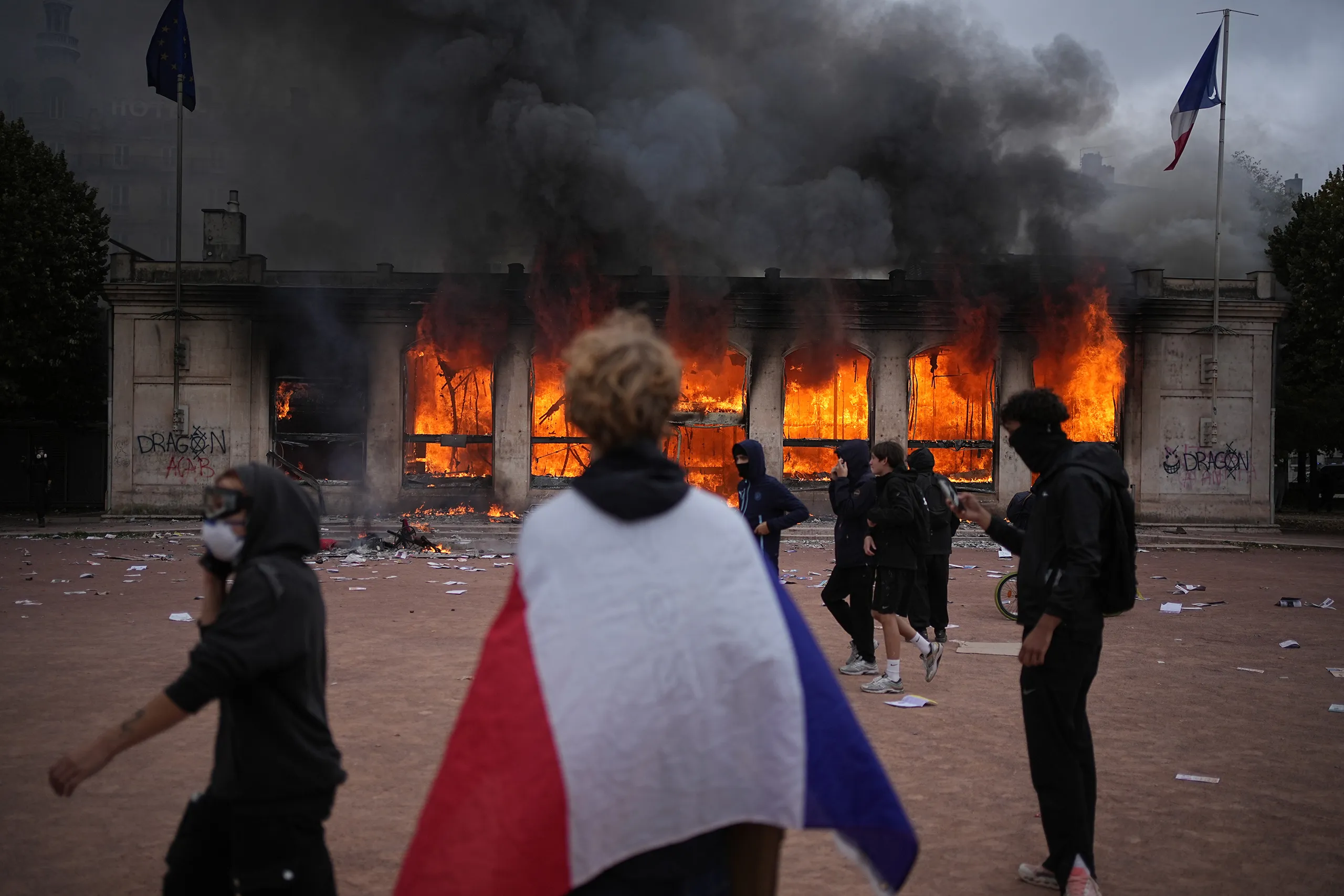
我最近与伦敦玛丽女王大学现代法国史荣休教授、多部法国史著作的作者朱利安·杰克逊通了电话,他撰写过包括夏尔·戴高乐权威传记在内的多部著作,我们谈了谈法国的局势。在我们经过删减以便更清晰、更精炼的谈话中,我们讨论了骚乱对该国政治未来的意义,为何马克龙的总统任期正以灾难告终,以及这些骚乱是否会被视为法国历史的转折点。
I recently spoke by phone with Julian Jackson, an emeritus professor of modern French history at Queen Mary University of London, and the author of a number of books on French history, including the definitive biography of Charles de Gaulle, about the situation in France. During our conversation, which has been edited for length and clarity, we discussed what the riots mean for the political future of the country, why Macron’s Presidency is ending disastrously, and whether the riots will be understood as a hinge point of French history.
青年抗议本身有多重要,又因为它们象征着国家的怎样状态而有多重要?
How much are the youth protests important in and of themselves, and how important are they because of what they symbolize about the state of the country?
这是一个很好的思考方式,因为有些事件因其所代表的意义而变得重要,而这些事件之所以重要,是因为它们揭示了当今法国社会中大量的焦虑与不满。但我认为,周六发生的骚乱使这些事件的重要性发生了质的变化,或者说发生了质变。因此,我认为这造成了一种质的转变。我们已从一场揭示年轻一代——不仅是他们,还有老一代——诸多焦虑的抗议,转变为对国家或政府运作方式的整体质疑。
That is a good way to think about it, because some events become important for what they represent, and these events are important because of what they reveal about a whole mass of anxieties and discontent in France today. But I think their importance has now become qualitatively metamorphosed, or changed, by what happened on Saturday with the rioting. So I think that’s created a qualitative change. We have moved from a protest that is revealing a lot of anxieties of the younger generation—and not just them, but also older generations—into a whole questioning about the functioning of the state or the government.
我记得读到过有人说,将有“10月17日之前”和“10月17日之后”之分。我认为这可能有点言过其实,但它无疑改变了政治格局。你特指当晚的暴力程度吗?
I remember reading something saying that there will be a “before October 17th” and an “after October 17th.”And I think that may be slightly overdoing it, but it certainly transformed the political landscape. You are referring specifically to the amount of violence that night?
是的。不仅仅是暴力。还有那种国家完全措手不及、毫无控制力的感觉。仿佛出现了一个真空。1968年其实也有过类似的情绪,当时戴高乐的二号人物爱德华·巴拉迪尔描述说,他就是有一种感觉,国家什么也做不了。所以我认为那天晚上出现了那种真空感,因为人们确实需要得到安抚,确信他们的财产和生命能得到保护。
Yes. But not just the violence. There was also the sense that the state was completely taken unawares and just had no control. It was like there was almost a void. There was a similar mood in 1968, actually, when de Gaulle’s No. 2, Édouard Balladur, described how he just had a sense that the state wasn’t able to do anything. And so I think there was that sense of a sort of void on that night, because people do need reassurance that they can be protected—their property and their lives.
我那天傍晚碰巧在巴黎参加一个晚宴,在座的都是中间派,也许略偏右,但完全不是极端分子。令人印象深刻的是,其中一位特别愤怒,几乎气得发疯。这有点像1871年巴黎公社后一些人的描述,说那是一种狂欢式的、狂乱的、下流的起义。他用的也是同类语言,说这些人干脆该枪毙了。他指的是暴徒,不是学生,但这让我看到了那晚引发的一种阶级恐慌、社会恐慌。现在你在法国哪里都能听到人们极其担忧接下来会发生什么。
I was at a dinner party that evening just by chance, in Paris, and they were all, I think, fairly centrist, maybe slightly right of center, but totally not extremist people. And it was striking how one of them in particular was in a state of almost apoplectic fury. It was a bit like the way that some people wrote, after the Paris Commune of 1871, that this was a kind of Saturnalian, orgiastic, obscene uprising. And he talked in the same sort of language, that these people should just be shot. He meant the rioters, not the students, but what it showed me was a sort of class panic, a social panic, that that night created. And everywhere you go in France, people are terribly worried now about what’s going to happen next.
你暗示这可能被视为一个枢纽时刻,我最初的想法是,你指的是大家回首时会说,这就是他们知道勒庞将上台执政的时刻。是的。
You are suggesting that this could be seen as a hinge moment, and my first thought was that you meant it will be the moment when everyone looks back and says that this was when they knew Le Pen was going to come to power. Yeah.
接着你刚才描述那个晚宴,我自己想,这或许也会成为那类人——中间派到中右派——在自己心中为迈出这一巨大一步、投票给勒庞寻找理由。
And then, when you were just describing that dinner party, I thought to myself, this is also going to be a reason, perhaps in their own minds, for people like that—centrist to right-of-center—to justify taking this giant step and voting for Le Pen.
至于这是否消除了许多人接受“可以投票给该党”这一想法的最后障碍,我认为你说得没错。我仍然不会说玛丽娜·勒庞肯定会当选。距离大选还有六个月,很多事情都可能发生。但显然,如果你要押注的话,她会当选,而由于发生的事情,她的胜算显然大增,这不仅是因为这会吓得人们去投她的票,还因为此刻唯一另一个真正发出声音的人是极左翼的梅朗雄。
Whether or not it’s pulled down the last obstacle to a lot of people accepting the idea that they could vote for this party or not, I think you’re right. I still won’t say that Marine Le Pen is definitely going to be elected. They’ve got six months to go, and a lot of things can happen. But obviously if you’re putting money on it, she will be elected, and the chances have obviously increased hugely as a result of what happened, not only because it will frighten people into voting for her but also because the only other person who’s been audible, really, in this moment is Mélenchon, on the extreme left.
我认为过去两年他失去了一些吸引力,原因有很多,部分是因为反犹太主义指控,部分只是因为他确实显得有点状态不佳,有点像过气人物。但这件事肯定让他重振旗鼓。
He had lost a bit of traction over the last two years, I think because of a number of things, partly because of antisemitism and partly just because he did seem to be slightly losing it and slightly a figure of the past. But this has definitely reinvigorated him.
显然他无法为周六晚上的抢掠和洗劫辩护,但他很狡猾。当被问及此事时,他说:“我又不是政府,这不该由我来评论。我要说的是,我认为学生们的诉求至少是合理的,我完全支持他们,我将和他们一起示威。评论暴力行为不是我的事,那是国家该处理的事。”这显然是一个极其狡诈的回答。
And he obviously can’t defend the pillaging and looting on Saturday night, but he’s very clever. He says when he’s asked, Well, I’m not the government. It’s not for me to make a comment on that. I’m going to say that I think the students are at least legitimate in their demands, and I’m completely with them, and I will demonstrate with them. And it’s not for me to comment on the violence because that’s something the state should deal with. And it’s obviously a completely devious answer.
但非常有趣的是,你可以称之为中间派的政客们在过去几天里几乎完全听不到声音。他们就是不知道说什么。所以,是的,我认为这是一个两极分化的时刻,但方向是双向的。我认为这会为梅朗雄赢来新支持,也会为玛丽娜·勒庞赢来新支持。所以我同意你的怀疑态度。谁知道这是不是一个转折点,但目前感觉确实像。
But what’s very interesting is that what you might call the centrist politicians have almost been completely inaudible over the last few days. They just don’t know what to say. So, yes, I think it is a radicalizing moment, but in both directions. I think it will win Mélenchon new support and win Marine Le Pen new support. So I agree with your skepticism. Who knows whether it’s a turning point, but it sort of feels like that at the moment.
法国的选举制度是这样的:首先会举行总统候选人的第一轮投票,然后排名前两位的候选人进入第二轮投票。勒庞在民意调查中的支持率明显高于中间派候选人,有望在最终轮投票中胜出(她的领先优势为小幅到中等程度)。不过,她在与第二轮投票的候选人梅朗雄的较量中以超过30个百分点的优势获胜。
And the way the French election works is that there’s a first round for the Presidential contenders and then the two front-runners go forward. And Le Pen is polling well against the centrist candidates in a possible final round, with small to medium leads. But she beats Mélenchon by over thirty points. Absolutely.
如果中间派候选人真的能够进入第二轮投票,那么他们确实有可能在六个月后的总统选举中获胜。不过,我们目前还无法预测周六发生的这些事件所带来的影响会持续多久,因为显然未来还会有更多的抗议活动发生。通过与人们的交谈,我感觉到他们正处于一种非常紧张、不安的状态:他们知道政府已经陷入瘫痪、无法采取任何行动,因此只能等待总统选举的结果。这种等待的氛围中充满了焦虑与恐惧。
And all I would say about that is that if, and it is an if, a centrist candidate does get to the second round, at that point there’s a chance they could be in a position to actually win six months down the line, but we don’t know how long the impact of what happened on Saturday is going to go on because there are more demonstrations coming up, obviously. I had the sense, talking to people, that they’re living on a volcano and they’re sort of tiptoeing around, knowing that the government’s paralyzed, and it can’t do anything, so they just wait till the Presidential election. And there’s this sort of strange, ghostly expectancy, which is quite weird, a mixture of apprehension and fear.
您提到,从社会左翼到社会右翼的中间派候选人似乎都显得有些无所作为(或者说“瘫痪”了)。为什么呢?
You said the centrist candidates, from the socialist center-left to the center-right, seem somewhat paralyzed. Why?
原因很简单:梅朗雄从一开始就得到了学生们的全力支持(他的支持率高达100%),学生们非常喜爱他;而勒庞则主张“我们需要秩序”。相比之下,中间派候选人却不知道自己应该站在哪一边。如果他们过于支持学生的抗议活动,可能会被视为在为混乱行为提供合法性;但如果他们完全支持警方的行动,又会引发新的争议。
Well, Mélenchon has been with the lycée a hundred per cent from Day One, they love him, and Le Pen basically says, We need order. Meanwhile, the centrists are not sure where to situate themselves. If they go too close to the school protesters, they seem to be legitimatizing disorder, but then if they go too close to supporting everything the police does, that is a problem, too.
这正是中间派的典型困境——当两个极端派别都拥有强大的说服力时,中间派就很难找到自己的立场。此外,一些中间派成员曾经在马克龙政府中任职,这也给他们带来了额外的压力,使他们更加难以明确自己的立场。
It is the classic problem of centrism when the two extremes are so voluble and actually convincing to their own constituencies, and also some of the centrists were in Macron’s government, so that is also a problem for them, and it is difficult for them to find their voice.
之所以如此,是因为此刻你绝不能低估的一点,就是所有人对马克龙都怀有冷漠的蔑视。我还没遇到过一个对马克龙说好话的人。其实,前几天我和他的一位部长共进午餐,那位部长显然对他赞不绝口。但除此之外,几乎不可能了。当然,人们对马克龙在某一层面的印象是,他是一个相当专制的人物,对人们指手画脚,是一位“纵向”总统。但另一方面,又是一个根本没有权力的“纵向”总统。他集两者之弊于一身。
And the reason for that is that the one thing you cannot underestimate at this moment is the cold contempt everyone has for Macron. I have not met a person who has anything good to say about Macron. Actually, I had lunch with one of his ministers the other day who obviously did say good stuff about him. But beyond that, it’s almost impossible. And, of course, the picture people have of Macron at one level is a rather authoritarian figure telling people what to do, a sort of vertical President. But then another, a vertical President who simply has no power. He’s the worst of both worlds.
我差点要说他看起来无能为力,但人们也认为他是自上而下的——他们说得对,他确实是。但不幸的是,他无能为力,因为已经没有可以拉动的杠杆了,这是一种非常奇怪的局面。
I was about to say he seems helpless, but people also think he’s a top-down–They’re right; he is. But unfortunately, without being able to do anything, because there are no levers to pull any longer, which is a very sort of strange situation.
说你遇到的唯一喜欢他的人是他的一位部长,这让我想起那条头条:“杜卡基斯赢得了80%的杜卡基斯家族选票。”是的,完全正确。我确实记得这件事。
Saying the only person you met who likes him is a minister of his reminds me of the headline, “Dukakis Wins 80 Percent of Dukakis Family Vote.”Yes, absolutely. I remember that actually.
我记得四五年前,可能是2022年马克龙第二次击败勒庑的时候,人们曾这样说:基本上,马克龙取得了惊人的政治成功,他将担任总统十年,但与此同时,他扼杀了中间偏右和中间偏左,却没有提供任何替代方案。因此,当他离任时,将会出现一个鸿沟。我记得五年前政治分析人士就这么说过,有时候政治分析人士说的话后来被证明是对的,有时候又被证明是错的。但这次,他们说得完全正确。
I remember something people were saying four or five years ago, maybe around the second time that Macron fought off Le Pen, in 2022, that basically Macron has had incredible political success, and he will have been President for ten years, but at the same time, he’s killed off the center right and the center left and not provided any alternative. And so you’ve had this chasm that, when he leaves, is going to exist. I remember political analysts saying that five years ago, and it seems like sometimes political analysts say things that turn out to be true and sometimes it turns out to be not true. But it turned out to be exactly right.
我完全同意。我自己也在多篇文章中表达过类似的观点,尤其是关于马克龙的看法。大概五年前我就说过:马克龙的悲剧在于——尽管他似乎确实具备某些领导能力——但他要么对国家的继任问题漠不关心,要么根本无法认真思考这个问题。与他形成鲜明对比的是瓦莱里·吉斯卡尔·德斯坦(Valéry Giscard d’Estaing)——同样是一位中间派自由主义者,但他确实努力在戴高乐主义者和左翼势力之间建立了一个中间政党。
I completely agree. I have written something along those lines myself in various pieces about Macron. And I think I must have written five years ago myself that the tragedy of Macron, really, who did seem to offer something, was that he either seemed indifferent to or incapable of thinking about the succession. If you want to take a contrast with a President who he resembles, Valéry Giscard d’Estaing, who was also a centrist liberal, but who really did make efforts to build a center party between the Gaullists and the left. And Macron simply has either not bothered to do it or failed to do it. I don’t think he’s particularly bothered to do it. And what’s so striking is that whenever he’s had a prime minister, he immediately sets out to undermine that person who should be a credible successor.
而马克龙要么根本不愿意这么做,要么根本无法完成这一任务。他似乎对任何形式的组织结构或政治体系都缺乏兴趣。你知道人们曾如何开玩笑地形容他的政治运动吗?他们说这个运动的名称“En Marche”(前进)的首字母恰好与他本人的名字首字母相同……我认为马克龙既从政党的弱点中获益,先是社会党,然后是右翼的高卢主义者,同时也在某种程度上加速了这种弱点。
Macronism was always going to be strange because it does move from the center left to the center right. Some of the people under the Macron umbrella are really very far right, and the people on the left are not very far left, but they’re certainly not far from the Socialists. So he had succeeded, but he only succeeded in bringing over individuals. He was never interested enough in a structure. You know what people jokingly said about how his movement was originally called En Marche? And people said, typically, that the initials of the movement were his own initials. I think Macron both profited from the weakness of the political parties, first the Socialists and then the Gaullists on the right, and also hastened it, as it were.
他也没有创造出任何替代性的未来。他还确实在早期对法国人所谓的中介组织表现出了过多的轻蔑。他似乎觉得只有他和人民。所以,工会、地方市长、地方协会——他对那些实际上能让事情得以完成的公民社会组织极其轻视。诚然,我一开始是他的崇拜者,和许多人一样抱有巨大希望。我认为他在利用上台的可能性方面政治上非常出色,但在如何运用权力方面却灾难性地失败。
And he created no alternative future. He also really did show too much contempt in the early days for what the French call intermediary organizations. He sort of thought it was just him and the people. So, trade unions, local mayors, local associations—he was terribly dismissive of those sort of civil-society organisms that can actually make it possible to get things done. Admittedly, I started off as an admirer, and I had great hope, like so many people. I think he’s politically been brilliant at exploiting the possibilities of coming to power and then disastrous at knowing what to do with it.
我们谈了很多关于马克龙的问题,你所说的关于他失败的几乎所有事情,基本上都是性格缺陷或基于其性格缺陷的政治失误。你如何定义他的议程,以及他的政策在多大程度上是失败或非失败?因为法国显然正面临着许多人认为相当糟糕的未来预算状况。你也确实听到有些人指责他。你说其他人说,不,他尽力了;他提高了退休年龄。但我很想知道,你认为他的失败在多大程度上主要是个人的,又在多大程度上也是基于政策的。
We have talked a lot about Macron, and almost all of the things you’ve said about his failures are essentially character flaws or political errors based upon his character flaws. How would you define what his agenda was, and to what degree his policies were failures or not failures, too? Because France is obviously facing what a lot of people think is a pretty calamitous budget situation going forward. And you do hear some people blaming him for it. You say other people say, No, he tried his best; he raised the retirement age. But I’m curious how much you think his failures were, in fact, mostly personal and how much they were also policy-based.
嗯,我认为毫无疑问的是,法国人需要处理他们的养老金问题,而他所想做的完全正确。我认为他是一个自由主义者,是左翼自由主义者,是欧洲意义上的自由主义者,而非美国意义上的,他希望一定程度的放松管制,但带有略微左翼的社会修辞。你几乎可以说这是一种布莱尔主义。所以议程中有某种有吸引力且合理的东西。但黄背心运动始于汽油税上涨。然后就彻底完了。
Well, I think it seems to me incontrovertibly the case that the French need to deal with their issue of the pensions and that he was absolutely right in what he wanted to do. I think he was a liberal, he was a left liberal, a liberal in the European rather than the American sense, and he wanted a degree of deregulation, but with slightly leftist social rhetoric. It was a kind of Blairism, you might almost say. So there was something attractive and plausible in the agenda. But the Yellow Vest movement started after a gasoline-tax increase. And then it was done for good.
他将汽油税的提高包装成一项环保政策。然而,他完全没有预料到民众会做出怎样的反应。他更没有想到,受影响最大的其实并不是那些在巴黎支持环保政策的城市居民,而是那些生活在贫困地区、迫切需要依靠汽车通勤的人。这让他似乎与法国的现实脱节了。我认为他在一开始就犯了一个严重的错误:他声称自己会鼓励创业精神、建设一个“创业型国家”之类的;但他的首要举措却是废除了一项旨在实现收入再分配的税收政策,这一举动清楚地表明了他的立场——他其实是一个“为富人服务的总统”。
He had framed the gasoline-tax increase as an environmental policy. But of course, he wasn’t prepared for the reaction in any kind of way. And what he never thought of was that the people who were going to be most hit were not the sort of urbanites who believe in environmental protection in Paris but people living in deprived areas who desperately needed their cars to get to work. And so it’s almost as if he has this sense of detachment from what France really was. I also think he made a very big error at the very, very beginning. He said, Well, it’s going to be a regime. I’m going to encourage entrepreneurialism and a “startup nation,” all that kind of thing. But one of his first measures was to abolish a redistributive tax, and that was a really bad symbol that announced, I’m the President of the rich.
这个决策实在糟糕至极,因为它根本无法振兴经济,反而只是对富裕阶层的一种“施舍”。虽然社会主义左派人士可能不同意他的观点,但作为中立的社会民主党人,我认为他的想法本身并没有错。问题在于他的脱离现实的态度。要知道,在成为总统之前,他从未担任过任何公职,因此他对法国的真实状况缺乏深刻的理解。
And it was so badly judged because it wasn’t going to liberate the economy. It was a handout, really, to the richer segment of the population. And so I think he had some perfectly good ideas. People of the socialist left would not agree with that, but I, as a centrist Social Democrat, think that he had perfectly good ideas. But the problem isn’t the ideas. The problem is his disconnectedness. Remember, he had never been elected to anything before becoming President.
不久前,他对法国作家埃马纽埃尔·卡雷尔说过一句非常能说明问题的话:“我从来都没有经历过青少年时期。”这确实是一个非常暴露他真实想法的言论……当然,考虑到他的个人经历(尤其是他的浪漫主义倾向),这句话也让人感到不安,但我们暂时先不讨论这个话题吧。
He didn’t have that feel for France. I don’t know whether you saw, but he made a very revealing comment to the French writer Emmanuel Carrère a bit of time ago. He said, “I was never a teenager,” which is an extraordinarily revealing comment, actually. Also slightly disturbing given his romantic history, but we can leave that alone.
我想请教您关于戴高乐的看法,因为您写了一本非常惊人的关于他的传记。显然两人有很多不同之处,但也有很多相似之处:都超越了既有政党;都以某种超越政治的人物形象上台执政;马克龙执政十年,戴高乐执政十一年;执政第十年都爆发了学生运动。所以谁都能列举出这些相似之处。但您的书中最让我印象深刻的是,戴高乐也是一个非常古怪的人物,他会试图做出用马克龙的话说“朱庇特式”的决策。
Yes, yes. I want to ask you about de Gaulle because you wrote a really astonishing biography of him. There are obviously a lot of differences, but there are a lot of similarities: rising above the established parties; coming to power as this figure above politics, in some way; staying for ten years in Macron’s case, eleven in de Gaulle’s case; student uprisings at the ten-year mark. So anyone can come up with the similarities. But what struck me especially from your book is that de Gaulle was also just a very strange figure who would try to make these, in the Macron phrase, Jupiterian decisions.
戴高乐近乎独裁,可能表现得专制。他有时会以奇怪的方式将自己从政治中抽离,做出没人能理解的决定。读完您的书再看马克龙,我几乎觉得马克龙是在有意识地试图模仿这种做法,但在他身上就是行不通。
De Gaulle could be almost dictatorial. He could be authoritarian. He would sometimes remove himself from politics in strange ways and make decisions that no one could understand. And it almost felt to me, after reading your book and watching Macron, that Macron was sort of self-consciously trying to do this, but it just didn’t work in his case.
我认为你是对的。我认为这就是他向外界展示自己的方式。每位总统都有官方肖像,马克龙的肖像背景里放着戴高乐的战争回忆录。马克龙接任的是弗朗索瓦·奥朗德那届失败的总统任期,奥朗德曾说他想当一位“正常的总统”。在某种程度上,问题在于第五共和国体制其实并不真正允许“正常的总统”存在,你必须设法驾驭这个角色。
I think you’re right. I think that is how he pitched himself. Each President has an official photograph of themselves, and Macron’s has him with de Gaulle’s war memoirs in the back. Macron came after the failed Presidency of François Hollande, who said he wanted to be a normal President. And in a way, the problem is the Fifth Republic doesn’t really quite allow normal Presidents, and you’ve got to somehow inhabit the role.
马克龙确实想重建这样一种观念:第五共和国总统需要具备某种分量等等。他谈论“垂直性”,谈论要像朱庇特一样。这些全是戴高乐主义。我刚才说的无视中介机构,也是非常戴高乐主义的。但当然,他缺少的是谁也无法拥有的东西,那就是戴高乐在1958年掌权时,凭借作为戴高乐所拥有的所有历史积淀,能够做到这一点。
He did want to reëstablish the idea that the President of the Fifth Republic needs to have a certain weight and so on. He talked about verticality and about being Jupiterian. That’s all Gaullist. And what I said about ignoring intermediary institutions, very Gaullist. But of course what he didn’t have is what nobody could have really, which is that de Gaulle could do this with all the history that went with being de Gaulle in 1958, when he came to power.
马克龙上台时的履历是曾任总统府特别顾问和罗斯柴尔德银行家。戴高乐之所以能做到,是因为他拥有作为戴高乐而来的所有合法性分量。我不是说马克龙是个轻量级人物,但他就是无法做到那一点。他无法成为那种人物。
Macron arrived with a history of being a palace special adviser and a Rothschild banker. De Gaulle could do this because he had all the weight of legitimacy that came from being de Gaulle. I don’t say that Macron’s a lightweight, but he simply couldn’t do that. He couldn’t be that.
我很幸运你没问这个问题,但通常人们都会问我:戴高乐现在会怎么做?我总回答他们,这是个多么愚蠢的问题,因为他是属于他自己那个时代的人,戴高乐会怎么看待#MeToo运动、人工智能或环境问题,谁知道呢?但戴高乐的伟大之处在于他非凡的务实精神。尽管他性格古怪,却非常善于适应变化。但对于马克龙,我认为他在准备振兴戴高乐创建的那些体制,却失败了。
I’m quite lucky you haven’t asked, but usually people ask me the question, What would de Gaulle do now? And I always say to them, it’s such a stupid question because he was a man of his own time, and what de Gaulle would think about #MeToo or A.I. or the environment, who knows? But the great thing about de Gaulle was his extraordinary pragmatism. He was very adaptable despite his strangeness. But with Macron, I think he was preparing himself to reinvigorate the institutions that de Gaulle created, but failed.