从韩国到日本和中国,全球最大的存储芯片制造商将于本周寻求平息市场担忧,即人工智能支出正在超越未来需求。它们如何应对接连不断的财报披露和投资者提问,将有助于决定市场走向,并揭示人工智能行业的更广泛前景。
From South Korea to Japan and China, the world’s biggest memory chipmakers will this week seek to quell fears that AI spending is outpacing future demand. How they handle back-to-back earnings disclosures and investors’ questions will help determine the trajectory for markets and shed light on the broader outlook for the artificial intelligence industry.
周三,SK海力士公司率先拉开一系列关键财报的序幕,这对近1万亿美元的存储芯片市场至关重要,随后是三星电子株式会社、日本的铠侠控股株式会社以及中国快速崛起的长鑫存储技术有限公司。这四家公司合计市值超过2万亿美元,供应的组件占大型科技服务商数据中心支出的三分之一。
On Wednesday, SK Hynix Inc. kicks off a string of earnings reports critical for the near-$1 trillion memory-chip market, followed by Samsung Electronics Co., Japan’s Kioxia Holdings Corp. and China’s fast-rising CXMT Corp. Together, they command more than $2 trillion in market value and supply the components that make up a third of big tech providers’ data-center spending.
表面上看,这四家公司预计将公布惊人的数字,包括收入和利润的多倍增长,这是预计将持续数年的半导体短缺所导致的后果。
On the surface, the four are expected to reveal astounding numbers including manifold growth in revenue and profit, the consequence of a shortage of semiconductors that’s expected to persist for years to come.
然而,自2022年OpenAI推出ChatGPT赢得全球赞誉以来,它们面临的投资者谨慎程度几乎达到最高点。SK海力士及其同行正在应对一个密切关注借贷成本上升、并担心巨额支出计划将超越未来回报的市场。
Yet they’re encountering a higher level of investor caution than at almost any point in time since OpenAI debuted ChatGPT to global acclaim in 2022. SK Hynix and its peers are grappling with a market that’s zeroed in on rising borrowing costs and fears that massive spending plans will outpace future returns.
近几周以来,投资者日益紧张,起因是甲骨文公司援引不可抗力条款,以保护自身免受新墨西哥州数据中心延期的影响,导致该行业债券利差扩大。专注于数据中心的CoreWeave公司债务收益率飙升,其股价暴跌。英伟达公司支持的Firmus Grid Ltd.撤回了原本旨在开启澳大利亚人工智能时代的首次公开募股计划。而英国IPO候选者Nscale的上市计划,在微软公司退出该初创企业英国数据中心项目后承压。
Investors have grown increasingly nervous in past weeks since Oracle Corp. invoked a force-majeure provision to protect itself against delays at a New Mexico data center, with bond spreads widening across the sector. Yields also soared on data-center specialist CoreWeave Inc.’s debt as its stock tumbled. Nvidia Corp.-backed Firmus Grid Ltd. pulled plans for an initial public offering that was supposed to usher Australia into the AI era. And British IPO hopeful Nscale’s planned debut came under pressure after Microsoft Corp. withdrew from the startup’s UK data center project.
“内存是观察 AI 需求的最佳实时指标,”Global X Management 投资策略师 Billy Leung 表示。“价格每天都在变动,无法造假。”他指出,虽然这些结果可能无法终结关于 AI 泡沫的争论,但它们有助于确定这波繁荣是否建立在真实的订单基础之上。
“Memory is the best real-time read on AI demand,” said Billy Leung, an investment strategist at Global X Management. “Pricing moves every day and you can’t fake it.”While the results may not settle the AI bubble debate, they should help establish whether or not the boom is underpinned by genuine orders, he said.
这些亚洲芯片制造商的财报发布之际,恰逢全球一些最大的 AI 支出者——包括 Alphabet Inc.、Microsoft Corp. 和 Amazon.com Inc.——发布财报。
The Asian chipmakers’ results coincide with earnings from some of the world’s biggest AI spenders, including Alphabet Inc., Microsoft Corp. and Amazon.com Inc.
这些披露共同为 AI 技术提供商的信念提供了一次广泛的检验:即投入数据中心和计算设备的巨额资金,是否能产生足够的回报,以证明硬件制造商扩大产能的合理性。人们担心的不是 AI 需求会蒸发,而是营收可能难以跟上建设支持该基础设施所需的成本。
Together, their disclosures offer a broad test of AI tech providers’ faith that the enormous sums poured into data centers and computing equipment would generate sufficient returns to justify hardware makers’ expanding capacity. The concern is not that AI demand will evaporate, but that revenue may struggle to keep pace with the cost of building the infrastructure needed to support it.
由于芯片短缺挤压了从汽车到智能手机等各行各业,这四家亚洲存储芯片制造商都经历了前所未有的价格飙升。如果价格和订单持续激增,将确认资金最雄厚的客户——如 Alphabet 和 Meta Platforms Inc.——尽管面临越来越多的质疑,仍在推进扩张计划。
All four Asian memory makers have enjoyed an unprecedented run-up in prices because of a chip scarcity that’s squeezed industries from autos to smartphones. Continued surges in prices and orders would confirm the clients with the deepest pockets — like Alphabet and Meta Platforms Inc. — are pressing ahead with expansion despite mounting questions.
据 Roundhill Investments 首席执行官 Dave Mazza 称,从这些公司适度的交易估值倍数来看,投资者正在为下一次低迷定价,关注点已不在上一季度的业绩上。“数字本身几乎无关紧要,”他说。
Yet investors are pricing in the next downturn, judging by the companies’ modest trading multiples, according to Dave Mazza, chief executive officer of Roundhill Investments, and focus is less on last quarter’s results. “The numbers themselves are almost beside the point,” he said.
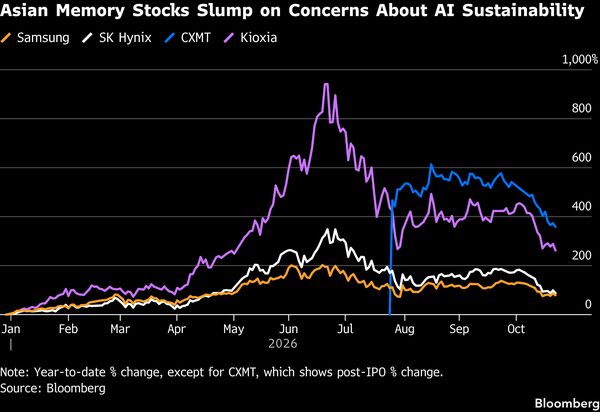
对于存储芯片投资者而言,债券和 IPO 市场的不确定性唤起了过往繁荣-衰退周期的记忆,并引发了对行业即将触及周期性顶峰的担忧。三星电子和 SK 海力士的股价已从 6 月高点下跌约一半。
For memory investors, the uncertainty in the bond and IPO markets has revived memories of past boom-and-bust cycles and fears that the industry is approaching a cyclical peak. Shares of Samsung and SK Hynix have fallen by roughly half from their June highs.
Rayliant Global Advisors投资组合管理主管Phillip Wool表示,尽管其管理的基金在近期抛售前已获利了结,但仍持有这两家公司的股份。他称,“毫无节制的看涨情绪”时代正让位于对基本面的更严格审视。“这一题材中的轻松获利机会已不复存在,”他说。
Phillip Wool, head of portfolio management at Rayliant Global Advisors, whose funds remain invested in both companies despite taking profits before the recent selloff, said the era of “unbridled bullishness” is giving way to greater scrutiny of fundamentals. “The easy money in this theme has been made,” he said.
一些分析师认为近期的抛售为时过早,指出未来几个月可能出现回购、分红及其他提升股东回报的举措,这些都可能成为催化剂。
Some analysts dismiss the recent selloffs as premature, pointing to possible buybacks, dividends and other measures to boost shareholder returns as potential catalysts in the months ahead.
三星证券分析师李钟旭(Jongwook Lee,音译)预计,股价有可能在明年第二季度反弹至新高。麦格理分析师认为存在结构性短缺而非即将出现供过于求,而花旗分析师Peter Lee预计存储芯片超级周期将持续九年,比此前预期的更长。
Samsung Securities Co. analyst Jongwook Lee expects a possibility of share prices rebounding to new highs in the second quarter of next year. Macquarie analysts see a structural shortage rather than an approaching glut, while Citigroup analyst Peter Lee expects the memory supercycle to last nine years, longer than previously anticipated.
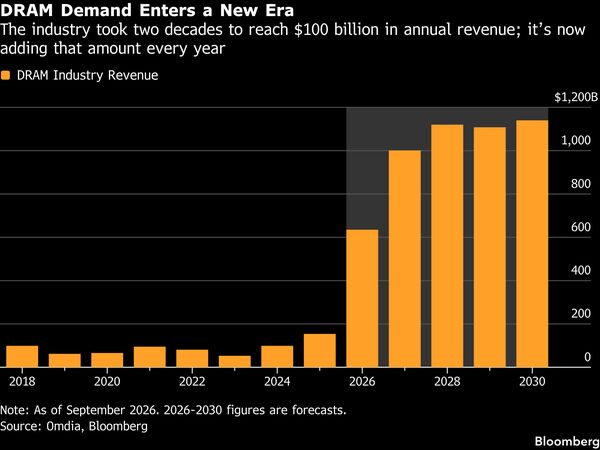
全球构建算力资源的竞争正为三星电子和SK海力士带来意外之财,这两家公司合计控制着全球约60%的动态随机存取存储器(DRAM)营收和80%以上的高带宽存储器(HBM)营收。KB证券分析师Jeff Kim估计,这两家公司在2026年和2027年将合计产生1571万亿韩元(约合1.2万亿美元)的营业利润——大致相当于过去26年累计利润的两倍。
The global race to build computational resources is delivering windfalls to Samsung and SK Hynix, which together control roughly 60% of global dynamic random-access memory revenue and more than 80% of high-bandwidth memory revenue. KB Securities Co.’s Jeff Kim estimates the two companies will generate a combined 1,571 trillion won ($1.2 trillion) in operating profit over 2026 and 2027 — roughly double their cumulative profit over the previous 26 years.
大部分预期增长已反映在订单簿中。Kim表示,韩国芯片制造商明年计划的存储芯片产量中,超过70%已通过与大型科技公司签订的五年供货协议锁定,留给包括智能手机和PC制造商在内的其他客户的份额不足30%。
Much of the anticipated growth is already reflected in order books. More than 70% of the Korean chipmakers’ planned memory production next year is covered by five-year supply agreements with major tech companies, leaving less than 30% available to other customers, including smartphone and PC makers, Kim said.
这为长鑫存储(CXMT)创造了机遇,该公司正在常规DRAM领域积极扩张,以获取与三星电子、SK海力士和美光科技公司(Micron Technology Inc.)正面竞争所需的技术诀窍。长鑫存储近期推出了旨在提高存储密度的4F²架构,试图缩小与海外竞争对手的技术差距,尽管这家总部位于北京的公司仍需解决良率等因素,才能成为有力的竞争者。投资者将重点审视的一个领域是存储芯片厂商的产能扩张计划。
That’s creating an opening for CXMT, which is expanding aggressively in conventional DRAM in pursuit of knowhow to compete head-on with Samsung, SK Hynix and Micron Technology Inc. CXMT recently unveiled a 4F² architecture aimed at increasing memory density in a bid to narrow the technology gap with overseas rivals, although the Beijing-based company would need to address factors such as production yields to be a serious contender. One area investors will scrutinize is the memory companies’ plans for capacity expansion.
长鑫存储的初步第三季度业绩凸显了任何繁荣在该行业面临的局限性,该行业需要不断增加投资以保持领先。尽管长鑫存储已占据全球DRAM营收约10%的份额,但在英伟达公司(Nvidia Corp.)等加速器所需的先进存储领域仍远远落后,这限制了其参与最赚钱的AI存储细分市场。
CXMT’s preliminary third-quarter results highlight the limits of any boom in an industry that requires ever-more investment to stay ahead. Although CXMT has captured roughly 10% of global DRAM revenue, it remains far behind in the advanced memory that Nvidia Corp. and other accelerators require, limiting its participation in the most lucrative AI memory segment.
尽管同比增幅强劲,但这家中国芯片制造商的环比营收增长放缓,利润增长几乎停滞,反映出部分常规DRAM合同价格涨幅趋缓。
Despite strong year-on-year gains, sequential revenue growth slowed and profit growth nearly stalled at the Chinese chipmaker, reflecting moderating rises in some conventional DRAM contract prices.
“更直接的风险在于大宗DRAM领域,中国产能爬坡可能会在威胁到AI端市场之前很久就对价格造成压力,”环球X管理公司(Global X Management)的梁(Leung)表示。然而,麦格理(Macquarie)认为,中国生产商仍难以满足国内需求,因此由中国引发的全球供应过剩不像投资者担心的那样可能发生。
“The more immediate risk is in commodity DRAM, where China’s capacity ramp could weigh on pricing well before it threatens the AI end of the market,” Global X Management’s Leung said. Macquarie, however, argues that Chinese producers are still struggling to satisfy domestic demand, making a China-driven global glut less likely than investors fear.
对于专注于NAND闪存的铠侠(Kioxia)而言,关注点在于这家日本公司迄今为止不愿大幅提价,以利用企业级固态硬盘(SSD)需求激增的机会。
For Kioxia, which specializes in NAND flash memory, attention is on the Japanese company’s reluctance so far to dramatically raise prices and capitalize on soaring demand for enterprise solid-state drives.
这家总部位于东京的公司与闪迪公司(Sandisk Corp.)合资生产,分析师预计其9月季度营业利润将增长20倍以上。关注点在于其能否达成长期协议,以抵御NAND残酷的价格波动。
The Tokyo-based company, which runs a joint production venture with Sandisk Corp., is expected by analysts to report a more than 20-fold rise in operating profit in the September quarter. The focus is on its ability in securing longer-term agreements to shield it from NAND’s brutal price volatility.
长期承诺并不能消除 AI 基础设施支出放缓的风险,尤其是在融资成本上升或客户难以获得足够回报的情况下。这些承诺也无法保证当前的短缺最终不会让位于产能过剩。
Long-term commitments don’t eliminate the risk of slowing AI infrastructure spending, particularly if financing becomes more expensive or customers struggle to earn adequate returns. Nor do they guarantee that today’s shortages won’t eventually give way to excess capacity.
但据 Roundhill 的马扎表示,强劲需求和资本支出纪律的具体证据将有助于争取时间。
But concrete evidence of strong demand and capital spending discipline will help buy time, according to Roundhill’s Mazza.
他说:“如果四大巨头能证明积压订单是已签约的,而非仅仅是预期的,那么‘内存需求见顶’的争论就会被推后一年。”
“If the big four can show the backlog is contracted rather than hoped for, the peak memory debate gets pushed out a year,” he said.